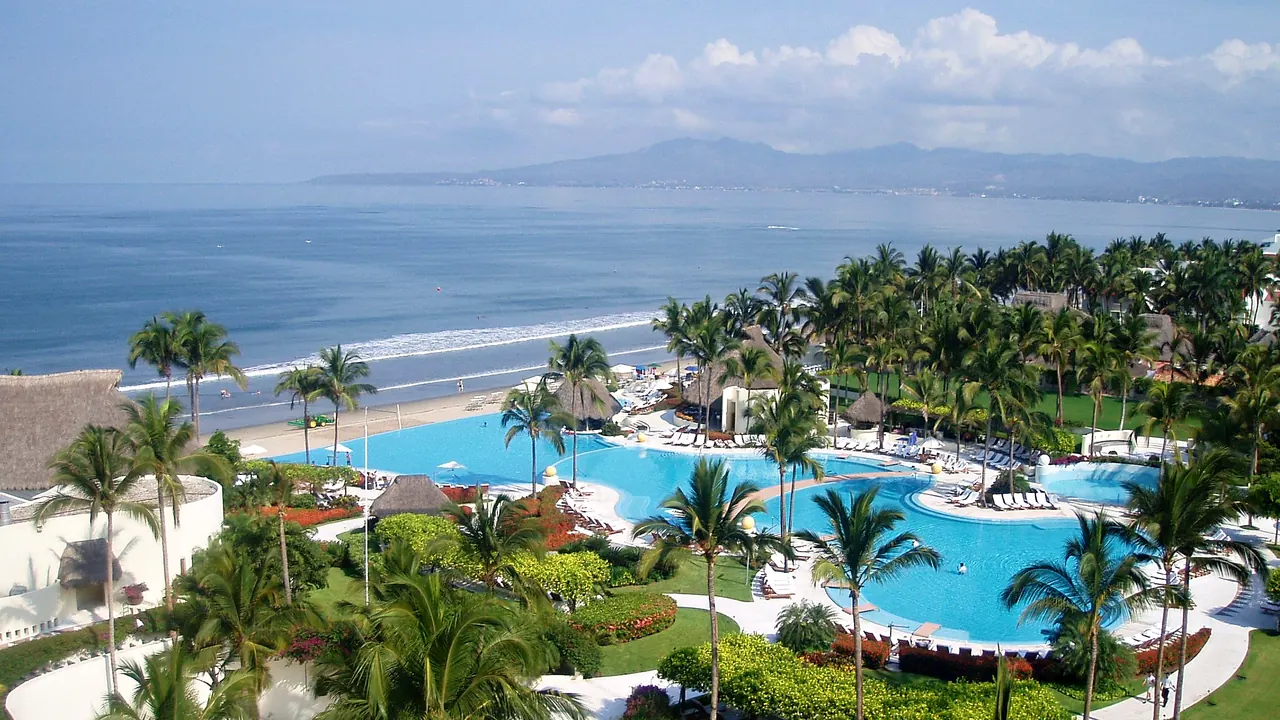
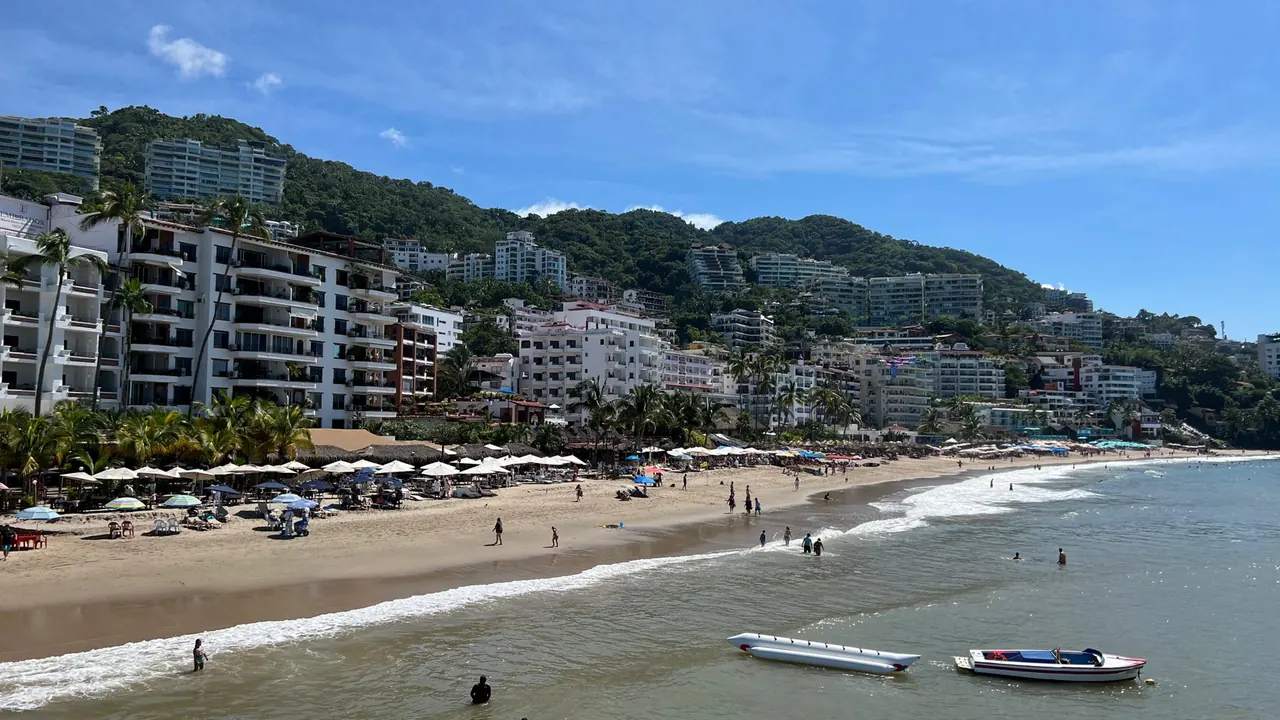
Photos: Nuevo Vallarta by Harpqueen, Public domain; Puerto Vallarta by RL0919, CC BY-SA 4.0, cropped.
Nuevo Vallarta or Puerto Vallarta?
Our verdict in twelve categories, each scored against the same fixed benchmark cities, and the climate month by month, so you can choose for your trip.
Choose Nuevo Vallarta for
- families
- day trips
- wellness
Nuevo Vallarta is the better pick for a resort stay where the beach and the pool are the whole point. It has a long, gentle strand, hotels built around families and quiet evenings, and you can take a taxi to Puerto Vallarta now and then for its restaurants and bars. It suits families with young children and couples who want to unpack once and slow right down.
Choose Puerto Vallarta for
- nightlife
- food and drink
- culture and sights
Choose Puerto Vallarta if you want a real town around you. In the cobbled old centre, along the Malecón and in the Zona Romántica you can walk to taco stands, late bars, cabaret, galleries and the market. It is also easier on the budget if you eat where residents do. Its beaches and the bay's wildlife are just as good, so staying in town costs you little.
Scoreboard
Twelve categories on one fixed scale from 0 to 100. The shaded stretch is the gap between the two.
Your match
Pick a travel style or drag the sliders, and both match scores follow your weighting.
Wins on families and day trips with your weighting.
Wins on nightlife and food and drink with your weighting.
What matters to you?
Category by category
What the scores mean for a trip.
Beaches & swimming
Both face the same warm Banderas Bay, and in either place the beach is the centre of the stay. The difference is in the shape of it. Nuevo Vallarta has one long, wide strand of soft sand running for kilometres in front of the resorts, and its gentle slope is ideal for swimming laps and paddling.
Puerto Vallarta offers variety instead. There is the busy town beach of Los Muertos with its loungers and grills, the rock pools of Conchas Chinas, and coves such as Mismaloya and Las Animas where the jungle meets the sea, some of them reached only by water taxi. Its sand is coarser, and in both places the summer rains can cloud the water.
Food & drink
Puerto Vallarta is much the better place to eat, and the good food is right in the streets where you stay. You get wood-grilled pescado zarandeado on the beach and evening taco stands selling birria and marlin. There is also a wide range of restaurants, up to chef-run dining rooms in the hills.
Nuevo Vallarta shares the same Nayarit and Jalisco seafood tradition, including aguachile and ceviche served in a coconut. Inside the enclave, though, most meals come from the resorts and the marina terraces. To eat well you head out to the beach shacks of Bucerías or into Puerto Vallarta itself.
Culture & sights
Neither is a sightseeing destination, but Puerto Vallarta at least has a town to look at. Its whitewashed hillside streets, the crown-topped Church of Our Lady of Guadalupe, the sculptures along the Malecón and the small museums on the Cuale river island fill a pleasant afternoon or two.
Nuevo Vallarta is a planned resort zone with no historic core, museums or landmarks. For any culture you take a day out to Puerto Vallarta or Bucerías.
Nightlife
This is where the two differ most. Puerto Vallarta goes out late. The open-fronted dance clubs along the Malecón fill up after midnight, and the Zona Romántica adds rooftop and mezcal bars and one of the largest gay scenes in Latin America.
Nuevo Vallarta is quiet by design: lobby bars, pool shows and a drink at the marina before an early night. You can stay there and go out in Puerto Vallarta, but every night out means a taxi there and back.
Nature & outdoors
Both share the bay's wildlife: humpback whales calving from December to March, turtles nesting in summer and autumn, and boat trips to the Marietas Islands. The difference is what lies close by. Nuevo Vallarta is near the Ameca river mangroves with their herons and crocodiles, it is closer to the surf and whale boats of Punta Mita, and it has golf inside the enclave.
Puerto Vallarta has the mountains right behind it. The jungle, the botanical garden and the coastal trail along the roadless south shore towards Las Animas and Yelapa are easy to reach, and so is snorkelling at Los Arcos.
Day trips
The two have almost the same list of outings, so the real difference is direction. Nuevo Vallarta is better placed for the northern coast. Bucerías is a short drive away, Sayulita, San Pancho and Punta Mita make easy days out, and Puerto Vallarta's old town is the best trip of all.
From Puerto Vallarta, the boat-only village of Yelapa and the south shore are closer, and the mountain road to San Sebastián del Oeste is a little shorter. Neither has major colonial or archaeological sites within easy reach.
Good for families
Nuevo Vallarta has the edge for families, mainly because the whole place is built for them. The resorts have shallow pools, slides and kids' clubs, the enclave is calm and partly gated, and a broad, gently shelving beach lies right outside.
Puerto Vallarta works well too. It adds the jungle zoo at Mismaloya and evening walks on the Malecón with street performers, but its steep cobbled streets are hard going with a pushchair. The calmest family beaches it has to offer are, in fact, Nuevo Vallarta's.
Getting around
Puerto Vallarta is easier to get about. The Malecón and footbridges over the Cuale link the old centre and the Zona Romántica, so you can do much of a stay on foot. Taxis, ride-hailing and water taxis cover the rest, though pavements are uneven and the back streets are steep.
Nuevo Vallarta is a long boulevard of resorts and gated condos where little beyond the beach is within walking distance, and reaching the highway buses means a hot walk. Expect to use taxis, shuttles or a hire car. In return, the airport is only about twenty minutes away.
Shopping & style
In Nuevo Vallarta you can buy swimwear, sun cream and souvenirs from the resort boutiques and a modest mall, and not much else. To take home the region's real craft, the Huichol yarn paintings and beadwork of the Wixárika communities in the Sierra Madre, you need a trip to Bucerías or Puerto Vallarta.
Puerto Vallarta is the better place to shop. Galleries fill the old centre and the Zona Romántica. Among the mass-produced souvenirs, the Mercado Municipal and the stalls on the Cuale river island also sell silver, embroidered textiles, ceramics and hammocks. Malls near the marina cover everyday needs, but there is little fashion or luxury shopping.
Affordability
Puerto Vallarta is the cheaper base. The tourist strip and the Malecón restaurants are expensive, but the old centre has simple guesthouses, family restaurants and taco stands at local prices, so you can choose how much to spend.
Nuevo Vallarta gives you fewer such choices. Almost all the accommodation is resorts and condos aimed at North Americans, and prices inside the enclave are set to match. An all-inclusive package at least makes costs predictable, and cheap buses and taxis put the cheaper food of Bucerías within reach.
Live music & performing arts
Neither has opera, orchestras or serious theatre, but Puerto Vallarta has more going on in the evenings. The long-running cabaret scene in the Zona Romántica puts on drag, comedy and revues in winter, bars host Latin jazz and acoustic sets, and the Papantla flyers perform on the Malecón.
In Nuevo Vallarta, performance means resort entertainment: poolside shows, mariachi and folkloric dinners, and one large acrobatic dinner theatre production that brings in visitors from around the bay.
Wellness & relaxation
Both are made for slowing down. In both, the spas are mostly inside resorts, and the temazcal sweat lodge is the local tradition. Nuevo Vallarta's advantage is quiet: there is nothing to rush off to, and the big resorts have full hydrotherapy circuits.
Puerto Vallarta's centre can be noisy at night, but it has something Nuevo Vallarta lacks: yoga and retreat centres in the roadless villages of the south shore, and boutique hotel spas in the hills.
When should you go?
Pick your month. The climate figures are measured averages, not a forecast.
Nuevo Vallarta in July
Puerto Vallarta in July
Daytime high, °C
Rainfall in the month, mm
Where the figures come from
Nuevo Vallarta has no weather station within reach, so its figures come from a gridded climate model rather than a measured record, and read a broad area rather than the city itself.
Puerto Vallarta has no weather station within reach, so its figures come from a gridded climate model rather than a measured record, and read a broad area rather than the city itself.
Temperature and rainfall are climate normals, averaged over the years shown. Nuevo Vallarta: 1991-2020 normals, TerraClimate 4 km grid at the town, no weather station within 90 km. Puerto Vallarta: 1991-2020 normals, TerraClimate 4 km grid at the town, no weather station within 90 km.
The two sit on the same bay and share almost the same climate. The best time to go is the dry season from November to May. Days are around 30°C, rain is rare and the sea is warm enough for swimming the whole time, at its coolest around 24°C in February and March. From June to September the rain comes in heavy afternoon storms, peaking at nearly 300mm in September. The heat climbs to 34°C with strong humidity, and the sea warms to 30°C. October is still fairly wet, and the dry months return in November.
What differs is how the summer feels. In Nuevo Vallarta a hot, wet month still works if you move only between the pool, the beach and an air-conditioned room. In Puerto Vallarta the pleasure lies in walking the Malecón and climbing the cobbled streets, and summer heat makes that hard work during the day, so the winter months matter more.
Which traveller are you?
On a family trip with young children, Nuevo Vallarta lets the days run themselves. Breakfast, swimming and the afternoon nap happen within a few steps, and outings stay gentle: a winter whale-watching boat or releasing turtle hatchlings at dusk.
For a food and nightlife trip, choose Puerto Vallarta. One evening can take in sunset on the Malecón, marlin tacos from a street cart, a mezcal bar in the Zona Romántica and dancing past midnight, all on foot.
On a trip on a tight budget, Puerto Vallarta is easier to keep cheap. You can sleep in a plain room in the old centre, lunch on fish on a stick from beach sellers and take the bus up the coast.
Before you go
| Measure | Nuevo Vallarta | Puerto Vallarta |
|---|---|---|
| Official language | Spanish, Nahuatl, Yucatec Maya | Spanish, Nahuatl, Yucatec Maya |
| Currency | Mexican Peso (MXN) | Mexican Peso (MXN) |
| Sockets | AB127 V, 60 Hz | AB127 V, 60 Hz |
| Driving side | Right | Right |
| Time zone | UTC-6 | UTC-6 |
| Emergency number | 911 | 911 |
| Elevation | 3 m | 101 m |
| Main airport | Puerto Vallarta International Airport (PVR)4 km from centre52 non-stop destinations | Puerto Vallarta International Airport (PVR)5 km from centre52 non-stop destinations |
| Public holidays this year | 9 days | 9 days |
By the numbers
| Measure | Nuevo Vallarta | Puerto Vallarta |
|---|---|---|
| City population | 1,301 | 224,166 |
| People per km² | - | 4,311 |
| Museums within 10 km | 0 | 2 |
| UNESCO World Heritage sites within 50 km | 1 | 1 |
| Swim season, months above 21 °C | 12 months | 12 months |
Where else could you go?
Every comparison below shares a destination with this one, so you can follow Nuevo Vallarta or Puerto Vallarta somewhere new.
- Sayulitavs Nuevo Vallarta
- Sayulitavs Puerto Vallarta
- Guadalajaravs Puerto Vallarta
- Guadalajaravs Nuevo Vallarta
- Mazatlanvs Nuevo Vallarta
- Mazatlanvs Puerto Vallarta