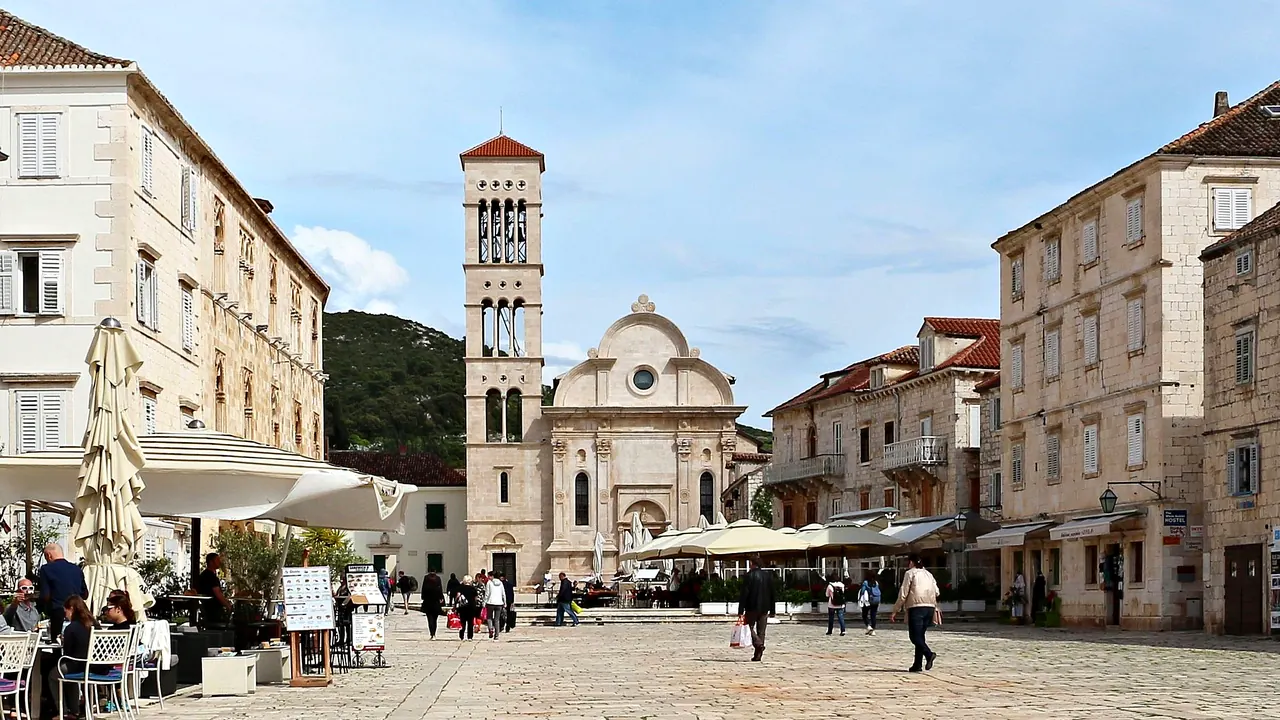
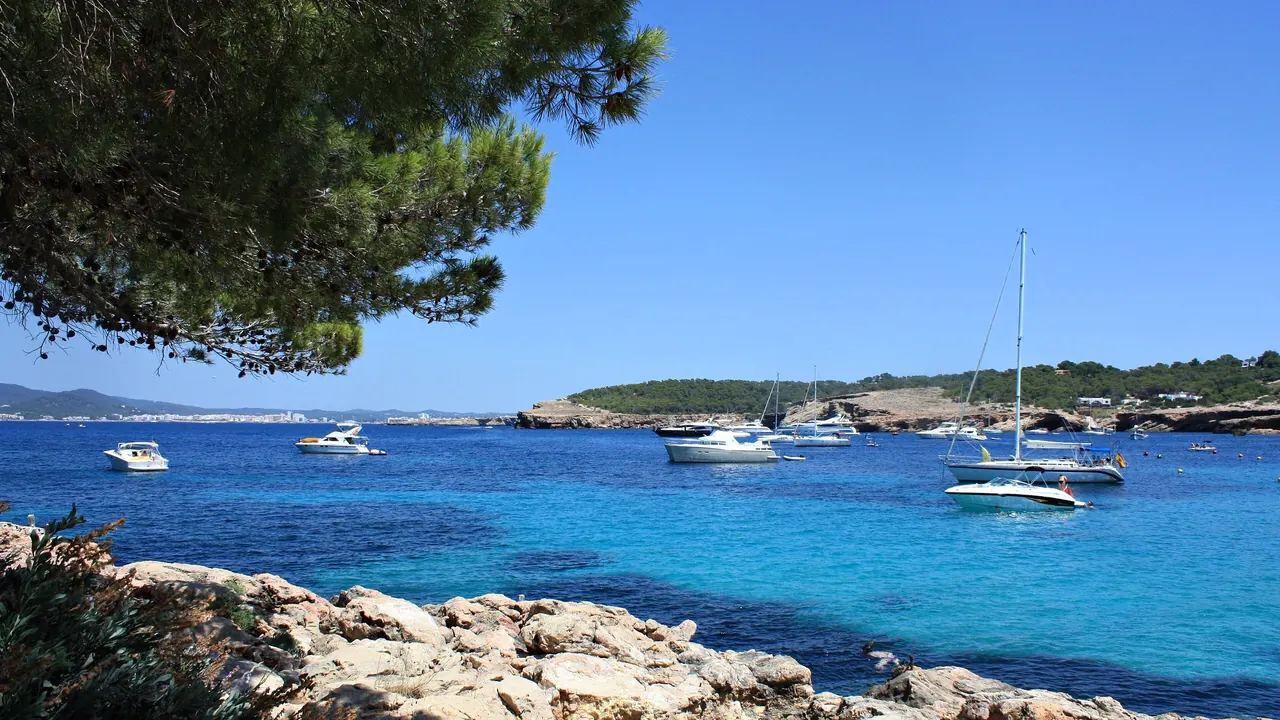
Photos: Hvar by Bernard Gagnon, CC BY-SA 4.0, cropped; Ibiza by Daria, CC BY 3.0, cropped.
Hvar or Ibiza?
Our verdict in twelve categories, each scored against the same fixed benchmark cities, and the climate month by month, so you can choose for your trip.
Choose Hvar for
- day trips
- prices
- food and drink
Hvar is the better pick if you want a Dalmatian island built around a Venetian harbour town, clear water off rocky ledges, serious local wine and catamarans that carry you on to Split, Korčula or Vis. It costs less than Ibiza, especially if you stay in Jelsa, Stari Grad or Vrboska. Its party scene is real but smaller, and you can leave it behind easily.
Choose Ibiza for
- nightlife
- shopping
- wellness
Ibiza is the island for a sandy beach and a night that ends after sunrise. Its club scene has no equal on Hvar, its dune beaches and turquoise sandbars are easier on bare feet and small children, and the farmhouse retreats in the north offer a slower kind of rest. Expect to pay heavily for all of it in summer, and don't expect much island-hopping beyond Formentera.
Scoreboard
Twelve categories on one fixed scale from 0 to 100. The shaded stretch is the gap between the two.
Your match
Pick a travel style or drag the sliders, and both match scores follow your weighting.
Wins on day trips and prices with your weighting.
Wins on nightlife and shopping with your weighting.
What matters to you?
Category by category
What the scores mean for a trip.
Beaches & swimming
Both islands have very clear water that reaches about 25°C in August, but what's underfoot is different. Hvar is almost all pebble and rock, so you swim from stone ledges and coves, often reached by taxi boat to the Pakleni Islands or by steep tracks down to the south coast.
Ibiza has the edge because it has real sand. There are dune beaches at Ses Salines and Es Cavallet, shallow sandbars at Cala Comte and Cala Bassa, and Formentera's Ses Illetes a short ferry ride away. Pine-backed coves in the north give it quieter spots as well.
Food & drink
The two are about level, and the difference is in what you eat and drink. On Hvar the wine stands out, with Plavac Mali from the slopes around Ivan Dolac and cellars that pour tastings, and the best meals are peka lamb and gregada in hill-village konobas.
On Ibiza look inland too, around Santa Gertrudis and Sant Josep, for bullit de peix and sofrit pagès. Coastal dining there is about long beach lunches and polished marina dinners. On Hvar much of the island closes outside summer.
Culture & sights
Ibiza has the stronger centrepiece in Dalt Vila. Its Renaissance walls, ramps and bastions climb to the cathedral and the castle, and the Phoenician tombs at Puig des Molins lie just below. Fortified white churches and watchtowers around the island fill out the picture.
Hvar's sights are more spread out and more modest. There is the Venetian square and the 1612 theatre in Hvar Town, the Greek origins of Stari Grad and the UNESCO-listed field pattern of its plain. On either island two days covers the essentials.
Nightlife
This is where the two islands differ most. Ibiza's clubs along Platja d'en Bossa and near Sant Rafel run every night from late spring to early autumn, with DJ residencies, parties past sunrise and opening and closing nights that draw people from across Europe.
Hvar Town is a smaller, yacht-crew version of the same idea. You start with sundowners on the waterfront, move on to cocktail bars up the stepped lanes, then take a taxi boat to the beach clubs on the Pakleni Islands, because of the noise limits in town. It's a lively summer scene, but it's built around bars rather than big clubs.
Nature & outdoors
There's little to choose between them, though the scenery differs. Hvar is a limestone ridge with abandoned stone villages, dry-stone terraces and lavender fields, and the walk up Sveti Nikola looks out towards Korčula and Vis.
Ibiza is lower, and its drama is on the coast, with Es Vedrà rising off Cala d'Hort and flamingos on the Ses Salines salt pans. Its seagrass meadows make it slightly the better choice for diving. On both islands summer heat pushes walking into spring and autumn.
Day trips
Hvar has far more choice. Catamarans reach Diocletian's Palace in Split in about an hour, and Korčula's walled town, Vis and Komiža, and Bol on Brač are all within reach. Its own harbour towns also make good outings from one another, as long as you plan around the boat timetables.
From Ibiza the obvious trip is Formentera. After that it's the white inland villages and the hippy markets, because Mallorca is too far by sea for a comfortable day out.
Good for families
Ibiza works better with children, mainly because of its sand. The east coast around Santa Eulària, Es Canar and Cala Llonga has shallow, calm resort bays, and the Spanish habit of late family dinners makes evenings easy.
Hvar's north-side towns of Jelsa, Vrboska and Stari Grad have calm, shallow water and safe promenades, but you'll need water shoes on the pebbles, and Hvar Town's steps and crowds are hard work with small children. Neither island has a zoo or theme park, and on both the boat trips are the highlight.
Getting around
Ibiza is easier to get around. It's compact, nowhere is much more than 45 minutes from Ibiza Town, and buses link the airport, the main resorts and beaches, with night buses to the clubs in summer.
On Hvar the journey starts with a ferry or catamaran from Split. After that you rely on infrequent buses along the island's spine and taxi boats for the coves. Narrow roads and a single-lane tunnel lead to the south coast. On both islands a car or scooter makes the remote coves much easier to reach.
Shopping & style
Ibiza gives you more to browse. It has its own look of loose white linen and boho clothing, sold in the lanes below Dalt Vila and in Santa Gertrudis, plus the hippy markets near Es Canar and Sant Carles.
Hvar's shopping is mostly about what the island produces: lavender oil from the harbour stalls, honey, olive oil, cellar wine and lace made by the Benedictine nuns. It makes a good bag of souvenirs, but not much more.
Affordability
Neither island is cheap in high summer, but Ibiza is clearly the more expensive of the two. Club entry, beach-restaurant bills, sunbeds and scarce night-time taxis all add up quickly, even if you stay in an apartment in Sant Antoni.
Hvar Town charges yacht-crowd prices too, but a room in Jelsa or Vrboska, dinners at village konobas and wine from the cellar door make a real difference. On both islands June and September cost noticeably less.
Live music & performing arts
Both islands are thin on staged performance, but what's on offer differs. Hvar has chamber and classical concerts in its churches and the Franciscan cloister on summer evenings, plus klapa singing at village feasts. Ibiza has open-air concerts, flamenco, jazz on bar terraces and folk dancing in traditional dress at village festivals.
Wellness & relaxation
Ibiza offers a fuller kind of rest. Yoga, meditation and holistic retreats have been part of life in the north since the hippy years, set in country hotels among the almond and olive groves around Sant Joan and Sant Llorenç, and the hotel spas are good.
On Hvar the rest comes mostly from the pace of Vrboska, Stari Grad and the hill villages, with long lunches and evening walks along the waterfront. Massage and yoga are seasonal and mostly offered by the larger hotels.
When should you go?
Pick your month. The climate figures are measured averages, not a forecast.
Hvar in July
Ibiza in July
Daytime high, °C
Rainfall in the month, mm
Where the figures come from
Hvar's temperatures are measured 38 km from the centre, at Split / Marjan.
Hvar has no rain gauge within 25 km of the centre, so its rainfall comes from a gridded climate dataset read at the destination rather than from a gauge further away.
Hvar's sunshine is measured 38 km from the centre, at Split / Marjan.
Temperature and rainfall are climate normals, averaged over the years shown. Hvar: 1991-2020 (sunshine 1971-2000) normals, Split / Marjan (38.2 km from centre). Ibiza: 1991-2020 normals, Ibiza / Es Codola (6.4 km from centre).
Both are summer islands, but Hvar's swimming season is the shorter of the two, running from June to late September, with the sea warmest in August. Around the main towns July and August reach about 31°C, which makes walking hard work in the middle of the day, though these are also Hvar's sunniest months. The rain returns in September and peaks at 116mm in November, and winter there is cool and grey. June and September are the best months for combining swimming and walking.
Ibiza's swimming season runs from June into October, and the sea there holds its warmth longer, still about 22°C in October. That makes a late swim a safer bet than on Hvar. Its summer is drier too, with July almost rainless, and it is milder at both ends of the year, with winter days near 16°C. It also gets more sunshine in winter and spring, so it is the better choice for a walk in the sun outside the main season.
Which traveller are you?
On a trip on a tight budget, Hvar is the easier island. Neither is cheap in summer, but family apartments in Jelsa or Stari Grad, inland konobas and wine bought straight from the cellar keep costs well below what Ibiza's beaches and clubs demand.
For a food and nightlife trip, Ibiza is the place. The food on the two islands is about level, but Ibiza's huge clubs open every night of the season with DJ residencies, while Hvar Town offers harbour cocktail bars and island beach clubs on a much smaller scale.
On a relaxing and wellness trip, Ibiza has more to offer. Yoga and holistic retreats in converted farmhouses around Sant Joan and Santa Gertrudis go back to the hippy years. Hvar's calm comes mostly from the slow pace of its quieter towns, with spas mainly in the bigger hotels.
Before you go
| Measure | Hvar | Ibiza |
|---|---|---|
| Official language | Croatian | Spanish |
| Currency | Euro (EUR) | Euro (EUR) |
| Sockets | CF230 V, 50 Hz | CF230 V, 50 Hz |
| Driving side | Right | Right |
| Time zone | UTC+1, UTC+2 in summer | UTC+1, UTC+2 in summer |
| Emergency number | 112 | 112 |
| Main airport | Split Saint Jerome Airport (SPU)69 non-stop destinations | Ibiza Airport (IBZ)89 non-stop destinations |
| Public holidays this year | 14 days | 13 days |
By the numbers
| Measure | Hvar | Ibiza |
|---|---|---|
| Population | - | 161,485 |
| People per km² | - | 280 |
| Swim season, months above 21 °C | 4 months | 5 months |
Where else could you go?
Every comparison below shares a destination with this one, so you can follow Hvar or Ibiza somewhere new.