Costa Blanca or Ibiza?
Our verdict in twelve categories, each scored against the same fixed benchmark cities, and the climate month by month, so you can choose for your trip.
Choose Costa Blanca for
- prices
- day trips
- families
Costa Blanca suits a longer, more varied trip, and it is easier on the budget. Its long sandy bays and theme parks make family days simple. The limestone mountains of the north give real hiking and climbing, and the rice cooking of Dénia and Alicante rewards anyone who eats with care. Valencia, Cartagena and the inland castle towns are all within a day's reach. Pick it if you want the beach as a base rather than the whole point, and if you want your money to go further.
Choose Ibiza for
- nightlife
- wellness
- shopping
Ibiza is for people whose trip is built around the night and the water. Nowhere else on the Mediterranean matches its summer club season, and its coves have some of the clearest sea on this side of Spain. The farmhouse hotels of the north also make a calm retreat in spring and autumn. In return you pay heavily in high season, and once you have seen Dalt Vila and Formentera there is little else within a day's reach.
Scoreboard
Twelve categories on one fixed scale from 0 to 100. The shaded stretch is the gap between the two.
Your match
Pick a travel style or drag the sliders, and both match scores follow your weighting.
Wins on prices and day trips with your weighting.
Wins on nightlife and wellness with your weighting.
What matters to you?
Category by category
What the scores mean for a trip.
Beaches & swimming
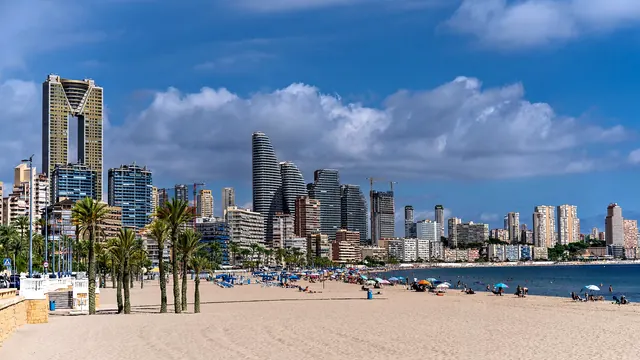
Both have excellent beaches, but of different kinds. The Costa Blanca's strength is long, easy sand: Benidorm's Levante and Poniente, San Juan near Alicante and the dune-backed strands of Guardamar, all with room to spread out. Its northern coves near Jávea and the pebble shore at Altea are clearer but give less sand.
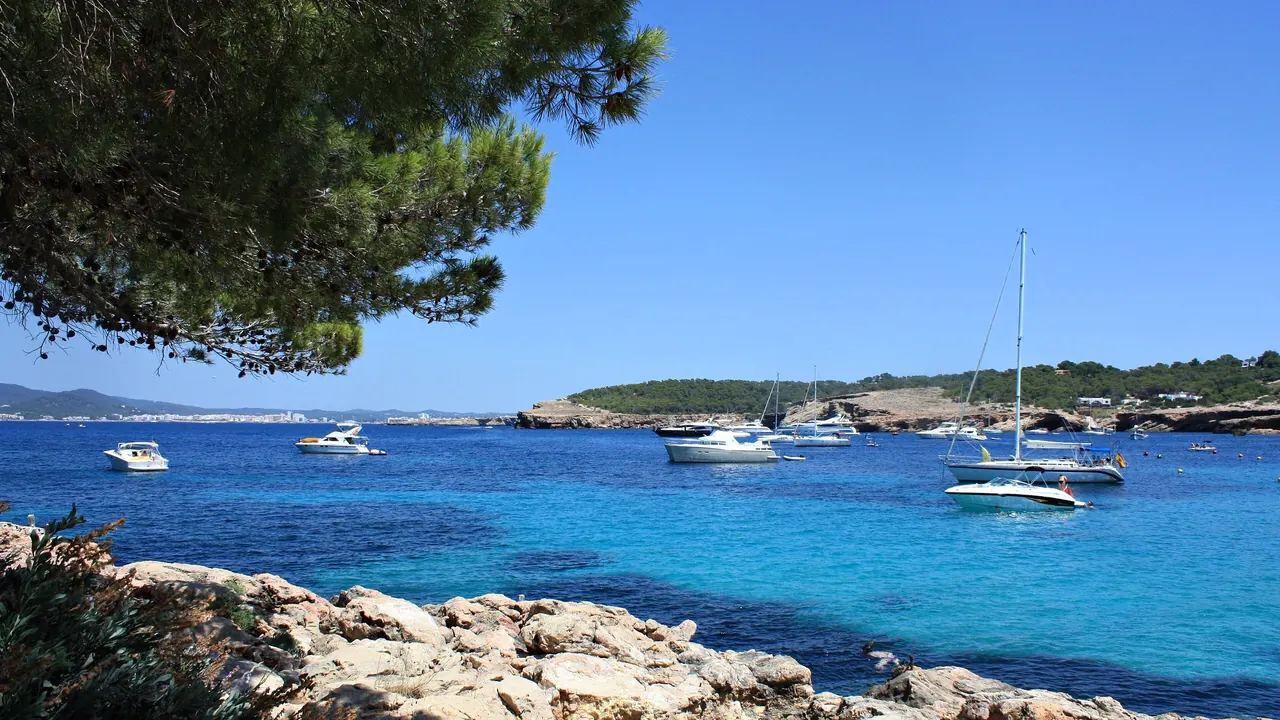
Ibiza is mostly a coastline of coves, with water made unusually clear by the seagrass offshore. You get turquoise sandbars at Cala Comte, sunset bays in the west, the dunes of Ses Salines in the south and pine-backed inlets in the north, and Formentera's Ses Illetes is a short ferry ride away. The sea is just as warm in both places.
Food & drink
The Costa Blanca eats better, and rice is the reason. Arroz a banda, black rice and Elche's egg-crusted arroz con costra are served at seafront family restaurants. Dénia is known for its red prawns, and Alicante has tapas around the Mercado Central. Turrón from Xixona and the sweet Fondillón wine round it off.
Ibiza has its own island cooking, such as bullit de peix, sofrit pagès and flaó tart, but you have to go to the country restaurants inland to find it. On the coast, meals are polished but expensive, and there is little market or street food. Both have resort strips best skipped, in Benidorm and Torrevieja on one side and Sant Antoni on the other.
Culture & sights
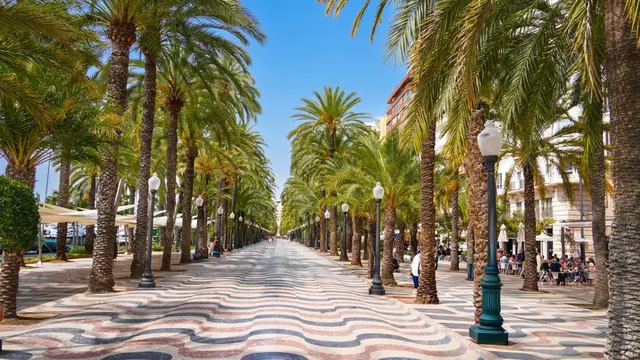
Neither is a major heritage destination, and each gives a few good days. The difference is how the sights are laid out. The Costa Blanca's are scattered along the coast: Alicante's Santa Barbara castle and the MARQ archaeological museum, Elche's Palmeral of date palms, and the hilltop villages of Altea and Guadalest. Its summer festivals, the Hogueras and the Moors and Christians parades, show its traditions at their liveliest.
Ibiza's sights are concentrated in one place. Dalt Vila's Renaissance walls climb to the cathedral and castle, and below them lies the Phoenician necropolis of Puig des Molins. The fortified white churches out in the villages complete a compact set you can see without much driving.
Nightlife
Ibiza is in another league. From late spring to early autumn its huge clubs along Platja d'en Bossa and near Sant Rafel open every night, with resident star DJs, parties that go on past sunrise, and opening and closing nights that people fly in for. Sunset bars in Sant Antoni and boat parties fill the hours before. Out of season, though, most of it closes.
The Costa Blanca's nightlife is cheaper and more cheerful. Benidorm runs late with British and Dutch bars, cabaret, drag shows and karaoke, and it keeps going through the winter. For a Spanish night out, Alicante's El Barrio fills with terraces and small bars under the castle.
Nature & outdoors
The Costa Blanca has far more for walkers and climbers. Limestone mountains drop straight into the sea at the Peñón de Ifach and Montgó. The Aitana range rises above 1,500m inland, and the crags around Sella draw climbers from across Europe.
Ibiza is low and covered in pine. Its high point for scenery is the rock island of Es Vedrà off Cala d'Hort, and its coastal paths make gentle walks rather than real hikes. Its best outdoor days are on the water, snorkelling and paddleboarding over the clear seagrass meadows. Both have salt pans with flamingos, at Torrevieja and Santa Pola on one side and Ses Salines on the other.
Day trips
The mainland gives the Costa Blanca a much longer list. Valencia, with its cathedral, silk exchange and City of Arts and Sciences, is an easy outing by train or road. Within reach too are Xàtiva's ridge-top castle, the gorge town of Alcoy, Murcia and the Roman theatre at Cartagena, plus the boat to the walled island village of Tabarca.
On Ibiza, the obvious outing is the ferry to Formentera for its quiet villages and beaches. After that come the white inland villages and the hippy markets, and the options run out quickly, since Mallorca is too far for a day.
Good for families
The Costa Blanca is the far easier family choice. Around Benidorm, calm, gently shelving beaches sit close to a theme park, water parks, an animal park and a marine park. The pools and waterfalls of the Fonts de l'Algar make a cool day out in summer.
Ibiza works for families only if the trip is mostly about the beach. The calm bays of Santa Eulària, Es Canar and Cala Bassa suit children, but beyond glass-bottom boat trips there is little made for them. Large parts of Sant Antoni and Platja d'en Bossa are set up for the club crowd.
Getting around
Both are manageable without a car in the main towns and awkward without one beyond them. The difference is distance. The Costa Blanca is a long coastline, an hour or more from end to end, joined by the slow coastal TRAM from Alicante to Dénia and by buses between the resorts.
Ibiza is compact, with nothing much more than 45 minutes from Ibiza Town. In summer, night buses run to the clubs and water taxis link some resorts. On both, the smaller coves need a car or scooter, and parking is scarce in high summer.
Shopping & style
Neither is a shopping destination. Ibiza has a clearer style of its own: loose white Adlib linen and boho clothing in the boutiques of the marina and Santa Gertrudis, and jewellery and leather at the long-running hippy markets.
The Costa Blanca's shopping is more practical. Alicante has high streets and a department store, and Elche's factory outlets sell shoes from Spain's shoe-making centre. The weekly markets in Jávea and Altea are good for ceramics and produce, and turrón makes the best thing to take home.
Affordability
The gap is wide. Benidorm and the resorts around Torrevieja are among the more affordable beach places in Western Europe, with plenty of apartments, set lunch menus and cheap drinks. Only the northern towns of Jávea, Moraira and Altea push costs up.
Ibiza in summer is one of the most expensive places in the Mediterranean, and club entry, beach restaurants, sunbeds and taxis add up quickly. Apartments in Sant Antoni, inland country restaurants and travelling in June or late September soften it, but rarely by enough to make it feel cheap.
Live music & performing arts
The Costa Blanca has the stronger programme. Alicante's Teatro Principal stages touring theatre and dance, and the ADDA auditorium has an orchestral season. Each August, Elche performs the Misteri d'Elx, a medieval sung play, in its basilica.
Ibiza's famous music comes from DJs in the clubs. Live performance there means occasional flamenco, jazz sets on terraces and folk dancing at village festivals. Neither has a scene to plan a trip around.
Wellness & relaxation
Ibiza is the better place to slow down. Converted farmhouses and country hotels among the almond and olive groves around Sant Joan and Santa Gertrudis host the yoga and meditation retreats the island has been known for since the hippy years. The quiet north feels a world away from the clubs.
The Costa Blanca has hotel spas, Arab-style baths in Alicante and a few health retreats in the hills above Altea. Its real calm is the slow pace of Jávea and Moraira outside summer, which suits a long winter stay. Neither has thermal springs.
When should you go?
Pick your month. The climate figures are measured averages, not a forecast.
Costa Blanca in July
Ibiza in July
Daytime high, °C
Rainfall in the month, mm
Where the figures come from
Costa Blanca's temperatures are measured 57 km from the centre, at Alicante.
Costa Blanca has no rain gauge within 25 km of the centre, so its rainfall comes from a gridded climate dataset read at the destination rather than from a gauge further away.
Temperature and rainfall are climate normals, averaged over the years shown. Costa Blanca: 1991-2020 normals, Alicante (56.6 km from centre). Ibiza: 1991-2020 normals, Ibiza / Es Codola (6.4 km from centre).
Around the main resort areas, the two follow much the same summer. The sea is warm enough to swim from June to October on both coasts and reaches 26°C in August. Daytime heat peaks in July and August, with highs near 31°C on the Costa Blanca, so walking the old towns or the hill paths is best kept to early mornings. For hiking and sightseeing, April, May and October are the comfortable months in both places.
The difference shows in the cooler half of the year. The Costa Blanca stays drier, at about 40mm a month from September to November, and keeps more sunshine through the winter. That is why it works as a mild base for a winter stay. On Ibiza, autumn is wetter, with close to 60mm in September and November, and the rain continues into winter. Late spring is the safer bet there outside the summer peak.
Which traveller are you?
On a food and nightlife trip, the Costa Blanca suits travellers who plan the day around a long rice lunch and a late drink under Alicante's castle. If dancing matters more than dinner, Ibiza wins: its summer runs on clubbing until dawn and recovering on the sand.
On a family trip with children, the Costa Blanca is far easier: when the children tire of the sand, a different kind of day out is only a short drive away. On Ibiza, after the beach and a boat trip, a week soon runs thin.
On a tight budget, the Costa Blanca lets you go in high summer and still eat out every day, as long as you base yourself in Benidorm or the south. Ibiza needs June or late September, a kitchen and the bus, and still costs dearly.
Before you go
| Measure | Costa Blanca | Ibiza |
|---|---|---|
| Official language | Spanish | Spanish |
| Currency | Euro (EUR) | Euro (EUR) |
| Sockets | CF230 V, 50 Hz | CF230 V, 50 Hz |
| Driving side | Right | Right |
| Time zone | UTC+1, UTC+2 in summer | UTC+1, UTC+2 in summer |
| Emergency number | 112 | 112 |
| Main airport | Alicante-Elche Miguel Hernández Airport (ALC)126 non-stop destinations | Ibiza Airport (IBZ)89 non-stop destinations |
| Public holidays this year | 13 days | 13 days |
By the numbers
| Measure | Costa Blanca | Ibiza |
|---|---|---|
| Population | - | 161,485 |
| People per km² | - | 280 |
| Swim season, months above 21 °C | 5 months | 5 months |
Where else could you go?
Every comparison below shares a destination with this one, so you can follow Costa Blanca or Ibiza somewhere new.
- Formenteravs Ibiza
- Formenteravs Costa Blanca
- Mallorcavs Ibiza
- Mallorcavs Costa Blanca
- Menorcavs Ibiza
- Costa Bravavs Ibiza