Spain
Alicante
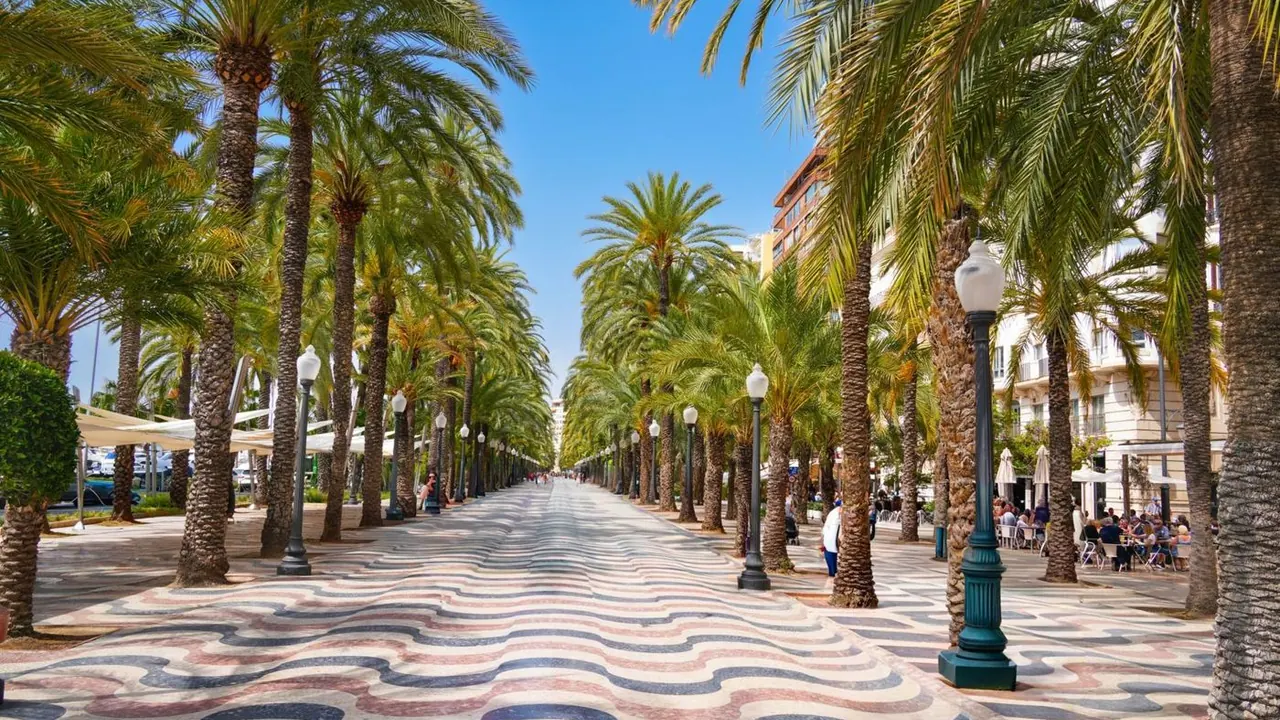
The Explanada de España
- Beaches82
- Day trips72
- Families68
Match
59
Every category weighted equally
- Beach & sun62
- Culture & arts56
- Food & nightlife58
- Family trip63
- Outdoors62
- Relax & unwind59
- Shopping & style56
- On a budget59
Alicante in twelve categories
Our verdict on each, scored 0 to 100 against the same fixed benchmark cities, so a score means the same thing on every page.
Beaches & swimming. Scores 82 out of 100.
Food & drink. Scores 67 out of 100.
Culture & sights. Scores 46 out of 100.
Nightlife. Scores 60 out of 100.
Nature & outdoors. Scores 63 out of 100.
Day trips. Scores 72 out of 100.
Good for families. Scores 68 out of 100.
Getting around. Scores 66 out of 100.
Shopping & style. Scores 44 out of 100.
Affordability. Scores 60 out of 100.
Live music & performing arts. Scores 37 out of 100.
Wellness & relaxation. Scores 40 out of 100.
Alicante category by category
Beaches & swimming
82Beach life is a large part of any stay here. Postiguet lies right under the castle at the end of the old town, so a swim fits between lunch and a walk along the Explanada. For more space, the tram runs to Albufereta and on to Playa de San Juan, about 7km of fine pale sand with shallow, calm water and a long promenade behind it. The Mediterranean reaches about 26°C in August and stays warm enough to swim from June into October.
A boat crosses to Tabarca, a small island with clear water and rocky swimming spots. North along the Costa Blanca, the coves and the long sandy bays around Villajoyosa and Benidorm are within an hour. In July and August the city beaches get very crowded, and Postiguet can feel cramped.
Food & drink
67Alicante eats rice above everything. Arroz a banda cooked in fish stock, black rice with squid ink, and arroz con costra with an egg crust baked over sausage and chicken appear on menus everywhere, usually for two or more people and at lunch rather than dinner. The Mercado Central, a modernist market hall, sells red prawns from nearby Dénia and Santa Pola, salted fish, mojama and local produce, and has counters for a drink and a snack.
The tapas bars around the old town and the streets near the market do the best everyday eating, with good local wines from the Alicante and Valencian denominations. Turrón from nearby Jijona is the local sweet, and summer means horchata and ice cream. Restaurants along the port and the Explanada are mainly for the view.
Culture & sights
46The main sight is the Castillo de Santa Bárbara, a large fortress on Mount Benacantil with views over the whole bay. You can reach it by a lift cut into the rock or walk up through the old quarter. Below it, the Barrio de Santa Cruz has whitewashed houses and steps covered in flowerpots. Nearby are the Basílica de Santa María and the Co-Cathedral of San Nicolás.
The MARQ archaeological museum is the best museum in the city, with clear, well-presented displays from Iberian to Roman times. The MACA has a collection of twentieth-century art in a baroque building. The Explanada, paved in rippling mosaic tiles, is the city's most famous street. Two days covers the city's sights comfortably.
Nightlife
60Evenings start late, with dinner after nine. Then people head to El Barrio, the old quarter under the castle, where small bars fill the narrow streets and spill out onto the steps until the early hours. Around the port and the marina there are larger bars and clubs aimed at a dressier crowd. In summer, terraces and beach bars at Playa de San Juan stay busy late into the night.
Students and many international residents keep things going all year, but the scene is at its liveliest from June to September. The Hogueras de San Juan, the city's big festival in late June, fills the streets for several nights with music, fireworks and outdoor parties. Visitors after serious club culture will find it limited.
Nature & outdoors
63The landscape is dry and bright, with rocky headlands and mountains rising just inland. The coastal path round Cabo de las Huertas is an easy walk. The marine reserve around Tabarca is good for snorkelling and diving, and the bay suits sailing, paddleboarding and kayaking. South of the city, the salt lagoons of Santa Pola and Torrevieja draw flamingos and other wading birds.
Within an hour inland, the limestone peaks of Puig Campana and the Sierra de Aitana offer real mountain hiking, and the crags around Sella are known for rock climbing. The cliffs of the Serra Gelada rise straight from the sea. Cycling on quiet mountain roads is popular in the mild winters. Midsummer heat makes most outdoor activity a morning affair, and most trailheads need a car.
Day trips
72Elche is the closest and most rewarding trip, about half an hour away. Its palm grove is a UNESCO World Heritage Site, and the Misteri, a medieval sacred drama, is performed in its basilica. The coastal tram runs north to Villajoyosa, known for its brightly painted houses and chocolate making, and on towards Benidorm and Altea, a white hilltop town above the sea. Inland, Guadalest is a castle village perched on a rock above a turquoise reservoir.
South, Orihuela has a cluster of baroque churches and convents. Murcia's cathedral is about an hour away, and Cartagena's Roman theatre a little more. Valencia, with its old town, the City of Arts and Sciences and the original paella country, takes about two hours by train. A boat to Tabarca makes a gentle half day.
Good for families
68The beaches make this an easy place to stay with children. Playa de San Juan has gentle, shallow water and space to spread out, Postiguet is a few minutes' walk from the centre, and the palm-lined promenade is good for scooters and pushchairs. Spanish family life runs late, so children out at ten in the evening are normal and welcome. Restaurants are relaxed about them.
The city itself has little made specifically for children. The lift up to the castle and the boat to Tabarca are popular, and the MARQ has hands-on displays. The bigger attractions are near Benidorm, about 45 minutes away by car: a large theme park, water parks and a marine park. Just outside Elche there is an animal park, where families walk round the enclosures and a small train tours part of the grounds. July and August are hot, so families tend to plan around the middle of the day.
Getting around
66Central Alicante is easy on foot. The old quarter, the Explanada, the port, the market and Postiguet beach are all within about fifteen minutes' walk of each other. Only the climb to the castle is steep, and a lift inside the rock handles that. The tram network runs from the centre along the coast to Playa de San Juan and continues north to Villajoyosa, Benidorm and Dénia, slowly but scenically. City buses cover the rest, and a bus links the airport with the centre.
For Elche, Murcia and Valencia there are regular trains. A car makes a real difference only for the inland mountain villages, the climbing crags and the more remote coves.
Shopping & style
44Shopping here is pleasant and practical rather than a reason to come. The main streets around Avenida Maisonnave and Calle Castaños have Spanish chains and department stores, and the old quarter has a few small independent shops. The Mercado Central is the best place for edible souvenirs: turrón from Jijona, saffron, local wine and olive oil.
Elche, half an hour away, is a centre of Spanish shoe making, and its factory outlets attract bargain hunters. Esparto grass baskets and ceramics turn up at the weekly street markets. Luxury fashion and serious design boutiques are thin.
Affordability
60Prices are moderate for the Mediterranean coast, and lower than in Spain's big cities. A set lunch menu, tapas and a glass of local wine are fair value, and locals eat out often because of it. The tram and buses are cheap, and many of the main sights, including the castle grounds, are free or nearly free. Rice dishes are good value at lunchtime, especially away from the seafront.
Rooms are the main expense. Hotels and apartments near the beaches cost much more in July and August and during the Hogueras festival. Between October and May, the same rooms are easy to find and far cheaper, and the weather usually stays mild.
Live music & performing arts
37The performing arts scene is small but real. The Teatro Principal, a nineteenth-century theatre in the centre, presents Spanish-language drama, touring musicals, dance and comedy. The ADDA auditorium, a modern concert hall, hosts the provincial symphony orchestra and visiting classical and jazz performers through the season. Live music in bars and summer open-air concerts cover the lighter side.
Most of the programme is in Spanish, and there is no opera company or local tradition that visitors seek out. The Hogueras de San Juan in June brings bands, processions and street performance, but for a dense cultural calendar this is not the place.
Wellness & relaxation
40There is no bathing culture of its own. Wellness here means hotel spas, a handful of day spas and massage studios, and the long, slow Mediterranean routine of a seafront walk, a late lunch and a siesta through the afternoon heat. Outside the high summer weeks, the city moves at an easy pace, and the palm-shaded Explanada and the quieter streets of the old quarter are good places to slow down.
The nearest real spa towns are in neighbouring Murcia: Archena and Fortuna have thermal springs used since Roman times, about an hour or so away by car. For most visitors, rest here simply means the sun and an unhurried day.
When should you go?
Pick a month to see what it is like. The climate figures are measured averages, not a forecast.
Alicante in July
Daytime high, °C
Rainfall in the month, mm
The whole year
Shaded against this city’s own year: the deepest cell is its best month for that figure and the palest its weakest.
Temperature and rainfall are climate normals, averaged over the years shown. Alicante: 1991-2020 normals, Alicante (2.8 km from centre).
Before you go
| Measure | Alicante |
|---|---|
| Official language | Spanish |
| Currency | Euro (EUR) |
| Sockets | CF230 V, 50 Hz |
| Driving side | Right |
| Time zone | UTC+1, UTC+2 in summer |
| Emergency number | 112 |
| Elevation | 3 m |
| Main airport | Alicante-Elche Miguel Hernández Airport (ALC)10 km from centre126 non-stop destinations |
| Public holidays this year | 13 days |
By the numbers
| Measure | Alicante |
|---|---|
| City population | 366,221 |
| People per km² | 1,819 |
| Museums within 10 km | 8 |
| UNESCO World Heritage sites within 50 km | 2 |
| Swim season, months above 21 °C | 5 months |
Compare Alicante with
Every comparison with a written verdict behind it.