India
Mysore
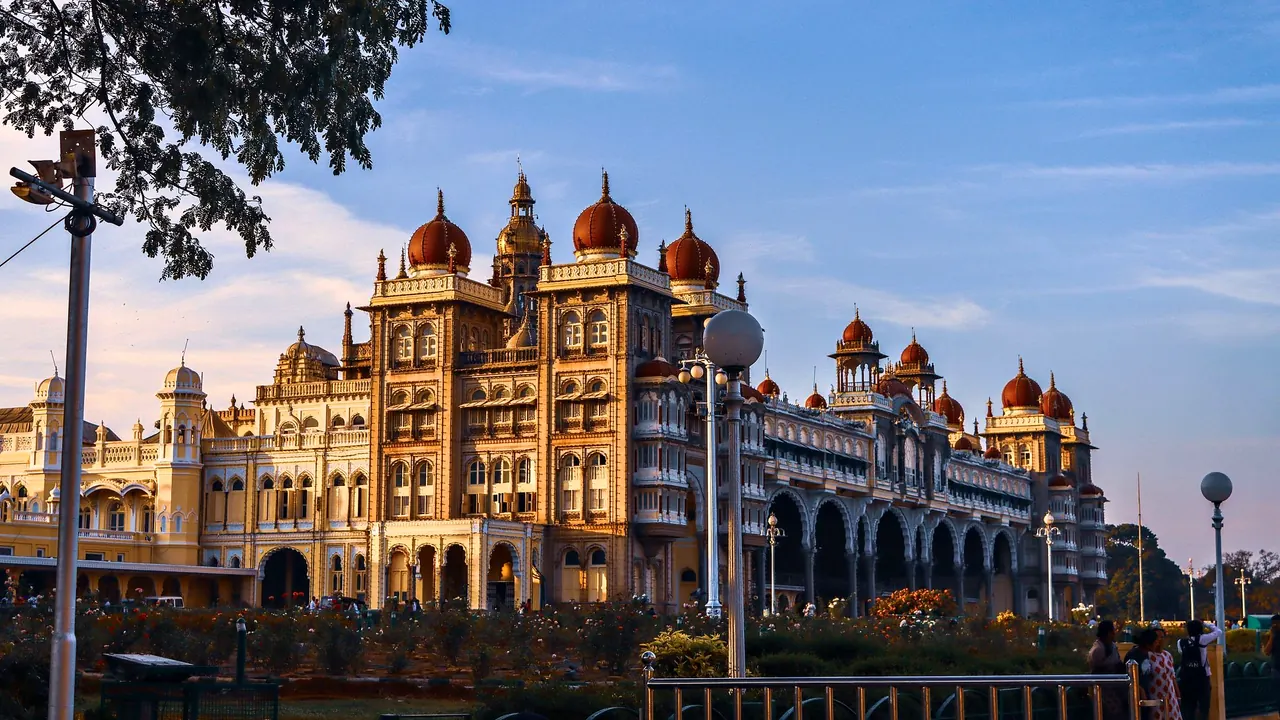
Mysore Palace in golden light
- Affordable cities90
- Wellness & relaxation66
- Culture & sights64
Photo: Pranavsinh suratia, Pexels License
Match
47
Every category weighted equally
- Beach & sun46
- Culture & arts49
- Food & nightlife42
- Family trip50
- Outdoors53
- Relax & unwind50
- Shopping & style46
- On a budget52
Mysore in twelve categories
Our verdict on each, scored 0 to 100 against the same fixed benchmark cities, so a score means the same thing on every page.
Beaches & swimming. Scores 4 out of 100.
Food & drink. Scores 48 out of 100.
Culture & sights. Scores 64 out of 100.
Nightlife. Scores 12 out of 100.
Nature & outdoors. Scores 63 out of 100.
Day trips. Scores 60 out of 100.
Good for families. Scores 46 out of 100.
Getting around. Scores 36 out of 100.
Shopping & style. Scores 44 out of 100.
Affordability. Scores 90 out of 100.
Live music & performing arts. Scores 33 out of 100.
Wellness & relaxation. Scores 66 out of 100.
Mysore category by category
Beaches & swimming
4Mysore sits inland on the southern Deccan plateau, roughly 250km from the nearest coast, and has no beach life at all. The reservoir at Krishnaraja Sagar and the Kaveri river are places to look at, not to swim in. Visitors who want water head for a hotel pool, and anyone set on the sea needs to fly or drive to the Karnataka or Kerala coast and make it a separate trip.
Food & drink
48Eating in Mysore is about South Indian vegetarian cooking done simply and very well. Breakfast is the main event: soft, butter-rich dosas, idli and vada in small, crowded eateries, washed down with strong filter coffee served in steel tumblers. At lunch the classic Karnataka meal comes on a banana leaf, refilled until you stop it. The city also gave its name to Mysore pak, a dense, ghee-heavy sweet sold by long-established confectioners.
Devaraja Market, with its stacks of flowers, fruit and spices, is worth a slow walk. Beyond this the range is narrow: a handful of North Indian and Chinese-style places, hotel restaurants and very little fine dining. Drinking is limited to hotel bars and a few pubs.
Culture & sights
64Mysore was the seat of the Wodeyar maharajas, and the city still reads as a royal capital. The Mysore Palace, an Indo-Saracenic fantasy of domes, stained glass and carved halls, is among the most visited monuments in India, and on Sunday evenings and festival nights it is lit by tens of thousands of bulbs. The Jaganmohan Palace holds an old royal art collection, including Raja Ravi Varma paintings, and the neo-Gothic St Philomena's Church is one of the largest in the country.
On Chamundi Hill above the city the towered Chamundeshwari temple and a giant stone Nandi bull draw pilgrims daily. Grand civic buildings, broad avenues and the former royal guest palaces fill out a centre seen comfortably in two or three days. Dasara, the ten-day autumn festival with its elephant procession, is the city at its most spectacular.
Nightlife
12Mysore goes to bed early. Evenings are for the palace illuminations, a walk through the market and dinner, and after that the choice is a hotel bar or one of a small number of pubs that wind down well before midnight. There is no club scene to speak of, and travellers looking for a night out usually save it for Bengaluru.
Nature & outdoors
63The city's own outdoors is gentle: the climb up the thousand-odd stone steps of Chamundi Hill at dawn, and the birdlife around Karanji and Kukkarahalli lakes. A short drive north, the Ranganathittu bird sanctuary on the Kaveri has nesting painted storks, pelicans and crocodiles basking on the river islands, best seen from a rowing boat.
The real draw lies about two hours south and west, where the forests of Bandipur and Nagarhole, with Kabini between them, hold tigers, leopards, wild elephants and gaur, and jeep safaris run from lodges on the reserve edges. The Western Ghats and the coffee hills of Kodagu are further out. The mild plateau climate makes winter the most comfortable season, and the monsoon turns everything green.
Day trips
60The best short outing is Srirangapatna, about half an hour away on an island in the Kaveri, with the ruined fort, mosque and summer palace of Tipu Sultan and an ancient Vishnu temple. About an hour east, the small Keshava temple at Somnathpur is a perfect Hoysala work, its star-shaped base carved with friezes of elephants, horsemen and epics.
Further out, Shravanabelagola, roughly two hours north, has the colossal monolithic statue of the Jain saint Gomateshwara on a granite hill. Talakad's half-buried temples in the sand and the hilltop temple town of Melukote round out the list. A hired car with a driver is the practical way to combine them, since public buses are slow.
Good for families
46Mysore has more for children than most Indian cities of its size. The zoo, laid out by the maharajas in the nineteenth century, is large, shaded and well kept, and the small rail museum has old royal carriages to climb into. Children usually love the palace lit up at night and the musical fountains at Brindavan Gardens below the Krishnaraja Sagar dam, and boating on Karanji Lake fills an afternoon.
The pace is calmer and the climate milder than in the big cities, but traffic, broken pavements and auto-rickshaw rides take care, and food and water need the usual precautions. The Dasara crowds are a lot for small children.
Getting around
36The core around the palace, Sayyaji Rao Road and the market is compact enough to walk, though pavements are uneven and traffic gives way reluctantly. Beyond that, auto-rickshaws and app-booked cabs do most of the work, and the city buses are cheap but hard for a newcomer to read. Chamundi Hill, Brindavan Gardens and the zoo are short rides apart. For day trips most visitors hire a car with a driver. A fast intercity rail line and an expressway link the city to Bengaluru.
Shopping & style
44Shopping here means the city's own crafts. Mysore silk, smooth, heavy and woven with gold zari, is sold as sarees and scarves at the government silk weaving factory and in the shops along Sayyaji Rao Road. Sandalwood is the other speciality, as soap, oil and carvings, together with the incense rolled in workshops across the city, rosewood inlay and traditional Mysore paintings with gold leaf.
Devaraja Market is the place for spices, kumkum powder and flower garlands. Beyond crafts the offer is ordinary: a few malls and chain stores and little in fashion or design. Fakes are common, so buy silk and sandalwood from government emporia or long-established dealers.
Affordability
90Mysore is a very cheap place to stay. Vegetarian meals and breakfasts in local eateries cost very little, auto-rickshaw rides across town are inexpensive, and simple hotels and guesthouses are plentiful. Entry to the palace, zoo and museums is modest even at the rates charged to foreigners. Spending rises at the converted royal palaces and comfortable heritage hotels, at the long-stay yoga courses, and when hiring a driver for day trips or booking a safari lodge, but daily life in the city stays well below Western prices.
Live music & performing arts
33Mysore has a proud classical tradition: the Wodeyar court supported Carnatic music, and the veena style of the city is still taught and played. In practice the visitor's chances are uneven. During Dasara the palace grounds and city stages host nightly concerts and dance, while for the rest of the year there are occasional recitals at cultural halls and productions by the city's state-funded repertory theatre company, mostly in Kannada. Hotels sometimes stage short classical dance shows. Look for the listings, but do not plan a trip around them outside the festival.
Wellness & relaxation
66Mysore's place in wellness comes from yoga. The city is the birthplace of Ashtanga yoga, and students arrive from around the world to practise for weeks or months in the leafy residential neighbourhood of Gokulam. Their days start before dawn on the mat and move slowly from there: coconut-water stalls, rooftop cafés, Sanskrit and chanting classes. Ayurvedic clinics offer oil massages and longer treatments, and drop-in classes are easy to find.
There is no bathing or spa tradition beyond hotel spas, and the centre, with its horns and traffic, is not restful. The calm is found in the quiet suburbs and the early morning, not in the city as a whole.
When should you go?
Pick a month to see what it is like. The climate figures are measured averages, not a forecast.
Mysore in July
Daytime high, °C
Rainfall in the month, mm
The whole year
Shaded against this city’s own year: the deepest cell is its best month for that figure and the palest its weakest.
Where the figures come from
Mysore has no weather station within reach, so its figures come from a gridded climate model rather than a measured record, and read a broad area rather than the city itself.
Temperature and rainfall are climate normals, averaged over the years shown. Mysore: 2001-2020 normals, NASA POWER reanalysis grid, no weather station within 90 km.
Before you go
| Measure | Mysore |
|---|---|
| Official language | Hindi, English |
| Currency | Indian Rupee (INR) |
| Sockets | CM230 V, 50 Hz |
| Driving side | Left |
| Time zone | UTC+5:30 |
| Emergency number | 108 or 112 |
| Elevation | 770 m |
| Main airport | Kempegowda International Airport Bengaluru (BLR)151 km from centre98 non-stop destinations |
By the numbers
| Measure | Mysore |
|---|---|
| City population | 920,550 |
| People per km² | 8,161 |
| Museums within 10 km | 6 |
| UNESCO World Heritage sites within 50 km | 1 |
Compare Mysore with
Every comparison with a written verdict behind it.