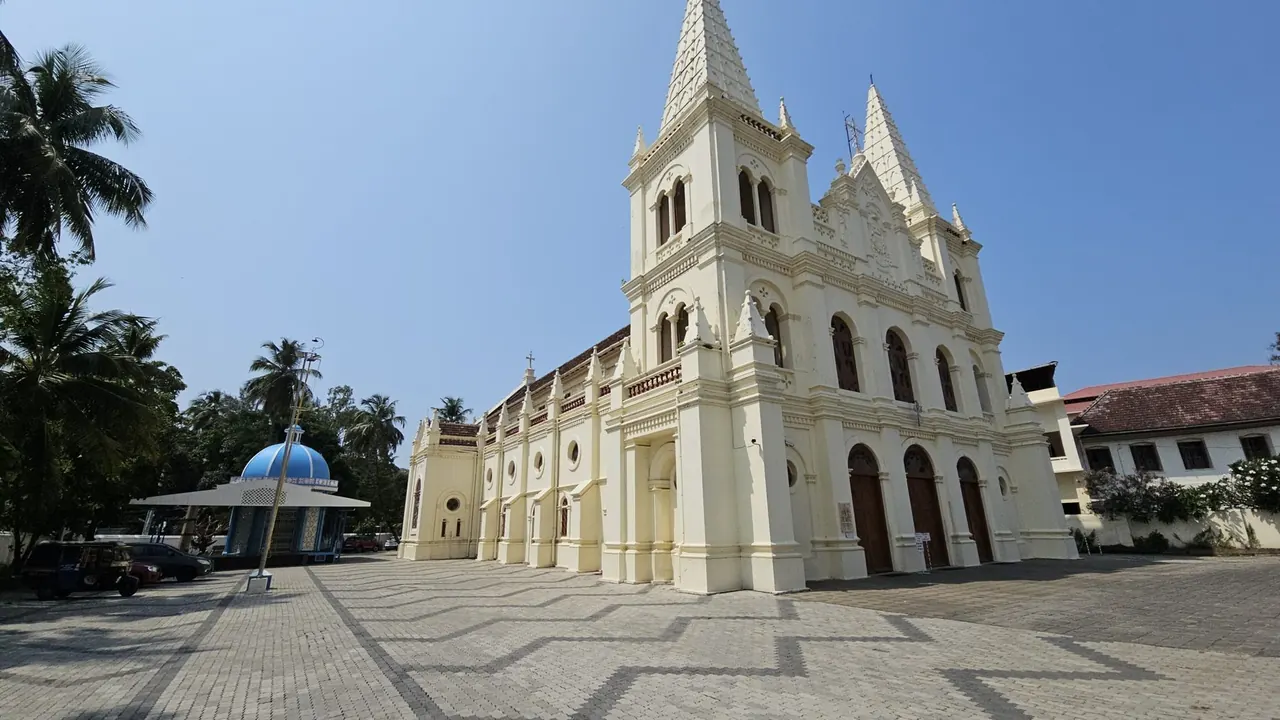
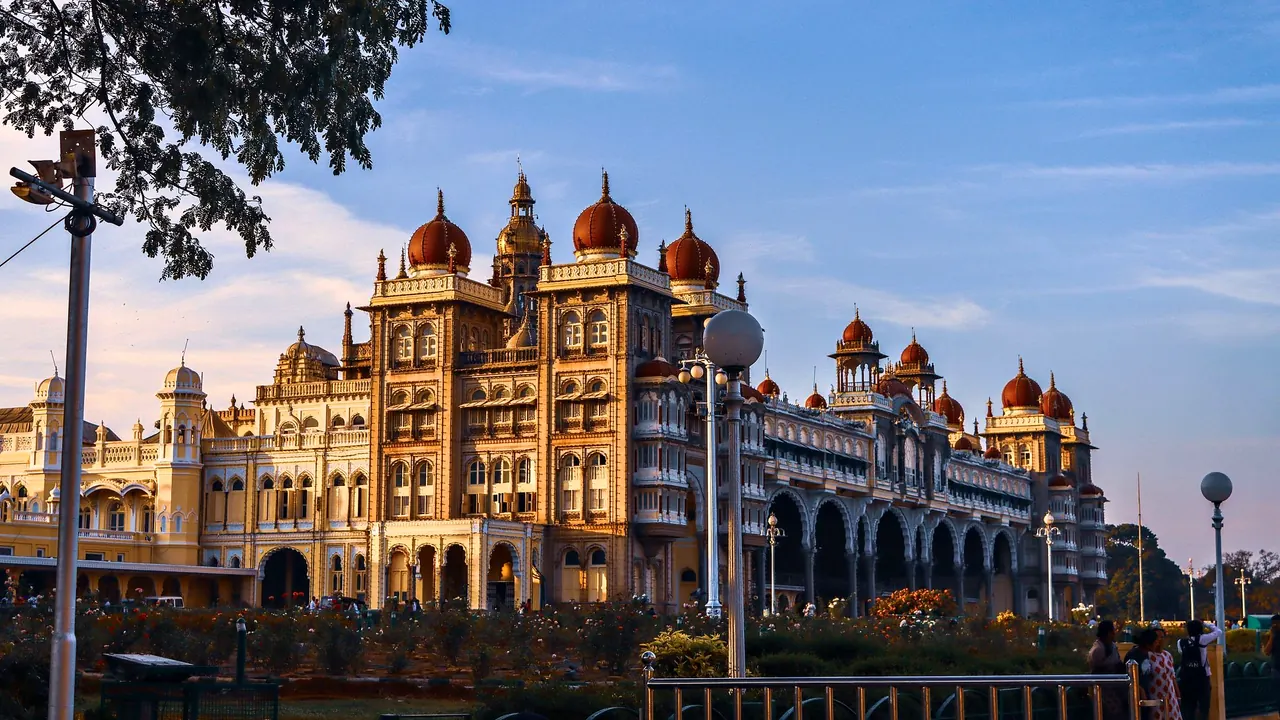
Photos: Kochi by Vis M, CC BY-SA 4.0, cropped; Mysore by Pranavsinh suratia, Pexels License.
Kochi or Mysore?
Our verdict in twelve categories, each scored against the same fixed benchmark cities, and the climate month by month, so you can choose for your trip.
Choose Kochi for
- beaches
- food and drink
- getting around
Kochi suits the traveller who wants water in every part of the trip: ferries across the harbour, a day on the backwaters, seafood cooked in coconut and curry leaf, and a swim at Cherai when the sea is calm. Its old quarter of spice warehouses, a synagogue and colonial churches is easy to explore slowly, and it also makes the better base for anyone coming for Ayurvedic treatment.
Choose Mysore for
- nature and the outdoors
- day trips
- families
Mysore is the better pick for royal grandeur on land and for wildlife. The palace and Chamundi Hill fill the city itself, and within reach are Hoysala temples, Tipu Sultan's island fortress and the tiger forests of Bandipur and Nagarhole. Families, yoga students and anyone who would rather see an elephant in the wild than a beach will get more from it.
Scoreboard
Twelve categories on one fixed scale from 0 to 100. The shaded stretch is the gap between the two.
Your match
Pick a travel style or drag the sliders, and both match scores follow your weighting.
Wins on beaches and food and drink with your weighting.
Wins on nature and the outdoors and day trips with your weighting.
What matters to you?
Category by category
What the scores mean for a trip.
Beaches & swimming
Kochi at least gives you a beach to plan around. The sand at Fort Kochi is for evening strolls by the fishing nets, but Cherai on Vypeen island, about an hour north, is a long, swimmable stretch backed by palms and a lagoon, though only outside the monsoon.
Mysore has nothing of the kind. It sits on the plateau some 250km from the coast, its reservoir and river are not for swimming, and a hotel pool is the only way to get into the water.
Food & drink
Kochi eats with more range. Seafood is the centre of it, from fish curry soured with kudampuli to the day's catch cooked beside the Chinese nets, and the Syrian Christian and Muslim kitchens add beef fry, duck roast and biryani.
Mysore's strength is narrower: vegetarian breakfasts of buttery dosa and idli with filter coffee in steel tumblers, banana-leaf meals and the ghee-rich Mysore pak. It is excellent at what it does but offers little beyond that. Drinking is restricted in both places, but more so in Kerala.
Culture & sights
Both cities have about two or three days of sightseeing, but of very different kinds. Kochi's is layered and small in scale: St Francis Church, the Paradesi Synagogue with its Chinese tiles, the murals of Mattancherry Palace and the Dutch and Portuguese houses left by centuries of the spice trade, with the Biennale bringing contemporary art in the years it runs.
Mysore is about one royal court on a grand scale. The illuminated Mysore Palace, the Ravi Varma paintings in the Jaganmohan Palace, St Philomena's Church and the temple on Chamundi Hill make it the stronger choice for monuments, and Dasara with its elephant procession is the time to see it.
Nightlife
Neither city is a place for a night out, and the difference is small. Kochi's evenings last slightly longer: a sunset walk past the nets, an unhurried seafood dinner, and hotel bars or a handful of licensed lounges in Ernakulam for a drink.
In Mysore the evening is the palace lit up and a walk through the market, and its few pubs close well before midnight. Anyone who wants a proper night out goes to Bengaluru.
Nature & outdoors
Mysore has the bigger outdoor draw. Bandipur, Nagarhole and Kabini, about two hours away, are tiger and elephant country with jeep safaris from lodges on the forest edge. Closer to the city there are the dawn climb up Chamundi Hill's steps and boat rides among the nesting storks at Ranganathittu.
Kochi's outdoors is on the water: kayaks and country boats through the Kumbalangi canals and the paddy villages around Vembanad Lake, birds at Thattekad and the Athirappilly falls. It is lovely, but softer, and the real hills at Munnar need an overnight stay.
Day trips
Mysore's excursions are both closer and more striking. Srirangapatna, with Tipu Sultan's fort and summer palace, is about half an hour away. The carved Hoysala temple at Somnathpur and the huge Jain statue at Shravanabelagola are famous monuments in their own right.
Kochi's outings rely more on atmosphere than on sights. Alappuzha is the start for a day on the backwaters, the Muziris sites trace the old Roman-era port, and Thrissur has its great temple, but congested roads stretch every journey.
Good for families
Mysore gives children more to do. The maharajas' old zoo is large and shaded, the rail museum has royal carriages to climb into, the Brindavan fountains and the lit-up palace make good evenings, and the milder plateau air makes days outside easier.
Kochi's best moments for children are on the water: ferry crossings, backwater boats and the fishing nets being hauled in. Apart from a water park on the city's edge, though, the constant humid heat means most families need a pool hotel and outings kept to the mornings.
Getting around
Kochi is the easier city to move around, mainly thanks to the water. Ferries and the water metro link Fort Kochi with Ernakulam, a metro line runs through the commercial side, and the flat old quarter can be walked or cycled.
Mysore depends on the road. The area around the palace and market is walkable, but uneven pavements and pushy traffic make it tiring, and the city buses are hard for visitors to work out, so rickshaws and cabs do most of the work. Its strong point is the quick rail and expressway link to Bengaluru.
Shopping & style
Both cities sell their own crafts rather than fashion, and each has its specialities. In Kochi you rummage: antique doors and temple bells in the Jew Town warehouses, pepper and cardamom from wholesale spice merchants, and cream-and-gold kasavu handloom.
Mysore is the place for gold-threaded silk, sandalwood oil and carvings, incense and gilded paintings. Buy these from government emporia or old dealers, because fakes are everywhere.
Affordability
Both cities are very cheap day to day, with simple rooms, banana-leaf meals and rickshaw rides costing very little. The difference is in the splurges each one invites. In Kochi it is a heritage hotel, a private houseboat or a residential Ayurveda course, while scarce alcohol keeps evenings inexpensive. In Mysore it is a palace hotel, a hired driver for the temple circuit or a few nights at a safari lodge.
Live music & performing arts
Kochi makes it easier to see a performance. Kathakali is staged every evening in Fort Kochi, and you can watch the actors put on their green-and-red make-up beforehand, often with Kalaripayattu or Mohiniyattam on the same programme.
Mysore's Carnatic and veena heritage is deep, but outside Dasara it comes down to occasional recitals and theatre mostly in Kannada, so catching a performance there is down to luck.
Wellness & relaxation
In Kochi, wellness means Ayurveda practised as medicine. A doctor's consultation leads to a course of warm-oil massage and shirodhara that can last one to three weeks, ideally during the monsoon. Fort Kochi's shaded lanes or a backwater resort give the quiet to go with it.
In Mysore, wellness means the mat. It is the birthplace of Ashtanga yoga, and students settle in leafy Gokulam for weeks of pre-dawn practice, chanting classes and slow afternoons by the coconut stalls. The Ayurvedic clinics there are a side offering, and outside the suburbs the traffic-filled centre is no more restful than Ernakulam.
When should you go?
Pick your month. The climate figures are measured averages, not a forecast.
Kochi in July
Mysore in July
Daytime high, °C
Rainfall in the month, mm
Where the figures come from
Kochi has no weather station within reach, so its figures come from a gridded climate model rather than a measured record, and read a broad area rather than the city itself.
Mysore has no weather station within reach, so its figures come from a gridded climate model rather than a measured record, and read a broad area rather than the city itself.
Temperature and rainfall are climate normals, averaged over the years shown. Kochi: 2001-2020 normals, NASA POWER reanalysis grid, no weather station within 90 km. Mysore: 2001-2020 normals, NASA POWER reanalysis grid, no weather station within 90 km.
The two overlap best in December and January. Kochi's dry season runs from December to March, with little rain and a sea of about 29°C, so these are the months for Cherai. It is hot and sticky throughout, though, and by March the afternoons are heavy going in the streets. The southwest monsoon breaks in May and peaks in June at around 494mm. Rain stays heavy until October, so for half the year swimming is unsafe and outdoor plans often fall through. Those wet months are, however, the traditional season for Ayurvedic treatment.
Mysore, up on the plateau, has a milder and drier year. November to January is the comfortable time for walking the city, with highs of 27°C to 31°C. From February it warms quickly, and March and April, at about 36°C, make the afternoons hard work. Its monsoon is far gentler than Kochi's, with a fraction of the rain each month, so a trip from June to October is much more workable inland than on the coast.
Which traveller are you?
On a beach and sun trip, Kochi is the only real choice. Mysore is far inland, while Kochi has Cherai's palm-backed sand an hour north and a warm sea to swim in between November and March.
For an outdoors trip, Mysore wins. Jeep safaris in Bandipur, Nagarhole and Kabini offer the chance of tigers, leopards and wild elephants, and Ranganathittu's storks and crocodiles are close by. Kochi's kayak trips through the canals are gentler.
On a food and nightlife trip, Kochi is the better table, with fried pearl spot, Syrian Christian duck roast and Malabar snacks, and toddy shops by the backwaters. Neither city goes out late, but Mysore's mainly vegetarian menu is narrower.
Before you go
| Measure | Kochi | Mysore |
|---|---|---|
| Official language | Hindi, English | Hindi, English |
| Currency | Indian Rupee (INR) | Indian Rupee (INR) |
| Sockets | CM230 V, 50 Hz | CM230 V, 50 Hz |
| Driving side | Left | Left |
| Time zone | UTC+5:30 | UTC+5:30 |
| Emergency number | 108 or 112 | 108 or 112 |
| Elevation | 0 m | 770 m |
| Main airport | Cochin International Airport (COK)24 km from centre36 non-stop destinations | Kempegowda International Airport Bengaluru (BLR)151 km from centre98 non-stop destinations |
By the numbers
| Measure | Kochi | Mysore |
|---|---|---|
| City population | 677,381 | 920,550 |
| People per km² | 7,138 | 8,161 |
| Museums within 10 km | 4 | 6 |
| UNESCO World Heritage sites within 50 km | 0 | 1 |
| Swim season, months above 21 °C | 12 months | - |
Where else could you go?
Every comparison below shares a destination with this one, so you can follow Kochi or Mysore somewhere new.