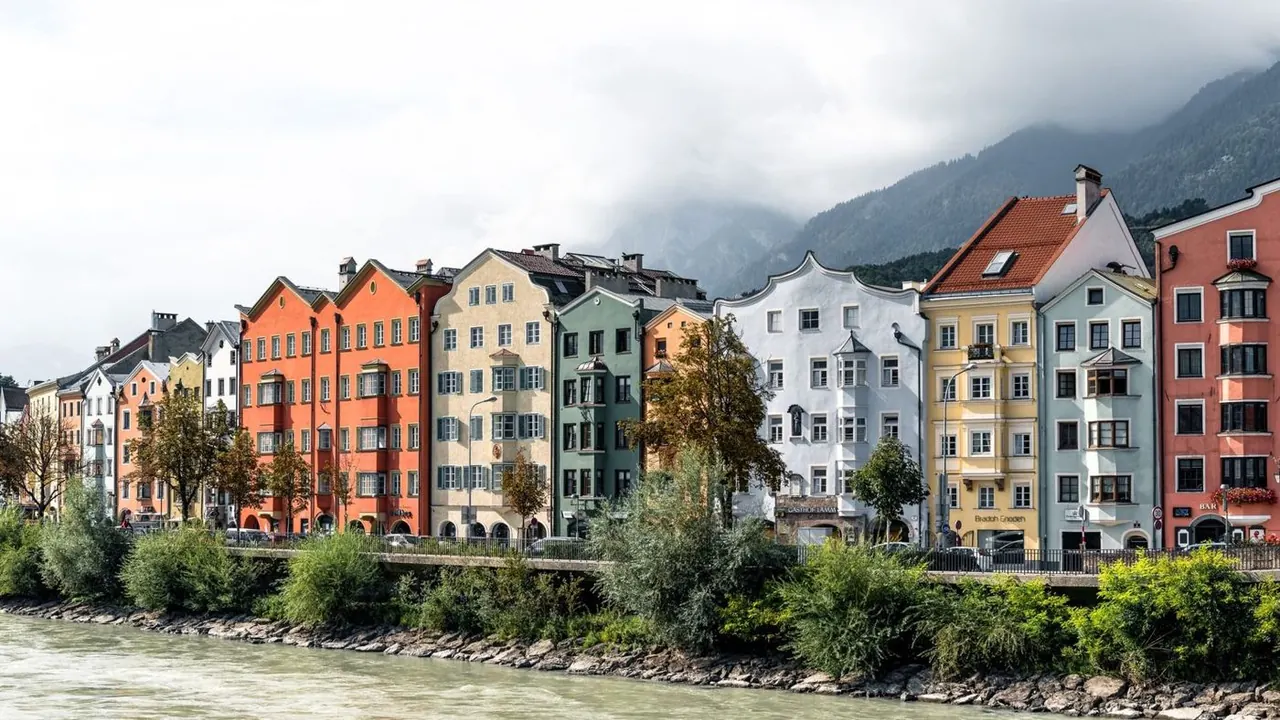
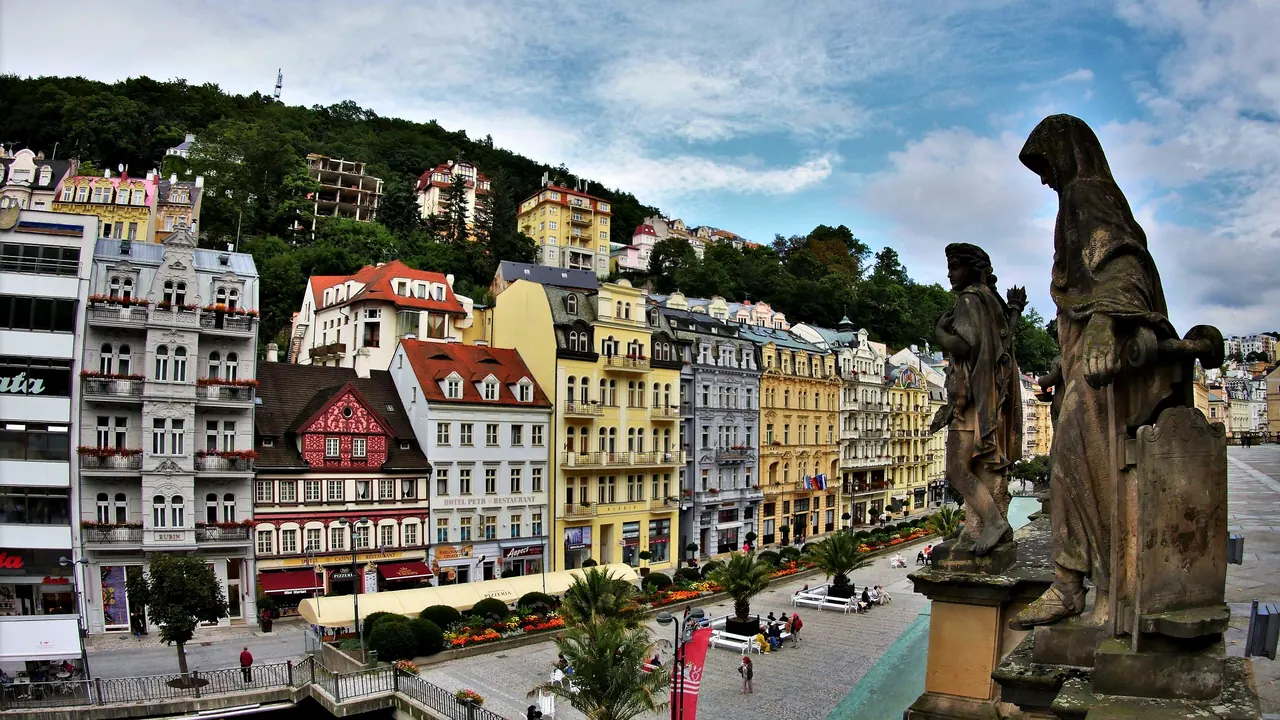
Photos: Innsbruck by Wolfgang Weiser, Pexels License; Karlovy Vary by Rolf Dietrich Brecher from Germany, CC BY-SA 2.0, cropped.
Innsbruck or Karlovy Vary?
Our verdict in twelve categories, each scored against the same fixed benchmark cities, and the climate month by month, so you can choose for your trip.
Choose Innsbruck for
- nature and the outdoors
- families
- nightlife
Innsbruck is for travellers who want to be active. The Nordkette ridge is a funicular and cable-car ride from the old town, and the ski areas, glacier, trails and via ferratas start almost at the edge of the city. It also has more going on after dark, an easier time for children and better rail links to Munich, Salzburg and South Tyrol. Choose it for a mountain trip with a compact Habsburg old town attached.
Choose Karlovy Vary for
- wellness
- prices
- shopping
Karlovy Vary suits a slower trip built around rest. The whole town exists for taking the waters: you sip from springs along the colonnades, book treatments in a spa hotel and take gentle forest walks between coffee and cake. It costs noticeably less than Innsbruck once you step off the main promenade. Go there for a few unhurried days of cures and Belle Époque streets, not for excitement.
Scoreboard
Twelve categories on one fixed scale from 0 to 100. The shaded stretch is the gap between the two.
Your match
Pick a travel style or drag the sliders, and both match scores follow your weighting.
Wins on nature and the outdoors and families with your weighting.
Wins on wellness and prices with your weighting.
What matters to you?
Category by category
What the scores mean for a trip.
Beaches & swimming
Neither city is a swimming destination, but Innsbruck gives you more for a hot afternoon. The small lakes on the plateaus above town, the Lanser See and the Natterer See, warm to about 22°C in high summer, and the Achensee further out is beautiful if chilly.
Karlovy Vary has Lake Medard, a flooded mine near Sokolov about half an hour away, and a few forest reservoirs. Most swimming there happens in pools, the most unusual being the warm outdoor pools fed by the springs.
Food & drink
Both serve hearty central European cooking, but Innsbruck has a slight edge. Its best meals come at mountain huts reached by cable car, with Gröstl or Kaspressknödel and a valley view. The student districts and a small fine-dining tier add a little range.
Karlovy Vary's table is narrower: roast pork, dumplings and svíčková with good Czech beer. Its own specialities are the warm spa wafers and Becherovka, which is still distilled in town. Neither place has markets or street food worth seeking out.
Culture & sights
The two are about even, but you see them in different ways. Innsbruck's culture is a set of distinct sights: the Golden Roof, the Hofburg, Maximilian's tomb in the Hofkirche with its bronze giants, two solid museums, and Ambras Castle with its cabinet of curiosities.
In Karlovy Vary the townscape is the attraction. You walk past pastel tiers of Belle Époque hotels and along the UNESCO-listed colonnades, and watch the Vřídlo geyser shoot up in its hall. Its museums are small and specialised.
Nightlife
Innsbruck has a real if modest night out, thanks to its university. Bars and small clubs fill the brick arches under the railway viaduct and stay open late at weekends, and in winter there is après-ski in the resorts. Karlovy Vary is mostly asleep by eleven, apart from the film festival week, so outside that week an evening means a hotel bar or a Czech pub.
Nature & outdoors
This is where Innsbruck pulls furthest ahead. From the old town you can be on a ridge at about 2,300m in under half an hour. The Karwendel lies behind it, and the Stubai Glacier, ski areas, via ferratas and rafting rivers are all close by.
Karlovy Vary's outdoors is green and gentle: beech and spruce forest, graded spa paths up to the Diana tower, and the moors of the Slavkov Forest. The Ore Mountains offer modest skiing at Klínovec, and the Ohře is good for easy canoeing.
Day trips
Innsbruck sits on the main rail lines through the Alps, so a day out can easily cross a border. Munich and Salzburg are each a little under two hours by train, and over the Brenner Pass, Bolzano and Merano add Italian arcades, South Tyrolean wine and Ötzi the Iceman. Closer in are medieval Hall in Tirol, glassmaking Rattenberg and the Swarovski Crystal Worlds, and Neuschwanstein is about two hours by car.
Karlovy Vary's outings stay closer to home but are well worth taking. Loket's castle in a tight loop of the Ohře is only twenty minutes away, and the sister spa towns of Mariánské Lázně and Františkovy Lázně are about an hour. Cheb and the brewing city of Plzeň are longer outings of an hour or more, and Prague takes a long day by coach, about two hours each way.
Good for families
Innsbruck is much easier with children. The funicular stops at the Alpenzoo, with its bears, wolves and ibex, on the way up the mountain. Summer brings adventure trails and plateau lakes, and winter brings ski schools on gentle slopes.
In Karlovy Vary children enjoy the geyser, sipping from spouted spa cups and riding the funicular to the lookout. Beyond that, the town is made for adults on a cure, and the steep valley sides are hard work with a pushchair.
Getting around
Innsbruck is the easier city to move around. Its flat, compact centre puts the old town, the Hofburg and the river a few minutes apart, trams run out to Igls and the Stubai valley, and the funicular up the mountain starts at the edge of the old town. In winter, ski buses run to the surrounding areas, and the central station makes onward travel simple.
Karlovy Vary is pleasant to walk along its narrow riverside strip, but the valley sides are steep. The climbs to hotels and viewpoints often mean a local bus or the funicular. Trains to Loket, Cheb and Mariánské Lázně run on slow regional lines, and a car makes the forests and villages easier to reach.
Shopping & style
Shopping is about even, but what you buy is different. In Innsbruck it means high-street chains on Maria-Theresien-Strasse, loden jackets, dirndls and Speck, and some excellent specialist ski and outdoor shops. Karlovy Vary caters to well-off spa guests with jewellers and boutiques, and its real local goods are Moser crystal, Karlovy Vary porcelain and Bohemian garnets.
Affordability
Karlovy Vary is clearly the cheaper stay. The grand hotels and colonnade restaurants charge for the setting, but one street back the pubs and canteens charge local Czech prices, and the springs and promenades cost nothing.
Innsbruck adds an Alpine resort premium to Western European prices, and cable car tickets add up quickly on an active trip. The guest and city cards soften this, and spring and autumn are the cheaper seasons.
Live music & performing arts
Innsbruck has the fuller programme. The Tiroler Landestheater stages opera, drama and dance, the Tyrolean Symphony Orchestra performs regularly, and the summer Festival of Early Music fills historic rooms such as the Spanish Hall at Ambras.
Karlovy Vary offers lighter fare: spa-orchestra concerts, some held outdoors on the colonnades, touring shows in the ornate Fellner and Helmer theatre, and an autumn Dvořák festival. Its best-known festival is for film rather than music.
Wellness & relaxation
Karlovy Vary wins easily, because wellness is its whole reason for being. Thirteen springs feed the colonnades, sanatoria offer medical stays with carbonated baths and peat wraps, and the slow round of springs, cake and forest walks is the point of a visit.
Innsbruck's version is a sauna after a day in the mountains. Its best hotel spas are up in Igls and the plateau villages, and the big thermal complexes in the Ötztal and Zillertal are about an hour away.
When should you go?
Pick your month. The climate figures are measured averages, not a forecast.
Innsbruck in July
Karlovy Vary in July
Daytime high, °C
Rainfall in the month, mm
Where the figures come from
Karlovy Vary's station stands 156 m above the city centre, so the centre is likely a little warmer than the figures say.
Karlovy Vary has no rain gauge within 25 km of the centre, so its rainfall comes from a gridded climate dataset read at the city rather than from a gauge further away.
Karlovy Vary's sunshine is measured 37 km from the centre, at Cheb.
Temperature and rainfall are climate normals, averaged over the years shown. Innsbruck: 1991-2020 normals, Innsbruck-Flughafen (3.3 km from centre). Karlovy Vary: 1999-2020 (sunshine 1981-2010, rainfall 1991-2020) normals, Karlovy Vary (4.6 km from centre).
Innsbruck has the warmer summers. July reaches about 26°C, which is warm enough for the plateau lakes, but summer is also the wettest season, with afternoon storms building to around 144mm in August. May, June and September are the best months for hiking, with long days and less heat. Winter highs stay close to freezing, but that is ski season, and the valley gets a fair amount of winter sun.
Karlovy Vary is cooler all year. Its summer peaks at about 22°C, which is comfortable for walking the colonnades and forest paths, and only July is particularly wet. Winters are colder and much greyer than in Innsbruck, with highs around 1°C and very little sun from November to January. That makes late spring to early autumn the time to go, unless all you want is a warm spa interior.
Which traveller are you?
On an outdoors trip, Innsbruck is the clear choice. High ridges, the Karwendel nature park and a year-round glacier are all within easy reach, with hiking, skiing, paragliding and rafting. Karlovy Vary's gentle spa paths and rolling forests are pleasant but tame by comparison.
For a relaxing and wellness trip, Karlovy Vary is built for it. You drink from the thirteen springs, book medical spa stays with mineral baths and massages, and keep an unhurried pace. Innsbruck has good hotel saunas, but no thermal springs of its own.
On a family trip with children, Innsbruck works better. The Alpenzoo, the mountain adventure trails, the warm plateau lakes and the ski schools give children plenty to do. Karlovy Vary's geyser and funicular are fun for an afternoon, but the town is aimed at adults.
Before you go
| Measure | Innsbruck | Karlovy Vary |
|---|---|---|
| Official language | German, Austrian Sign Language | Czech |
| Currency | Euro (EUR) | Czech Koruna (CZK) |
| Sockets | CF230 V, 50 Hz | CE230 V, 50 Hz |
| Driving side | Right | Right |
| Time zone | UTC+1, UTC+2 in summer | UTC+1, UTC+2 in summer |
| Emergency number | 112 | 112 |
| Elevation | 574 m | 447 m |
| Main airport | Innsbruck Airport (INN)4 km from centre40 non-stop destinations | Václav Havel Airport Prague (PRG)100 km from centre178 non-stop destinations |
| Public holidays this year | 16 days | 13 days |
By the numbers
| Measure | Innsbruck | Karlovy Vary |
|---|---|---|
| City population | 132,499 | 49,073 |
| People per km² | 1,263 | 830 |
| Museums within 10 km | 28 | 2 |
| UNESCO World Heritage sites within 50 km | 1 | 3 |
Where else could you go?
Every comparison below shares a destination with this one, so you can follow Innsbruck or Karlovy Vary somewhere new.
- Munichvs Innsbruck
- Cortina d'Ampezzovs Innsbruck
- Dresdenvs Karlovy Vary
- Praguevs Karlovy Vary
- Leipzigvs Karlovy Vary
- Salzburgvs Innsbruck