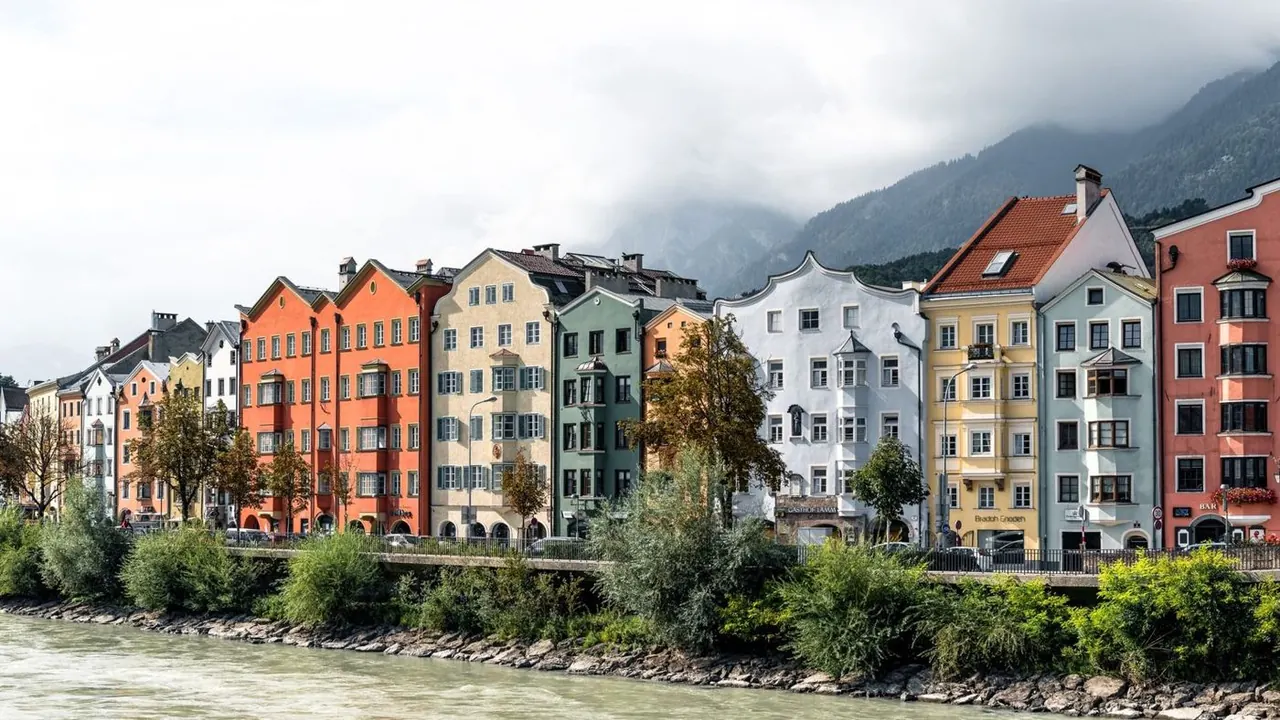
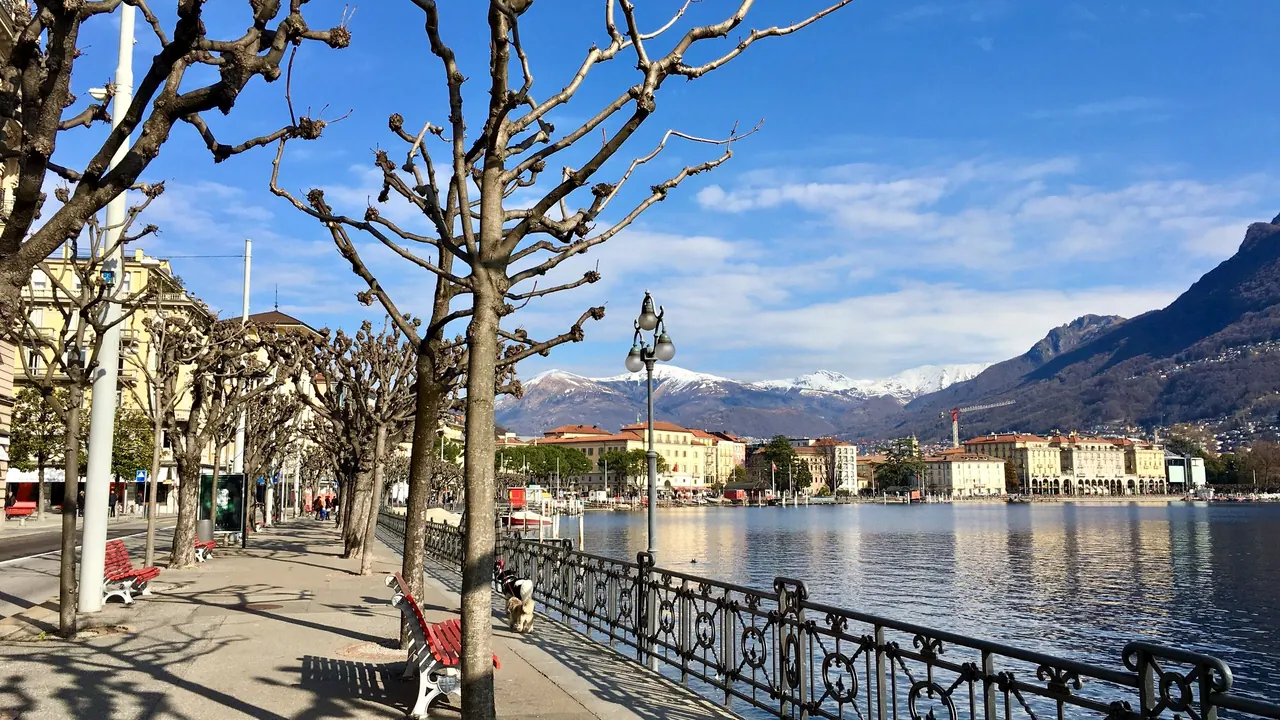
Photos: Innsbruck by Wolfgang Weiser, Pexels License; Lugano by Thomas Woodtli from Zürich, Switzerland, CC BY-SA 2.0, cropped.
Innsbruck or Lugano?
Our verdict in twelve categories, each scored against the same fixed benchmark cities, and the climate month by month, so you can choose for your trip.
Choose Innsbruck for
- prices
- culture and sights
- nature and the outdoors
Innsbruck is the choice for travellers who want the mountains to be the trip itself. A funicular from the edge of the old town connects to the Nordkette cable cars, and the ski areas around the city share one pass in winter. The Habsburg old town, with the Hofkirche and Ambras Castle, also has more to see than Lugano. On top of that, it is the gentler of the two on the budget, and its university keeps the evenings livelier.
Choose Lugano for
- beaches
- day trips
- shopping
Lugano suits a slower lake vacation with an Italian accent: lidos on a proper swimming lake, long lunches in a grotto with Ticino Merlot, and boats to Gandria and Morcote. Its real strength is its position on the border. Milan, Como, Bellinzona and Lake Maggiore are all close, so it works well for travellers who want a calm, comfortable base and plan to spend many days on excursions.
Scoreboard
Twelve categories on one fixed scale from 0 to 100. The shaded stretch is the gap between the two.
Your match
Pick a travel style or drag the sliders, and both match scores follow your weighting.
Wins on prices and culture and sights with your weighting.
Wins on beaches and day trips with your weighting.
What matters to you?
Category by category
What the scores mean for a trip.
Beaches & swimming
Neither city has a coast, but Lugano at least has its own swimming lake. The main lido sits at the mouth of the Cassarate, with smaller bathing spots towards Castagnola and Paradiso and lake baths in villages you reach by boat, all from June to early September.
In Innsbruck you have to head up to the shallow Lanser See or Natterer See on the plateaus for a summer dip. The beautiful Achensee is too cold for most swimmers, so a swim there fills an afternoon rather than a whole vacation.
Food & drink
The two are broadly level, and in both the setting matters more than the range. Innsbruck's best meals are Gröstl, Kaspressknödel and Kaiserschmarrn at mountain huts reached by cable car. Lugano's equivalent is the grotto, where you eat polenta and braised meats at granite tables under chestnut trees.
Lugano has the better drink and the market. Ticino Merlot grows close to town, and the old centre has a weekly market, which Innsbruck lacks. Innsbruck has Viennese-style coffee houses and cheaper student places, and neither city offers much street food.
Culture & sights
Innsbruck has clearly more to see. Its time as a Habsburg seat left the Hofburg, the Golden Roof and the Hofkirche, where 28 bronze figures stand around Maximilian I's tomb. Ambras Castle adds its cabinet of curiosities and armour collection, and together they fill two or three days.
Lugano's sights take about a day. The highlights are the arcaded Lombard old town, San Lorenzo above the lake and Luini's Passion fresco in Santa Maria degli Angioli. The LAC and the Hesse museum in Montagnola round it out pleasantly, but there is less depth.
Nightlife
Innsbruck has more going on after dark, thanks to its students. Bars and small clubs fill the brick arches under the railway viaduct and stay open late at weekends, and in winter there is après-ski in the resorts.
Lugano's evenings centre on an aperitivo and a long dinner, with a smart local crowd and high prices. Most nights the town is quiet before midnight, and young locals who want to go out go to Milan.
Nature & outdoors
Both cities have mountains, but Innsbruck's are higher and wilder. The Nordkette ridge rises straight above the city and leads into the Karwendel. The Stubai Glacier keeps snow for most of the year, and in winter several ski areas are close by.
Lugano's landscape is gentler: lake and wooded slopes rather than high Alps. Monte Brè, San Salvatore and Monte Generoso give wide views. The Gandria path and the Lema to Tamaro ridge make fine walks, and kayaks and paddleboards are easy to hire on the water.
Day trips
Lugano has the stronger excursions because it sits right on the Italian border. Milan is just over an hour by train, Como about half an hour, and Bellinzona's castles and the Lake Maggiore shore are both close.
Innsbruck's options are good but further out. Hall in Tirol is ten minutes away, while Munich, Salzburg and Bolzano over the Brenner each take roughly two hours. That makes the bigger cities long days rather than easy hops.
Good for families
Both cities are safe and calm, and neither has big attractions built for children. In Innsbruck the Alpenzoo, with its ibex, bears and lynx, is on the funicular line, and there are ski schools in winter.
Lugano relies on the lake: boat trips, slides at the lidos, mountain railways and the miniature park at Melide. Its steep streets are hard work with a pushchair, whereas central Innsbruck is flat.
Getting around
Both cities are just as easy to get around without a car. Innsbruck's centre is flat, with trams running out to Igls and the Stubai valley.
Lugano's centre is all slope. A short funicular links the station to the old town, and lake boats do much of the work that trams do in Innsbruck.
Shopping & style
Lugano is a little better for shopping, mainly because of Via Nassa. Its arcades hold Swiss watchmakers, jewellers and Italian fashion houses, and there is a large designer outlet near Mendrisio.
Innsbruck's strengths are more practical: loden jackets, dirndls, woodcarvings and excellent outdoor and ski shops. In both, a serious shopping trip still ends up in a bigger city.
Affordability
Innsbruck is expensive, but Lugano costs far more. Innsbruck's prices drop in spring and autumn, and student cafés and city cards that bundle transport with lifts make a difference.
In Lugano, hotels, meals, wine, boats and mountain railways all carry Swiss prices. Grotti, set lunches and the regional transport that comes with a hotel stay soften the bill only a little.
Live music & performing arts
The two are about even, with different strengths. Innsbruck's Landestheater stages its own opera and operetta, and the summer Festival of Early Music uses settings like the Spanish Hall at Ambras.
Lugano centres on the acoustics of the LAC concert hall and the free Estival Jazz concerts on Piazza della Riforma. Opera lovers there head to La Scala.
Wellness & relaxation
Neither city has thermal springs, so relaxing works differently in each. Innsbruck's version is a hotel sauna in Igls after a day on the trails, with big thermal spas in the Ötztal and Zillertal about an hour away.
Lugano's calm comes from its pace: palm-lined lakeside benches in Parco Ciani, afternoons at a lido and grotto lunches. For pools and saunas there is an indoor complex near Rivera.
When should you go?
Pick your month. The climate figures are measured averages, not a forecast.
Innsbruck in July
Lugano in July
Daytime high, °C
Rainfall in the month, mm
Temperature and rainfall are climate normals, averaged over the years shown. Innsbruck: 1991-2020 normals, Innsbruck-Flughafen (3.3 km from centre). Lugano: 1991-2020 normals, Lugano (1.2 km from centre).
Innsbruck has proper winters, with days around 4°C in December and January, and that is ski season. Summer is warm, about 26°C in July, but June, July and August are also the wettest months, with rain peaking at 144mm in August. For hiking and walking the streets, May and September give the best mix of warmth and drier weather. June is just as pleasant for temperature but brings more wet days. The plateau lakes are only worth a swim in July and August.
Lugano is milder all year. Its winters stay several degrees warmer, and December to March is its driest stretch, which makes it good for walking around town. Summer days reach 27°C and get more sunshine than Innsbruck's, so July and August are the months for the lidos. The catch is the rain. It falls heavily from April to November and peaks at 178mm in May, so a spring or autumn hike here comes with a real chance of a wet day.
Which traveller are you?
For an outdoors trip, Innsbruck is the clear choice. You can be on a 2,300m ridge within half an hour of the old town, the Karwendel starts behind it, and the same slopes offer skiing, via ferratas, rafting and hut-to-hut hiking.
For a beach and sun trip without a coast, Lugano is the better bet. It has sunnier summers, a lake warm enough for long swims and lidos with decks and ladders into the water. Innsbruck's small plateau lakes are an afternoon outing at most.
On a culture and arts trip, Innsbruck gives you more to fill the days. Its Habsburg palaces and museums are a few minutes' walk apart, and in summer early music plays in historic halls. Lugano's own sights take a day, so its culture relies on trips to Milan.
Before you go
| Measure | Innsbruck | Lugano |
|---|---|---|
| Official language | German, Austrian Sign Language | French, German, Italian, Romansh |
| Currency | Euro (EUR) | Swiss Franc (CHF) |
| Sockets | CF230 V, 50 Hz | CJ230 V, 50 Hz |
| Driving side | Right | Right |
| Time zone | UTC+1, UTC+2 in summer | UTC+1, UTC+2 in summer |
| Emergency number | 112 | 112 |
| Elevation | 574 m | 283 m |
| Main airport | Innsbruck Airport (INN)4 km from centre40 non-stop destinations | Milan Malpensa International Airport (MXP)46 km from centre208 non-stop destinations |
| Public holidays this year | 16 days | 15 days |
By the numbers
| Measure | Innsbruck | Lugano |
|---|---|---|
| City population | 132,499 | 63,495 |
| People per km² | 1,263 | 837 |
| Museums within 10 km | 28 | 17 |
| UNESCO World Heritage sites within 50 km | 1 | 5 |
Where else could you go?
Every comparison below shares a destination with this one, so you can follow Innsbruck or Lugano somewhere new.
- Comovs Lugano
- Milanvs Lugano
- Bergamovs Lugano
- Zermattvs Lugano
- Munichvs Innsbruck
- Cortina d'Ampezzovs Innsbruck