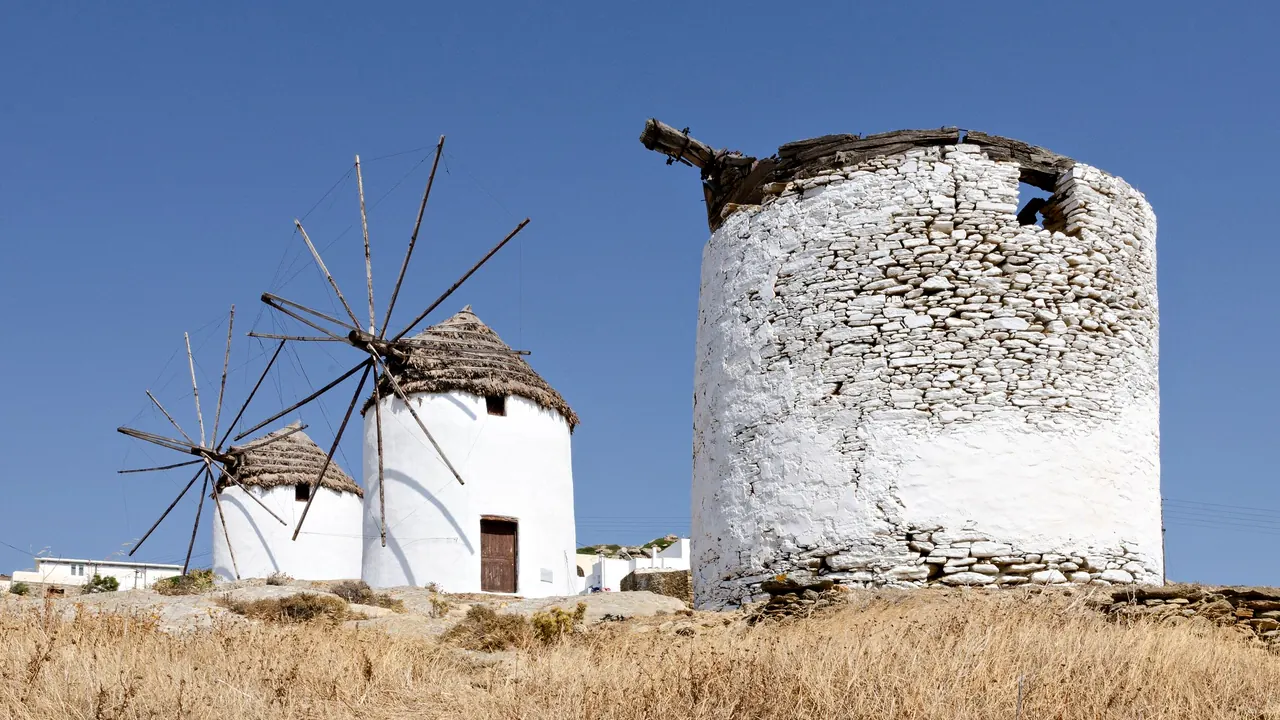
Photos: Ios by NorbertNagel, CC BY-SA 4.0, cropped.
Ios or Peloponnese?
Our verdict in twelve categories, each scored against the same fixed benchmark cities, and the climate month by month, so you can choose for your trip.
Choose Ios for
- nightlife
- getting around
- beaches
Ios suits a young group, or anyone whose idea of a summer week is long beach days on sand followed by nights moving from bar to bar through the lanes of Chora until dawn. It is a compact island where you stay in one place, swim at Mylopotas or Manganari and let the evenings carry the trip. The price is that there is little else to fill the days: ancient sites, serious food and quiet are not what it does.
Choose Peloponnese for
- culture and sights
- nature and the outdoors
- live music and the arts
The Peloponnese is the better choice for a fuller, slower trip with a hire car, built around Mycenae, Olympia, Mystras and Monemvasia, mountain walking in Arcadia and the Mani, and country cooking with local wine. Its beaches hold their own against Ios, and it is far easier with children or for resting. What you give up is the night: outside Patras, evenings end over dinner by the harbour.
Scoreboard
Twelve categories on one fixed scale from 0 to 100. The shaded stretch is the gap between the two.
Your match
Pick a travel style or drag the sliders, and both match scores follow your weighting.
Wins on nightlife and getting around with your weighting.
Wins on culture and sights and nature and the outdoors with your weighting.
What matters to you?
Category by category
What the scores mean for a trip.
Beaches & swimming
The two are evenly matched on beaches, and both are sand-led. Ios packs its beach life into a small island: the long social bay at Mylopotas with sunbeds and water sports, and the clear, shallow coves of Manganari in the south when the meltemi blows up the north side.
The Peloponnese offers range rather than concentration, spread over hours of driving: the horseshoe of Voidokilia and the Messinian sands, the pale turquoise water of Elafonisos, pebble coves below Mani villages and easy family beaches at Tolo. Its water is a touch warmer in late summer, and outside the peak months many beaches are close to empty.
Food & drink
The mainland eats far better. The Peloponnese cooks from its own land, with Kalamata olives and oil, slow-cooked goat, Mani cured pork and wild greens, and it makes serious wine in Nemea, on the Tripoli plateau and at Monemvasia. Kalamata's covered market and the tables of Nafplio give a town-sized choice.
Ios has a few careful tavernas in Chora and Yialos and its own skotyri cheese, but in summer many kitchens are feeding the night crowd with gyros and pizza. Good meals there have to be hunted down.
Culture & sights
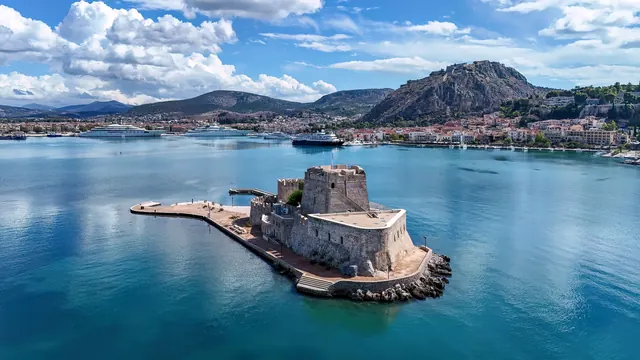
This is the widest gap between the two. The Peloponnese holds a large share of ancient and medieval Greece: Mycenae and Tiryns, the theatre of Epidaurus, Olympia, Messene, Bassae, and then Byzantine Mystras, the rock of Monemvasia and the Venetian fortresses of Nafplio and Methoni. A week barely covers it.
On Ios the whitewashed village of Chora is itself the main sight, with the Early Cycladic walls at Skarkos, the small museum and the legendary tomb of Homer adding an afternoon at most.
Nightlife
Ios wins this outright, and for many visitors it is the reason to go. Its summer nights fill the lanes and square of Chora with young crowds moving between small bars and clubs until dawn, with afternoon beach parties at Mylopotas beforehand. It is loud and cheap rather than stylish, and it falls silent outside June to September.
In the Peloponnese the evening usually means dinner and a drink on Nafplio's waterfront or Kalamata's seafront. Only Patras, a university city on the north coast, has a club scene, and it is far from the beaches and ancient sites.
Nature & outdoors
The Peloponnese has the landscape for an outdoors trip: Taygetos rising to about 2,400m, the Lousios gorge with its cliff monasteries, the long Menalon Trail, the rack railway through the Vouraikos gorge and the stark Mani walking down to Cape Tainaron. Add birdwatching at the Gialova lagoon and sea kayaking.
Ios is handsome in a bare, rocky way, with mule tracks to chapels and windmills, boat trips to sea caves and windsurfing at Mylopotas, but it is good for a morning's walk rather than a whole trip.
Day trips
Ios relies on the ferry, which makes Santorini and its Akrotiri excavations an easy hop and Naxos, Sikinos or Folegandros good outings in high summer. Outside summer, same-day returns become uncertain.
The Peloponnese gives more choice and does not depend on timetables, provided you drive: Hydra and Spetses from the Argolid ports, Nemea's wineries, Athens about two hours away, the old towns of Pylos and Methoni, Monemvasia, Elafonisos and the Arcadian villages.
Good for families
The Peloponnese is the easier family choice. It has shallow sandy bays at Tolo, in Messinia and on Elafonisos, resort hotels with kids' clubs, welcoming tavernas and ancient sites that older children can enjoy early in the day, though long car journeys come with it.
Ios can manage a beach week at Manganari in June or September, but Chora's steep steps defeat a pushchair, there is nothing aimed at children, and in July and August the party noise carries late.
Getting around
Neither is especially easy, but in different ways. Ios is reached only by ferry, yet once there the harbour, Chora and Mylopotas form a small triangle served by a frequent summer bus and an old stepped path, so a carless stay works if you stick to it; the far bays need a scooter or car.
The Peloponnese is car country from the start. Motorways make the main towns quick, but mountain and Mani roads are slow, buses rarely reach sites or beaches, and only compact Nafplio and the old towns are pleasant on foot.
Shopping & style
Neither is a shopping destination, but the Peloponnese gives you more to bring home: jewellery and ceramics in Nafplio's lanes, olive oil, honey and herbs, wine straight from Nemea's wineries and lively weekly markets in Kalamata and Tripoli. On Ios shopping comes down to beachwear, sandals and souvenirs in Chora's late-opening shops, with a handful of boutiques.
Affordability
Both come in cheaper than the glamorous Cycladic islands, and the mainland goes a little further. The Peloponnese rewards travellers with village rooms in the Mani and Arcadia, taverna meals and local wine, though a hire car and site fees are hard to avoid.
Ios keeps its backpacker side, with hostels, campsites, grill food and bar offers, but rooms of any comfort, the quiet-bay boutique hotels and ferry fares add up in high summer. On both, June and September give the same sea for less.
Live music & performing arts
The Peloponnese has one experience Ios cannot match: ancient drama at night in the theatre of Epidaurus during its long-running summer festival, with concerts at the Little Theatre nearby and a dance festival in Kalamata. Ios has occasional summer events at the open-air theatre by the windmills and saints'-day village music, but the island's soundtrack is its bars.
Wellness & relaxation
For rest, the Peloponnese is the better bet. Its slow stone villages and empty coves are restful in themselves, and it adds thermal springs at Loutraki and Methana, the warm sulphur lake at Kaiafas and full resort spas in Messinia.
Ios is built for late nights in high summer. It can be calm at Manganari or in June and September, with some hotel massage and yoga, but anyone wanting quiet has to plan around the island's main purpose.
When should you go?
Pick your month. The climate figures are measured averages, not a forecast.
Ios in July
Peloponnese in July
Daytime high, °C
Rainfall in the month, mm
Where the figures come from
Ios's temperatures are measured 41 km from the centre, at Santorini Island / Monólithos.
Ios has no rain gauge within 25 km of the centre, so its rainfall comes from a gridded climate dataset read at the destination rather than from a gauge further away.
Peloponnese's temperatures are measured 89 km from the centre, at Kalamata Airport.
Peloponnese has no rain gauge within 25 km of the centre, so its rainfall comes from a gridded climate dataset read at the destination rather than from a gauge further away.
Temperature and rainfall are climate normals, averaged over the years shown. Ios: 2000-2025, 12 years observed (rainfall 1991-2020) normals, Santorini Island / Monólithos (40.9 km from centre). Peloponnese: 1991-2020 normals, Kalamata Airport (89 km from centre).
Both are beach destinations from June to early October, and in high summer both are hot, around 30°C on Ios and 32°C at the main Peloponnese base, with almost no rain from June to August. The Peloponnese sea warms a little further, to about 26°C against 24°C on Ios, and long hot sunny days make July and August its strongest beach months but the hardest for sightseeing or walking at midday. For ancient sites and mountain trails, May, late September and October are the comfortable months there.
Ios has the more reliably dry shoulder season, with September still almost rainless, but its rain arrives in October and grows through winter, when most of the island closes anyway. On the mainland the turn comes later and harder: November and December are the wettest months, at about 95mm, although April and May, still fairly dry and green, are a good time for its interior.
Which traveller are you?
On a food and nightlife trip where the nights come first, Ios is the clear choice: from June to September you simply walk out into Chora after dark and the evening finds you, on foot and until dawn. Come for the bars, not the cooking.
For a culture and arts trip, Ios offers its whitewashed village and an afternoon of minor sites, while the Peloponnese can fill a week from Nafplio alone and still leave Olympia and the south for a second base. Depth decides it.
On an outdoors trip, Ios gives a few pleasant walks over bare hills and some wind for windsurfing, but the Peloponnese is the one to plan around. Come in spring or autumn and its green mountain interior holds enough walking for several days.
Before you go
| Measure | Ios | Peloponnese |
|---|---|---|
| Official language | Greek | Greek |
| Currency | Euro (EUR) | Euro (EUR) |
| Sockets | CF230 V, 50 Hz | CF230 V, 50 Hz |
| Driving side | Right | Right |
| Time zone | UTC+2, UTC+3 in summer | UTC+2, UTC+3 in summer |
| Emergency number | 112 | 112 |
| Main airport | Santorini International Airport (JTR)60 non-stop destinations | Athens Eleftherios Venizelos International Airport (ATH)176 non-stop destinations |
| Public holidays this year | 15 days | 15 days |
By the numbers
| Measure | Ios | Peloponnese |
|---|---|---|
| Swim season, months above 21 °C | 5 months | 5 months |
Where else could you go?
Every comparison below shares a destination with this one, so you can follow Ios or Peloponnese somewhere new.