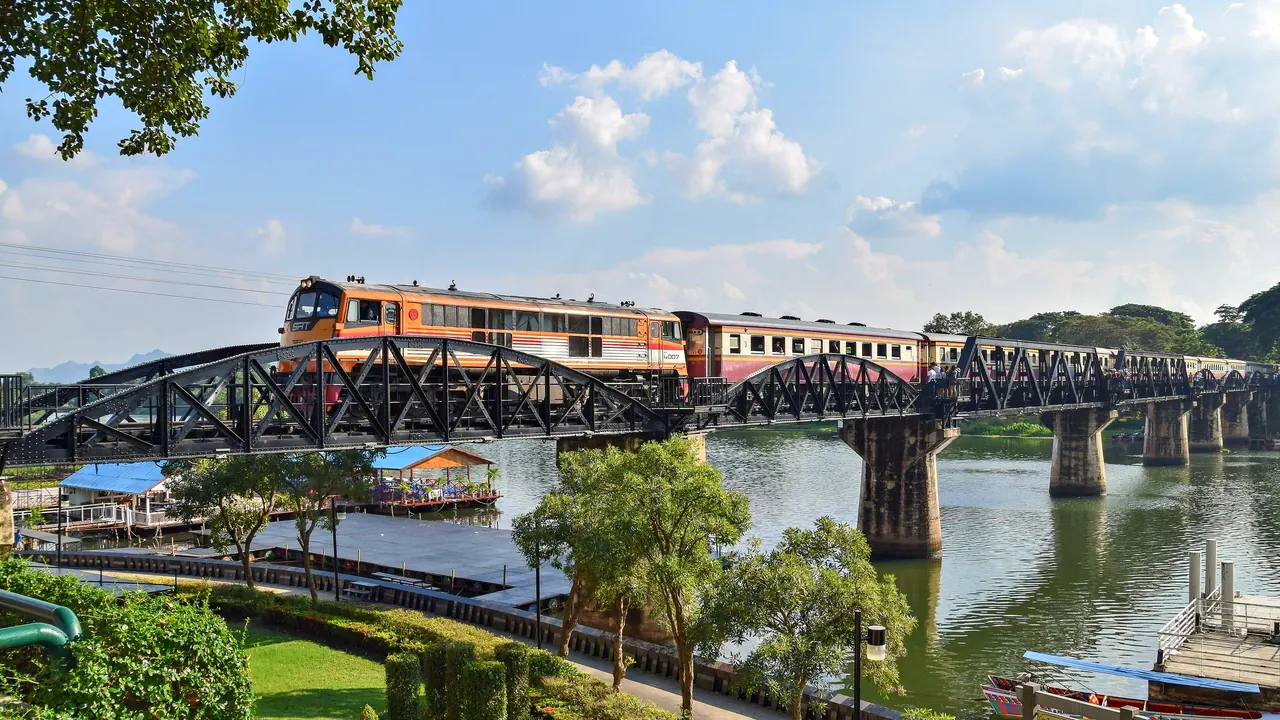
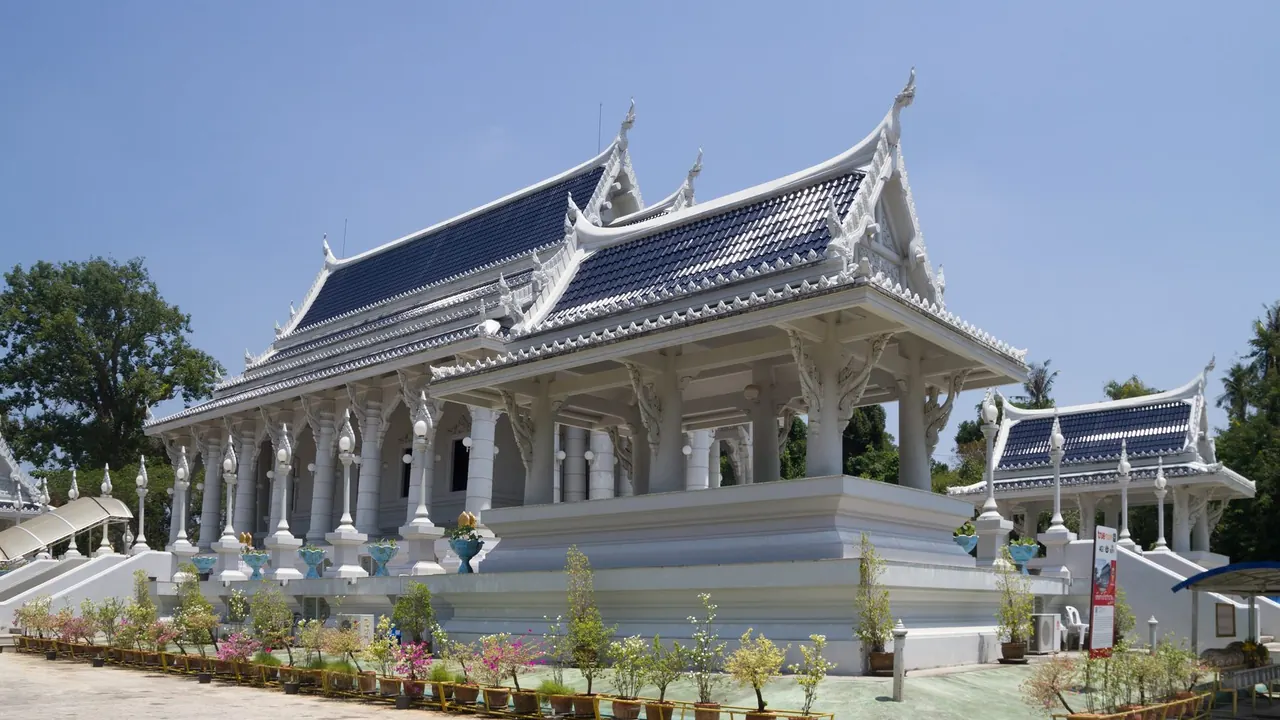
Photos: Kanchanaburi by Krzysztof Golik, CC BY-SA 4.0, cropped; Krabi by Maksym Kozlenko, CC BY-SA 4.0, cropped.
Kanchanaburi or Krabi?
Our verdict in twelve categories, each scored against the same fixed benchmark cities, and the climate month by month, so you can choose for your trip.
Choose Kanchanaburi for
- culture and sights
- day trips
- prices
Kanchanaburi is the better pick for travellers who want a quiet, inexpensive base with a story behind it. The wartime railway, the war cemeteries and the museums make a day of sightseeing with real meaning, and Erawan's waterfalls and the slow river fill the rest of the stay. It works best as a few days' detour inland rather than as a week of lying in the sun.
Choose Krabi for
- beaches
- wellness
- nature and the outdoors
Choose Krabi if the trip is about water and scenery. Limestone cliffs above white sand at Railay and Phra Nang, island hopping, kayaking through mangroves and spas with sea views make it the stronger choice for a beach vacation, for families who want warm, shallow water, and for anyone who simply wants to rest. It costs a little more and offers very little history.
Scoreboard
Twelve categories on one fixed scale from 0 to 100. The shaded stretch is the gap between the two.
Your match
Pick a travel style or drag the sliders, and both match scores follow your weighting.
Wins on culture and sights and day trips with your weighting.
Wins on beaches and wellness with your weighting.
What matters to you?
Category by category
What the scores mean for a trip.
Beaches & swimming
There is no real contest here. Kanchanaburi is an inland river town more than three hours from the Gulf coast, and its swimming means the turquoise tiers of Erawan and lazy floats off a raft house on the Kwai.
Krabi is built around its sand: Railay West and Phra Nang under their limestone walls, the quieter Klong Muang and Tubkaek, and island coves a short longtail ride away, with calm, clear water through the dry season. If both towns are on one itinerary, save the beach days for Krabi.
Food & drink
Both serve honest, cheap Thai food without fine dining, but Krabi's cooking has more character. Kanchanaburi offers central Thai provincial fare: noodle soups at shophouse counters, the night market by the station, and river fish such as snakehead eaten on floating restaurants at sunset.
Krabi brings the southern Thai kitchen, which is hotter and shaped by the region's Muslim communities, with turmeric fish soups, khao mok gai and roti, plus fresh prawns and fish grilled by the shore. For the best of it, eat in Krabi Town rather than on Ao Nang's tourist strip.
Culture & sights
Kanchanaburi has the weightier sightseeing, even though it tells a single story. The bridge, the rows of graves at the War Cemetery and Chung Kai, the Thailand-Burma Railway Centre and the JEATH museum bring the wartime railway to life, and there are a few cave temples on the edge of town.
Krabi has nothing comparable: the Tiger Cave Temple with its hilltop Buddha, a riverside promenade and some Chinese shophouses in Krabi Town, and the prehistoric caves of Khao Khanab Nam. It is a place for landscape, not history.
Nightlife
Neither is a place for a big night out, and both are quiet by midnight. Kanchanaburi's evenings mean a short strip of backpacker bars with pool tables and cover bands, plus karaoke rafts drifting down the river at weekends.
Krabi has a little more going on: Ao Nang's beach-road bars and a late alley with the odd dancefloor, and Railay's reggae beach bars with fire-spinning on the sand. Anyone wanting a proper party takes the ferry to Phi Phi.
Nature & outdoors
Both make fine bases for the outdoors, but Krabi's scenery is more dramatic and more varied. Kanchanaburi offers jungle and river: Erawan's seven tiers of waterfalls, Sai Yok's caves, kayaking on the dam reservoirs and cycling through paddy fields, all at their greenest after the rains.
Krabi adds the sea to the limestone. The sheer towers above Railay and Tonsai draw climbers from around the world, sea kayaking through Ao Thalane's mangroves and around the Hong islands is superb, and diving and snorkelling sit alongside inland outings to the Emerald Pool and the Dragon Crest hike.
Day trips
Kanchanaburi has more worthwhile places within a day's reach. The slow train along the cliffs to Nam Tok, Hellfire Pass with its memorial, the Khmer temple at Prasat Muang Singh, the great chedi at Nakhon Pathom and the canal markets at Amphawa all make easy outings, and Bangkok is possible in a long day.
From Krabi, most excursions are boat trips taken for the scenery itself. Phi Phi Don, Koh Lanta's stilted Old Town and the fishing villages of Koh Yao Noi are the main places to visit, Phuket's Old Town is a long day away, and there is no major heritage site nearby.
Good for families
Krabi is the easier choice with children, because the days organise themselves around the sea. The shallow, warm water at Klong Muang and Phra Nang and the resort pools and kids' clubs north of Ao Nang make a dry-season stay simple, though unsheltered longtails and strong sun need care.
Kanchanaburi has good moments for children: the Erawan pools, the train over wooden trestles, a night in a raft house and the safari park. But the town's main sights are cemeteries and museums, and nearly every outing involves a minivan.
Getting around
Both are awkward without your own wheels, in different ways. Kanchanaburi strings its guesthouses, bridge and cemeteries along several kilometres of river, so bicycles and songthaews handle the short hops. Scooters, drivers or tours cover Erawan and Sai Yok, with a slow train and sparse buses as the public option.
Krabi has the walkable Ao Nang strip and white songthaews to Krabi Town, but Railay can only be reached by longtail, which stops running in heavy seas, and the islands depend on boats and tour pick-ups.
Shopping & style
Neither is worth the journey for shopping. Kanchanaburi's one distinctive buy is blue sapphire from the province's old mines, sold in a few gem shops where some knowledge helps, alongside its night market and the souvenir stalls by the bridge. Krabi has Ao Nang's beachwear stalls and tailors, and the more local weekend walking-street market in Krabi Town.
Affordability
Kanchanaburi stretches a budget further, mainly because the cheap rooms are where travellers want to be anyway, by the river and close to the bridge and cemeteries. The spending that does add up is largely optional: foreigner fees at Erawan and the other parks, a private driver for the day, or a night at one of the comfortable resorts upstream.
In Krabi, prices rise as you get closer to the sea. Krabi Town is as cheap as anywhere in Kanchanaburi, but most visitors stay by the beaches, where Ao Nang costs more and Railay, supplied entirely by boat, costs the most. Island tours, park fees and imported drinks then add a steady extra to almost every beach day.
Live music & performing arts
Kanchanaburi's live entertainment comes almost entirely in one burst each year, while Krabi has small shows every evening. River Kwai Bridge Week, usually held from late November into early December, restages the wartime bombing of the bridge with a sound-and-light show, fireworks and a fair along the riverbank, and is worth planning a visit around if your dates allow.
Krabi has fire-spinning on the sand at Railay and Ao Nang and Muay Thai bouts staged for visitors near Ao Nang. Apart from that, music in both towns means cover bands in the bars, and neither has a theatre or concert hall.
Wellness & relaxation
Krabi offers more for a restful stay. The resort spas on Klong Muang, Tubkaek and Railay often have open-air pavilions facing the sea, yoga classes and retreats are easy to find, and the Hot Springs Waterfall at Khlong Thom runs warm water over limestone into pools in the forest.
Relaxing in Kanchanaburi is simpler and quieter: a hammock on a raft house over the upper Kwai, cheap Thai massage in town and a few resort spas. The small hot springs at Hin Dat are a two-hour drive north.
When should you go?
Pick your month. The climate figures are measured averages, not a forecast.
Kanchanaburi in July
Krabi in July
Daytime high, °C
Rainfall in the month, mm
Where the figures come from
Krabi's temperatures are measured 67 km from the centre, at Phuket Airport.
Krabi has no rain gauge within 25 km of the centre, so its rainfall comes from a gridded climate dataset read at the city rather than from a gauge further away.
Temperature and rainfall are climate normals, averaged over the years shown. Kanchanaburi: 1961-1990 (rainfall 1981-2010) normals, Kanchanaburi (0.4 km from centre). Krabi: 1991-2020 (sunshine 1961-1990) normals, Phuket Airport (66.6 km from centre).
Kanchanaburi is at its best from November to February, when the rains have passed, the countryside is still green and January sees barely 1mm of rain. March and April are the hard months: highs reach 38°C, walking between the bridge and the cemeteries becomes a chore and the waterfalls run thin. The monsoon builds from May and peaks in September and October, bringing heavy downpours but full waterfalls.
Krabi stays hot but steady all year, and the Andaman Sea is warm enough to swim in every month, at around 29°C. The beach season runs from December to April, and January to March is the sunniest and driest stretch. From May the southwest monsoon brings cloud and rough seas, and October is the wettest month at about 321mm, so boat trips become hit and miss. Both towns share their best dry-season window from December to February, which makes that the time to combine them.
Which traveller are you?
On a culture and arts trip, Kanchanaburi is the clear choice. The Bridge over the River Kwai, the war cemeteries and the Thailand-Burma Railway Centre make a moving day, and Hellfire Pass extends it. In Krabi the sightseeing barely goes beyond the Tiger Cave Temple's long climb.
For a beach and sun trip, Krabi wins without contest. Railay West and Phra Nang lie beneath limestone cliffs, island hops reach Poda and the Hong islands, and the sea stays warm all year. Kanchanaburi is hours from any coast and has only river and waterfall swimming.
On a tight budget, Kanchanaburi makes your money go further. Raft rooms and guesthouses cost very little, the local train and buses are almost free and the night market feeds you cheaply. Krabi Town is just as cheap, but Ao Nang, Railay and daily longtail fares soon add up.
Before you go
| Measure | Kanchanaburi | Krabi |
|---|---|---|
| Official language | Thai | Thai |
| Currency | Baht (THB) | Baht (THB) |
| Sockets | ABCF220 V, 50 Hz | ABCF220 V, 50 Hz |
| Driving side | Left | Left |
| Time zone | UTC+7 | UTC+7 |
| Emergency number | Police 191, ambulance 1669, fire 199 | Police 191, ambulance 1669, fire 199 |
| Elevation | 30 m | 16 m |
| Main airport | Suvarnabhumi Airport (BKK)137 km from centre150 non-stop destinations | Krabi International Airport (KBV)9 km from centre14 non-stop destinations |
By the numbers
| Measure | Kanchanaburi | Krabi |
|---|---|---|
| City population | 25,651 | 30,499 |
| Museums within 10 km | 2 | 0 |
| UNESCO World Heritage sites within 50 km | 0 | 0 |
| Swim season, months above 21 °C | - | 12 months |
Where else could you go?
Every comparison below shares a destination with this one, so you can follow Kanchanaburi or Krabi somewhere new.
- Phuketvs Krabi
- Bangkokvs Kanchanaburi
- Ayutthayavs Kanchanaburi
- Hua Hinvs Kanchanaburi
- Pattayavs Kanchanaburi
- Penangvs Krabi