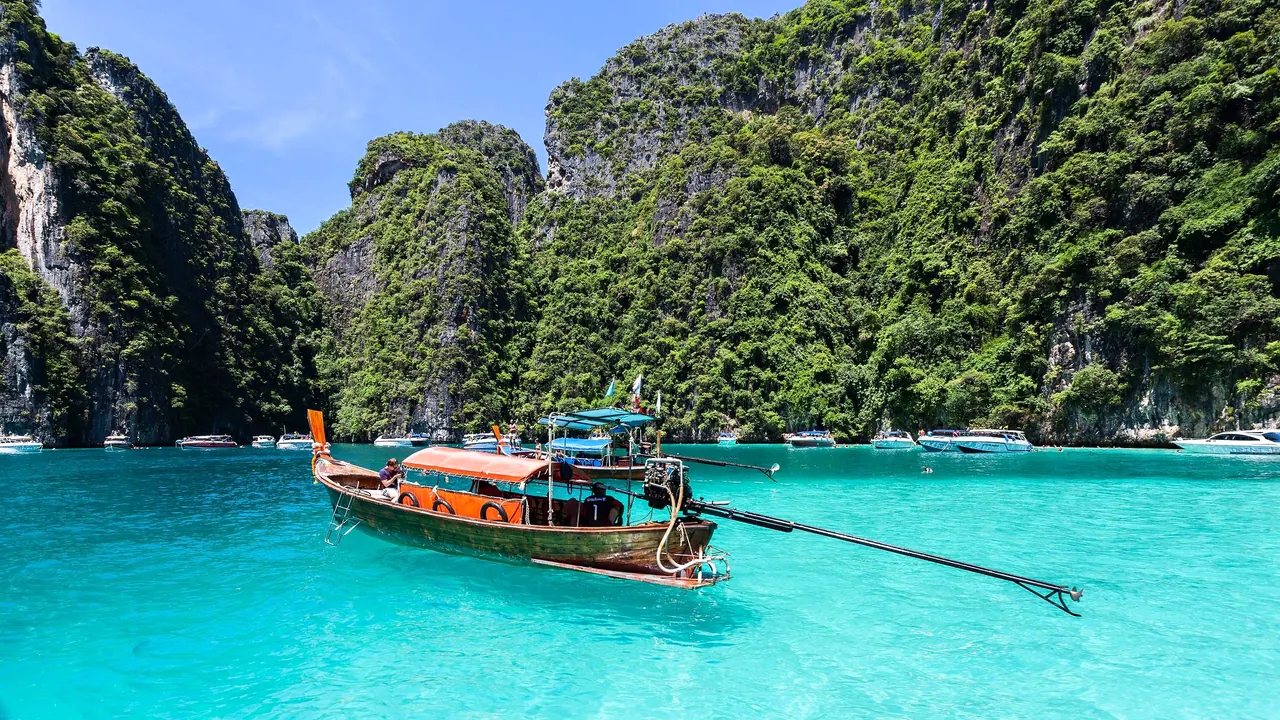
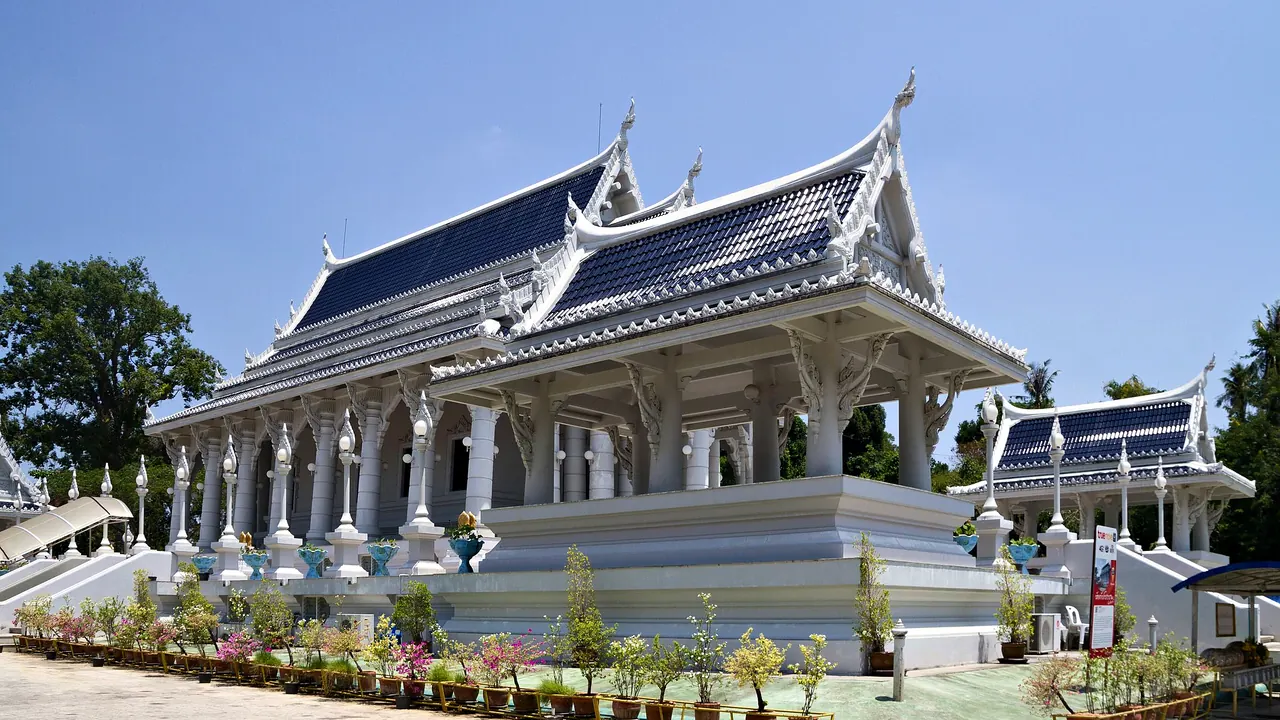
Photos: Koh Phi Phi by Diego Delso, CC BY-SA 3.0, cropped; Krabi by Maksym Kozlenko, CC BY-SA 4.0, cropped.
Koh Phi Phi or Krabi?
Our verdict in twelve categories, each scored against the same fixed benchmark cities, and the climate month by month, so you can choose for your trip.
Choose Koh Phi Phi for
- nightlife
- getting around
- beaches
Koh Phi Phi suits travellers who want to wake up on a small car-free island with the limestone cliffs and turquoise water right outside. It is the better pick for a few days of beach by day and parties by night on Loh Dalum, or, for a quieter stay, a resort at Laem Tong in the north. In return you pay more, eat more simply and see little beyond the sea, and the island has given most of what it offers within a few days.
Choose Krabi for
- prices
- wellness
- food and drink
Krabi makes more sense as a base for a longer or more varied stay. From Ao Nang or Railay you get beaches just as good, world-class climbing and mangrove kayaking, proper southern Thai cooking in Krabi Town, family resorts, hot springs and far easier budgets. Phi Phi itself is a ferry ride away for a day or a night. What you give up is that island feeling and the late beach parties.
Scoreboard
Twelve categories on one fixed scale from 0 to 100. The shaded stretch is the gap between the two.
Your match
Pick a travel style or drag the sliders, and both match scores follow your weighting.
Wins on nightlife and getting around with your weighting.
Wins on prices and wellness with your weighting.
What matters to you?
Category by category
What the scores mean for a trip.
Beaches & swimming
The beaches are about equally good, with the same warm Andaman water and the same limestone backdrop. The difference is in how you reach them. On Phi Phi the best swimming is on the island itself, a walk or short longtail ride to Long Beach or a stay at Laem Tong. Loh Dalum, by the village, is shallow at low tide, and Maya Bay is more for looking at than for swimming.
From Krabi the showpiece sand at Railay West and Phra Nang is a boat ride from Ao Nang, whose own beach is plain. Klong Muang and Tubkaek offer quieter resort stretches, and island hops reach Poda, Chicken Island, the Hong islands and Phi Phi too.
Food & drink
Krabi is clearly the better place to eat. Its cooking is properly southern Thai, with fiery curries, turmeric fish soups and khao mok gai shaped by the region's Muslim communities, and Krabi Town's walking-street market and riverside stalls cook for locals rather than tour groups.
Phi Phi eats from the backpacker menus of Tonsai village, where the food is toned down for visitors and every ingredient comes by boat. Its best moments are simple: a banana roti from a cart or fish grilled on the beach at night.
Culture & sights
Neither is a place for sightseeing, but Krabi at least has something to set out for. The Tiger Cave Temple's long climb to a hilltop Buddha is a real outing, and Krabi Town adds Chinese shophouses, the riverside and the twin peaks of Khao Khanab Nam. On Phi Phi the list ends with a small tsunami memorial and a passing look at Viking Cave from a boat.
Nightlife
Phi Phi is the party island of the two, and Krabi's own visitors know it: the ones after a big night take the ferry across. On Loh Dalum the bars lay out mats, put on fire dancing and play loud dance music until the early hours, and some village bars stage amateur Muay Thai bouts. The crowd is young and the scene is uniform.
Krabi's evenings are cocktails and sports screens along Ao Nang's beach road, or hammocks and reggae in Railay's beach bars. There are no real clubs, and most places are winding down by midnight.
Nature & outdoors
Both are built on the same dramatic karst, but Krabi has more of it to use. Railay and Tonsai rank among the world's best-known sport-climbing spots, kayakers paddle the mangroves of Ao Thalane and around the Hong islands, Phang Nga Bay is within reach, and inland there is rainforest at the Emerald Pool and the Dragon Crest hike.
Phi Phi's strength is concentrated and mostly under water: the soft-coral walls of Bida Nok and Bida Nai, blacktip reef sharks at Shark Point, kayaking into Pileh Lagoon and the sunset viewpoint above the isthmus. Divers have it on their doorstep, but the island is small and has shown you most of it within a few days.
Day trips
Krabi is the better base for getting out. Koh Lanta's Old Town, the fishing villages of Koh Yao Noi and Phi Phi itself are all by boat, and Phuket's Old Town is a long day by road or ferry. Inland, though, there is little heritage to add.
From Phi Phi every outing beyond the boat tours to empty islands means a ferry, about an hour to Lanta, longer to Railay and a draining two hours each way to Phuket. Such places are better planned as separate stops on the route than as day trips.
Good for families
Krabi works better with children. The resorts north of Ao Nang have pools and kids' clubs, the water at Klong Muang and Phra Nang is shallow and warm in the dry season, and days can mix the beach with gentle boat trips or the Emerald Pool, though nothing is built specially for children.
Phi Phi can suit a family that stays put at Laem Tong, where the water is calm and the absence of cars helps. The village is loud until late, the paths to the outer beaches are steep and unlit, medical care is basic and the ferry can be rough.
Getting around
Phi Phi is the simpler place to move about, at least around the village, since there are no cars and Tonsai and Loh Dalum are a few minutes apart on foot. Beyond that it is longtail boats or rough hill paths, and reaching the island at all takes up to two hours by ferry.
Krabi is spread out and informal. Songthaew pickups link Ao Nang, the northern beaches and Krabi Town, which is about 30 minutes away. Further trips mean taxis, ride-hailing or a hired scooter, and Railay can only be reached by boat. Patchy pavements and heat make walking hard work.
Shopping & style
Neither is worth a shopping trip, but Krabi has a little more texture. Krabi Town's weekend walking-street market sells local snacks, clothes and handmade pieces, there are small craft shops and tailors in Ao Nang, and plain malls cover anything you forgot. Phi Phi's lanes stop at sarongs, sunscreen, snorkel gear and souvenir T-shirts, so it pays to arrive with what you need.
Affordability
Krabi is much kinder to the wallet. Krabi Town runs at local prices for rooms and market meals, and Ao Nang still has plenty of affordable guesthouses and Thai restaurants among its resorts. Only boat-bound Railay comes close to island prices.
On Phi Phi everything is shipped in and space is tight, so rooms, drinks and longtail rides all cost more, and there is an island entry fee on top of the marine park charge. Dormitories and roti carts keep a backpacker going, but it never feels like ordinary Thai pricing.
Live music & performing arts
Both are close to empty for live arts, and the little there is takes a similar form, with fire shows on the sand and cover bands in bars. Krabi adds Muay Thai fights staged for visitors at a small stadium near Ao Nang, which is a step up from the bouts Phi Phi's bars put on as part of a night out.
Wellness & relaxation
For a restful trip Krabi has more range. Resort spas along Klong Muang, Tubkaek and Railay have open-air pavilions facing the sea, yoga classes and small retreats are easy to find, and the warm mineral pools of the Hot Springs Waterfall at Khlong Thom are about an hour's drive away.
Phi Phi offers massage on beach mats and spas at the northern resorts, but peace depends on your address. Laem Tong and the eastern bays are slow and quiet, while near Tonsai the music carries late into the night.
When should you go?
Pick your month. The climate figures are measured averages, not a forecast.
Koh Phi Phi in July
Krabi in July
Daytime high, °C
Rainfall in the month, mm
Where the figures come from
Koh Phi Phi's temperatures are measured 65 km from the centre, at Phuket Airport.
Koh Phi Phi has no rain gauge within 25 km of the centre, so its rainfall comes from a gridded climate dataset read at the destination rather than from a gauge further away.
Krabi's temperatures are measured 67 km from the centre, at Phuket Airport.
Krabi has no rain gauge within 25 km of the centre, so its rainfall comes from a gridded climate dataset read at the destination rather than from a gauge further away.
Temperature and rainfall are climate normals, averaged over the years shown. Koh Phi Phi: 1991-2020 (sunshine 1961-1990) normals, Phuket Airport (65.2 km from centre). Krabi: 1991-2020 (sunshine 1961-1990) normals, Phuket Airport (66.6 km from centre).
The two share one climate, since Phi Phi lies just off the Krabi coast. The best months in both are December to March, when rainfall drops to around 40mm in February, sunshine is at its strongest and the sea is calm and clear. Daytime heat stays in the low 30s all year, peaking around 34°C in March, so walking around at midday is tiring in any season, and the sea stays warm enough to swim every month. Rain builds from April and peaks in October at over 300mm, with the cloudiest skies around September.
The difference shows in the wet months. On Phi Phi the southwest monsoon affects everything, because every arrival, departure and outing goes by boat and some crossings and tours are cancelled in heavy swell. From Krabi, a rough-sea day can still go to the Emerald Pool, the Tiger Cave Temple or the hot springs inland.
Which traveller are you?
For a food and nightlife trip where the night matters most, Koh Phi Phi is the choice: fire shows, dance music and buckets on Loh Dalum go on until the early hours. Krabi eats better but is mostly quiet by midnight.
On a family trip with children, Krabi is the safer bet. Resorts north of Ao Nang have pools and kids' clubs, the shallow water at Klong Muang suits small children, and there is real medical care nearby, unlike Phi Phi's noisy village and rough crossings.
On a tight budget, Krabi stretches the money much further. Krabi Town's guesthouses and market meals cost far less than anything on Phi Phi, where everything arrives by boat, there is an island entry fee and dormitories are the only real economy.
Before you go
| Measure | Koh Phi Phi | Krabi |
|---|---|---|
| Official language | Thai | Thai |
| Currency | Baht (THB) | Baht (THB) |
| Sockets | ABCF220 V, 50 Hz | ABCF220 V, 50 Hz |
| Driving side | Left | Left |
| Time zone | UTC+7 | UTC+7 |
| Emergency number | Police 191, ambulance 1669, fire 199 | Police 191, ambulance 1669, fire 199 |
| Elevation | - | 16 m |
| Main airport | Krabi International Airport (KBV)14 non-stop destinations | Krabi International Airport (KBV)9 km from centre14 non-stop destinations |
By the numbers
| Measure | Koh Phi Phi | Krabi |
|---|---|---|
| Population | - | 30,499 |
| Museums within 10 km | - | 0 |
| UNESCO World Heritage sites within 50 km | - | 0 |
| Swim season, months above 21 °C | 12 months | 12 months |
Where else could you go?
Every comparison below shares a destination with this one, so you can follow Koh Phi Phi or Krabi somewhere new.
- Koh Lantavs Koh Phi Phi
- Phuketvs Koh Phi Phi
- Koh Lantavs Krabi
- Phuketvs Krabi
- Koh Lipevs Koh Phi Phi
- Langkawivs Koh Phi Phi