Photos: Kanchanaburi by Krzysztof Golik, CC BY-SA 4.0, cropped; Pai by Christophe95, CC BY-SA 4.0, cropped.
Kanchanaburi or Pai?
Our verdict in twelve categories, each scored against the same fixed benchmark cities, and the climate month by month, so you can choose for your trip.
Choose Kanchanaburi for
- day trips
- culture and sights
- families
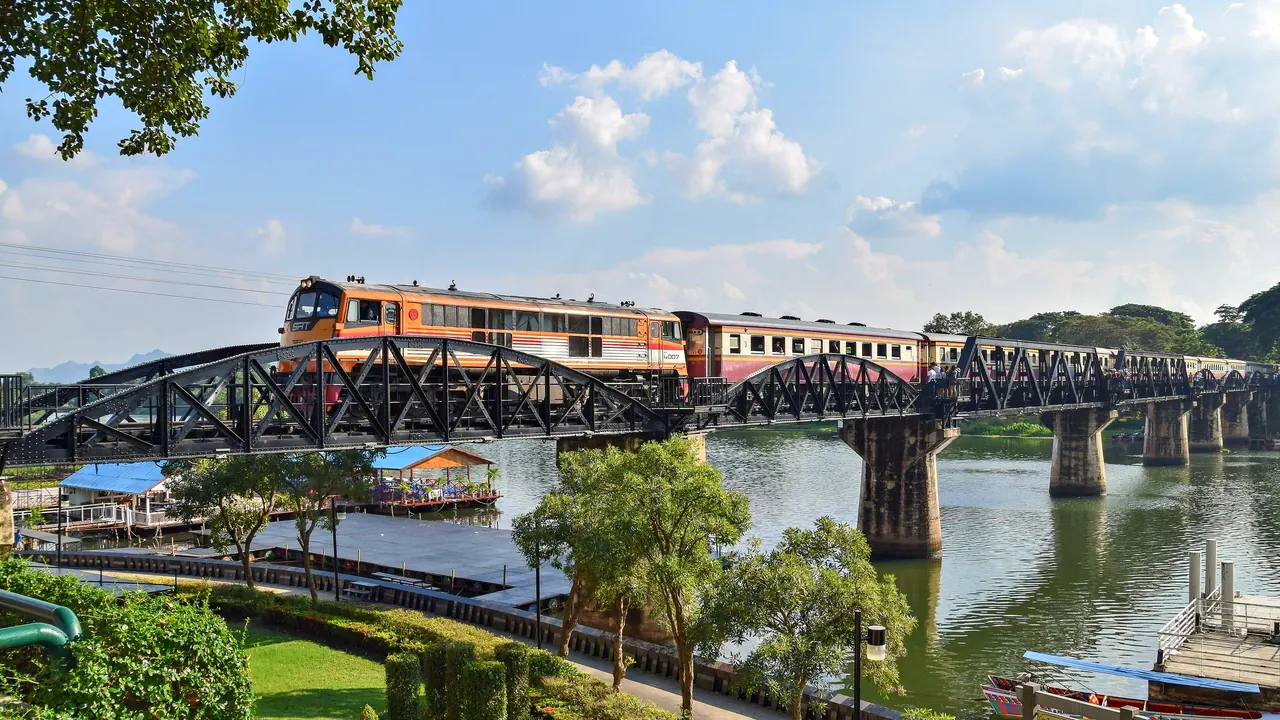
Kanchanaburi suits travellers who want the trip to carry some weight as well as scenery. The story of the Death Railway, told through the bridge, the war cemeteries and Hellfire Pass, gives it a depth Pai can't match. Its place on the western edge of the central plains also opens up many more outings, from Khmer ruins to canal markets. Families will find it the easier base too, with the slow train, the Erawan pools and the raft houses.
Choose Pai for
- wellness
- live music and the arts
- nightlife
Pai is for people who want to stop moving for a while. Hot springs, yoga retreats and long afternoons over the rice fields make it the better place to unwind, and its evenings are livelier, with live music coming out of the bars around the walking street. It expects you to be confident on a scooter and has little to see beyond the valley, so it rewards a slow stay more than a sightseeing list.
Scoreboard
Twelve categories on one fixed scale from 0 to 100. The shaded stretch is the gap between the two.
Your match
Pick a travel style or drag the sliders, and both match scores follow your weighting.
Wins on day trips and culture and sights with your weighting.
Wins on wellness and live music and the arts with your weighting.
What matters to you?
Category by category
What the scores mean for a trip.
Beaches & swimming
Neither town is a beach destination, and in both the swimming is in fresh water. Kanchanaburi's is the more memorable: the turquoise tiered pools at Erawan, where small fish nibble your feet, and lazy floats off a raft house on the River Kwai.
Pai has river splashing, a dip under Mo Paeng waterfall, inner-tube floats in the hot season and small pools at guesthouses. The sea is also nearer to Kanchanaburi, a few hours to the Gulf coast compared with a long day's travel from Pai.
Food & drink
Both towns eat cheaply and well without reaching any great heights. Kanchanaburi stays closer to everyday Thai life, with shophouse noodles, the night market by the railway station, and river fish such as snakehead eaten at sunset on the floating restaurants.
Pai's food leans towards the visitors who stay for weeks. There is khao soi and Shan cooking on the walking street, vegan plates, wood-fired pizza and good espresso in the small cafés, and Yunnanese noodles and tea in Santichon. Choose Kanchanaburi for local flavour and Pai for variety and a decent breakfast.
Culture & sights
Here Kanchanaburi is far ahead. Its sights tell one powerful story, the building of the Death Railway. You can walk across the bridge, see the rows of Allied graves at the War Cemetery and at Chung Kai across the river, and learn how the line was built at the Railway Centre and the JEATH museum.
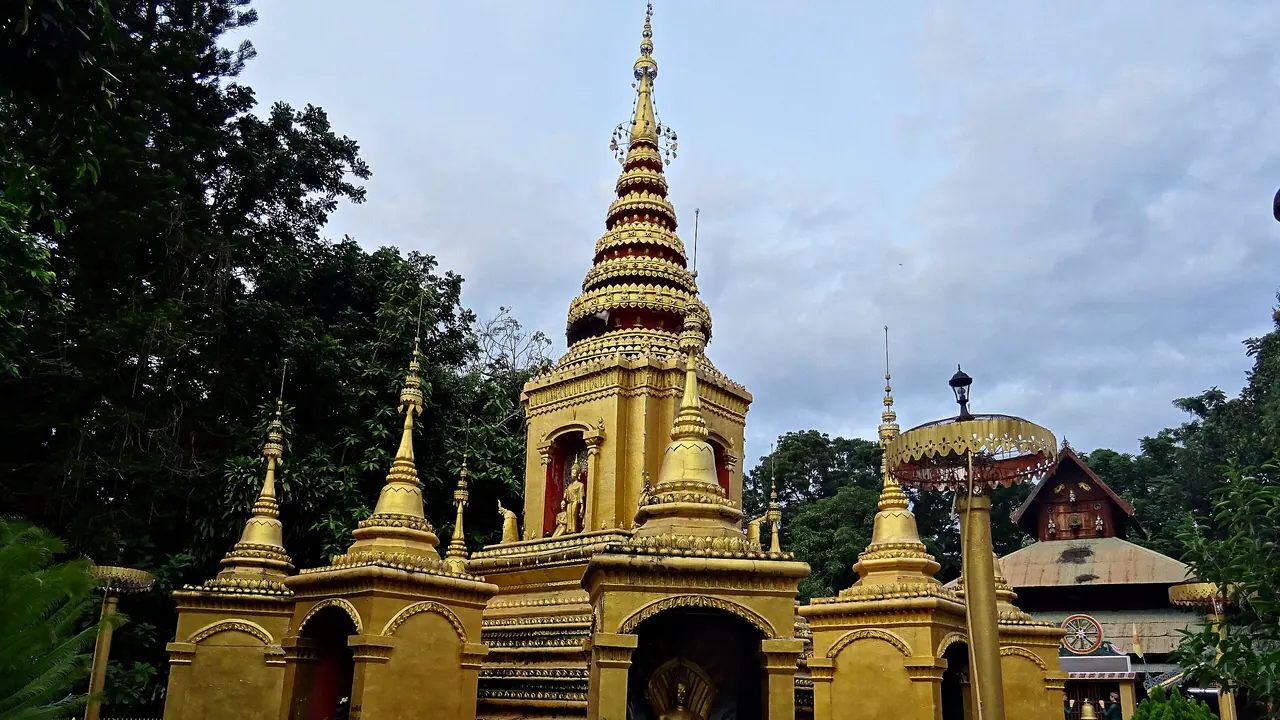
Pai has nothing to compare. The white Buddha at Wat Phra That Mae Yen, a few Shan-style temples, the old wartime iron bridge and the mud-brick houses of Santichon fill half a day. People come for the valley, not for the sights.
Nightlife
Pai has the livelier evenings. Once the walking-street market winds down, the reggae bars and the bamboo garden bars strung with fairy lights fill with young travellers, and now and then a party carries on outside town. The centre still quietens around midnight.
Kanchanaburi's riverside strip is quieter: cheap beer, pool tables and a cover band, and at weekends the noisiest thing is the karaoke rafts drifting past. Neither town has a club worth seeking out.
Nature & outdoors
Both are strong for the outdoors, but the landscapes are different. Kanchanaburi is jungle and river at the edge of the protected limestone hills along the border. You can climb past Erawan's seven tiers of waterfalls, explore the caves at Sai Yok and kayak on the reservoirs behind the dams.
Pai is a mountain valley you explore by scooter: the eroded ridges of Pai Canyon at sunset, morning mist in the rice fields seen from Yun Lai, hill-tribe treks and the river cave at Tham Lod. Pai has more varied ground to look at, and Kanchanaburi has more water to be out on.
Day trips
Kanchanaburi wins easily. The old railway runs north along cliffs to Nam Tok, with Hellfire Pass and its memorial trail further on, and the Khmer temple at Prasat Muang Singh makes a quiet half day. To the east, the giant chedi at Nakhon Pathom and the canal markets at Damnoen Saduak and Amphawa are within two hours.
Pai is remote by comparison. Apart from the Lahu and Lisu villages around Soppong, the nearest towns are hours away on roads full of bends, so most people move on to them rather than go and come back in a day.
Good for families
Kanchanaburi gives children more to do. They can ride the slow train over wooden trestles, swim in the Erawan pools, sleep in a raft house over the river and see the safari park, even if the war museums will bore younger ones.
Pai works best for older children who like the outdoors, with waterfalls, hot springs, elephant-free farm visits and the night market. Against it are the winding road from Chiang Mai, which is known for making passengers sick, the need for scooters and evenings aimed at backpackers.
Getting around
Neither town is easy without your own wheels, but Kanchanaburi gives you more choice. A bicycle or a songthaew covers the town, which stretches along the river, and the slow train and local buses reach the railway line, Erawan and Sai Yok, though slowly.
Pai's centre is a few streets you can walk, but there is no public transport beyond it. The canyon, the waterfalls and the hot springs all mean a scooter, a hired songthaew or a tour, and the hill roads catch out many inexperienced riders.
Shopping & style
Kanchanaburi offers little beyond the everyday: its night market, a daytime market in the centre, souvenir stalls by the bridge and a modest mall for basics. The one thing it has that Pai lacks is its gem shops, which sell blue sapphires from the province's old mines. Buying well there takes real knowledge.
Pai's evening walking street is the better place to browse, with hill-tribe textiles, woven bags, loose cotton trousers, handmade jewellery and small art prints, much of it made locally. The stalls soon start to repeat one another and there are no proper shops, so in either town anything more serious has to wait for Chiang Mai or Bangkok.
Affordability
Both are among the cheapest places to stay in Thailand, with low-cost guesthouses, cheap market meals and inexpensive massages. Kanchanaburi's local train and buses cost almost nothing, while in Pai scooter rental is what keeps getting around cheap.
The extra costs are different. In Kanchanaburi they come from the separate foreigner fees at national parks, private drivers and tours. In Pai, prices in the tourist centre are higher than in ordinary northern towns and climb in high season.
Live music & performing arts
Pai is the place for music. Most nights several bars host acoustic sets and blues, reggae or jazz jams by local and travelling musicians. The quality is uneven, but these sessions are part of the town's easy-going character.
Kanchanaburi has no regular scene beyond cover bands. Its one big occasion is River Kwai Bridge Week, usually from late November into early December, when a sound-and-light show with fireworks restages the wartime bombing of the bridge.
Wellness & relaxation
Pai is the better place to unwind. You can soak in the Tha Pai hot springs in their forest park or in simpler pools up in the hills on a cool morning, and yoga, meditation and detox retreats run on the edge of town.
In Kanchanaburi, the rest comes mainly from the pace: hammocks on raft houses over the upper River Kwai and spas at the larger resorts. Its only hot springs, the small ones at Hin Dat, are about two hours north.
When should you go?
Pick your month. The climate figures are measured averages, not a forecast.
Kanchanaburi in July
Pai in July
Daytime high, °C
Rainfall in the month, mm
Where the figures come from
Pai's temperatures are measured 64 km from the centre, at Mae Hong Son.
Pai's station stands 242 m below the city centre, so the centre is likely a little cooler than the figures say.
Pai has no rain gauge within 25 km of the centre, so its rainfall comes from a gridded climate dataset read at the city rather than from a gauge further away.
Pai's sunshine is measured 86 km from the centre, at Chiang Mai.
Temperature and rainfall are climate normals, averaged over the years shown. Kanchanaburi: 1961-1990 (rainfall 1981-2010) normals, Kanchanaburi (0.4 km from centre). Pai: 1971-2000 (sunshine 1991-2020, rainfall 1991-2020) normals, Mae Hong Son (63.7 km from centre).
The two towns follow the same broad pattern. There is a dry spell around the turn of the year, then a hot season in March and April when afternoons reach 38°C and walking anywhere is hard work, and then the monsoon. The timing of the rain is what differs. Pai's rains start earlier and peak in July and August at around 230mm, then ease by October. Kanchanaburi's heaviest rain comes later, with September and October both above 200mm.
In Kanchanaburi, December and January are the safest choice: almost no rain, warm rather than scorching, and the countryside still green after the wet season. Pai is at its best from November to February. December highs fall to about 29°C, valley mornings are cool and the sunshine is reliable. Avoid Pai in March and April, when smoke from field burning hides the hills.
Which traveller are you?
On a culture and arts trip, Kanchanaburi is the clear choice. The bridge, the Allied war cemeteries, the Thailand-Burma Railway Centre and Hellfire Pass tell one coherent and sobering history. Pai's hilltop Buddha and a few temples fill half a day at most.
For a relaxing and wellness trip, Pai is the better pick. It has warm mineral springs in the valley, massage shops on every street and retreats that run from a day to several weeks, all suited to a long, slow stay. Kanchanaburi's calm comes mostly from its riverside raft houses.
On a family trip with children, Kanchanaburi is easier going. The slow train over wooden trestles, the fish-filled pools at Erawan and the safari park keep children busy. Pai's sick-making mountain road, the need for scooters and its backpacker evenings make it best for older children.
Before you go
| Measure | Kanchanaburi | Pai |
|---|---|---|
| Official language | Thai | Thai |
| Currency | Baht (THB) | Baht (THB) |
| Sockets | ABCF220 V, 50 Hz | ABCF220 V, 50 Hz |
| Driving side | Left | Left |
| Time zone | UTC+7 | UTC+7 |
| Emergency number | Police 191, ambulance 1669, fire 199 | Police 191, ambulance 1669, fire 199 |
| Elevation | 30 m | 509 m |
| Main airport | Suvarnabhumi Airport (BKK)137 km from centre150 non-stop destinations | Chiang Mai International Airport (CNX)86 km from centre28 non-stop destinations |
By the numbers
| Measure | Kanchanaburi | Pai |
|---|---|---|
| City population | 25,651 | 3,598 |
| Museums within 10 km | 2 | 0 |
| UNESCO World Heritage sites within 50 km | 0 | 0 |
Where else could you go?
Every comparison below shares a destination with this one, so you can follow Kanchanaburi or Pai somewhere new.
- Chiang Maivs Pai
- Bangkokvs Kanchanaburi
- Ayutthayavs Kanchanaburi
- Chiang Raivs Pai
- Hua Hinvs Kanchanaburi
- Pattayavs Kanchanaburi