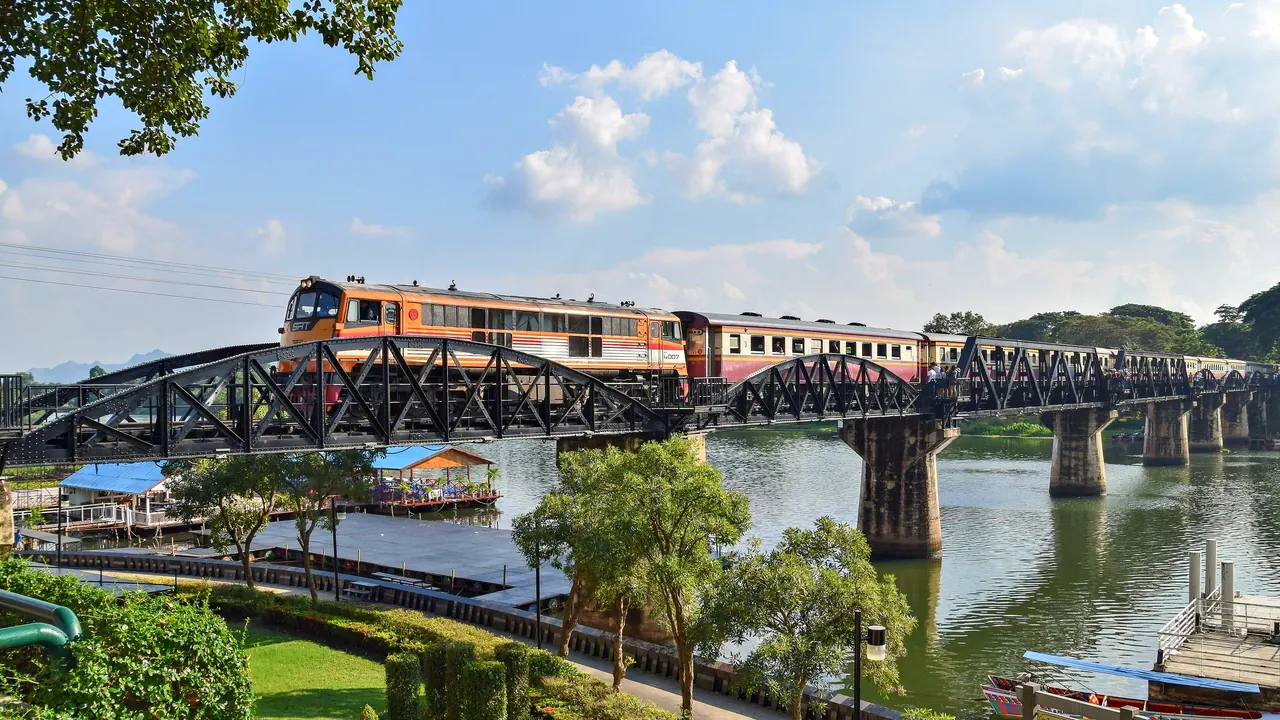
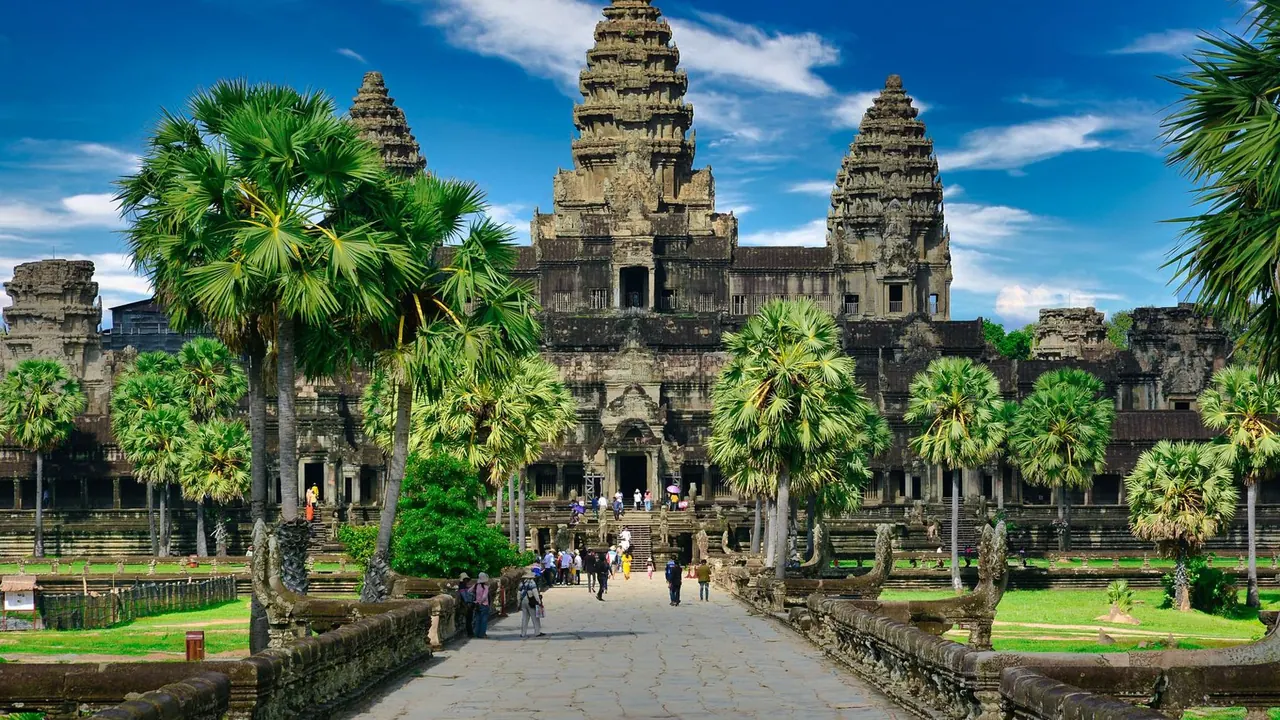
Photos: Kanchanaburi by Krzysztof Golik, CC BY-SA 4.0, cropped; Siem Reap by allPhoto Bangkok, Pexels License.
Kanchanaburi or Siem Reap?
Our verdict in twelve categories, each scored against the same fixed benchmark cities, and the climate month by month, so you can choose for your trip.
Choose Kanchanaburi for
- nature and the outdoors
- families
- beaches
Kanchanaburi suits travellers who want river and jungle more than monuments. Waterfalls, caves and raft houses on the River Kwai fill the days, the wartime railway history gives one serious and moving day, and the slow pace makes it a good choice for families and anyone happy to do very little in a hammock.
Choose Siem Reap for
- culture and sights
- live music and the arts
- shopping
Siem Reap is the choice if great sights are the point of the trip. Angkor's temples are reason enough to fly in and can fill several days. The town also offers more after dark, from Pub Street to apsara dance and the circus, and better craft shopping, though the countryside around it is flat and has much less outdoor variety.
Scoreboard
Twelve categories on one fixed scale from 0 to 100. The shaded stretch is the gap between the two.
Your match
Pick a travel style or drag the sliders, and both match scores follow your weighting.
Wins on nature and the outdoors and families with your weighting.
Wins on culture and sights and live music and the arts with your weighting.
What matters to you?
Category by category
What the scores mean for a trip.
Beaches & swimming
Neither town has a beach. Both are a long way from the sea: the Gulf coast is over three hours from Kanchanaburi and most of a day from Siem Reap. What differs is where you can swim. In Kanchanaburi it is in natural fresh water, in the turquoise limestone pools at Erawan or floating on the river from a raft house.
In Siem Reap the Tonle Sap is too muddy for swimming, so you swim in the hotel pool, and an afternoon there after a dawn at the temples becomes part of the daily routine.
Food & drink
The two eat about equally well, but the food is different. Kanchanaburi serves straightforward central Thai cooking: noodle counters, the night market by the railway station, and river fish at open-air or floating restaurants over the Kwai, best at sunset.
Siem Reap has the more distinctive cuisine, with fish amok, num banh chok for breakfast and sour lemongrass soups. It also has a small group of restaurants reworking Khmer ingredients in tasting menus, though you will need a tuk-tuk ride away from the pizza menus of Pub Street to find the better meals.
Culture & sights
This is where the two differ most. Siem Reap is the gateway to Angkor: Angkor Wat, the stone faces of the Bayon, Ta Prohm wrapped in tree roots and dozens of other temples in the forest, more than three days can cover. The Angkor National Museum and the colonial streets around the Old Market add some background in town.
Kanchanaburi tells one story well, the building of the Death Railway. You can walk across the bridge and visit the war cemeteries and the Thailand-Burma Railway Centre. It is moving and worthwhile, but it fills a day rather than a trip.
Nightlife
Siem Reap has more going on at night. Pub Street and the lanes around it are busy every evening and stay open late, with cheap beer and plenty of company, and there are quieter cocktail bars in the side alleys and by the river.
Kanchanaburi's few riverside bars with pool tables and cover bands usually close early, and its loudest nights are the weekend karaoke rafts drifting down the river. Neither town has any real club scene.
Nature & outdoors
Kanchanaburi wins easily outdoors. It sits at the edge of the large protected forest along the Burmese border, with the seven tiered falls of Erawan, the caves and cascades of Sai Yok, kayaking on the reservoirs and bamboo rafting on the river.
Siem Reap's countryside is flat paddy and sugar palms, pleasant for an early bike ride. Its highlights are the bird colonies at Prek Toal and the waterfall and forest walks on Phnom Kulen.
Day trips
Both have good day trips, but of different kinds. From Siem Reap almost every outing is another temple: the fine pink carving of Banteay Srei, the overgrown ruins of Beng Mealea, distant Koh Ker. The stilt villages on the lake make the one change of scene, and there are no other towns within an easy return trip.
From Kanchanaburi there is more variety. You can take the cliffside railway to Nam Tok, walk Hellfire Pass, visit the Khmer ruins at Prasat Muang Singh, see the great chedi at Nakhon Pathom or go to the canal markets, and Bangkok is possible as a long day.
Good for families
Kanchanaburi is the easier of the two with children, because its best days are spent in water and forest, which most children enjoy, and the town is calm. Its weak spot is the war history. The cemeteries and railway museums that make the town worth visiting mean little to a young child, and the falls and parks are long minivan rides away, so part of each outing is spent in a vehicle.
Siem Reap has the opposite balance. Angkor is only a short tuk-tuk ride from town, but nearly every day out is another temple, which suits curious older children far better than small ones, and almost nothing is set up for families. In either town, March to May is the hardest time to travel with children. In Siem Reap the chaotic traffic and broken pavements also make short walks around town tiring.
Getting around
Both towns need wheels rather than feet, but they work differently. Kanchanaburi is strung out along the river for several kilometres, and its waterfalls and parks are far apart. Local buses and the slow train are sparse, so most visitors rent a scooter or hire a driver.
Siem Reap's centre is small enough to walk, tuk-tuks wait on every corner or come by app, and the flat main temple circuits are easy by bicycle.
Shopping & style
Siem Reap is the better place to buy something worth taking home. Its workshops and social enterprises train artisans in silk weaving, carving and lacquerware, and the Old Market has kramas, spices and silver.
Kanchanaburi has a night market, souvenir stalls by the bridge and a few shops selling local sapphires, where you need some knowledge to buy well.
Affordability
Both are very cheap, and costs add up in different places. In Kanchanaburi rooms, meals and the local train cost almost nothing, so the extra costs are the foreigner fees at national parks and the drivers or tours you need to reach them.
In Siem Reap a tuk-tuk driver for the day and a daily massage are affordable even on a tight budget, but the Angkor pass is a real expense on a short stay.
Live music & performing arts
Siem Reap has two good reasons to go out in the evening that Kanchanaburi cannot match. One is classical apsara dance, best seen at the smaller, more serious performances. The other is a much-admired Cambodian circus under a big top, which tells Khmer stories through acrobatics and live music.
Kanchanaburi's one occasion is River Kwai Bridge Week, around late November and early December, when a sound-and-light show with fireworks restages the bombing of the bridge.
Wellness & relaxation
In Kanchanaburi, rest means a hammock over the upper Kwai with jungle across the bank. In Siem Reap it is more likely a massage after a dawn at the temples and a long afternoon by a garden-hotel pool. Siem Reap has more organised care, with proper spas offering herbal compresses, yoga classes and small retreats. In Kanchanaburi there are cheap Thai massage shops, and spas only at the larger riverside resorts.
What Kanchanaburi has is the quieter town and a natural place to soak, the small hot springs at Hin Dat, about two hours north. In Siem Reap the calm is in the lanes across the river, and it is worth staying there rather than close to Pub Street.
When should you go?
Pick your month. The climate figures are measured averages, not a forecast.
Kanchanaburi in July
Siem Reap in July
Daytime high, °C
Rainfall in the month, mm
Where the figures come from
Siem Reap has no weather station within reach, so its figures come from a gridded climate model rather than a measured record, and read a broad area rather than the city itself.
Temperature and rainfall are climate normals, averaged over the years shown. Kanchanaburi: 1961-1990 (rainfall 1981-2010) normals, Kanchanaburi (0.4 km from centre). Siem Reap: 2001-2020 normals, NASA POWER reanalysis grid, no weather station within 90 km.
Both towns are hot all year, and both are at their most comfortable in December and January, when it is dry and a little less fierce. After that Kanchanaburi heats up sharply before the monsoon, reaching 38°C in April, when walking the streets or the waterfall trails is hard going. Its rains come in bursts from May and peak late, at 236mm in September. In November it is still fairly wet, at about 106mm, which is why the forest is greenest from October to December.
Siem Reap's rains start at about the same time in May but fall more steadily through June, July and August, which keeps daytime highs down to around 30°C. They also peak in September, but they end sooner. By November rainfall is down to 37mm, so November is already a good month for long temple days while Kanchanaburi is still drying out. February to April is hot and tiring in both.
Which traveller are you?
For a culture and arts trip, Siem Reap is the clear pick. Angkor is one of the world's great sights and takes days to see properly, and in the evenings there is apsara dance and the circus. Kanchanaburi's war sites fill one sobering day.
On an outdoors trip, Kanchanaburi has much more to offer. The forested limestone hills by the border hold Erawan's seven tiers of falls, Sai Yok's caves and reservoirs for kayaking. Around Siem Reap the land is flat paddy, best seen by bicycle and boat.
On a family trip with children, Kanchanaburi is easier going. There are natural pools to splash in, a slow train over wooden trestles, a raft house to sleep in and a safari park. Siem Reap is fun for older children who like scrambling through ruins, but steep temple steps soon tire younger ones.
Before you go
| Measure | Kanchanaburi | Siem Reap |
|---|---|---|
| Official language | Thai | Khmer |
| Currency | Baht (THB) | Riel (KHR) |
| Sockets | ABCF220 V, 50 Hz | ACG230 V, 50 Hz |
| Driving side | Left | Right |
| Time zone | UTC+7 | UTC+7 |
| Emergency number | Police 191, ambulance 1669, fire 199 | Police 117, ambulance 119, fire 118 |
| Elevation | 30 m | 18 m |
| Main airport | Suvarnabhumi Airport (BKK)137 km from centre150 non-stop destinations | Siem Reap-Angkor International Airport (SAI)39 km from centre16 non-stop destinations |
| Public holidays this year | - | 21 days |
By the numbers
| Measure | Kanchanaburi | Siem Reap |
|---|---|---|
| City population | 25,651 | 147,866 |
| Museums within 10 km | 2 | 6 |
| UNESCO World Heritage sites within 50 km | 0 | 1 |
Where else could you go?
Every comparison below shares a destination with this one, so you can follow Kanchanaburi or Siem Reap somewhere new.
- Bangkokvs Kanchanaburi
- Ayutthayavs Kanchanaburi
- Hua Hinvs Kanchanaburi
- Pattayavs Kanchanaburi
- Phnom Penhvs Siem Reap
- Pattayavs Siem Reap