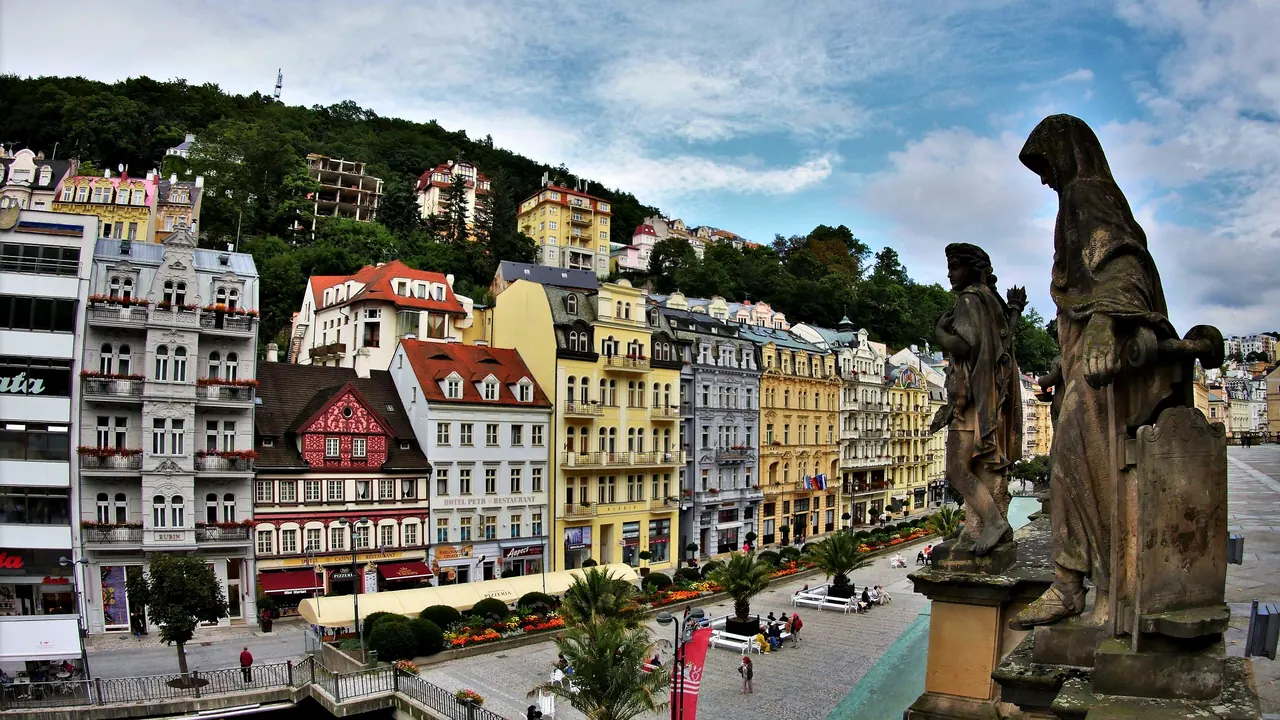
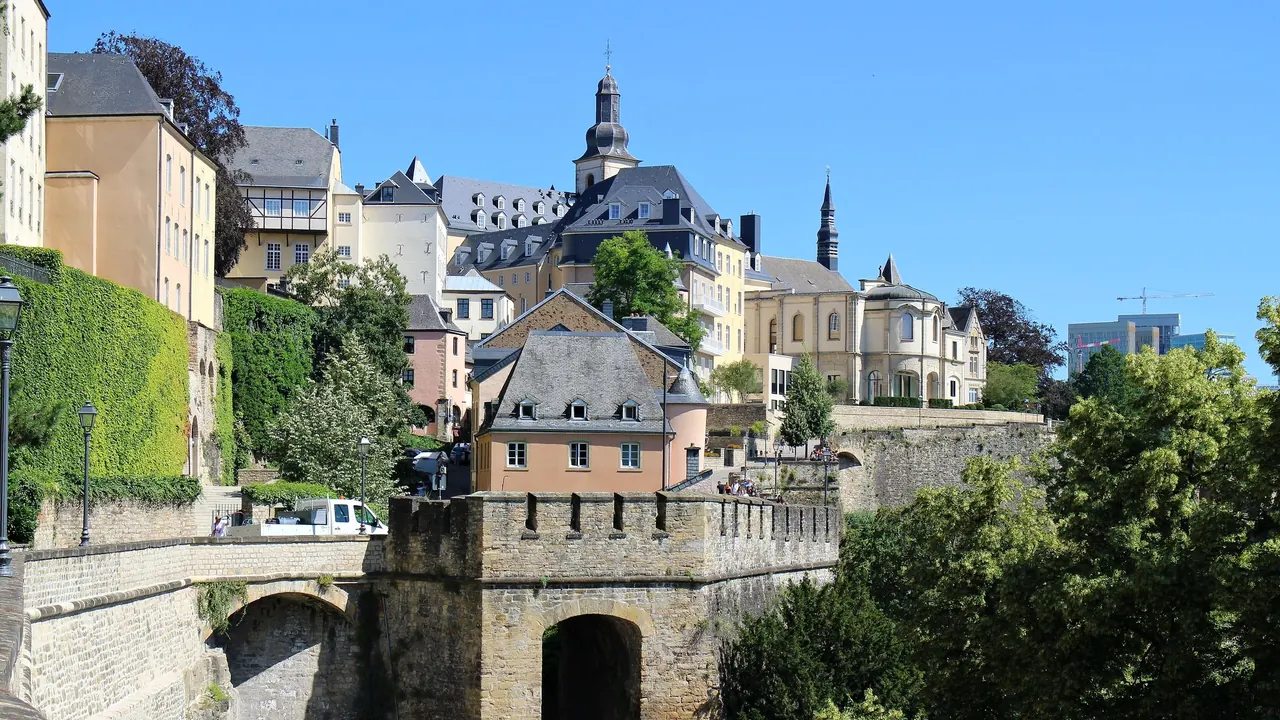
Photos: Karlovy Vary by Rolf Dietrich Brecher from Germany, CC BY-SA 2.0, cropped; Luxembourg by Suicasmo, CC BY-SA 4.0, cropped.
Karlovy Vary or Luxembourg?
Our verdict in twelve categories, each scored against the same fixed benchmark cities, and the climate month by month, so you can choose for your trip.
Choose Karlovy Vary for
- prices
- wellness
Karlovy Vary suits a slow, restorative stay built around the springs: sipping warm mineral water from a spouted cup along the colonnades, booking treatments in a spa hotel, and filling the gaps with forest walks, coffee and cake. It is also much kinder to the wallet, especially if you eat in the Czech pubs one street back from the promenades. Expect quiet evenings and not much aimed at children.
Choose Luxembourg for
- nightlife
- getting around
- live music and the arts
For a livelier, more varied short stay, Luxembourg is the better pick. Its fortress above the gorges matches the spa quarter as a sight, and around it the city adds a more serious table with Moselle wine, a proper concert hall, free public transport and Trier and Metz within easy reach by train. The catch is cost: rooms and restaurants are expensive, and that is the trade-off for everything else.
Scoreboard
Twelve categories on one fixed scale from 0 to 100. The shaded stretch is the gap between the two.
Your match
Pick a travel style or drag the sliders, and both match scores follow your weighting.
Wins on prices and wellness with your weighting.
Wins on nightlife and getting around with your weighting.
What matters to you?
Category by category
What the scores mean for a trip.
Beaches & swimming
Neither is a swimming destination, but Luxembourg gives a little more to work with on a hot day: designated bathing spots on the wooded shores of the Upper Sûre reservoir and the gravel-pit lakes at Remerschen in the Moselle valley.
Karlovy Vary's nearest equivalent is Lake Medard, a flooded mine near Sokolov, plus a few ponds in the hills. Its distinctive swim is in water warmed by the springs, in the outdoor thermal pool on the hillside.
Food & drink
Luxembourg eats much better. French cooking leads its restaurants, Belgian, German, Portuguese and Italian habits fill the brasseries and neighbourhood places, and there is a surprisingly deep tier of fine dining for a city of its size. The Moselle Rieslings and crémant poured by the glass are a pleasure in themselves.
Karlovy Vary sticks to hearty Czech cooking, roast pork, dumplings and svíčková with Pilsner-style beer, and its two treats are the warm spa wafers and Becherovka, the herbal liqueur born in the town. It is a place for cafés and cake rather than a reason to travel for the food.
Culture & sights
Both are UNESCO-listed and both are seen comfortably in a couple of days, but the sights are of a different kind. Karlovy Vary is a set piece of spa architecture: pastel Belle Époque hotels climbing the Teplá valley, the colonnades over the springs and the Vřídlo geyser, with small museums on glass and Becherovka.
Luxembourg's draw is a fortress city on a rock, with the Bock casemates to walk through, the Grund below and the Grand Ducal Palace above. It also has the larger museums, the National Museum of History and Art and contemporary art at MUDAM on Kirchberg.
Nightlife
Luxembourg has the better evenings, though still on a small scale. Bars and a couple of clubs cluster at the Rives de Clausen, the Grund has riverside pubs in old stone houses, and Hollerich keeps later hours, with an international crowd of young professionals busiest on Thursdays and Fridays.
Karlovy Vary is largely asleep by eleven, its spa guests walking the promenade after an early dinner. The only real exception is the film festival week, when parties and outdoor bars fill the valley.
Nature & outdoors
Both offer green, gentle country rather than drama, and the difference is in the kind of walking. In Karlovy Vary the beech and spruce forest starts at the edge of the spa quarter, with graded paths made for convalescents leading up to the Diana lookout, and the Ore Mountains add skiing at Klínovec in winter and easy canoeing on the Ohře.
Luxembourg brings its wooded gorges right through the city centre, and half an hour away the Müllerthal has mossy sandstone ravines and narrow rock passages. Beyond lie the Ardennes hills and the cycle paths along the Moselle vineyards, at their best in autumn.
Day trips
Luxembourg wins on reach because three countries are on its doorstep. Roman Trier and the Gothic cathedral of Metz are each under an hour by train, Nancy is not much further, and at home there are the castle at Vianden, Echternach's abbey and the Moselle wine villages.
Karlovy Vary's outings are closer to home but well worth making. Loket's castle in its river loop is twenty minutes away, Mariánské Lázně and Františkovy Lázně complete the spa trio, and Bečov's medieval reliquary and Plzeň's breweries round it out. Prague is a long day by coach.
Good for families
Luxembourg is the easier choice with children. The casemate tunnels and ramparts feel like an adventure, lifts take pushchairs down to the river quarters, and the natural history museum and Parc Merveilleux at Bettembourg are aimed at younger visitors.
Karlovy Vary charms children for a day or so with the geyser, tasting the warm springs, the funicular to the Diana lookout with its small animal enclosure and the spa wafers. After that, a town built for adults taking cures and its steep valley sides wear thin.
Getting around
Luxembourg is the simpler place to move about, because trams, buses and trains are free across the whole country. The tram links the station, old town and Kirchberg, public lifts connect the levels of the city, and trains reach Vianden, Clervaux and the Moselle without a car.
Karlovy Vary is a walk along one long riverside strip, with buses and the funicular for the climbs. Its regional trains to Loket and the other spa towns are slow, and a car helps for the forests and villages.
Shopping & style
Neither is a shopping destination, and each is best for a few local specialities. In Karlovy Vary that means Moser crystal, local porcelain and Bohemian garnets, sold alongside spa cups, wafers and Becherovka on the promenades of Stará louka and Tržiště.
Luxembourg leans to international luxury brands on the Grand-Rue and chains along Avenue de la Gare. Its souvenirs are Villeroy & Boch tableware and bottles of Moselle crémant, with a produce market on Place Guillaume II.
Affordability
Karlovy Vary is far cheaper. The grand hotels and colonnade restaurants charge for the setting, but Czech pubs one street back keep meals at local prices, and rooms fall outside summer and the festival week.
Luxembourg is expensive for both sleeping and eating, with hotels priced for business travellers. Free transport, free museums and good-value lunch menus help, and many visitors save by staying in Trier or Metz instead.
Live music & performing arts
Luxembourg has the stronger programme. The Philharmonie on Kirchberg hosts its own orchestra and touring soloists, the Grand Théâtre stages visiting opera and dance, and the Rotondes and summer concerts at Neimënster in the Grund widen the range.
Karlovy Vary's music grows out of its spa past. The symphony orchestra descends from the bands that played to spa guests and gives light classical concerts, some outdoors on the colonnades, while the ornate Fellner and Helmer theatre takes touring operetta and drama.
Wellness & relaxation
This is where Karlovy Vary pulls far ahead. The town exists to take the waters: guests drink from the springs along the colonnades as a prescribed cure, and dozens of spa hotels and sanatoria offer carbonated baths, peat wraps, massage and doctors' consultations, many with pools of warm spring water.
Luxembourg has no bathing culture of its own. Its spa is half an hour away at Mondorf-les-Bains, a pleasant day out, and otherwise it relies on hotel spas, the Kirchberg pool complex and quiet riverside walks.
When should you go?
Pick your month. The climate figures are measured averages, not a forecast.
Karlovy Vary in July
Luxembourg in July
Daytime high, °C
Rainfall in the month, mm
Where the figures come from
Karlovy Vary's station stands 156 m above the city centre, so the centre is likely a little warmer than the figures say.
Karlovy Vary has no rain gauge within 25 km of the centre, so its rainfall comes from a gridded climate dataset read at the city rather than from a gauge further away.
Karlovy Vary's sunshine is measured 37 km from the centre, at Cheb.
Temperature and rainfall are climate normals, averaged over the years shown. Karlovy Vary: 1999-2020 (sunshine 1981-2010, rainfall 1991-2020) normals, Karlovy Vary (4.6 km from centre). Luxembourg: 1991-2020 normals, Luxembourg / Luxembourg (6.3 km from centre).
Both are inland central European towns with mild summers and cold winters, so the streets are pleasant to walk from May to September in either. Luxembourg runs a few degrees warmer through the year, reaching 24°C in July and August, and its summers are noticeably sunnier. Karlovy Vary's valley is colder in winter, with daytime highs near freezing from December to February. That suits the warm spring-fed pools and the skiing in the Ore Mountains rather than long outdoor sightseeing.
Rain behaves differently. Karlovy Vary is fairly dry for much of the year but gets its heaviest showers in high summer, peaking around 95mm in July, while Luxembourg is damp in every month and wettest in December at about 89mm. Only July and August are warm enough for lake swimming in either place. May, June and September are the best balance of warmth and comfortable walking in both, with Luxembourg's September a little brighter.
Which traveller are you?
On a relaxing and wellness trip, Karlovy Vary is the clear choice. Taking the waters is the town's whole purpose: thirteen springs along the colonnades, spa hotels with medical treatments and warm pools, and an unhurried daily rhythm. Luxembourg offers a single day at Mondorf-les-Bains instead.
For a trip on a tight budget, Karlovy Vary goes much further. The pubs and canteens a street back from the colonnades serve Czech food and beer at local prices, and the springs cost nothing. Luxembourg stays expensive for rooms and meals, even with free public transport.
For a short city break, Luxembourg fills two or three days better: the casemate tunnels and the Grund, a strong restaurant scene with Moselle crémant, concerts at the Philharmonie and free trams to carry you between them. Karlovy Vary's evenings end early and its town is mainly a spa.
Before you go
| Measure | Karlovy Vary | Luxembourg |
|---|---|---|
| Official language | Czech | French, German, Luxembourgish |
| Currency | Czech Koruna (CZK) | Euro (EUR) |
| Sockets | CE230 V, 50 Hz | CF230 V, 50 Hz |
| Driving side | Right | Right |
| Time zone | UTC+1, UTC+2 in summer | UTC+1, UTC+2 in summer |
| Emergency number | 112 | 112 |
| Elevation | 447 m | 300 m |
| Main airport | Václav Havel Airport Prague (PRG)100 km from centre178 non-stop destinations | Luxembourg-Findel International Airport (LUX)6 km from centre115 non-stop destinations |
| Public holidays this year | 13 days | 12 days |
By the numbers
| Measure | Karlovy Vary | Luxembourg |
|---|---|---|
| City population | 49,073 | 137,678 |
| People per km² | 830 | 2,663 |
| Museums within 10 km | 2 | 19 |
| UNESCO World Heritage sites within 50 km | 3 | 4 |
Where else could you go?
Every comparison below shares a destination with this one, so you can follow Karlovy Vary or Luxembourg somewhere new.
- Dresdenvs Karlovy Vary
- Praguevs Karlovy Vary
- Leipzigvs Karlovy Vary
- Maastrichtvs Luxembourg
- Nurembergvs Karlovy Vary
- Colognevs Luxembourg