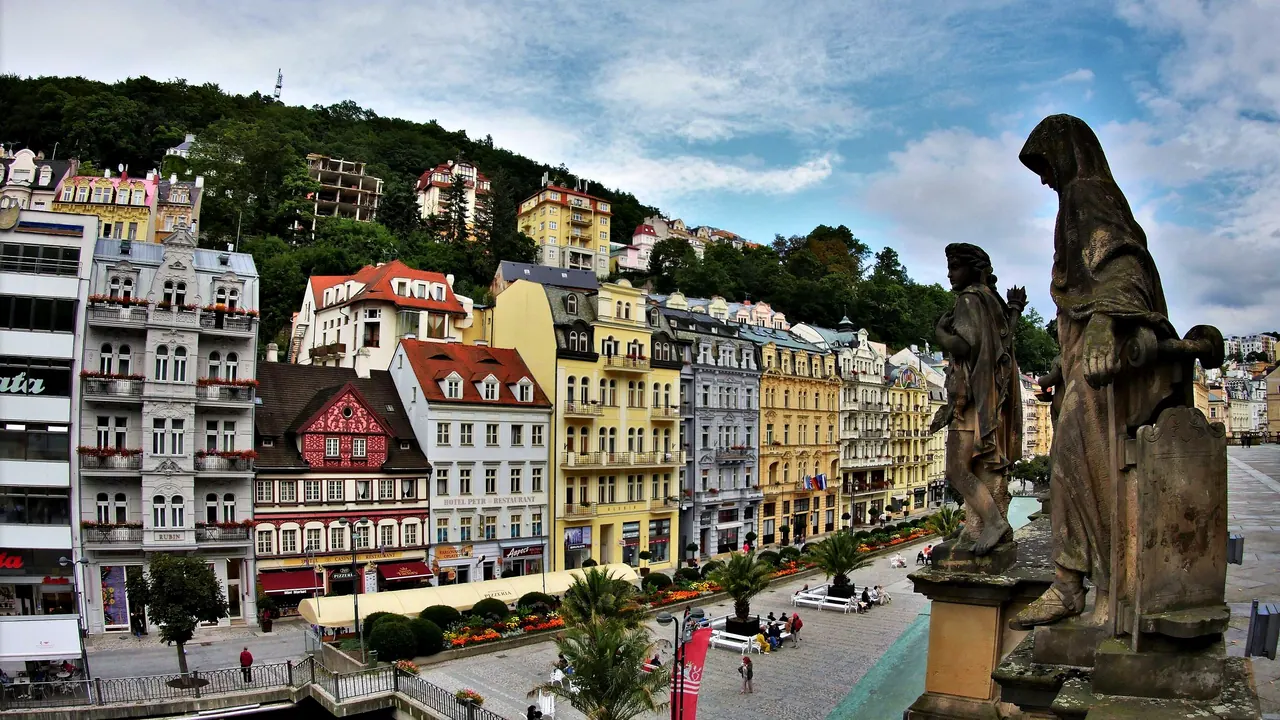
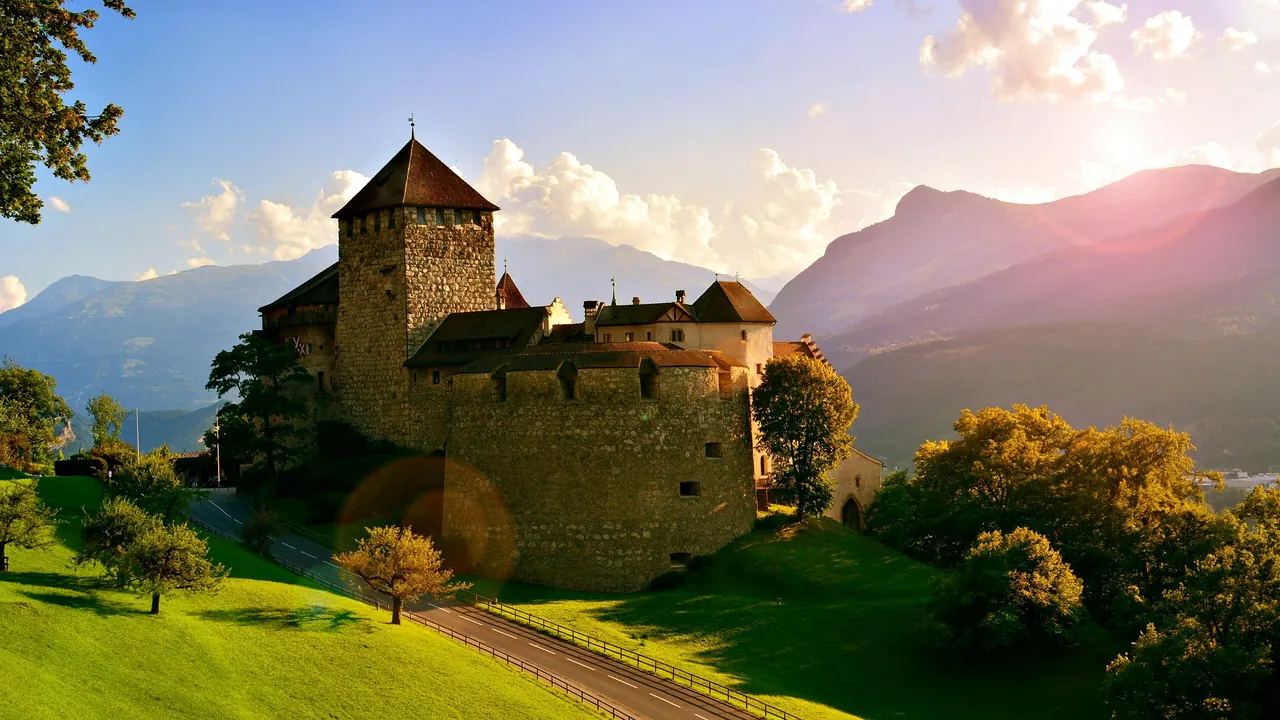
Photos: Karlovy Vary by Rolf Dietrich Brecher from Germany, CC BY-SA 2.0, cropped; Vaduz by Justin LaBerge, CC BY 2.0, cropped.
Karlovy Vary or Vaduz?
Our verdict in twelve categories, each scored against the same fixed benchmark cities, and the climate month by month, so you can choose for your trip.
Choose Karlovy Vary for
- prices
- wellness
- shopping
Karlovy Vary suits a slow, restorative stay built around the springs, with treatments booked at a spa hotel and evenings at a light classical concert in the ornate theatre or out on the colonnades. The UNESCO-listed spa quarter gives you more to look at, and Moser crystal and Bohemian porcelain give you more to take home. Czech pubs one street back from the colonnades also keep the bill far lower than in Vaduz.
Choose Vaduz for
- nature and the outdoors
- day trips
- beaches
If the mountains are the point of the trip, go to Vaduz. Trails start at the edge of town, and the Rätikon peaks and Malbun are half an hour up the road. Switzerland and Austria are close enough for a different outing every day. Expect Swiss prices and a small town that goes quiet early, and plan to spend your days outdoors rather than in museums or baths.
Scoreboard
Twelve categories on one fixed scale from 0 to 100. The shaded stretch is the gap between the two.
Your match
Pick a travel style or drag the sliders, and both match scores follow your weighting.
Wins on prices and wellness with your weighting.
Wins on nature and the outdoors and day trips with your weighting.
What matters to you?
Category by category
What the scores mean for a trip.
Beaches & swimming
Neither place is for swimmers, and the options are about equally thin. The difference is in what you swim in. Around Karlovy Vary it is Lake Medard, a flooded former mine near Sokolov, a few reservoirs, or the warm spring-fed outdoor pools. From Vaduz the trip is to proper Alpine and pre-Alpine lakes: the steep-walled Walensee in about half an hour or the shore of Lake Constance, though the season there is short.
Food & drink
Karlovy Vary has the edge, mostly thanks to its own specialities. Warm spa wafers are sold along the colonnades, Becherovka is distilled in town, and there is good Pilsner-style beer alongside roast pork, dumplings and svíčková. The cafés on the Teplá promenades also give you somewhere to linger between springs.
Vaduz has fewer places to eat and less variety. You get hotel dining rooms, a few spots on the Städtle and inns up in the hills serving Käsknöpfle and game. Its real strength is wine: the prince's estate below the castle makes Pinot Noir and Chardonnay.
Culture & sights
Karlovy Vary offers a good deal more. The whole UNESCO-listed spa quarter is the attraction: pastel tiers of hotels and bathhouses up the valley sides, the Corinthian Mill Colonnade, the carved timber Market Colonnade and the Vřídlo geyser. Add Dientzenhofer's baroque church and the gilded Orthodox church, and the town fills a couple of days.
Vaduz fills one day. Its draw is art rather than architecture, with the Kunstmuseum Liechtenstein and the Hilti Art Foundation holding a strong modern collection. Beyond those there are the National Museum and the stamp museum, and the castle you can only admire from outside.
Nightlife
Both towns go to bed early, but Karlovy Vary has a little more to offer. Its Czech pubs, wine bars and casinos keep a few people out, and the film festival week in early summer fills the valley with parties. Vaduz has a few wine bars and hotel lounges on the Städtle. For anything livelier, people cross the border to Feldkirch or go on to Zurich.
Nature & outdoors
Vaduz is much the stronger for the outdoors. Mountains rise straight from the Rhine valley floor, and the paths go from vineyards to high Rätikon ridges and the exposed Fürstensteig. There is skiing at Malbun, cycling on the flat Rhine dam path, and the Säntis massif close by.
Karlovy Vary's landscape is softer. Beech and spruce forest surrounds the town, with well-graded old spa paths up to the Diana tower and moorland in the Slavkov Forest. Klínovec in the Ore Mountains has skiing in winter, and the Ohře is good for easy canoeing.
Day trips
Vaduz has the wider choice because it sits where two countries meet. Feldkirch is twenty minutes away, St Gallen's abbey library and painted Appenzell are about an hour, and Lindau and Bregenz on Lake Constance and the city of Zurich are also within reach. Public transport often means changing trains, so a car helps.
Karlovy Vary's outings stay mostly within West Bohemia, but they are good ones. There is castle-topped Loket in its river loop, the spa towns of Mariánské Lázně and Františkovy Lázně, and the St Maurus reliquary at Bečov. Prague is a long day out.
Good for families
Neither town does much for children, but they keep them busy in different ways. In Karlovy Vary the fun is in the town itself: the geyser, sipping spring water from spouted cups, the funicular and the animal enclosure at the top. The steep slopes are hard work with a pushchair, though.
Vaduz has a flat centre that is easy with a pushchair, but almost nothing indoors for children. Family time there is spent outside at pools, on gentle mountain walks or on the beginner slopes at Malbun. That suits older children who enjoy hiking.
Getting around
Both towns are easy on foot, with different terrain. Karlovy Vary is a long riverside strip with steep sides, helped by buses and the funicular, and it has two railway stations, though the lines are slow. Vaduz's centre is short and flat, and its buses reach every village and up to Malbun. It has no station of its own, so longer trips start with a bus to Buchs, Sargans or Feldkirch.
Shopping & style
Karlovy Vary is much better for shopping. Moser crystal, made in town since the nineteenth century, local porcelain and Bohemian garnets are all worth buying, and the boutiques on Stará louka and Tržiště cater to well-off spa guests.
In Vaduz, shopping means a handful of shops on the Städtle selling watches, souvenirs and collectable stamps. A bottle of the local wine is the best thing to take home, and serious shoppers go to Zurich.
Affordability
The two are far apart on cost. Karlovy Vary charges more for the grand hotels and the colonnade setting, but Czech pubs and canteens a street back keep everyday spending modest. Outside summer and the festival week, rooms are cheaper still.
Vaduz is among the most expensive stays in Europe. It runs at Swiss prices and has very few budget beds, so some visitors sleep across the border in Austria to keep costs down.
Live music & performing arts
Neither town has a real scene, but Karlovy Vary offers more evenings out. Its symphony orchestra grew out of the old spa bands and plays regularly, sometimes outdoors on the colonnades in summer, and the Fellner and Helmer theatre stages operetta and drama. Liechtenstein's programme mostly takes place at the national theatre in neighbouring Schaan, with a short orchestral season and a summer classical festival in Vaduz.
Wellness & relaxation
The gap here is wide. In Karlovy Vary the cure is in the town itself. You sip mineral water from a spouted porcelain cup as you walk between the colonnades, and the many spa hotels and sanatoria add carbonated baths, peat wraps, massage and a doctor's consultation. Walk-in bathing is limited, so the treatments come with a booked stay. Even so, hotel pools and an outdoor pool above the river are filled with spring water.
Vaduz has no bathing tradition of its own, and only a handful of hotels have a spa. For thermal water you drive about twenty-five minutes across the Rhine to Bad Ragaz, where the Tamina springs fill a large public bath. Vaduz itself offers calm rather than treatments: a tidy little capital that goes to bed early, where a day in the hills does most of the unwinding.
When should you go?
Pick your month. The climate figures are measured averages, not a forecast.
Karlovy Vary in July
Vaduz in July
Daytime high, °C
Rainfall in the month, mm
Where the figures come from
Karlovy Vary's station stands 156 m above the city centre, so the centre is likely a little warmer than the figures say.
Karlovy Vary has no rain gauge within 25 km of the centre, so its rainfall comes from a gridded climate dataset read at the destination rather than from a gauge further away.
Karlovy Vary's sunshine is measured 37 km from the centre, at Cheb.
Vaduz's temperatures are measured 51 km from the centre, at Sigmarszell-Zeisertsweiler.
Vaduz has no rain gauge within 25 km of the centre, so its rainfall comes from a gridded climate dataset read at the destination rather than from a gauge further away.
Temperature and rainfall are climate normals, averaged over the years shown. Karlovy Vary: 1999-2020 (sunshine 1981-2010, rainfall 1991-2020) normals, Karlovy Vary (4.6 km from centre). Vaduz: 1991-2020 normals, Sigmarszell-Zeisertsweiler (51.3 km from centre).
Neither town is a beach destination, so the question is when walking is pleasant. Both are at their best from late May to September. Karlovy Vary peaks at about 22°C in July and August and Vaduz a little warmer at around 24°C. Summer is also the wettest time in both. July brings Karlovy Vary its heaviest rain at about 95mm, while Vaduz is wetter all year and gets around 126mm in August, much of it in mountain showers. Vaduz has more sunshine through most of the year.
Winter is colder in Karlovy Vary, with January highs near 1°C and very few sunny hours, but the warm springs, the thermal pools and the cafés suit grey days well. Vaduz stays a few degrees milder in the valley and has snow up at Malbun for skiing. In late autumn, though, fog can settle over the Rhine valley while the heights above stay sunny. For hiking in Vaduz, aim for June to early October.
Which traveller are you?
On a relaxing and wellness trip, Karlovy Vary is the clear pick. Its thirteen springs, drinking cure, sanatoria with medical treatments and thermal pools are the whole reason the town exists. Vaduz offers quiet streets, and its nearest real thermal bath is over the border at Bad Ragaz.
For an outdoors trip, choose Vaduz. You can walk from the centre into vineyards and beech forest, high Rätikon ridge walks and the Fürstensteig are close by, and Malbun has skiing in winter. Karlovy Vary's spa paths are gentle and the surrounding hills roll rather than rise.
On a trip with a tight budget, Karlovy Vary wins easily. One street back from the colonnades, pubs and canteens charge local Czech prices, and buses and the funicular cost little. Vaduz runs at Swiss prices and has very few cheaper rooms.
Before you go
| Measure | Karlovy Vary | Vaduz |
|---|---|---|
| Official language | Czech | German |
| Currency | Czech Koruna (CZK) | Swiss Franc (CHF) |
| Sockets | CE230 V, 50 Hz | CJ230 V, 50 Hz |
| Driving side | Right | Right |
| Time zone | UTC+1, UTC+2 in summer | UTC+1, UTC+2 in summer |
| Emergency number | 112 | 112 |
| Elevation | 447 m | 455 m |
| Main airport | Václav Havel Airport Prague (PRG)100 km from centre184 non-stop destinations | Zürich Airport (ZRH)81 km from centre226 non-stop destinations |
| Public holidays this year | 13 days | 21 days |
By the numbers
| Measure | Karlovy Vary | Vaduz |
|---|---|---|
| Population | 49,073 | 5,668 |
| People per km² | 830 | 328 |
| Museums within 10 km | 2 | 7 |
| UNESCO World Heritage sites within 50 km | 3 | 3 |
Where else could you go?
Every comparison below shares a destination with this one, so you can follow Karlovy Vary or Vaduz somewhere new.
- Zurichvs Vaduz
- Lucernevs Vaduz
- Dresdenvs Karlovy Vary
- Praguevs Karlovy Vary
- Leipzigvs Karlovy Vary
- Luganovs Vaduz