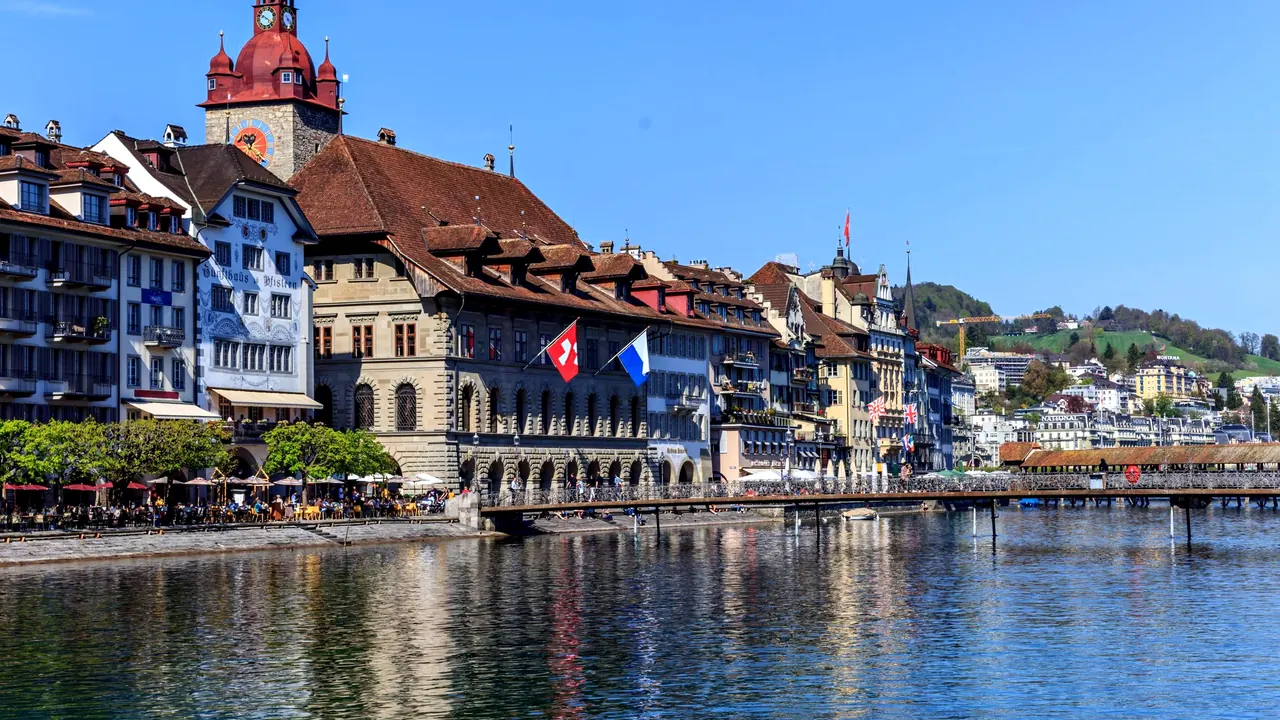
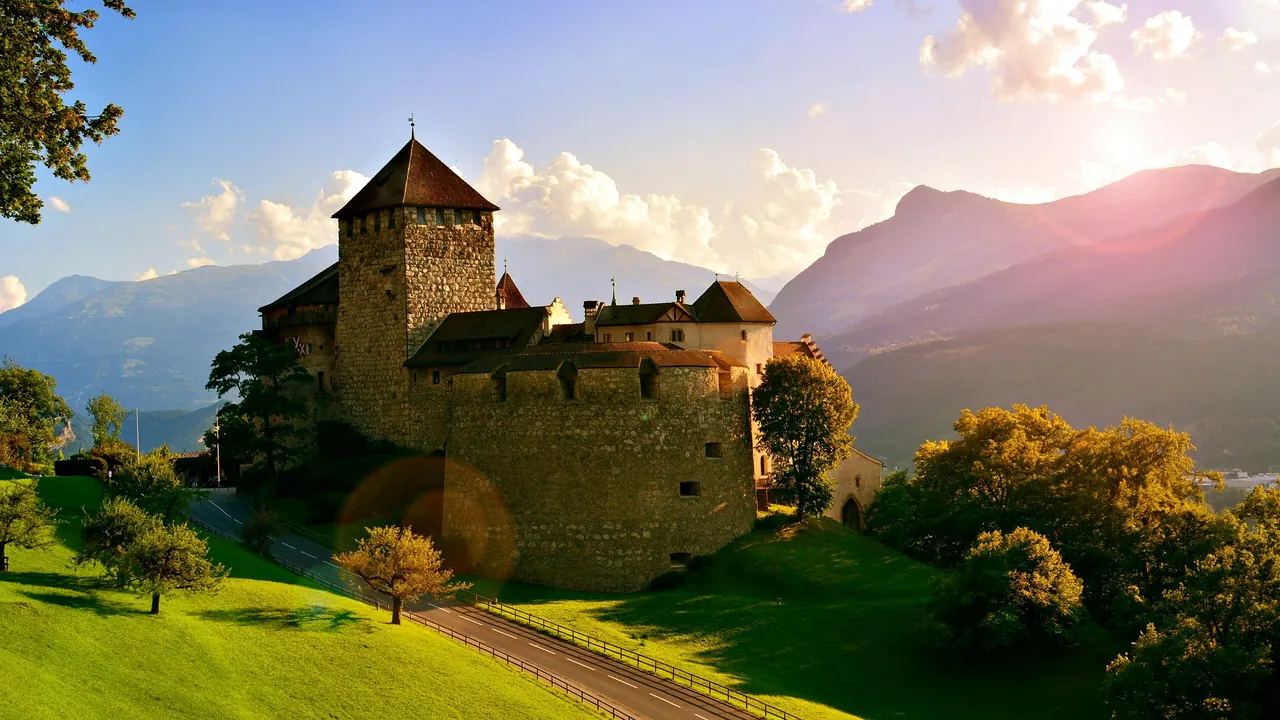
Photos: Lucerne by ILOVESwitzerland, Pexels License; Vaduz by Justin LaBerge, CC BY 2.0, cropped.
Lucerne or Vaduz?
Our verdict in twelve categories, each scored against the same fixed benchmark cities, and the climate month by month, so you can choose for your trip.
Choose Lucerne for
- live music and the arts
- shopping
- culture and sights
Lucerne is the better choice for most travellers, and especially for a first visit to Switzerland. It has the famous picture of a covered bridge, a medieval Old Town and a lake ringed by peaks. On top of that come a concert hall with an international reputation and a car-free network of steamers, cogwheel railways and trains that reaches both the mountains and the big Swiss cities. Families, music lovers and anyone without a car will get more from it.
Choose Vaduz for
Vaduz does not lead in any category we score.
Vaduz suits someone who wants a smaller and quieter base and is happy to make their own entertainment outdoors. Footpaths climb through vineyards from the edge of town, Malbun's slopes are half an hour up the road, and the prince's own wine is on sale in the Städtle. With a car, it also makes a good base for exploring the corner where Switzerland and Austria meet. It works best for walkers and drivers who have already seen the classic Swiss sights.
Scoreboard
Twelve categories on one fixed scale from 0 to 100. The shaded stretch is the gap between the two.
Your match
Pick a travel style or drag the sliders, and both match scores follow your weighting.
Wins on live music and the arts and shopping with your weighting.
Has no clear advantage with the weighting you have chosen.
What matters to you?
Category by category
What the scores mean for a trip.
Beaches & swimming
Lucerne has its swimming right in town. Locals swim from the Lido, the old wooden lake baths and the lawns at Ufschötti, all close to the centre. The shore is grass and jetties rather than sand, but you can walk there with a towel.
Vaduz has no water of its own to swim in, since the Rhine is not a swimming river. On a hot day you go to the municipal pools or drive to the Walensee or Lake Constance. Both lakes reach about the same summer temperature as Lake Lucerne, but in Vaduz a swim takes an outing to get to.
Food & drink
Neither town is a reason to travel for food, but Lucerne gives you more choice. It has Chügelipastete and lake perch in the old guild houses, terraces along the Reuss, a Saturday market and a few modern bistros in the Neustadt. The catch is that many restaurants by the Chapel Bridge are geared to coach parties.
Vaduz has a handful of hotel dining rooms and village inns serving Käsknöpfle and game in autumn. Its cooking sits somewhere between Swiss and Austrian. What it has that Lucerne lacks is wine grown below the castle, sold in town by the prince's own estate.
Culture & sights
Lucerne has far more to see. Its well-preserved medieval centre has the wooden Chapel Bridge, the climbable towers of the Musegg Wall, the Lion Monument and the Bourbaki Panorama. Add the Rosengart Collection and Wagner's villa at Tribschen and you can fill two days.
Vaduz takes a single unhurried day. Its strength is modern art, in the Kunstmuseum's black cube and the Hilti Art Foundation next to it, along with a national museum and a stamp museum. The castle above town is the prince's home, so you see it only from outside.
Nightlife
Lucerne is quiet in the evening, but it has some nightlife: wine bars and pubs along the river, a few cocktail bars and small clubs in the Neustadt, and student weekends. During Fasnacht the whole Old Town stays out in costume until dawn.
Vaduz has almost nothing after dinner beyond a few wine bars and hotel lounges on the Städtle. Young locals cross the border to Feldkirch for a night out.
Nature & outdoors
Both are excellent mountain bases, but Lucerne has the grander setting and the easier access. The lake is right there, Pilatus and Rigi have their famous railways, the Stanserhorn has an open-top cable car, and Titlis keeps snow all year. Steamers let you combine a boat ride, a train and a hike in one day.
Vaduz is more of a place to set off on foot. Trails start at the edge of town and climb through vines and beech forest. The Rätikon peaks above Malbun offer high walks such as the exposed Fürstensteig, and the Rhine dam path is good for flat cycling. Malbun also makes a modest family ski area in winter.
Day trips
Lucerne sits at the centre of the Swiss rail network. Bern, Basel and Zurich are all under an hour away, and the lake steamers run to the Rütli meadow and the William Tell country at Altdorf. You never need to drive.
From Vaduz the outings cross a border more often than not: Feldkirch's arcaded lanes, the abbey library at St Gallen, Appenzell, and Lindau on Lake Constance. The choice is good, but without a train station you usually change at Buchs or Sargans, so a car makes the trips much easier.
Good for families
Lucerne has the more child-friendly vacation. The Swiss Museum of Transport has trains, planes and a planetarium, and the mirror maze in the Glacier Garden and the wildlife park at Goldau add more. Cogwheel trains and steamers are fun for children in themselves, although rainy days can still run short of ideas.
Vaduz is just as safe and easy with a pushchair, but it has nothing made for children. Families spend their time at the open-air pools, on gentle walks above Triesenberg or on the beginner slopes at Malbun. Older children who like hiking will get the most out of it.
Getting around
Lucerne is far easier for a visitor without a car. The station, the steamer piers and the Old Town are all on the same stretch of lakefront. Integrated tickets carry you from the city buses onto boats, cogwheel railways and cable cars.
You can walk the whole of the pedestrian centre in Vaduz in a few minutes, and buses reach every village and run up to Malbun. Further afield is harder, because the nearest stations are in Buchs, Sargans or Feldkirch. That is why many visitors here end up hiring a car.
Shopping & style
Lucerne's shopping is mostly Swiss watches, from the big houses around Schwanenplatz. Add army knives, chocolate, a few independent shops in the Old Town lanes and the Saturday riverside market. It is limited, but there is a real afternoon's browsing.
In Vaduz the Städtle has only a handful of shops. The things worth taking home are Liechtenstein stamps and a bottle of local wine, and anyone who wants proper shopping heads to Zurich.
Affordability
Both are among the most expensive places in Europe to visit, so neither works on a tight budget. In Lucerne much of the cost comes from the mountain railways and cable cars, and hotels cost more during the music festival. A Swiss travel pass and picnics from the supermarket help.
In Vaduz the problem is how few hotels there are, which leaves almost nothing at the cheaper end. Museums and buses are not a big expense. The usual way to save is to stay across the border in Austria.
Live music & performing arts
Lucerne is a classical music destination in its own right. The Lucerne Festival brings leading orchestras to Jean Nouvel's lakefront hall, which is known for its acoustics and has a programme all year. The city theatre adds opera and dance, and Fasnacht fills the streets with Guggenmusik brass bands.
Vaduz offers what a very small country can. There is drama and dance at the theatre in neighbouring Schaan, a short orchestral season, a summer classical festival and church concerts. Over a week you will probably find something to see, but nobody would plan a trip around it.
Wellness & relaxation
These two are roughly equal for relaxation, but in different ways. In Lucerne, rest means a slow steamer ride, a dip at the wooden lake baths, or the trip by boat and cogwheel train to Mario Botta's mineral bath high on the Rigi.
Vaduz has proper thermal water closer to hand, at Bad Ragaz about twenty-five minutes away, where bathers have come for centuries. It also avoids the midday tour crowds that fill Lucerne's Old Town.
When should you go?
Pick your month. The climate figures are measured averages, not a forecast.
Lucerne in July
Vaduz in July
Daytime high, °C
Rainfall in the month, mm
Where the figures come from
Lucerne has no rain gauge within 25 km of the centre, so its rainfall comes from a gridded climate dataset read at the destination rather than from a gauge further away.
Lucerne's sunshine is measured 42 km from the centre, at Zurich Town / Ville..
Vaduz's temperatures are measured 51 km from the centre, at Sigmarszell-Zeisertsweiler.
Vaduz has no rain gauge within 25 km of the centre, so its rainfall comes from a gridded climate dataset read at the destination rather than from a gauge further away.
Temperature and rainfall are climate normals, averaged over the years shown. Lucerne: 2005-2025 (sunshine 1991-2020, rainfall 1991-2020) normals, Emmen (4.2 km from centre). Vaduz: 1991-2020 normals, Sigmarszell-Zeisertsweiler (51.3 km from centre).
The two places share almost the same climate, so the timing is much the same. From June to August daytime highs reach about 24°C, which is warm enough for lake swimming and long days in the hills. That is also the wettest stretch in both, with summer downpours and thunderstorms. May and September are milder and good for hiking and city walking. From November to February highs sit around 4°C. That is cold for sightseeing on foot but brings the snow for skiing and sledging.
The difference is in the rain. Lucerne gets noticeably more, around 141mm in July and August against about 126mm in Vaduz, and it is wetter in winter too. In late autumn and early winter Vaduz also gets slightly more sun. Its valley can still sit under fog while the slopes above are bright.
Which traveller are you?
On a culture and arts trip, Lucerne is the clear pick. The Chapel Bridge, the Lion Monument, the Picasso and Klee collection at the Rosengart and the lakefront concert hall during the Lucerne Festival give far more than Vaduz's two art museums.
On a family trip with children, Lucerne also wins. The Swiss Museum of Transport can fill a whole day, and the Glacier Garden, the summer toboggan run on Pilatus and the paddle steamers add more. Vaduz has almost nothing laid on for younger children.
For a relaxing and wellness trip, Vaduz has a slight edge. The historic thermal baths at Bad Ragaz are a short drive away, and evenings are even quieter. Lucerne's Old Town fills with tour groups at midday, and its best mineral bath is on the Rigi.
Before you go
| Measure | Lucerne | Vaduz |
|---|---|---|
| Official language | French, German, Italian, Romansh | German |
| Currency | Swiss Franc (CHF) | Swiss Franc (CHF) |
| Sockets | CJ230 V, 50 Hz | CJ230 V, 50 Hz |
| Driving side | Right | Right |
| Time zone | UTC+1, UTC+2 in summer | UTC+1, UTC+2 in summer |
| Emergency number | 112 | 112 |
| Elevation | 436 m | 455 m |
| Main airport | Zürich Airport (ZRH)49 km from centre226 non-stop destinations | Zürich Airport (ZRH)81 km from centre226 non-stop destinations |
| Public holidays this year | 12 days | 21 days |
By the numbers
| Measure | Lucerne | Vaduz |
|---|---|---|
| Population | 86,234 | 5,668 |
| People per km² | 2,963 | 328 |
| Museums within 10 km | 14 | 7 |
| UNESCO World Heritage sites within 50 km | 1 | 3 |
Where else could you go?
Every comparison below shares a destination with this one, so you can follow Lucerne or Vaduz somewhere new.