Kazakhstan
Almaty
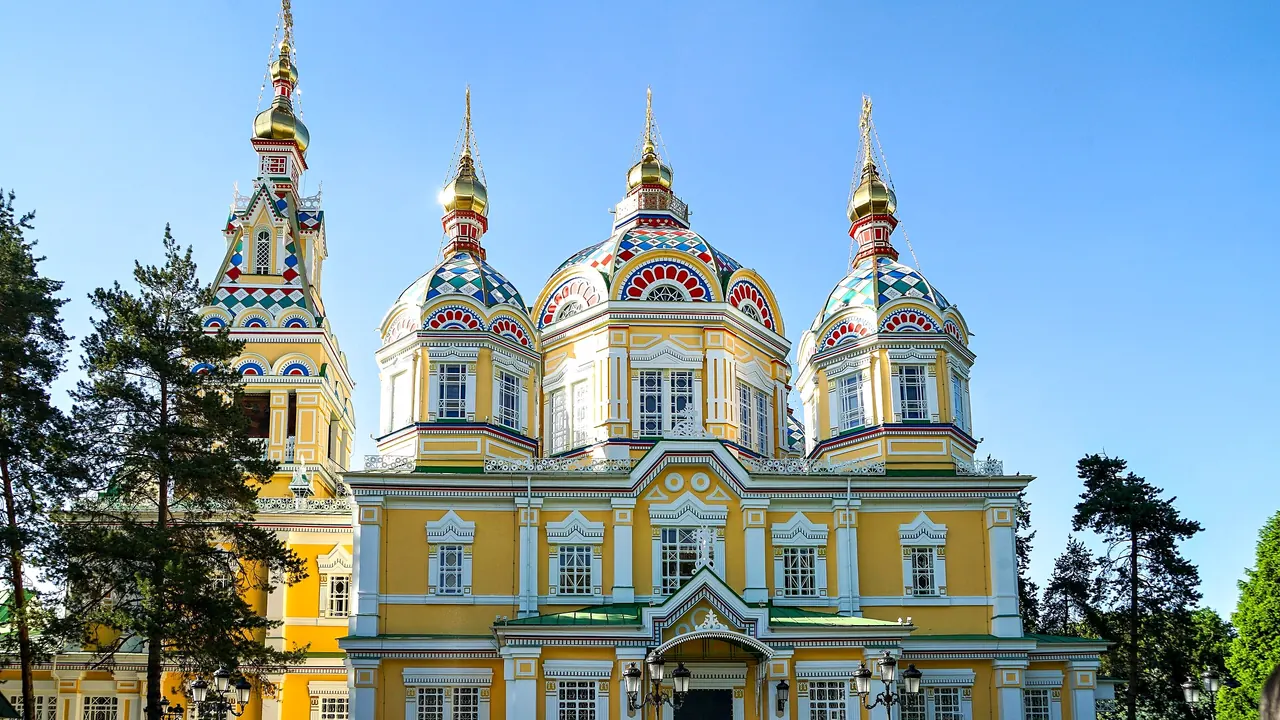
The Ascension Cathedral in Panfilov Park
- Nature & outdoors88
- Affordable cities74
- Food & drink58
Photo: Kalpak Travel, CC BY 2.0, cropped
Match
48
Every category weighted equally
- Beach & sun47
- Culture & arts47
- Food & nightlife48
- Family trip49
- Outdoors50
- Relax & unwind49
- Shopping & style48
- On a budget51
Almaty in twelve categories
Our verdict on each, scored 0 to 100 against the same fixed benchmark cities, so a score means the same thing on every page.
Beaches & swimming. Scores 12 out of 100.
Food & drink. Scores 58 out of 100.
Culture & sights. Scores 40 out of 100.
Nightlife. Scores 45 out of 100.
Nature & outdoors. Scores 88 out of 100.
Day trips. Scores 18 out of 100.
Good for families. Scores 50 out of 100.
Getting around. Scores 50 out of 100.
Shopping & style. Scores 38 out of 100.
Affordability. Scores 74 out of 100.
Live music & performing arts. Scores 52 out of 100.
Wellness & relaxation. Scores 55 out of 100.
Almaty category by category
Beaches & swimming
12Almaty sits deep in Central Asia, thousands of kilometres from any ocean, so beaches are not part of a city stay. The nearest place to swim is the Kapchagay reservoir to the north, where sandy shores and warm summer water draw crowds of locals at weekends. It is about an hour and a half by road over flat steppe and is more a local escape than a beach worth travelling for. In the city, swimming means a pool. The mountain lakes above town are cold and meant for looking at.
Food & drink
58Eating in Almaty means meeting the whole of Central Asia at one table. Kazakh dishes are built on meat: beshbarmak with flat noodles, horse-meat sausage called kazy, and baursak dough puffs eaten with tea. Most visitors find Uyghur cooking the real pleasure, with hand-pulled lagman noodles and juicy manty, alongside Uzbek plov, shashlik grilled over coals and Korean salads left by the Soviet-era Korean community.
The Green Bazaar is the place to start. It has halls of dried fruit, nuts, horse meat, honey and fermented mare's milk, and the stallholders hand out tastings. The leafy central grid is full of cafés and good coffee, and there is a solid layer of modern restaurants. Fine dining is thin, though, and wine is mostly imported.
Culture & sights
40Almaty is a young city by heritage standards. Earthquakes and Soviet planning left little older than the late nineteenth century, and its interest lies in a handful of good sights and a striking twentieth-century cityscape. The wooden Zenkov Cathedral, painted in bright colours, stands in Panfilov Park beside the war memorial. Local lore says it was built without nails, though it is in fact held together with bolts and metal ties; what is true is that it came through the earthquake of 1911 largely intact. The Central State Museum covers nomadic history, Scythian gold and Kazakh yurt culture, and the Kasteyev State Museum of Arts holds the best collection of Kazakh painting and applied art.
The Soviet modernist buildings are a quieter draw: the Palace of the Republic, the tall Hotel Kazakhstan and mosaic-covered façades throughout the grid. Two or three days covers the city's sights comfortably.
Nightlife
45Almaty is the place in Central Asia where people go out, and weekends run late. Cocktail bars, craft beer pubs and lounges cluster in the centre's tree-lined streets around Panfilov and Abylai Khan, and a handful of clubs keep going until morning on Fridays and Saturdays. The crowd is young, well dressed and mixes Russian and Kazakh speakers. Weeknights are much quieter, and the scene is small and local rather than one that draws travellers on its own. Taxis are the usual way home.
Nature & outdoors
88The mountains are the reason to come. The snow-capped wall of the Trans-Ili Alatau rises straight from the southern edge of the city, and on clear days its 4,000m peaks fill the end of every street. Within half an hour you are at the Medeu high-altitude skating rink. From there a gondola climbs to Shymbulak, a proper ski area in winter and a base for high hiking in summer, with a further lift towards the Talgar Pass at over 3,000m.
A short drive leads to spruce-lined gorges, the turquoise Big Almaty Lake and long trails toward glaciers and the Ile-Alatau National Park. Cycling the foothills and paragliding are popular. Further out, Charyn Canyon and the Kolsai and Kaindy lakes are spectacular but need an overnight trip. Late spring to early autumn is best for hiking, and winter for skiing.
Day trips
18Almaty is a base for landscapes, not for visiting other towns. The surrounding region has few places of interest in their own right. The nearest heritage outing is Esik, about an hour east, where the burial mounds yielded the famous Golden Man warrior costume. The UNESCO-listed Tamgaly petroglyphs, thousands of Bronze Age rock carvings, are a long half day across the steppe. Bishkek in Kyrgyzstan is reachable by road but involves a border crossing and makes better sense as an overnight trip. Most excursions from the city head into the mountains and canyons instead.
Good for families
50Children are welcomed warmly in Kazakh culture, and the city has a fair set of simple pleasures. Kok-Tobe hill, reached by cable car, has small fairground rides, a petting zoo and views over the city. Central Park has rides, a lake with boats and the city zoo next door, and the open-air Medeu rink makes winter skating a treat. In the mountains, Shymbulak has easy slopes for beginners, and summer picnics in the gorges suit families well.
There is no large theme park or aquarium of note, though. Broad avenues with fast traffic and long distances on foot make getting around with small children harder than the leafy streets suggest.
Getting around
50The city centre is laid out as a regular grid on a gentle slope rising toward the mountains, so south is uphill and the peaks always show the way. Its tree-lined streets and irrigation channels make walking pleasant in the core. The metro is a single short line, handsome but of limited use, and buses cover the city cheaply with a contactless card, though routes take some deciphering. Most visitors lean on ride-hailing apps, which are quick and inexpensive. Distances beyond the centre are long and rush-hour traffic is heavy, but buses run up to Medeu, and the gondolas continue to Shymbulak without a car.
Shopping & style
38Shopping in Almaty is mostly bazaars and malls. The Green Bazaar is the most rewarding stop, with dried fruit, nuts, spices, honey and tea to carry home. The huge Barakholka market on the city's edge is a sprawling maze of cheap clothes and goods, more an experience than a place to buy. For souvenirs, look for felt work, embroidered textiles, carpets, silver jewellery and miniature yurts. Several large malls carry international and luxury brands. Local design boutiques exist but are few, and the city is not a reason to travel for shopping.
Affordability
74Almaty is cheap for most of what a visitor spends money on. Bazaar meals, Uyghur noodle houses and cafés cost little, ride-hailing across town is inexpensive, buses and the metro are nearly free, and museum and opera tickets cost a fraction of what they do further west. Accommodation is the main exception. Good business hotels in the centre are priced closer to international norms, and imported wine and cocktails in smart bars add up. Overall, travellers on a modest budget can live comfortably.
Live music & performing arts
52Almaty keeps the solid repertory culture of a former Soviet capital, and it is easy and cheap to go along. The Abai State Opera and Ballet Theatre, a grand neoclassical building in the centre, stages classic ballet and opera through the season in the Russian tradition. The Kazakh State Philharmonic presents orchestral concerts and performances on the dombra and other traditional instruments. Russian- and Kazakh-language drama theatres and a puppet theatre complete the formal scene, and a few jazz bars and smaller venues host live music. The quality is respectable rather than famous, and most theatre is not in English.
Wellness & relaxation
55Almaty has a genuine bathing tradition, centred on Arasan, a vast Soviet-era bath complex beside Panfilov Park. Built in 1982, it has Russian banya steam rooms with birch-twig whisking, Finnish saunas and a domed Turkish hammam under one roof. It is a local institution, not a tourist spa. In the foothills, the Alma-Arasan gorge has hot springs and old sanatoria, and mountain resorts offer saunas with views of the peaks.
The city itself is calmer than its size suggests. Shady avenues, park benches and long tea breaks set an unhurried pace, though traffic and winter smog break the spell.
When should you go?
Pick a month to see what it is like. The climate figures are measured averages, not a forecast.
Almaty in July
Daytime high, °C
Rainfall in the month, mm
The whole year
Shaded against this city’s own year: the deepest cell is its best month for that figure and the palest its weakest.
Temperature and rainfall are climate normals, averaged over the years shown. Almaty: 1991-2020 normals, Almaty (1.7 km from centre).
Before you go
| Measure | Almaty |
|---|---|
| Official language | Russian, Kazakh |
| Currency | Tenge (KZT) |
| Sockets | CF220 V, 50 Hz |
| Driving side | Right |
| Time zone | UTC+5 |
| Emergency number | 112 |
| Elevation | 893 m |
| Main airport | Almaty International Airport (ALA)16 km from centre93 non-stop destinations |
| Public holidays this year | 13 days |
By the numbers
| Measure | Almaty |
|---|---|
| City population | 2,228,675 |
| People per km² | 3,268 |
| Museums within 10 km | 20 |
| UNESCO World Heritage sites within 50 km | 1 |
Compare Almaty with
Every comparison with a written verdict behind it.