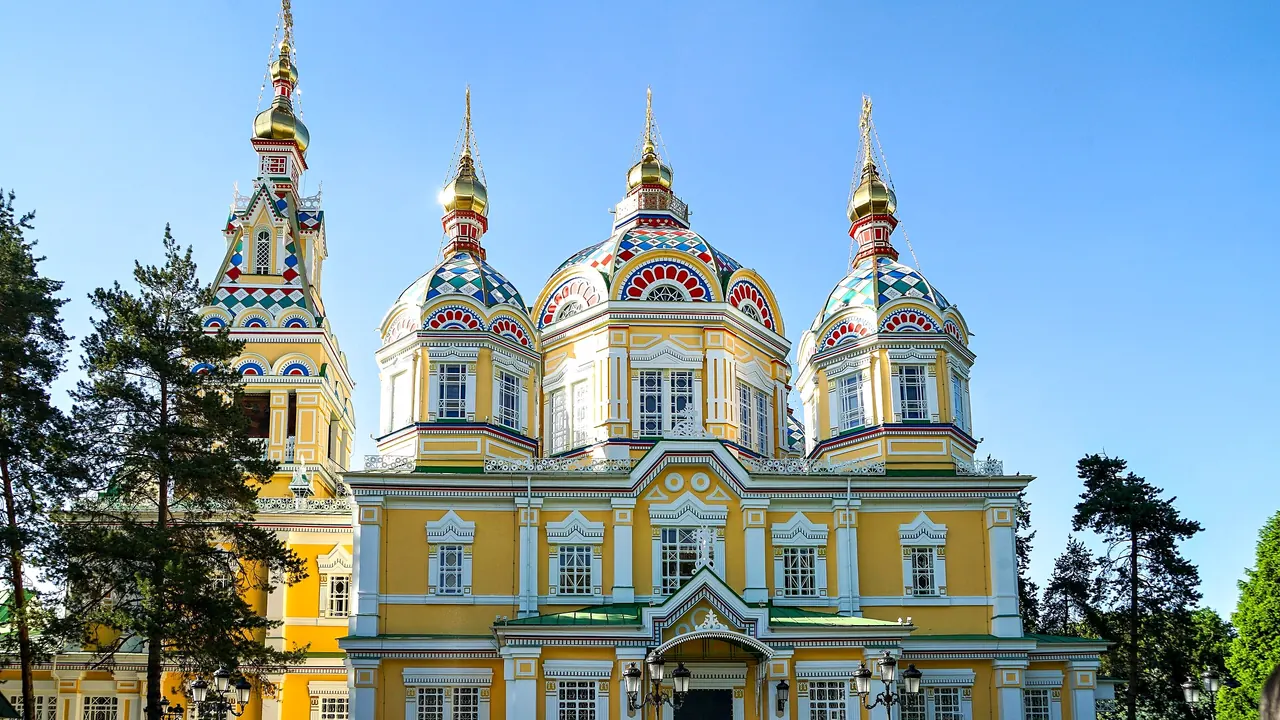
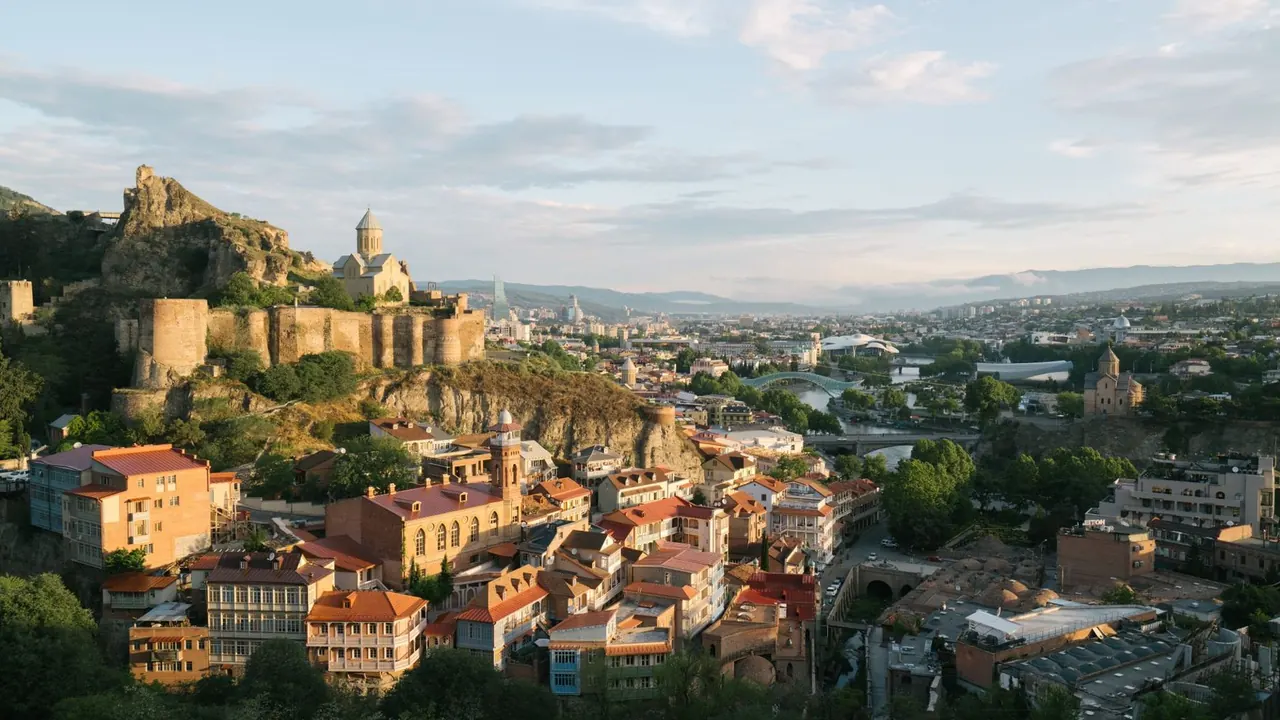
Photos: Almaty by Kalpak Travel, CC BY 2.0, cropped; Tbilisi by ArtHouse Studio, Pexels License.
Almaty or Tbilisi?
Our verdict in twelve categories, each scored against the same fixed benchmark cities, and the climate month by month, so you can choose for your trip.
Choose Almaty for
- nature and the outdoors
- beaches
- families
Almaty is for travellers who want big mountains right next to the city. The Trans-Ili Alatau rises from the southern edge of town, so you can spend the morning at the Green Bazaar and the afternoon on a trail above Shymbulak, which turns into a proper ski area in winter. The city itself makes a leafy, easy-going base with good Uyghur noodles and a couple of solid museums, but you come for the landscape.
Choose Tbilisi for
- day trips
- nightlife
- culture and sights
Tbilisi suits a trip built around the city and the country around it. Its old lanes, sulphur baths, Georgian cooking and clay-jar wine fill several days and evenings, and its techno clubs draw dancers from across Europe. Mtskheta, the Kakheti wine country and the cave monastery of David Gareja give it a run of day trips that Almaty cannot match.
Scoreboard
Twelve categories on one fixed scale from 0 to 100. The shaded stretch is the gap between the two.
Your match
Pick a travel style or drag the sliders, and both match scores follow your weighting.
Wins on nature and the outdoors and beaches with your weighting.
Wins on day trips and nightlife with your weighting.
What matters to you?
Category by category
What the scores mean for a trip.
Beaches & swimming
Neither city is a beach destination, and in both you swim in a reservoir, a lake or a pool. What differs is distance and style. Almaty's Kapchagay reservoir has sandy shores and warm summer water, but it is an hour and a half away across the steppe. Tbilisi's options are closer and smaller: the Tbilisi Sea reservoir and the hilltop Lisi and Turtle lakes, fine for cooling off on a hot July day.
Food & drink
Almaty's food reflects its place at the meeting point of Central Asia. You will find Kazakh beshbarmak and kazy sausage, Uyghur lagman and manty, Uzbek plov and Korean salads, and at the Green Bazaar the stallholders hand out tastings of dried fruit, honey and mare's milk. It is varied and satisfying, but the wine is mostly imported.
Tbilisi is the better place to eat, and wine is a large part of the reason. Khinkali dumplings, Adjarian khachapuri, walnut sauces and shoti bread hot from clay ovens make up a cuisine with a strong character of its own. Amber wines from Kakheti, made in buried clay jars called qvevri, are poured all over Sololaki and the Old Town.
Culture & sights
Almaty has little older than the late nineteenth century. Its sights are the painted wooden Zenkov Cathedral in Panfilov Park, the Central State Museum with its Scythian gold, the Kasteyev State Museum of Arts and a cityscape of Soviet modernist buildings and mosaics. Two or three days is enough.
Tbilisi goes back much further and is more rewarding to explore on foot. The Old Town lies below the Narikala fortress, with sixth-century Anchiskhati, the domed sulphur baths and houses with carved balconies. Sololaki adds Art Nouveau mansions, and the Georgian National Museum's treasury of Colchian gold is a real highlight.
Nightlife
Almaty is where Central Asia goes out, and weekends run late in the cocktail bars and craft beer pubs around Panfilov and Abylai Khan. Still, the scene is small and local, and weeknights are quiet.
Tbilisi has a reputation that reaches abroad. Its techno clubs in industrial and old Soviet buildings book international DJs, keep strict door policies and run past dawn. On calmer nights there are wine bars in old Sololaki houses and courtyard bars near Marjanishvili, which makes for a fuller night out than Almaty can offer.
Nature & outdoors
Almaty is the stronger choice for the outdoors. Peaks of about 4,000m rise straight from the city. Medeu is half an hour away, a gondola climbs to Shymbulak and the Talgar Pass, and spruce gorges, Big Almaty Lake and the Ile-Alatau National Park are a short drive further. Charyn Canyon and the Kolsai lakes are worth an overnight trip.
Tbilisi has green hills you can reach from town by funicular and cable car, and trails from Turtle Lake into the forests of Tbilisi National Park. The high Caucasus is about two hours away along the Georgian Military Road, though, so the big mountain scenery takes a full day or a night away, where Almaty has it at the end of the street.
Day trips
From Almaty, most outings head into the mountains or canyons rather than to other towns. The main heritage trips are the burial mounds at Esik, where the Golden Man was found, and the Tamgaly petroglyphs, a long half day across the steppe.
Tbilisi is one of the region's best bases for day trips. The ancient capital Mtskheta is half an hour away, Uplistsikhe's rock-cut town pairs with Gori, and Kakheti offers walled Sighnaghi, monasteries and family wine cellars in one full day. David Gareja and the Ananuri fortress add two more very different excursions.
Good for families
Both cities welcome children warmly and offer a similar set of simple treats, without any big theme park. Almaty's extras lean towards the seasons and the mountains: the cable car to Kok-Tobe's rides and petting zoo, boating in Central Park, winter skating at Medeu and easy beginner slopes at Shymbulak. Its broad avenues and long distances are the drawback.
In Tbilisi the treat is the funicular to the Mtatsminda Ferris wheel, and children are welcome in restaurants late into the evening. The trouble is the steep cobbles, underpasses with stairs and summer heat, all hard work with a pushchair.
Getting around
Getting around is about as easy in either city, and in both most visitors rely on cheap ride-hailing apps. Almaty's centre is a regular grid on a gentle slope with the mountains always to the south. It is pleasant to walk, but its single metro line is of limited use, and the long distances beyond the centre push you into taxis or buses, which do run all the way to Medeu.
Tbilisi's centre is more compact, but it is hilly and the pavements are broken. Its two metro lines serve the main axis well, and day trips are easiest with a driver.
Shopping & style
Neither city is a shopping destination, and the best buys in both are local. In Almaty they are mostly edible: dried fruit, nuts, honey and spices from the Green Bazaar, plus felt, carpets and silver, with the sprawling Barakholka market more for the experience than for buying.
Tbilisi is better for crafts and bottles. Look for Soviet curios and old silver at the Dry Bridge market, cloisonné enamel jewellery, qvevri wine and chacha, and a few local designers in Vera and Sololaki.
Affordability
Both cities are inexpensive, and Tbilisi is slightly cheaper still. In Almaty, bazaar meals, noodle houses, transport and opera tickets cost little, but good central hotels are priced closer to international levels.
Tbilisi has plenty of guesthouses and simple apartments, most churches cost nothing to enter, and a generous Georgian meal with local wine is cheap. Only boutique hotels and cocktail bars approach European prices.
Live music & performing arts
Both cities keep a full season of opera and classical ballet, but their strengths are different. Almaty's Abai State Opera and Ballet Theatre follows the Russian repertory tradition, and the Kazakh State Philharmonic mixes orchestral concerts with dombra music, all at low prices.
Tbilisi has more that is unique to it. Its national ensembles perform athletic folk dances, its ancient polyphonic singing can be heard at concerts and in church services, and the Gabriadze marionette theatre stages puppet plays that need no translation.
Wellness & relaxation
Almaty's bathing culture is Soviet and Russian. Arasan, the huge 1982 complex by Panfilov Park, has banya steam rooms with birch-twig whisking, saunas and a hammam, and there are hot springs and old sanatoria in the Alma-Arasan gorge. Winter smog and traffic take the edge off the calm.
Tbilisi is built on its springs, and that gives it the edge. In the brick-domed sulphur baths of Abanotubani you can book a private room with its own hot pool and a vigorous kisi scrub, a ritual that has barely changed in centuries. Long meals in shaded courtyards add to the slow pace, even though the streets are loud.
When should you go?
Pick your month. The climate figures are measured averages, not a forecast.
Almaty in July
Tbilisi in July
Daytime high, °C
Rainfall in the month, mm
Temperature and rainfall are climate normals, averaged over the years shown. Almaty: 1991-2020 normals, Almaty (1.7 km from centre). Tbilisi: 1991-2020 (sunshine 1961-1990) normals, Tbilisi (13.8 km from centre).
Almaty has the harder year. Winters are properly cold, with January highs around 1°C, which suits the ski slopes at Shymbulak but not long walks around the city's street grid. Spring is the wet season: April is the rainiest month at 108mm, and May is nearly as wet. June and September are the best months for both the city and the hiking trails, with warm days, little rain and plenty of sunshine. July and August reach about 31°C in town and stay sunny and fairly dry, so they are a good time to head up into the cooler gorges.
Tbilisi is milder and drier in winter, at around 7°C in January, so a winter city break works there in a way it does not in Almaty. May and June are its wettest months. In high summer the valley gets hot, around 32°C, which makes the steep streets hard work. September and October are the best months for walking the Old Town and visiting the Kakheti vineyards, with mild days and little rain.
Which traveller are you?
For an outdoors trip, Almaty is the clear choice. Buses and gondolas take you to Medeu and Shymbulak without a car, Big Almaty Lake and the trails towards the glaciers are a short drive away, and in winter the same mountains offer real skiing close to town.
On a food and nightlife trip, Tbilisi wins easily. Khinkali, khachapuri and amber wine from clay jars make every meal worth planning, the wine bars of Sololaki stay open late, and at weekends the big techno clubs keep going until well after dawn.
For a culture and arts trip, Tbilisi also has more to give. Sixth-century churches, carved balconies and the Colchian gold are all within walking distance, Georgian polyphonic singing and folk dance fill the stage, and the monasteries of Mtskheta and Kakheti are easy day trips.
Before you go
| Measure | Almaty | Tbilisi |
|---|---|---|
| Official language | Russian, Kazakh | Georgian |
| Currency | Tenge (KZT) | Lari (GEL) |
| Sockets | CF220 V, 50 Hz | CF220 V, 50 Hz |
| Driving side | Right | Right |
| Time zone | UTC+5 | UTC+4 |
| Emergency number | 112 | 112 |
| Elevation | 893 m | 575 m |
| Main airport | Almaty International Airport (ALA)16 km from centre93 non-stop destinations | Tbilisi International Airport (TBS)15 km from centre64 non-stop destinations |
| Public holidays this year | 13 days | 17 days |
By the numbers
| Measure | Almaty | Tbilisi |
|---|---|---|
| City population | 2,228,675 | 1,331,485 |
| People per km² | 3,268 | 1,849 |
| Museums within 10 km | 20 | 29 |
| UNESCO World Heritage sites within 50 km | 1 | 1 |
Where else could you go?
Every comparison below shares a destination with this one, so you can follow Almaty or Tbilisi somewhere new.
- Yerevanvs Tbilisi
- Bakuvs Tbilisi
- Tashkentvs Almaty
- Samarkandvs Almaty
- Bukharavs Almaty
- Istanbulvs Tbilisi