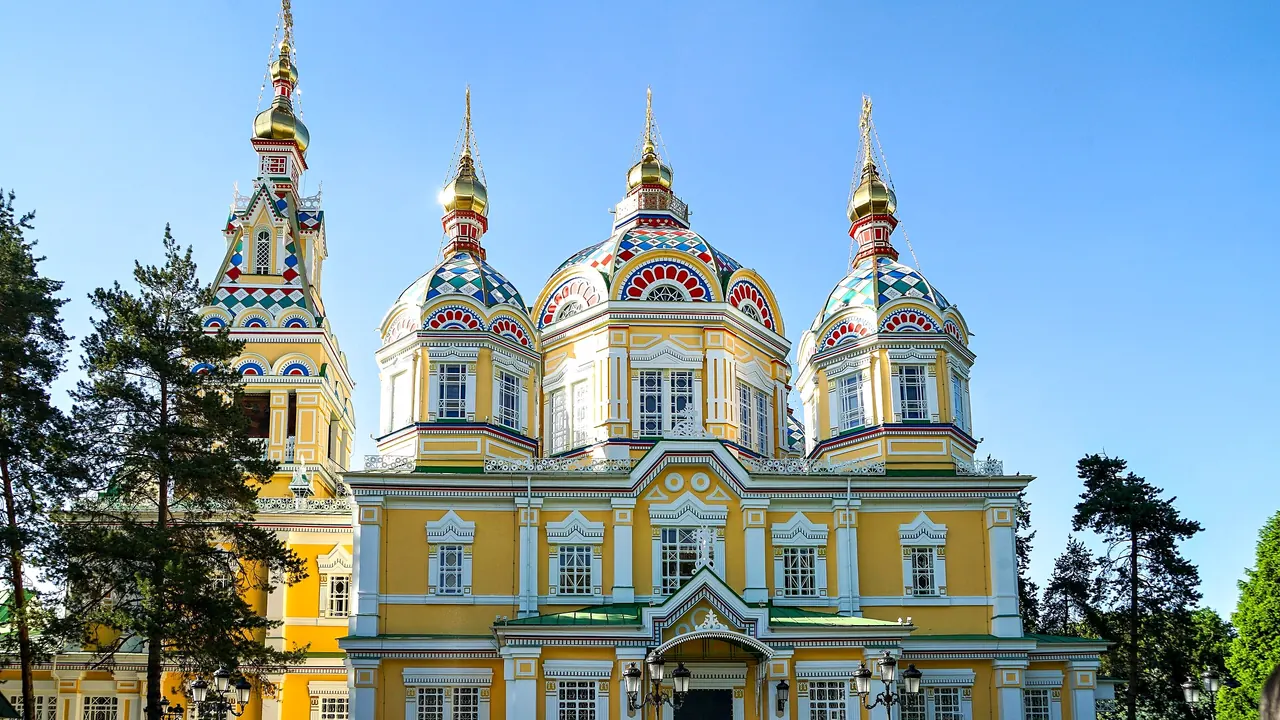
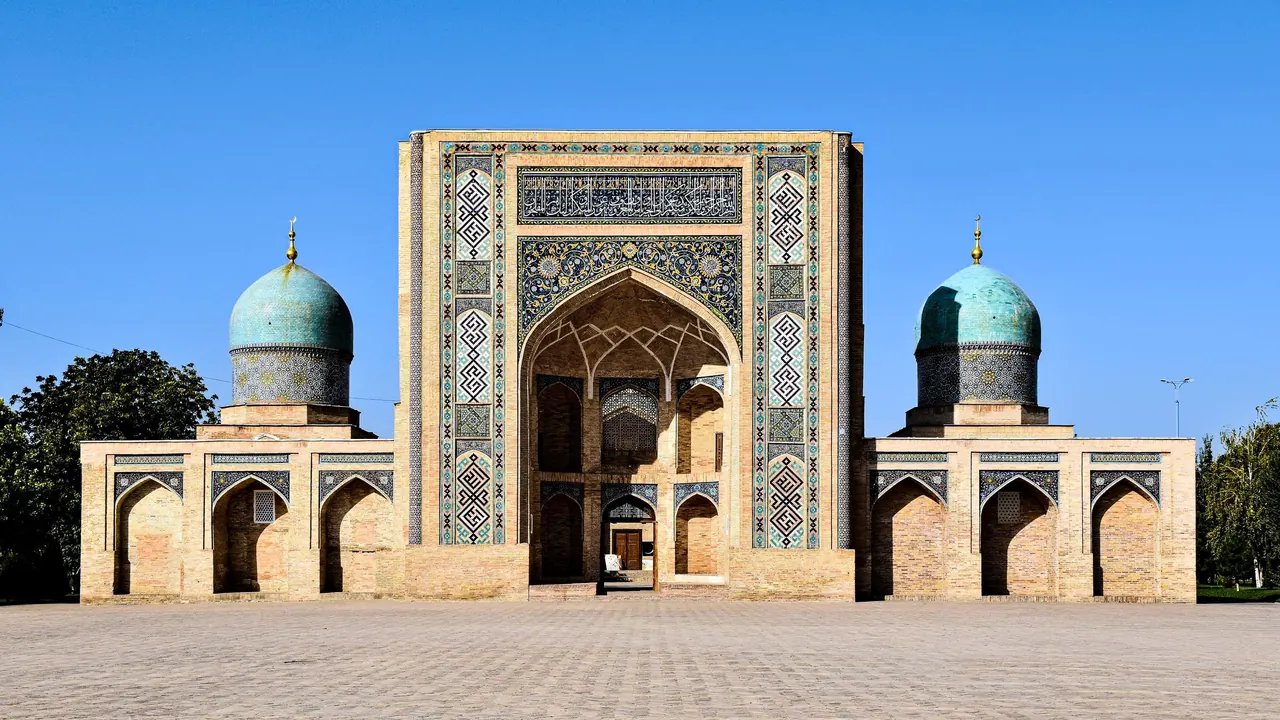
Photos: Almaty by Kalpak Travel, CC BY 2.0, cropped; Tashkent by AXP Photography, Pexels License.
Almaty or Tashkent?
Our verdict in twelve categories, each scored against the same fixed benchmark cities, and the climate month by month, so you can choose for your trip.
Choose Almaty for
- nature and the outdoors
- wellness
- nightlife
Almaty is the choice for travellers who want mountains to be part of the trip. The Trans-Ili Alatau rises straight from the city's southern edge, so hiking, skiing at Shymbulak and walks to glacier lakes fit easily between city days. Evenings bring a livelier weekend bar scene, and you can unwind in the steam rooms of Arasan.
Choose Tashkent for
- day trips
- culture and sights
- getting around
If the trip is about Silk Road history, Tashkent makes more sense. In the city you have the Hazrat Imam complex, the decorated metro and the Navoi Theatre. Its biggest advantage is the fast train to Samarkand, which puts the Registan within a day's reach. It is also a little cheaper and easier to get around without a car, but its summers are fiercely hot.
Scoreboard
Twelve categories on one fixed scale from 0 to 100. The shaded stretch is the gap between the two.
Your match
Pick a travel style or drag the sliders, and both match scores follow your weighting.
Too close to call, level with your weighting
Wins on nature and the outdoors and wellness with your weighting.
Wins on day trips and culture and sights with your weighting.
What matters to you?
Category by category
What the scores mean for a trip.
Beaches & swimming
Neither city is a beach destination, and in both the nearest swim is at a reservoir about an hour and a half away. Almaty's Kapchagay lies out on the flat steppe, with sandy shores and warm summer water. Tashkent's Charvak sits in the foothills, with pebbly shores and cool, clear mountain water.
In town, Tashkent has big outdoor water parks for a hot afternoon. In Almaty, swimming means a pool.
Food & drink
Both cities share Silk Road staples such as lagman, shashlik and dried fruit from the bazaar, and neither has much fine dining or local wine. Almaty offers the wider range: Uyghur noodle houses, Kazakh beshbarmak and horse-meat kazy, Korean salads, and a café and coffee culture across its leafy grid.
Tashkent is narrower and more focused. Midday plov from communal cauldrons, tandir-baked samsa and stamped non bread are eaten slowly on tea-house platforms, and the cooking is so heavy on meat that vegetarians struggle. The Green Bazaar and Chorsu are equally good places to start.
Culture & sights
Tashkent has more to see, even though the 1966 earthquake destroyed most of its old town. The Hazrat Imam complex, with its very old Quran, the Kukeldash Madrasa above Chorsu and the carved rooms of the Museum of Applied Arts give it an Islamic heritage that Almaty lacks. Its chandeliered metro stations are sights in their own right.
Almaty's appeal is narrower: the painted wooden Zenkov Cathedral in Panfilov Park, the Scythian gold in the Central State Museum, the Kasteyev collection of Kazakh art and streets of Soviet modernist mosaics. Both cities need two or three days, but Tashkent fills them more fully.
Nightlife
Almaty is the better city for a night out. At weekends its cocktail bars, craft beer pubs and lounges around Panfilov and Abylai Khan fill with a young crowd, and a few clubs stay open until morning.
Tashkent is quieter. Nights out there mean karaoke, beer gardens and long dinners with friends, and most places close around midnight. Its best evenings are in summer, on terraces and in parks once the heat breaks.
Nature & outdoors
This is Almaty's great strength. The mountains start at the edge of the city, so the Medeu rink is half an hour away and a gondola carries you up to Shymbulak's ski runs and summer trails. Big Almaty Lake and glacier walks are a short drive further, and Charyn Canyon and the Kolsai lakes make spectacular overnight trips.
Tashkent sits on a hot, flat plain, and its mountains are an hour and a half away in the Chimgan range and Ugam-Chatkal National Park. The tulip-covered foothills are lovely in spring, but the peaks are lower and further away, and they are not part of daily city life as they are in Almaty.
Day trips
Tashkent wins clearly here, thanks to Samarkand. The high-speed train reaches the Registan, the Gur-e-Amir and Shah-i-Zinda in just over two hours. That makes a long day there one of the great outings of the region, although staying a night is even better.
Day trips from Almaty go to landscapes rather than towns. The burial mounds at Esik, where the Golden Man was found, and the Tamgaly petroglyphs are the heritage options. Bishkek involves a border crossing and is better done with a night away.
Good for families
Children are made very welcome in both cities, and both have zoos, parks with rides and wide avenues that are hard work with small children. Almaty's family treats lean towards the mountains: the cable car up Kok-Tobe with its petting zoo, open-air skating at Medeu and easy beginner slopes at Shymbulak.
Tashkent's are more about summer, with water parks and fairy-tale amusement parks. But summer days there often pass 35°C, so spring and autumn are much better for a family visit.
Getting around
Tashkent is the easier city to cover without a car. Its metro has several clear lines with frequent trains, and the old town and main squares are close to stations, although the long Soviet-scale blocks make walking slow in the heat.
Almaty's single short metro line is of little use to visitors, so cheap ride-hailing does most of the work. In return, its shaded central grid is more pleasant on foot, rising gently towards the peaks, and buses and gondolas go all the way up to Medeu and Shymbulak.
Shopping & style
Neither city is worth the trip for shopping, and in both the bazaars are more rewarding than the malls. Tashkent is better for crafts, with suzani embroidery, ikat silk, blue Rishtan ceramics and knives around Chorsu, though much of this costs less where it is made, elsewhere in Uzbekistan.
In Almaty, the best things to take home are honey, nuts and tea from the Green Bazaar, along with felt work and carpets. There is also the vast Barakholka market, and its malls carry the luxury brands that Tashkent almost entirely lacks.
Affordability
Accommodation is what separates the two. In Almaty, bazaar meals, Uyghur noodle houses and near-free buses keep daily costs low, but good hotels in the centre are priced close to international levels, and imported wine and cocktails in smart bars add up quickly.
Tashkent's international business hotels are expensive too, but its simple guesthouses and mid-range hotels keep a stay cheap. With plov, bread and tea, metro rides and opera seats all costing little, a modest budget goes a little further there.
Live music & performing arts
Almaty's main stage is the Abai Theatre, a grand neoclassical building where ballet and opera follow the Russian tradition. The Kazakh State Philharmonic is the place to hear the dombra and other traditional instruments alongside orchestral concerts, and a few jazz bars cover the informal side.
In Tashkent the Alisher Navoi Theatre is worth seeing for the building alone, with each hall decorated in the style of a different Uzbek region, and maqom singing and folk ensembles add a musical tradition of their own. Both cities kept the Soviet habit of a full repertory season with easy tickets. In both, though, drama is mostly in Russian or the local language, so ballet, opera and concerts are the safer choice for visitors.
Wellness & relaxation
Almaty has the real bathing culture. Arasan, the huge Soviet-era bath complex beside Panfilov Park, has Russian banya with birch whisking, Finnish saunas and a domed hammam under one roof, and the Alma-Arasan gorge adds hot springs and old sanatoria.
Tashkent has neighbourhood hammams and a few spa complexes, but most visitors use their hotel's facilities. The calm there comes from long afternoons in tea houses and walks in the Botanical Garden.
When should you go?
Pick your month. The climate figures are measured averages, not a forecast.
Almaty in July
Tashkent in July
Daytime high, °C
Rainfall in the month, mm
Temperature and rainfall are climate normals, averaged over the years shown. Almaty: 1991-2020 normals, Almaty (1.7 km from centre). Tashkent: 1991-2020 normals, Tashkent (5.1 km from centre).
The two climates run on different calendars. Almaty has real winters, with highs around 1°C in January, which suits the ski slopes above town but not long walks through the streets. Spring is the wettest time, with rain peaking at 108mm in April and staying high into May. June to September is the best stretch, sunny and warm, reaching about 31°C in July. That is ideal for mountain hiking, and the reservoir is warm enough for a swim in high summer.
Tashkent is milder in winter but much hotter in summer. From June to August it is almost completely dry, the sun shines for very long hours and July highs reach about 36°C, which is too hot for comfortable sightseeing, although that is when locals swim at Charvak. Its best seasons are spring, around 22°C in April with the foothills green, and September to October. Winter and early spring bring most of its rain.
Which traveller are you?
On an outdoors trip, Almaty is the clear winner. Trails, ski runs, the Medeu rink and Big Almaty Lake are all close to the centre. Tashkent's Chimgan range needs a longer drive, and the summer heat in the city rules out much activity.
For a culture and arts trip, Tashkent offers more. The Hazrat Imam complex and the Museum of Applied Arts fill your days, the Navoi Theatre fills your evenings, and Samarkand's Registan is a long but very rewarding day trip by train.
On a relaxing and wellness trip, Almaty suits better. You can spend a long session in the banya and hammam at Arasan, soak in the Alma-Arasan hot springs and enjoy shady avenues. In Tashkent, a spa visit usually means the facilities at your hotel.
Before you go
| Measure | Almaty | Tashkent |
|---|---|---|
| Official language | Russian, Kazakh | Uzbek |
| Currency | Tenge (KZT) | Uzbekistan Sum (UZS) |
| Sockets | CF220 V, 50 Hz | CFI220 V, 50 Hz |
| Driving side | Right | Right |
| Time zone | UTC+5 | UTC+5 |
| Emergency number | 112 | 112 |
| Elevation | 893 m | 455 m |
| Main airport | Almaty International Airport (ALA)16 km from centre93 non-stop destinations | Tashkent International Airport (TAS)6 km from centre112 non-stop destinations |
| Public holidays this year | 13 days | - |
By the numbers
| Measure | Almaty | Tashkent |
|---|---|---|
| City population | 2,228,675 | 2,956,384 |
| People per km² | 3,268 | 8,830 |
| Museums within 10 km | 20 | 27 |
| UNESCO World Heritage sites within 50 km | 1 | 1 |
Where else could you go?
Every comparison below shares a destination with this one, so you can follow Almaty or Tashkent somewhere new.
- Samarkandvs Tashkent
- Bukharavs Tashkent
- Samarkandvs Almaty
- Bukharavs Almaty
- Bakuvs Tashkent
- Tbilisivs Tashkent