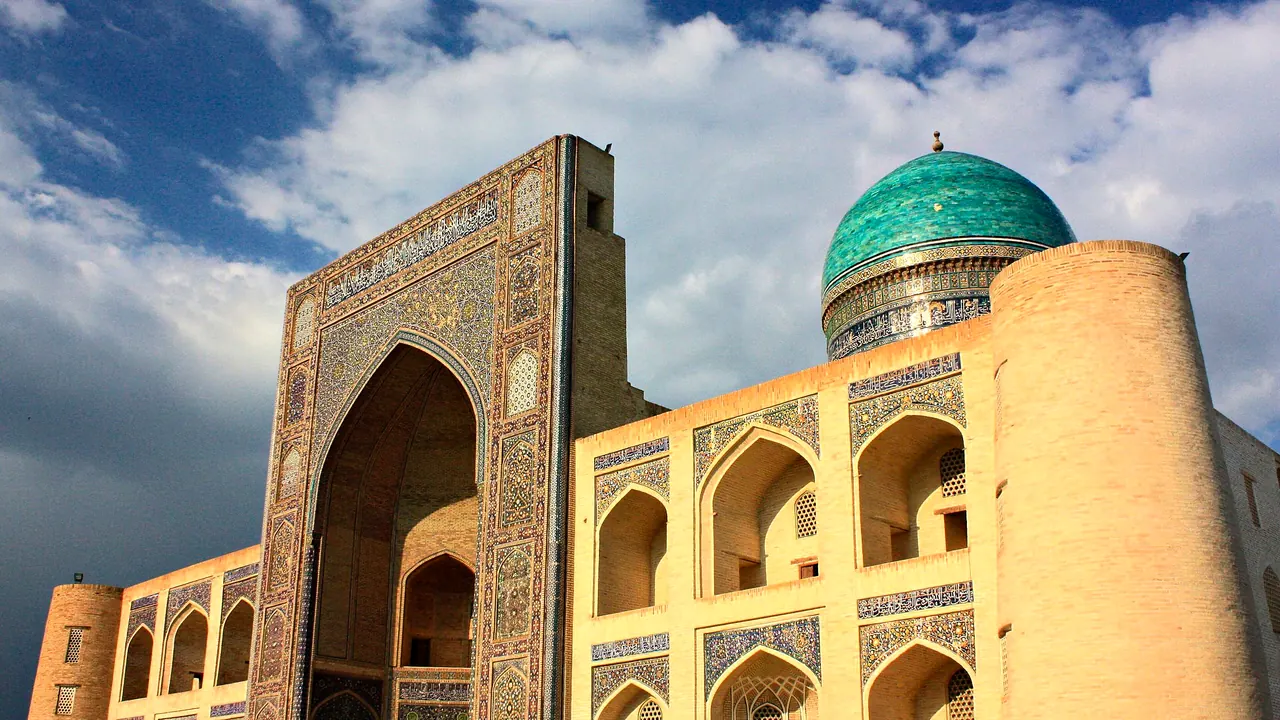
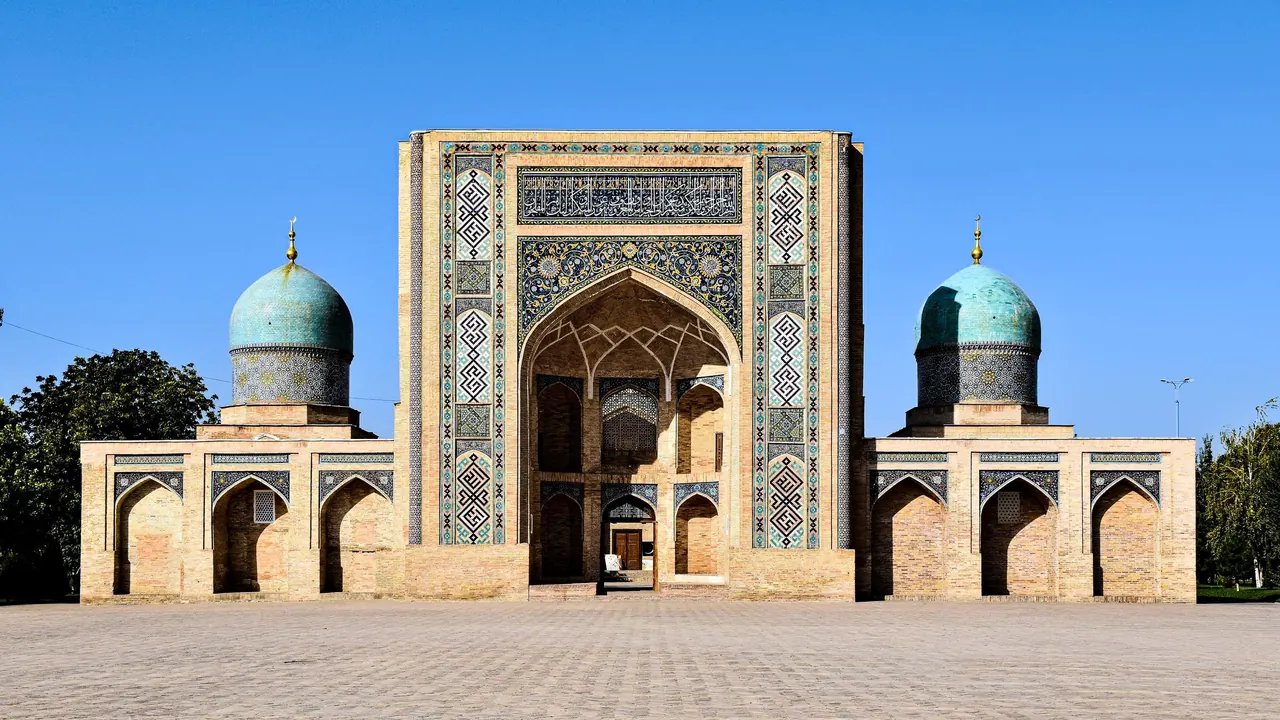
Photos: Bukhara by RK, CC BY-SA 4.0, cropped; Tashkent by AXP Photography, Pexels License.
Bukhara or Tashkent?
Our verdict in twelve categories, each scored against the same fixed benchmark cities, and the climate month by month, so you can choose for your trip.
Choose Bukhara for
- culture and sights
- wellness
- shopping
Bukhara is the better choice if you come to Central Asia for its architecture. The old town is an almost complete ensemble of minarets, madrasas, trading domes and lived-in lanes, and you can cross all of it on foot. Evenings by Lyabi-Hauz, the domed bathhouses and the courtyard guesthouses make for a slow, calm stay. Craft shopping is better here too. It suits a few unhurried days built around looking, not doing.
Choose Tashkent for
- nature and the outdoors
- live music and the arts
- nightlife
Tashkent makes more sense for a trip with more variety. It has the Navoi opera and ballet house, a fuller table around Chorsu Bazaar, a handful of bars and, above all, the Tian Shan foothills within reach for hiking, skiing or a cold swim in Charvak. Children get a zoo, amusement parks and water parks, and the metro makes the sprawling city manageable. Its historic heritage is thin by comparison, so treat it as a base for the mountains and an evening at the theatre rather than for monuments.
Scoreboard
Twelve categories on one fixed scale from 0 to 100. The shaded stretch is the gap between the two.
Your match
Pick a travel style or drag the sliders, and both match scores follow your weighting.
Wins on culture and sights and wellness with your weighting.
Wins on nature and the outdoors and live music and the arts with your weighting.
What matters to you?
Category by category
What the scores mean for a trip.
Beaches & swimming
Neither city is anywhere near a coast, so swimming is a sideline in both. In Bukhara the old pools are for sitting beside, and a hotel pool is the only option in the summer heat.
Tashkent has more to offer. It has big outdoor water parks, and in July and August you can drive about 80km into the foothills to the Charvak reservoir, with pebbly shores and cool mountain water. It is a good day out rather than a reason to go.
Food & drink
Both cities cook the same Uzbek repertoire of plov, samsa, shashlik, lagman and stamped round bread, with tea poured endlessly. Tashkent does it on a bigger scale. It has the great communal plov kitchens serving from huge cauldrons at midday, and Chorsu Bazaar's halls of bread, meat, nuts and kurt cheese give you more to explore and graze on.
In Bukhara the attraction is the setting more than the range. You eat at tables under the mulberry trees around the old pools, but the old-town menus repeat one another. Both places are hard work for vegetarians and offer little fine dining.
Culture & sights
This is where Bukhara pulls far ahead. The Poi Kalon ensemble, the Ark, the Samanid Mausoleum, Bolo Hauz and Chor Minor form a historic centre of rare completeness, and caravanserais and trading domes fill the lanes in between. The museums inside are modest, but the buildings are the point.
Tashkent lost most of its old town in the 1966 earthquake and is mainly a Soviet capital of avenues and squares. Its strengths are in pockets: the Hazrat Imam complex with its ancient Quran, the carved rooms of the Museum of Applied Arts and the ornate metro stations. It has better museums but far fewer monuments.
Nightlife
Neither is a place for a big night out, but Tashkent at least gives you a choice. There are pubs, beer gardens, a few cocktail bars and clubs around Amir Timur Square, and karaoke and long dinners with friends, mostly winding down around midnight.
Bukhara's evening is a single scene: tea and dinner by Lyabi-Hauz beneath the floodlit madrasas, then an early night. A drink means a hotel bar or a restaurant that serves beer.
Nature & outdoors
Tashkent has the mountains on its doorstep, and that changes the trip. The western Tian Shan rises within about an hour and a half, with Big Chimgan above the turquoise Charvak reservoir. Summer brings hiking through walnut and juniper valleys, riding and paragliding, and winter brings skiing at Chimgan and Amirsoy.
Bukhara sits in a flat oasis of cotton fields and canals at the edge of the Kyzylkum. The desert yurt camps towards Nurata involve a long drive and an overnight stay rather than an easy outing.
Day trips
These are broadly even, and both rest on the same star: Samarkand by high-speed train, slightly closer from Bukhara. The difference lies in what comes next.
From Bukhara there are short heritage and craft outings: Gijduvon's family pottery workshops, the twelfth-century minaret at Vabkent and the walled tombs of Chor Bakr. From Tashkent the alternatives are mountain valleys and the reservoir rather than towns.
Good for families
Tashkent gives children more to do. It has a large zoo, fairy-tale amusement parks, summer water parks, the Botanical Garden and big parks where local families gather in the evening. Its drawbacks are the long walks along wide avenues and sights that mean little to small children, though cheap taxis help.
Bukhara is easier to move around in but thinner on entertainment. The flat, mostly pedestrian old town works well with a pushchair, but a puppet show or a camel at the summer palace is about as far as children's attractions go. Summer heat there can pass 40°C.
Getting around
Both are easy without a car, but in different ways. In Bukhara almost everything lies within about 20 minutes' walk across a flat, largely car-free old town. You only need a taxi for the outlying shrine, the summer palace and the distant railway station.
Tashkent is built on a Soviet scale, so you depend on its clear, frequent metro, with stations close to the old town and the main squares, and on cheap app taxis to fill the gaps.
Shopping & style
Bukhara is the better place to buy crafts. In its sixteenth-century trading domes and madrasa courtyards, workshops sell suzani, ikat, carpets, gold-thread caps and the famous stork-shaped scissors, often made in the next room. Quality varies, so take your time.
Tashkent's stalls around Chorsu and in the old madrasas carry similar goods, but much of the finest work comes from Bukhara and other towns and costs less at the source. Beyond that, Tashkent mostly offers malls with international chains.
Affordability
Both are very cheap, and the gap between them is small. Meals, taxis and entry tickets cost little in either city.
What differs is where you stay. In Bukhara, good-value family guesthouses in old merchant houses with tiled courtyards are the norm. Tashkent's international business hotels sit well above everything else in the capital, so it pays to choose a guesthouse or mid-range hotel there.
Live music & performing arts
Tashkent is the only one of the two where you can plan an evening around a performance. The Alisher Navoi Theatre stages classic opera and ballet in halls decorated in regional styles, and the conservatory, philharmonic and Russian and Uzbek drama add to the choice.
Bukhara's performances are mostly staged for visitors: folk music, dance and costume shows in a madrasa courtyard by Lyabi-Hauz, plus small puppet plays.
Wellness & relaxation
Bukhara is the more restful stay. Its centuries-old bathhouses under brick domes near the trading halls still offer steam, a scrub and a vigorous herbal massage. The courtyard mornings and quiet lanes at dusk set a slow pace.
In Tashkent bathing is less a part of a visit, and most visitors use hotel spas. Calm there comes from the Botanical Garden and tea-house platforms, and for a real retreat you would head to the mountain sanatoria around Chimgan.
When should you go?
Pick your month. The climate figures are measured averages, not a forecast.
Bukhara in July
Tashkent in July
Daytime high, °C
Rainfall in the month, mm
Temperature and rainfall are climate normals, averaged over the years shown. Bukhara: 2004-2020 (rainfall 1991-2020) normals, Bukhara / Tsyplan (3.4 km from centre). Tashkent: 1991-2020 normals, Tashkent (5.1 km from centre).
Bukhara and Tashkent follow almost the same temperature curve. Winters are cold, with daytime highs around 7°C in January. Summers are fierce, and Bukhara is the hotter of the two, reaching 38°C in July. In both cities, walking the streets in the middle of the day from June to August is hard going, and Bukhara already feels hot in May. April and October are the most comfortable months for sightseeing in either city, with late September close behind.
The real difference is rain. Bukhara is dry almost all year, and even in its wettest month, March, it gets only about 29mm. Tashkent gets proper rain from November to April, peaking at 73mm in February, so a spring trip there will bring some wet days, though that is also when the tulips cover the foothills. From June to September Tashkent is dry and very sunny. In July and August, its hottest months, locals escape to the cool mountain water of the Charvak reservoir.
Which traveller are you?
On a culture and arts trip, Bukhara is the clear pick. Its walkable old town of madrasas, the Ark, the Kalon Minaret and the Samanid Mausoleum outclasses anything in Tashkent. The capital's one advantage is the opera and ballet.
For an outdoors trip, choose Tashkent. The Chimgan range and Ugam-Chatkal National Park are about an hour and a half away, with ridge hiking and horse riding in summer, skiing in winter and the Charvak reservoir for swimming. Bukhara has flat oasis and desert.
On a relaxing and wellness trip, Bukhara suits better. You can steam and be scrubbed in centuries-old bathhouses under brick domes, then pass slow afternoons over tea by the pools. Its car-free lanes keep the whole stay quieter than Tashkent's broad avenues.
Before you go
| Measure | Bukhara | Tashkent |
|---|---|---|
| Official language | Uzbek | Uzbek |
| Currency | Uzbekistan Sum (UZS) | Uzbekistan Sum (UZS) |
| Sockets | CFI220 V, 50 Hz | CFI220 V, 50 Hz |
| Driving side | Right | Right |
| Time zone | UTC+5 | UTC+5 |
| Emergency number | 112 | 112 |
| Elevation | 225 m | 455 m |
| Main airport | Bukhara International Airport (BHK)5 km from centre11 non-stop destinations | Tashkent International Airport (TAS)6 km from centre112 non-stop destinations |
By the numbers
| Measure | Bukhara | Tashkent |
|---|---|---|
| City population | 280,187 | 2,956,384 |
| People per km² | 7,111 | 8,830 |
| Museums within 10 km | 2 | 27 |
| UNESCO World Heritage sites within 50 km | 1 | 1 |
Where else could you go?
Every comparison below shares a destination with this one, so you can follow Bukhara or Tashkent somewhere new.
- Samarkandvs Bukhara
- Samarkandvs Tashkent
- Almatyvs Tashkent
- Almatyvs Bukhara
- Bakuvs Tashkent
- Tbilisivs Tashkent