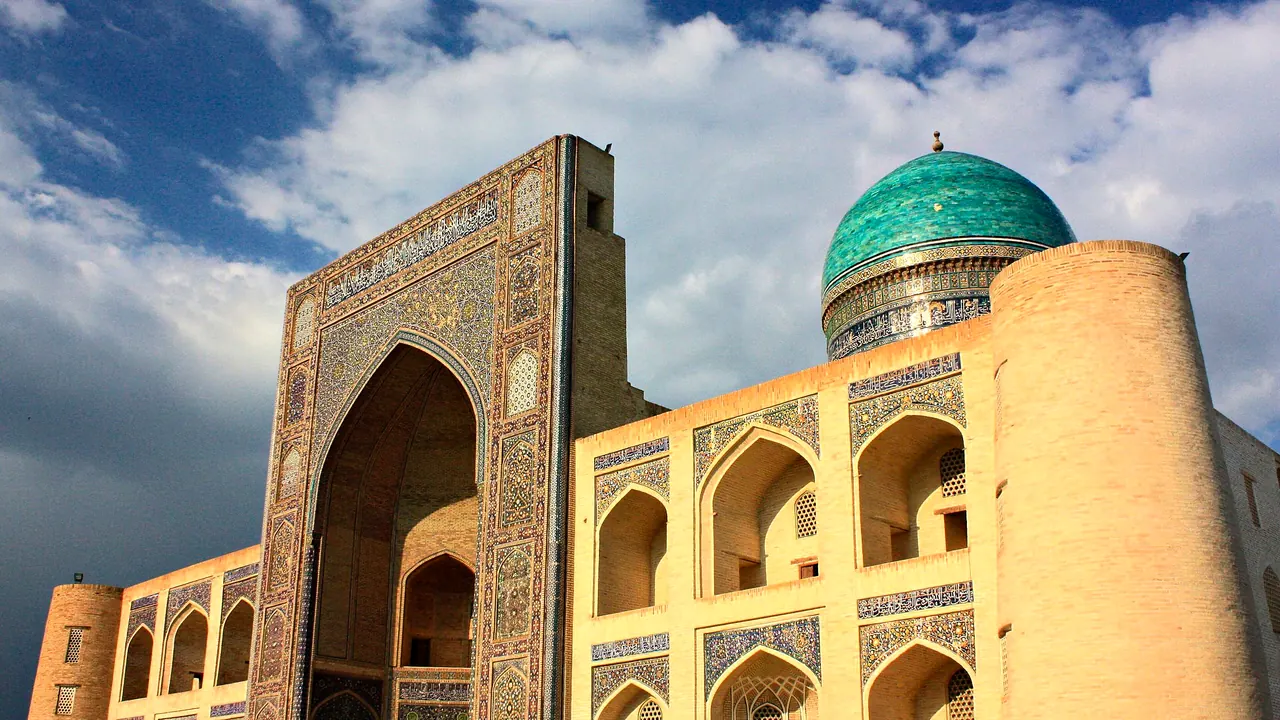
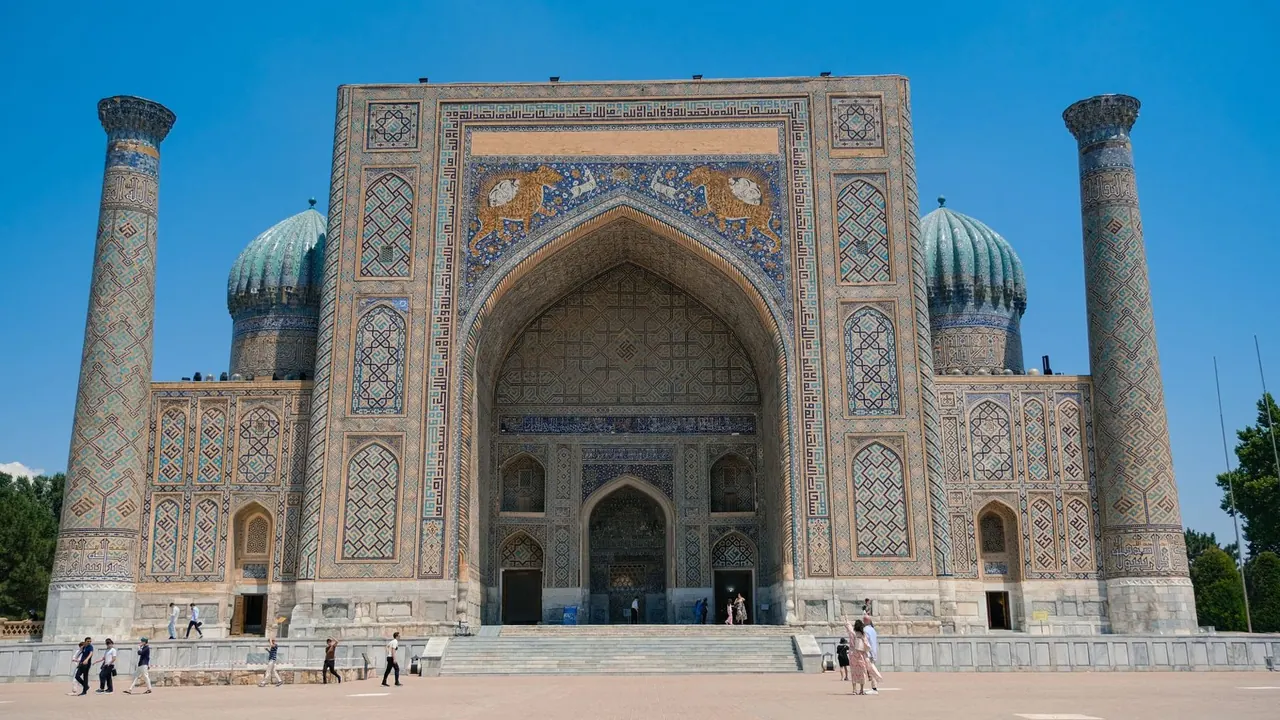
Photos: Bukhara by RK, CC BY-SA 4.0, cropped; Samarkand by Yaşar Başkurt, Pexels License.
Bukhara or Samarkand?
Our verdict in twelve categories, each scored against the same fixed benchmark cities, and the climate month by month, so you can choose for your trip.
Choose Bukhara for
- wellness
- shopping
- families
Bukhara suits travellers who want to slow down inside one intact old town. Its lanes, trading domes and madrasas fit within a short walk, its centuries-old bathhouses and teahouse platforms make the days restful, and its craft workshops are the better place to buy embroidery, carpets and hand-forged knives. Choose it if your idea of a good afternoon is a scrub in a domed bath, then tea beside an old pool.
Choose Samarkand for
- nature and the outdoors
- day trips
- food and drink
Samarkand rewards those after the grandest single monuments and a bit more to do around them. The Registan, Shah-i-Zinda and Timur's tomb are more spectacular than anything in Bukhara, the food has more local character, and the city makes a better base. Mountain valleys for walking lie an hour away, and Shahrisabz and Bukhara itself are easy day trips.
Scoreboard
Twelve categories on one fixed scale from 0 to 100. The shaded stretch is the gap between the two.
Your match
Pick a travel style or drag the sliders, and both match scores follow your weighting.
Wins on wellness and shopping with your weighting.
Wins on nature and the outdoors and day trips with your weighting.
What matters to you?
Category by category
What the scores mean for a trip.
Beaches & swimming
Neither city is anywhere near the sea, and neither has a beach. Bukhara's historic pools, Lyabi-Hauz among them, are for sitting beside. Around Samarkand, locals cool off in the shallow Zarafshan river and the irrigation channels, but that is not something to plan a trip around. In both cities a hotel pool is the only real way to swim, and in Bukhara's fiercer summer heat it matters even more.
Food & drink
The two cities cook the same Uzbek dishes, plov at lunchtime, samsa, shashlik and endless green tea. Bukhara offers less around them. Its pleasure is the setting, under the mulberry trees by the old pools or on teahouse platforms, but menus repeat across the old town, and vegetarians struggle.
Samarkand gives the same cuisine more local identity. It has its own layered plov and the dense, glazed Samarkand bread known across Central Asia, and Siab Bazaar beside Bibi-Khanym is a better market to graze through than anything in Bukhara. A winery dating from the nineteenth century adds a tasting to the trip.
Culture & sights
These are the two great Silk Road cities, and the difference between them is one of shape. Bukhara is the more complete. Its old town hangs together from the Kalon Minaret to the Ark and the tenth-century Samanid Mausoleum, and the residential lanes in between still feel lived in, so the whole place works as one monument.
Samarkand has the more spectacular individual buildings. These are the Registan square, the tilework of Shah-i-Zinda and the gold interior of Gur-e-Amir, along with Ulugh Beg's observatory and the Afrasiyab murals. Between them, though, lie Soviet-era avenues rather than an intact old quarter.
Nightlife
Both cities go to bed early, and neither has a club. A Bukhara evening is gentle: tea or dinner by Lyabi-Hauz under the floodlit madrasas, then quiet streets. Samarkand is a little louder, with big restaurants where wedding parties dance to live bands and a few lounges in the Russian-era quarter. Even so, anyone who wants a late night should wait for Tashkent.
Nature & outdoors
Samarkand has far better access to the outdoors. The Zarafshan range rises to the south, and about an hour away the Aman-Kutan valley and the hills above Urgut have streams, juniper woods, walnut groves and trails through Tajik-speaking villages. The Nuratau mountains are within reach for longer homestay treks.
Bukhara sits in a flat oasis of cotton fields and canals that gives way to scrub desert. Its outdoor option is a yurt camp with camel rides towards the Nurata lakes, which means a long drive and a night away.
Day trips
Each city is the other's best day trip, linked by a high-speed train that takes under two hours. Beyond that, Samarkand has more within reach. Shahrisabz, Timur's birthplace, is a drive over a mountain pass that fits into a day, the Urgut Sunday bazaar sells old suzani among the produce, the paper-making village of Konigil is just outside town, and Tashkent is about two hours away by train.
Bukhara's nearby trips are smaller: the ceramics workshops of Gijduvon, the minaret at Vabkent and the Chor Bakr necropolis. From Bukhara, both Shahrisabz and Khiva need an overnight stay.
Good for families
Neither city is built for children, but both are safe, and strangers in both are warm towards small visitors. Bukhara's advantage is its size. The old town is flat, mostly pedestrian and compact, so pushchairs cope and little legs do not have far to go.
Samarkand has parks with simple rides and wide pedestrian streets around the Registan, but the sights are further apart. Older children with an interest in history and tilework get the most out of it. Both cities are best avoided with young children in high summer.
Getting around
Both are walking cities with cheap app taxis for the outlying sights, and neither calls for a car. Bukhara's old town is a single compact, largely car-free area, where most things lie within twenty minutes on foot through the trading domes. Samarkand is laid out in a line instead: one pedestrian street runs from the Registan past Bibi-Khanym to Shah-i-Zinda, but the observatory, Afrasiyab and the station need a taxi.
Shopping & style
Bukhara is the better place to buy crafts. In its sixteenth-century trading domes and the madrasa courtyards around them, suzani, ikat, carpets, gold-thread caps, hammered copper and the stork-shaped scissors are often sold next to the room where they were made. Take your time and bargain gently, as quality varies.
Samarkand sells much the same from madrasa cells in the Registan and Shah-i-Zinda, but souvenirs crowd out the good pieces more. Its own specialities are hand-knotted carpets and the mulberry-bark paper pressed at Konigil.
Affordability
Both cities are very cheap for plov, tea, taxis and monument entry, and family-run guesthouses are good value in either. Bukhara's guesthouses are often old merchant houses with tiled courtyards. In Samarkand, prices climb at the upper-end hotels around the Registan in spring and autumn, and imported alcohol is not cheap.
Live music & performing arts
Samarkand offers a little more of an evening programme. The Registan is lit for sound-and-light shows, and in some years it hosts the Sharq Taronalari festival of music from across the East. Bukhara's offering is smaller: folk dance and costume shows in a madrasa courtyard beside Lyabi-Hauz, plus puppet shows of local tales.
In either city, classical maqom music is more likely to be heard by chance at a wedding than in a concert.
Wellness & relaxation
Bukhara is the more restful of the two. Several bathhouses that are centuries old still work under brick domes near the trading halls, offering steam, scrub and herbal massage much as they always have. The town's slow rhythm of courtyard mornings and afternoons over tea completes the effect.
Samarkand keeps the hammam tradition alive in a single old bathhouse near Bibi-Khanym, plus hotel spas. Its calm is found on a shaded topchan in a chaikhana, or in the old quarter once the tour groups have gone.
When should you go?
Pick your month. The climate figures are measured averages, not a forecast.
Bukhara in July
Samarkand in July
Daytime high, °C
Rainfall in the month, mm
Temperature and rainfall are climate normals, averaged over the years shown. Bukhara: 2004-2020 (rainfall 1991-2020) normals, Bukhara / Tsyplan (3.4 km from centre). Samarkand: 1991-2020 normals, Samarkand (10 km from centre).
Both cities have cold winters, with highs around 7°C in January, and a long, very hot summer, so the best weather for walking the streets comes in spring and autumn. Bukhara is the hotter and drier of the two. July reaches about 38°C, and almost no rain falls from May to October. April and October are its most comfortable months for sightseeing, with September close behind. By May the middle of the day is already hard going. Neither city has a beach season.
Samarkand stays a few degrees cooler, at about 34°C in July, but its spring is much wetter. March and April are the rainiest months, with close to 69mm each, though the rain also turns the hills green. May is warm and very sunny but still showery. June to September are dry, and September is warm without the peak heat, which makes it the best month for combining the monuments with a walk in the valleys.
Which traveller are you?
On an outdoors trip, Samarkand lets you swap madrasas for whole days on foot. A short morning drive puts you on village trails in green hills, and in spring a walk can turn into a trek of several days. Bukhara offers little beyond a night at a desert camp.
For a relaxing and wellness trip, Bukhara is the easier place to unwind. A traditional steam and massage can become a daily afternoon ritual, the compact old town keeps every day unhurried, and evenings end early and quietly. Samarkand's sights are further apart, and tour groups fill them.
On a shopping trip, Bukhara is the better use of your time. You can spend several slow hours comparing textiles stall by stall, meet the people who make them and go home with an old suzani or a hand-forged knife. In Samarkand, the good finds are harder to spot among the souvenirs.
Before you go
| Measure | Bukhara | Samarkand |
|---|---|---|
| Official language | Uzbek | Uzbek |
| Currency | Uzbekistan Sum (UZS) | Uzbekistan Sum (UZS) |
| Sockets | CFI220 V, 50 Hz | CFI220 V, 50 Hz |
| Driving side | Right | Right |
| Time zone | UTC+5 | UTC+5 |
| Emergency number | 112 | 112 |
| Elevation | 225 m | 702 m |
| Main airport | Bukhara International Airport (BHK)5 km from centre11 non-stop destinations | Samarkand International Airport (SKD)5 km from centre29 non-stop destinations |
By the numbers
| Measure | Bukhara | Samarkand |
|---|---|---|
| City population | 280,187 | 546,303 |
| People per km² | 7,111 | 5,058 |
| Museums within 10 km | 2 | 11 |
| UNESCO World Heritage sites within 50 km | 1 | 1 |
Where else could you go?
Every comparison below shares a destination with this one, so you can follow Bukhara or Samarkand somewhere new.
- Tashkentvs Samarkand
- Tashkentvs Bukhara
- Almatyvs Samarkand
- Almatyvs Bukhara
- Jaipurvs Samarkand
- Bakuvs Samarkand