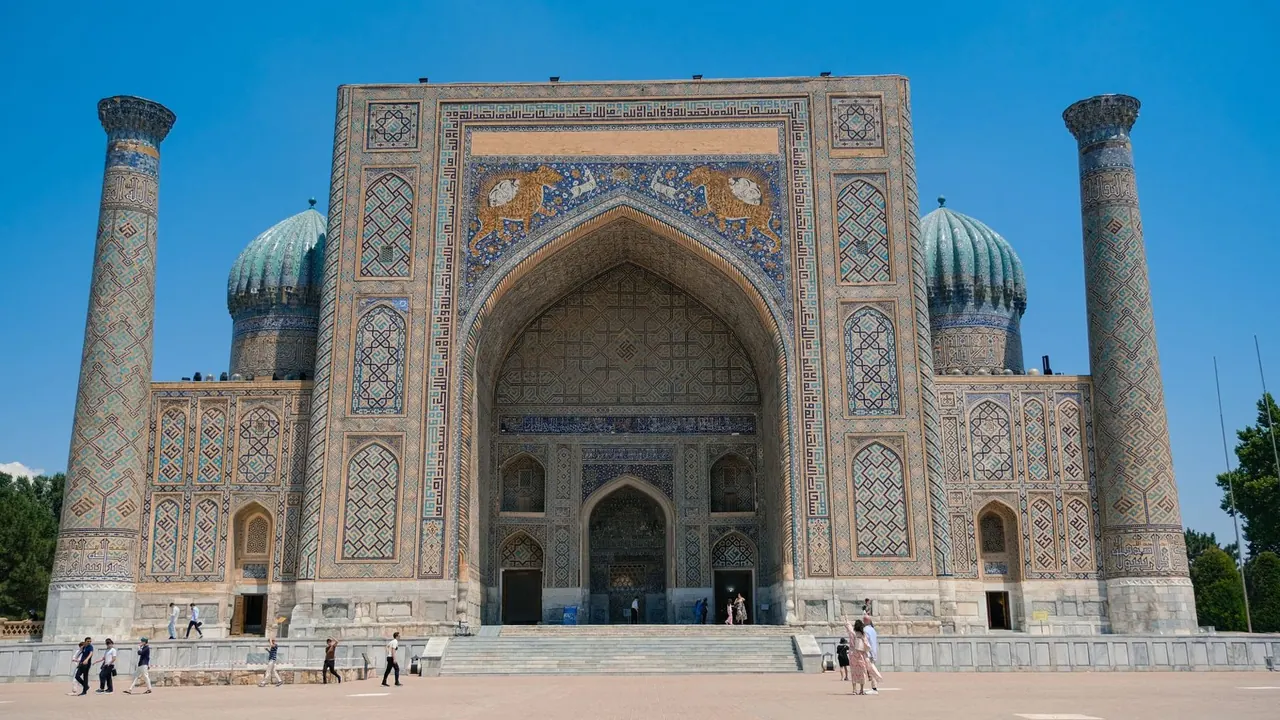
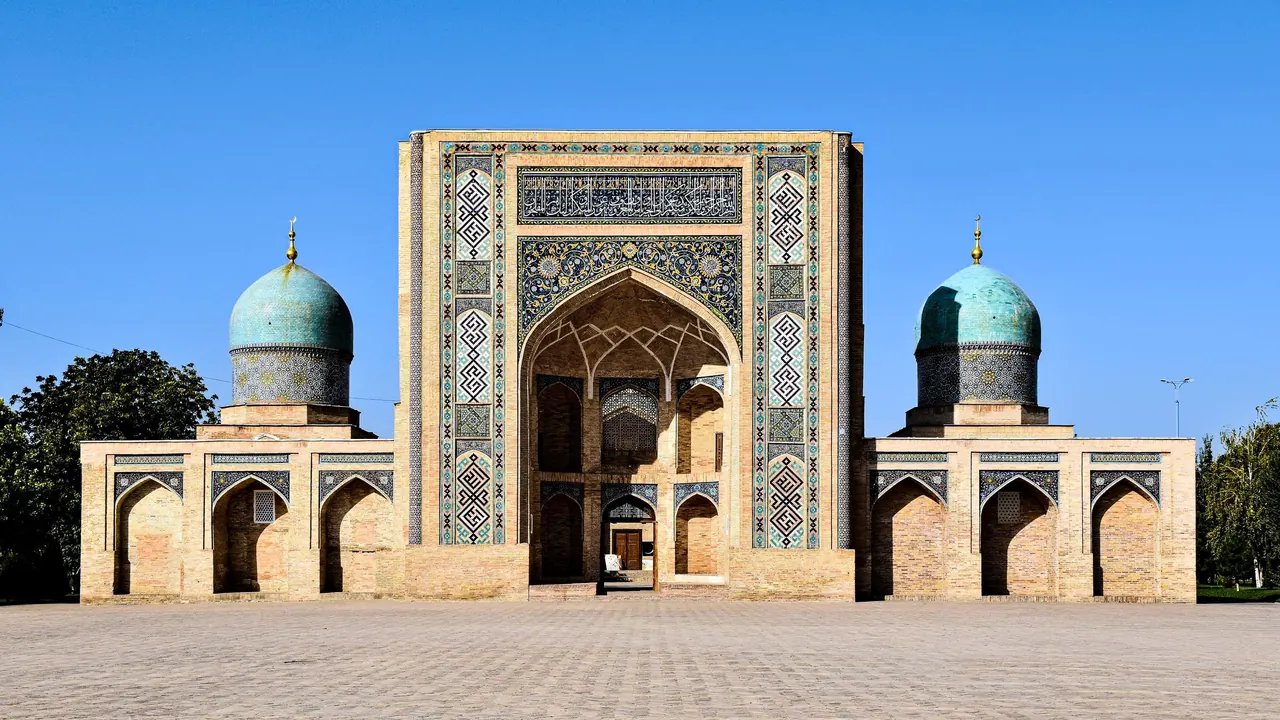
Photos: Samarkand by Yaşar Başkurt, Pexels License; Tashkent by AXP Photography, Pexels License.
Samarkand or Tashkent?
Our verdict in twelve categories, each scored against the same fixed benchmark cities, and the climate month by month, so you can choose for your trip.
Choose Samarkand for
- culture and sights
- day trips
- getting around
Samarkand is the choice for travellers who come to Uzbekistan for its monuments. The Registan, Shah-i-Zinda and Gur-e-Amir are among the finest Islamic buildings anywhere, the main sights sit along one walkable spine, and Bukhara and Shakhrisabz are easy day trips. It suits a focused stay of a few days built around architecture, tilework and bazaars, with quiet evenings.
Choose Tashkent for
- live music and the arts
- nature and the outdoors
- families
Tashkent works better as a base for a broader trip. Its old monuments are fewer, but it has an opera and ballet house worth an evening, the Tian Shan mountains within a short drive for hiking in summer and skiing in winter, and more to keep children busy. Nights out are livelier too, though still modest. If you want the city itself to supply variety, choose Tashkent.
Scoreboard
Twelve categories on one fixed scale from 0 to 100. The shaded stretch is the gap between the two.
Your match
Pick a travel style or drag the sliders, and both match scores follow your weighting.
Wins on culture and sights and day trips with your weighting.
Wins on live music and the arts and nature and the outdoors with your weighting.
What matters to you?
Category by category
What the scores mean for a trip.
Beaches & swimming
Neither city has a coast, but Tashkent at least gives you somewhere to swim. Its outdoor water parks fill up through the summer, and the Charvak reservoir, about 80km away in the foothills, has pebbly shores and cool mountain water for a day out in July or August.
In Samarkand, swimming means a hotel pool. The shallow Zarafshan river is where locals paddle, not somewhere a visitor would plan a trip around.
Food & drink
The food is much the same in both cities: plov at lunchtime, charcoal-grilled shashlik, samsa from tandoor ovens and long meals in tea houses. Both have the same weaknesses, too, with meat-heavy menus and little fine dining.
What differs is the detail. Samarkand has its own layered plov and its famous glazed non, best seen stacked at Siab Bazaar beside Bibi-Khanym. Tashkent adds hand-pulled lagman and the great communal plov kitchens, and Chorsu Bazaar under its green dome is the larger and busier market to explore.
Culture & sights
On culture the two cities are far apart. Samarkand holds the Timurid masterpieces: the three madrasas of the Registan, the tiled avenue of tombs at Shah-i-Zinda, the gilded interior of Gur-e-Amir and the huge Bibi-Khanym mosque, with Ulugh Beg's observatory and the Afrasiyab murals around them.
Most of old Tashkent was lost in the 1966 earthquake, so its heritage comes in pockets: the Hazrat Imam complex with its ancient Quran, the Kukeldash Madrasa, and the carved rooms of the Museum of Applied Arts. Its own character is Soviet modernism, best seen in the ornate metro stations. These are interesting, but they are not the reason people cross Central Asia.
Nightlife
After dark, Samarkand has one main pleasure: a long restaurant dinner, often next to a wedding party dancing to a loud live band, then a walk past the floodlit Registan. Apart from a few hotel bars, the streets are quiet well before midnight.
Tashkent gives you more choice once dinner is over. Pubs, beer gardens, cocktail bars and a handful of clubs are grouped near Amir Timur Square, karaoke is popular, and on summer nights people stay out on terraces and in the parks after the heat breaks. Most places still close around midnight, so it is a modest night out, but it is a night out.
Nature & outdoors
Tashkent has much more serious mountains within reach. In about an hour and a half you are in the western Tian Shan, where Big Chimgan rises above the turquoise Charvak reservoir. The Ugam-Chatkal National Park has ridge walks and juniper valleys, and Chimgan and Amirsoy turn into ski resorts in winter.
Samarkand's countryside is softer. The Aman-Kutan valley and the hills above Urgut have walnut groves, streams and village paths, and the Nuratau range suits homestay treks. All of it is pretty rather than grand, and best walked in spring or autumn.
Day trips
Samarkand is the better base for seeing other places. Bukhara's old town is about an hour and a half away by fast train, and Shakhrisabz, with the remains of Timur's White Palace, lies over a mountain pass. Closer in, the Sunday bazaar at Urgut and the paper-making village of Konigil make easy half days.
From Tashkent the obvious day trip is Samarkand itself, a long day by fast train. After that, the outings from the capital are to the mountains and the reservoir rather than to other historic towns.
Good for families
Children are welcomed warmly in both cities, but Tashkent gives them far more to do. There is a large zoo, the Botanical Garden, amusement parks and water parks, and the evening parks fill with local families.
In Samarkand, the pedestrian streets around the Registan are calm and safe, but the sights are mausoleums and madrasas spread out in the heat. It works best for older children who are genuinely curious about history or tilework.
Getting around
Both cities are easy to get around, in different ways. In Samarkand you mostly walk: a pedestrian street links the Registan, Bibi-Khanym, Siab Bazaar and Shah-i-Zinda, with Gur-e-Amir close by.
Tashkent is too spread out for that, with Soviet-scale avenues and long blocks, so you rely on its clear, frequent metro, which stops near the old town and the main squares. In both, cheap app taxis cover the rest.
Shopping & style
Shopping is mostly crafts in both cities, so the difference is in where you buy and how close you are to the makers. Samarkand sells suzani, ikat, ceramics and miniatures from workshops in the madrasa cells, carpets are woven locally, and mulberry paper is still made at Konigil.
Tashkent's craft stalls around Chorsu bring together work from across the country, including Rishtan blue pottery, but much of it is cheaper where it is made. In return, the capital has the modern malls that Samarkand lacks.
Affordability
Both cities are cheap. Bazaar meals, plov, tea and app taxis cost very little in either, and simple guesthouses keep a stay inexpensive. Where costs rise differs: in Samarkand it is the better hotels near the Registan in spring and autumn, and in Tashkent it is the international business hotels. Opera tickets and the metro add little to a budget in the capital.
Live music & performing arts
Tashkent is clearly better for performance. The Alisher Navoi Theatre puts on classic opera and ballet through the season in halls decorated in regional styles, and the conservatory and philharmonic halls hold classical concerts.
Samarkand's performances are mostly put on for visitors: folk costume shows and the sound-and-light display on the Registan. The Sharq Taronalari festival brings real musicians to the square, but only in some years.
Wellness & relaxation
Neither city is a wellness destination. Each has a few hammams and some hotel spas, and in both the real rest comes from long afternoons on a shaded tea-house platform. Samarkand adds its old domed bathhouse near Bibi-Khanym and quiet courtyards in the old quarter, while Tashkent has the Botanical Garden and the mountain sanatoria around Chimgan for a proper retreat.
When should you go?
Pick your month. The climate figures are measured averages, not a forecast.
Samarkand in July
Tashkent in July
Daytime high, °C
Rainfall in the month, mm
Temperature and rainfall are climate normals, averaged over the years shown. Samarkand: 1991-2020 normals, Samarkand (10 km from centre). Tashkent: 1991-2020 normals, Tashkent (5.1 km from centre).
Samarkand is at its best in April and May and again in September and October, when the days are warm enough to walk between the monuments in comfort. Spring is also its wettest stretch, with March the peak at about 69mm, so expect some showery days. From June to August the rain all but stops and the sun shines for long hours, but highs around 34°C push sightseeing into the mornings and evenings. Winters are cool, near 7°C in January, with short, often grey days.
Tashkent follows much the same pattern, with the same spring and autumn sweet spots, but its summer runs a little hotter, reaching about 36°C in July. That is the time to head up to the cool water of the Charvak reservoir. Its wet season comes earlier and lasts longer: rain builds from November and peaks in February at about 73mm, with a damp spring after it. Winter is also the ski season at Chimgan and Amirsoy, so a cold-weather visit has more point in Tashkent than among Samarkand's open-air sights.
Which traveller are you?
On a culture and arts trip, choose Samarkand for its buildings. The Registan, Shah-i-Zinda and Timur's tomb are unmatched in Central Asia, and Bukhara is a day trip away. Spend one night in Tashkent if you also want an evening of ballet.
On a family trip with children, Tashkent is the easier city. It has a large zoo, water parks, amusement parks and big evening parks, and the metro makes getting around simpler. In Samarkand there is little for children beyond tiled madrasas and hot walks between them.
For an outdoors trip, Tashkent is the better base. The Chimgan range and Ugam-Chatkal National Park are within a short drive, offering ridge hikes, horse riding, paragliding and winter skiing. Samarkand's nearby valleys and the Nuratau treks are gentler and less varied.
Before you go
| Measure | Samarkand | Tashkent |
|---|---|---|
| Official language | Uzbek | Uzbek |
| Currency | Uzbekistan Sum (UZS) | Uzbekistan Sum (UZS) |
| Sockets | CFI220 V, 50 Hz | CFI220 V, 50 Hz |
| Driving side | Right | Right |
| Time zone | UTC+5 | UTC+5 |
| Emergency number | 112 | 112 |
| Elevation | 702 m | 455 m |
| Main airport | Samarkand International Airport (SKD)5 km from centre29 non-stop destinations | Tashkent International Airport (TAS)6 km from centre112 non-stop destinations |
By the numbers
| Measure | Samarkand | Tashkent |
|---|---|---|
| City population | 546,303 | 2,956,384 |
| People per km² | 5,058 | 8,830 |
| Museums within 10 km | 11 | 27 |
| UNESCO World Heritage sites within 50 km | 1 | 1 |
Where else could you go?
Every comparison below shares a destination with this one, so you can follow Samarkand or Tashkent somewhere new.
- Bukharavs Samarkand
- Bukharavs Tashkent
- Almatyvs Tashkent
- Almatyvs Samarkand
- Jaipurvs Samarkand
- Bakuvs Samarkand