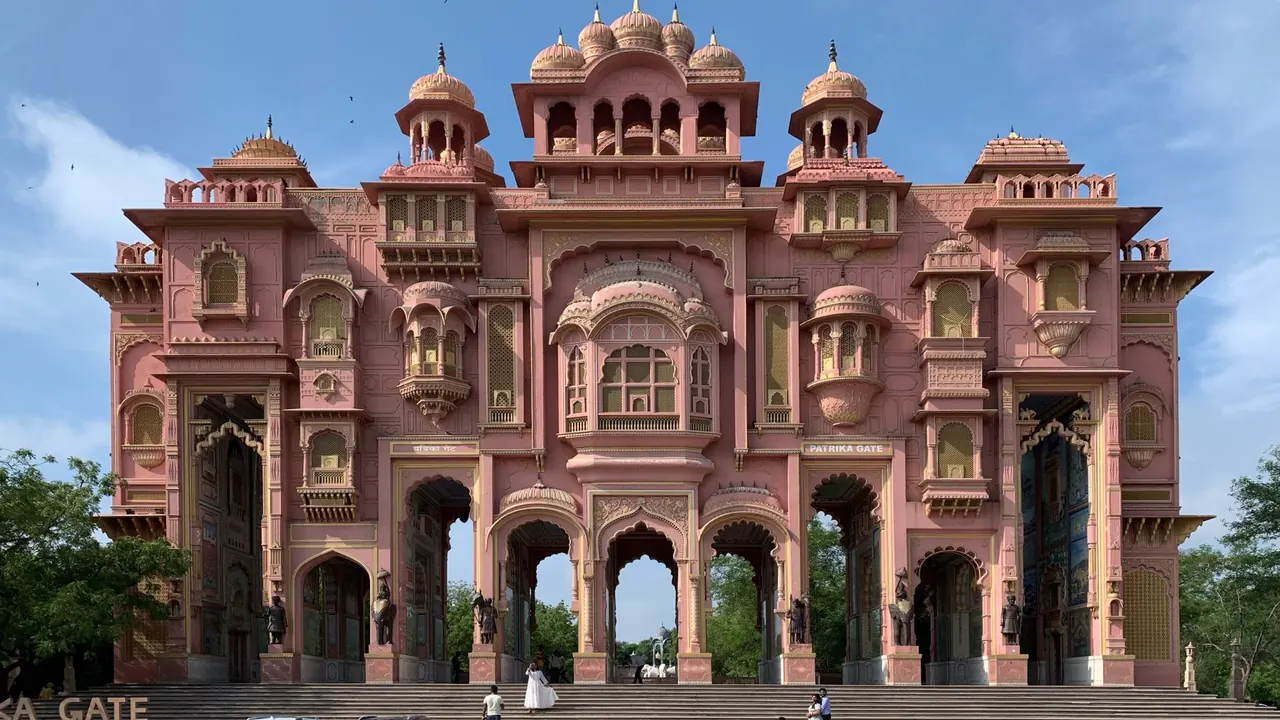
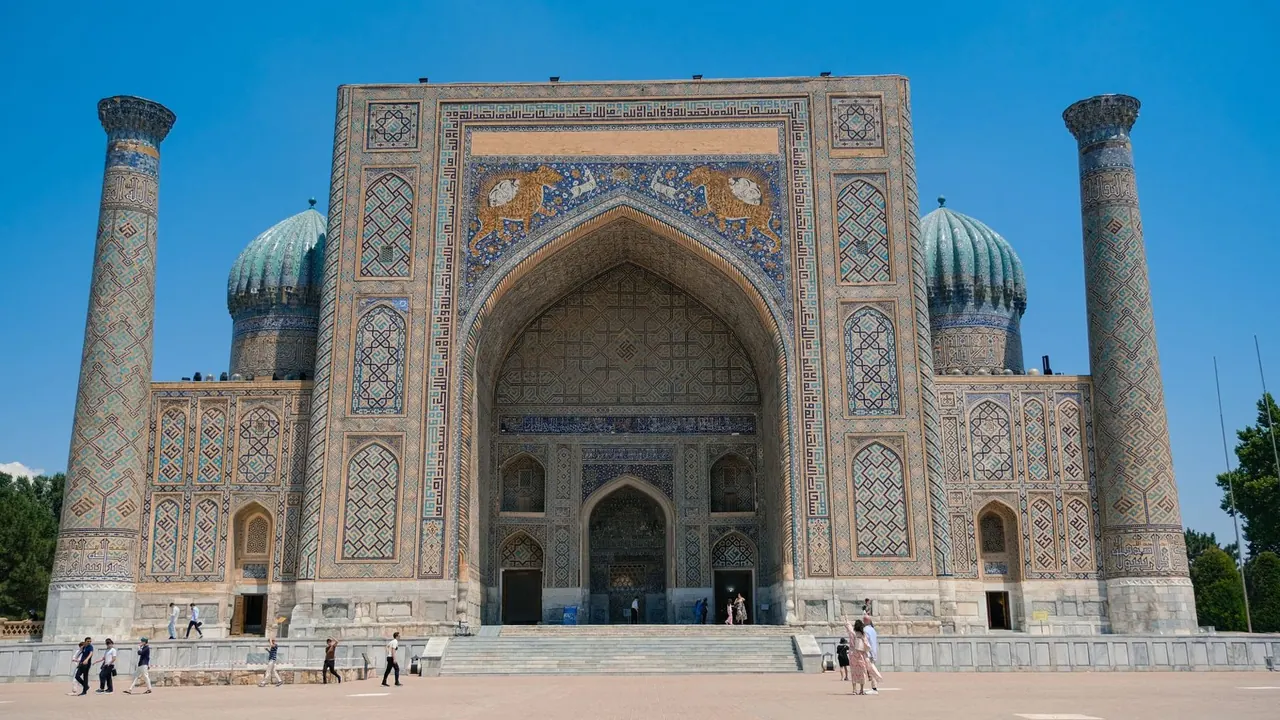
Photos: Jaipur by Chainwit., CC BY-SA 4.0, cropped; Samarkand by Yaşar Başkurt, Pexels License.
Jaipur or Samarkand?
Our verdict in twelve categories, each scored against the same fixed benchmark cities, and the climate month by month, so you can choose for your trip.
Choose Jaipur for
- shopping
- food and drink
- nightlife
Jaipur suits travellers who want to shop and eat as much as sightsee. The bazaars of the Pink City, with block-printed cottons, silver, gems and blue pottery, and a deep Rajasthani kitchen give the days more variety than Samarkand's craft stalls and narrow menus. The ridge-top forts at Amber add drama, and the city is a little cheaper too. The cost is noise, traffic and a reliance on rickshaws and drivers.
Choose Samarkand for
- getting around
- day trips
- families
Pick Samarkand when the architecture is the main reason for the trip and you want to see it at an unhurried pace. The Registan, Bibi-Khanym and Shah-i-Zinda line a calm pedestrian street, Gur-e-Amir is a short walk away, and the fast train puts Bukhara within a day. There is less to buy and less variety to eat, but for tilework, domes and quiet courtyards it is the easier and more restful of the two.
Scoreboard
Twelve categories on one fixed scale from 0 to 100. The shaded stretch is the gap between the two.
Your match
Pick a travel style or drag the sliders, and both match scores follow your weighting.
Too close to call, 1 point apart
Wins on shopping and food and drink with your weighting.
Wins on getting around and day trips with your weighting.
What matters to you?
Category by category
What the scores mean for a trip.
Beaches & swimming
Neither city is a place to swim. Jaipur sits deep in Rajasthan with no lake to bathe in, and Samarkand is in a doubly landlocked country, so in both a hotel pool is the only option. The pool matters more in Jaipur, where afternoons from April to June are hot enough to keep you indoors.
Food & drink
Jaipur gives you more to eat. Rajasthani cooking runs from dal baati churma and ker sangri to the fiery laal maas of the royal kitchens. Mornings start with pyaaz kachori and lassi in clay cups around Johari Bazaar and MI Road, and the sweet counters change with the seasons. Most food is vegetarian and alcohol is hard to find outside hotels.
Samarkand's eating is built around plov, its own layered version best eaten at lunch, along with the glazed Samarkand non and the dried fruit at Siab Bazaar. It is satisfying, but the same Uzbek and Russian menus repeat from place to place, and a local wine tasting is the only real change of pace.
Culture & sights
Both are first-rate for sightseeing, and both even have a historic observatory, Jaipur's Jantar Mantar and Ulugh Beg's in Samarkand. They differ in feel. In Jaipur the walled Pink City is a sight in its own right, with a working palace at its centre, the Hawa Mahal facade and the Amber Fort climbing its ridge above Maota Lake.
Samarkand is about Timurid tilework and turquoise domes: the Registan's three madrasas, the mausoleums of Shah-i-Zinda and the gilded interior of Gur-e-Amir. Between the monuments lie plain Soviet-era avenues rather than a historic street grid.
Nightlife
Neither is a city for late nights, but Jaipur offers a little more. After a rooftop dinner with the forts lit up, there are hotel bars, a few old-city lounges and some clubs in C-Scheme that fill at weekends and in the wedding season. In Samarkand the evening is usually a long restaurant dinner, perhaps beside a wedding party dancing to a live band, followed by a walk past the floodlit Registan before the streets go quiet.
Nature & outdoors
Both offer modest outdoor options, but of different kinds. Jaipur's highlight is wildlife: jeep safaris in Jhalana find leopards right on the edge of the city, and there are views from Nahargarh over the Aravalli scrubland. Samarkand is better for walking, with juniper and walnut country in the Aman-Kutan valley about an hour away and homestay treks in the Nuratau mountains. Jaipur's season for this is November to February, while Samarkand's is spring and autumn.
Day trips
Samarkand has the stronger excursions. The high-speed train reaches Bukhara's intact old town in about an hour and a half, and Shakhrisabz, Timur's birthplace, is about as far by road over a mountain pass. The Sunday bazaar at Urgut and the paper-making village of Konigil are closer to town.
Near Jaipur, the Chand Baori stepwell at Abhaneri, the palace at Samode and the printing villages of Sanganer and Bagru make easy outings. The famous names are harder work: Pushkar is around three hours by road, and Agra and the Taj Mahal take a long, tiring day.
Good for families
Jaipur has the bigger thrills for children: forts with ramparts, secret passages and stepwells, a traditional string-puppet show and a jeep safari in Jhalana looking for leopards. The cost is an old city that wears young visitors out, with traffic, uneven pavements, crowds and persistent sellers, so a hotel pool and a driver for the day make it much easier.
Samarkand offers calm instead of excitement, with safe, wide pedestrian streets around the Registan and parks with simple rides. Its mausoleums and madrasas hold less for small children, though, and suit older ones who already enjoy history or tilework. In both cities people are warm towards children.
Getting around
Samarkand is much easier to get around. Most of a visit happens on foot along the pedestrian street from the Registan to Shah-i-Zinda, and app taxis at fixed fares cover the observatory and the station. No car is needed.
In Jaipur, most visitors rely on auto-rickshaws, ride-hailing or a driver hired for the day, especially to reach Amber about 11km north. The short metro line misses most of the sights, and cows, traffic and missing pavements make walking even the main bazaars slow.
Shopping & style
For shopping Jaipur is far ahead, and for many visitors it is a reason to come in itself. Each bazaar has its own trade, from jewellery on Johari Bazaar to bangles on Maniharon ka Rasta, and the city produces block prints, blue pottery, rugs and miniatures. C-Scheme has boutiques that give the same crafts a modern design. Haggling is expected, and gem scams aimed at tourists are an old problem.
Samarkand's shopping is smaller and mostly in madrasa cells, where suzani, ikat silk and ceramics are sold alongside a lot of souvenirs. Mulberry paper from Konigil and dried fruit from Siab Bazaar make good things to take home.
Affordability
Both are cheap, and Jaipur is cheaper still. Thalis, street snacks and rickshaw rides cost very little, and even hiring a car and driver for the day is modest, though foreigners pay a higher entry fee at the main monuments. Samarkand is also easy on a modest budget, with cheap plov, app taxis, good-value guesthouses and low entry fees. In both cities the costs rise at upmarket hotels and on alcohol.
Live music & performing arts
Jaipur has more live performance to see. It has its own school of Kathak dance, Kalbeliya dancers and string puppeteers perform most evenings, and Charles Correa's Jawahar Kala Kendra stages classical music and dance. Samarkand's performances are mostly folk-costume shows and the Registan sound-and-light display. The Sharq Taronalari festival, held in some years, is a real draw, but the local theatre plays to an Uzbek and Russian audience.
Wellness & relaxation
Rest in Jaipur comes from the hotel. Heritage havelis and palace hotels have shaded courtyards, gardens and pools, and many offer Ayurvedic massage and yoga, which you will want after early starts in a loud, hot old city.
Samarkand has more calm outside your room. The old domed bathhouse near Bibi-Khanym keeps the Central Asian hammam alive with steam and massage, and long afternoons with green tea on a topchan in a shaded chaikhana set a slower pace than anything in Jaipur's streets.
When should you go?
Pick your month. The climate figures are measured averages, not a forecast.
Jaipur in July
Samarkand in July
Daytime high, °C
Rainfall in the month, mm
Where the figures come from
Jaipur has no rain gauge within 25 km of the centre, so its rainfall comes from a gridded climate dataset read at the city rather than from a gauge further away.
Temperature and rainfall are climate normals, averaged over the years shown. Jaipur: 1993-2020 (rainfall 1991-2020) normals, Jaipur / Sanganer (11.1 km from centre). Samarkand: 1991-2020 normals, Samarkand (10 km from centre).
The two cities are at their best at opposite ends of the year. Jaipur is pleasant from November to February, with January highs around 23°C, dry skies and comfortable walking. From April to June the heat builds to around 42°C and sightseeing shrinks to dawn and dusk. The monsoon follows, with August bringing about 226mm of rain, and the dry, warm weather returns in October.
Samarkand's winter is cold, with January highs near 7°C, and March and April are its wettest months, though the hills turn green. May, September and October are the sweet spots: warm, very sunny and dry enough for long days on foot. In midsummer highs reach about 34°C under almost unbroken sunshine. That is milder than Jaipur's peak but still too hot for walking in the afternoon.
Which traveller are you?
On a shopping trip, Jaipur is the clear choice. Each old-city bazaar has its own speciality, from silver and gems to lac bangles and quilts, and the block-printing villages nearby add more. Samarkand offers fewer crafts, and souvenirs crowd its madrasa stalls.
For a short city break, Samarkand works better. Its main monuments sit along one pedestrian street, so a few days on foot cover the essentials. In Jaipur the sights are spread out, and the time spent in rickshaws and traffic eats into a brief stay.
For a food and nightlife trip, Jaipur has the edge. Its kitchen ranges from kachori breakfasts to laal maas, and the evenings bring rooftop dinners and a few lounges in C-Scheme. Samarkand's menus repeat, and its streets empty well before midnight.
Before you go
| Measure | Jaipur | Samarkand |
|---|---|---|
| Official language | Hindi, English | Uzbek |
| Currency | Indian Rupee (INR) | Uzbekistan Sum (UZS) |
| Sockets | CM230 V, 50 Hz | CFI220 V, 50 Hz |
| Driving side | Left | Right |
| Time zone | UTC+5:30 | UTC+5 |
| Emergency number | 108 or 112 | 112 |
| Elevation | 431 m | 702 m |
| Main airport | Jaipur International Airport (JAI)10 km from centre27 non-stop destinations | Samarkand International Airport (SKD)5 km from centre29 non-stop destinations |
By the numbers
| Measure | Jaipur | Samarkand |
|---|---|---|
| City population | 3,073,350 | 546,303 |
| People per km² | - | 5,058 |
| Museums within 10 km | 6 | 11 |
| UNESCO World Heritage sites within 50 km | 3 | 1 |
Where else could you go?
Every comparison below shares a destination with this one, so you can follow Jaipur or Samarkand somewhere new.