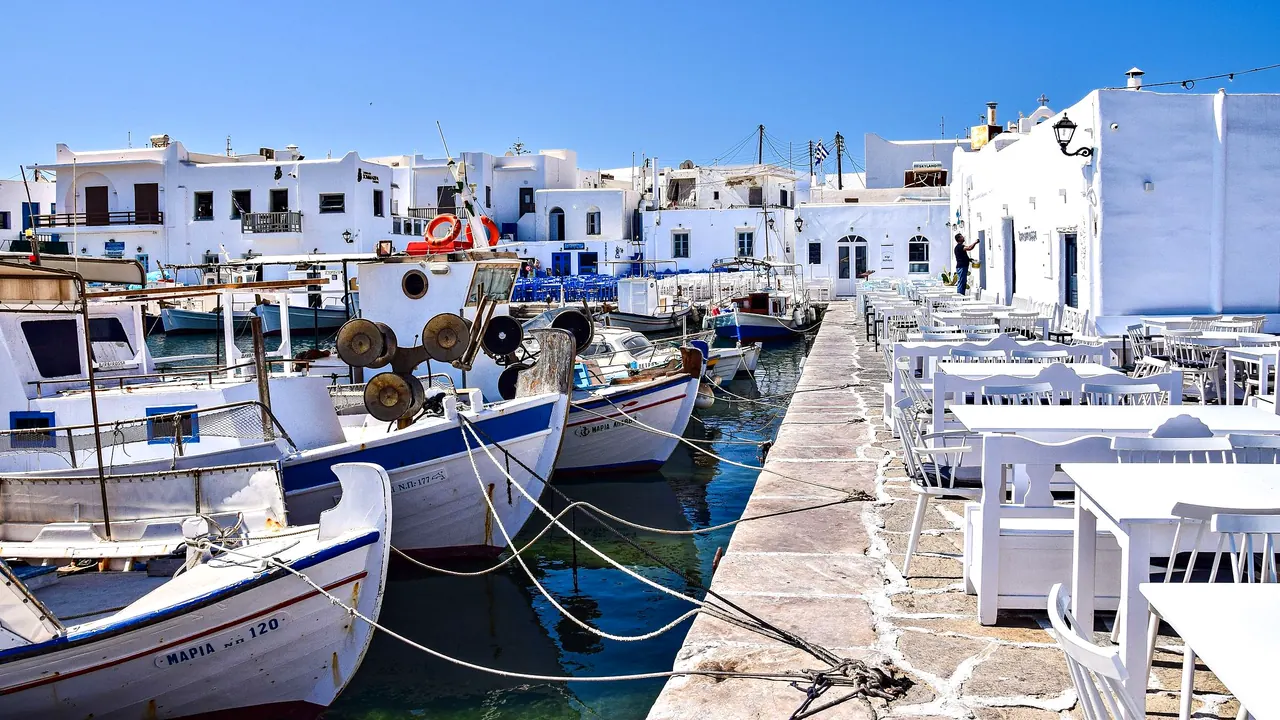
Photos: Paros by AXP Photography, Pexels License.
Kefalonia or Paros?
Our verdict in twelve categories, each scored against the same fixed benchmark cities, and the climate month by month, so you can choose for your trip.
Choose Kefalonia for
- nature and the outdoors
- prices
- beaches
Kefalonia is the island for travellers who want space and scenery and are happy to drive for it. Its beaches are the dramatic white-pebble coves under the west-coast cliffs. Mount Ainos and its fir forest, the Melissani cave and the turtles in Argostoli harbour give it a natural side Paros cannot match. Evenings are quiet, and a stay in the southern villages costs a little less.
Choose Paros for
- nightlife
- getting around
- culture and sights
Paros suits a more sociable, compact trip. The sandy bays are all a short ride apart, buses cover the main beaches in summer, and Naoussa gives you a proper night out by the harbour. The old church in Parikia and the villages of Lefkes add more history. Ferries to Antiparos and Naxos also make it a far better base for seeing other islands.
Scoreboard
Twelve categories on one fixed scale from 0 to 100. The shaded stretch is the gap between the two.
Your match
Pick a travel style or drag the sliders, and both match scores follow your weighting.
Wins on nature and the outdoors and prices with your weighting.
Wins on nightlife and getting around with your weighting.
What matters to you?
Category by category
What the scores mean for a trip.
Beaches & swimming
Both islands come to the beach first and are about equal here, but the beaches are different in kind. Kefalonia's famous ones are pebble crescents under white cliffs, Myrtos and Petani, with unusually clear water. The sand is in the south at Skala and Lourdas and at Xi on Paliki, so most visitors pick their base by the kind of beach they want.
Paros is sand almost all the way round, from the granite-boulder coves of Kolymbithres to the wide bays of Golden Beach and Santa Maria, and they are all close together. What decides your day there is the meltemi, which sends swimmers to the calmer south and west coasts, while on Kefalonia it is the long drive between coves.
Food & drink
The two are close, and both are taverna islands rather than places for fine dining. Kefalonia has more dishes of its own: meat pie with rice and spices, bourbourelia soup, salt cod with aliada and red mandoles. It also has the Robola wineries of the Omala valley, though menus repeat outside Argostoli.
Paros is about the setting and the seafood: octopus drying along Naoussa's harbour, clay-baked chickpeas and a glass of souma. Naoussa also has a few more polished modern Greek restaurants, which gives it a slight edge in range.
Culture & sights
Paros has more to see, though neither island is a sightseeing destination. Its centrepiece is the Panagia Ekatontapiliani in Parikia, one of the oldest surviving churches in Greece. Add the Frankish castle built from ancient marble, the marble quarries at Marathi and the intact village lanes of Lefkes.
Kefalonia lost most of its old buildings in the 1953 earthquake, so apart from Fiskardo's Venetian-era harbour its towns are plain and postwar. What remains is scattered: the fortress at Assos, the tholos tomb at Tzanata and the abandoned village of Old Vlachata.
Nightlife
Paros is far better for going out. In summer, Naoussa's lanes and harbour fill with cocktail bars and a well-dressed crowd that stays out past midnight, and Parikia's seafront has a looser strip with a few late clubs.
Kefalonia's evenings are slower: the Lithostroto in Argostoli, the bars at Lassi and a drink at the harbour in Skala or Fiskardo after dinner. Clubs are scarce, and outside July and August most places are quiet well before midnight.
Nature & outdoors
Kefalonia is much the stronger here. Mount Ainos rises to 1,628m in a national park of dark Greek fir with semi-wild horses. Below ground are the Melissani lake cave and the Drogarati chamber, and loggerhead turtles feed in Argostoli harbour. Kayaking and sailing towards Ithaca round it off.
Paros is dry, low Cycladic hill country with no forests or notable wildlife. Its outdoor strengths are the old Byzantine path from Lefkes to Prodromos and the meltemi, which makes Golden Beach and Pounta first-rate spots for windsurfing and kitesurfing.
Day trips
Paros sits in the middle of the Cyclades ferry network, and it shows. Antiparos is a short crossing away and Naxos's Chora under an hour by fast boat. In summer Mykonos, Ios, Sifnos, Delos and even Santorini can be reached in a day, though the last two make long days.
Kefalonia's best outing is Ithaca, a short ferry ride from Sami to Vathy and the fishing villages of Kioni and Frikes. Summer boats also reach northern Zakynthos and Lefkada, but beyond those the choice runs out, and much of the exploring happens on Kefalonia itself.
Good for families
Paros is slightly easier with young children, mainly because everything is close. Gently shelving sand at Livadia, Golden Beach and Logaras is only a short ride from any base.
Kefalonia works well if you stay in the south near Skala or Lourdas, as the north-west's pebble beaches drop off quickly. In return it offers outings children enjoy, the boat ride through Melissani and turtle spotting. The catch is long, winding drives in the heat, and neither island has zoos or theme parks.
Getting around
A hire car is close to essential on Kefalonia, which is large and mountainous. Argostoli to Fiskardo alone takes about an hour and a half on ridge and cliff roads, the buses run too rarely to plan a day around, and parking at Myrtos and Assos is tight in high season. The summer ferry from Argostoli to Lixouri saves one long detour.
Paros can be crossed by car in under half an hour, so getting about is far simpler, and in summer you can manage without a car at all. Buses run from Parikia to Naoussa, Lefkes and the main beaches, and small boats cross the bay to Kolymbithres. A scooter or car only matters for the smaller coves and inland villages.
Shopping & style
Neither island is a shopping trip, but Paros gives you more to browse. Naoussa's whitewashed lanes and Parikia's old market street have linen, resort wear, Greek designer jewellery and ceramics, though prices in Naoussa run high.
Kefalonia has the everyday shops of Argostoli's Lithostroto and a few boutiques around Fiskardo's harbour. Its best souvenirs are edible: Robola, thyme honey and boxes of mandoles.
Affordability
Kefalonia is the cheaper of the two. Apartments and small hotels around Skala, Lourdas, Lassi and the southern villages offer fair value. The extra costs are car hire, which almost every visitor needs, and the higher prices in Fiskardo and Assos.
Paros charges resort prices in Naoussa and at the well-known beaches, and sunbeds and ferry hops add up over a week. You can save by staying in Parikia or the inland and east-coast villages and using the buses. On both islands, June and September cost less than the August peak.
Live music & performing arts
Neither island has a theatre or concert scene, and both offer traditional music instead. On Kefalonia that means the kantades, Venetian-style serenades with guitar and mandolin, and Argostoli's philharmonic band at summer concerts in the squares.
On Paros, the music is island violin and lute at village feast days. The biggest occasions are the mid-August feast at the Ekatontapiliani and Naoussa's pirate-raid festival with fireworks.
Wellness & relaxation
The two are level, and on both pampering means hotel spas, with Paros adding a handful of yoga and retreat centres. The difference is in where you go to unwind. On Kefalonia it is green hill villages, the quiet Paliki peninsula and the north-east coast. On Paros it is Lefkes, Marpissa and Prodromos inland, or an evening on Antiparos away from Naoussa.
When should you go?
Pick your month. The climate figures are measured averages, not a forecast.
Kefalonia in July
Paros in July
Daytime high, °C
Rainfall in the month, mm
Where the figures come from
Kefalonia's temperatures are measured 59 km from the centre, at Zakinthos / Agrilia.
Kefalonia has no rain gauge within 25 km of the centre, so its rainfall comes from a gridded climate dataset read at the destination rather than from a gauge further away.
Paros's temperatures are measured 82 km from the centre, at Santorini Island / Monólithos.
Paros has no rain gauge within 25 km of the centre, so its rainfall comes from a gridded climate dataset read at the destination rather than from a gauge further away.
Temperature and rainfall are climate normals, averaged over the years shown. Kefalonia: 1991-2020 normals, Zakinthos / Agrilia (58.6 km from centre). Paros: 2000-2025, 12 years observed (rainfall 1991-2020) normals, Santorini Island / Monólithos (81.8 km from centre).
Both islands are summer places, with the sea warm enough to swim from June into early October. Kefalonia's summer is hotter, with highs around 32°C in July and August and very long sunny days, so walks on Mount Ainos are best done early in the morning. Its sea is also a little warmer, at about 26°C in August. Paros peaks nearer 30°C and is almost rainless from May to September, though the meltemi can blow hard in high summer.
The two part ways in autumn. On Kefalonia, August is the last really dry month. September is still warm enough for swimming but is changeable, with around 65mm of rain after an almost dry July and August, and October is wetter still. April and May are warm and mostly dry, which makes them the best months for hiking there. Paros stays dry through September and gets only light rain in October, and its winters are much less wet. Even so, neither island is a beach destination from November to April.
Which traveller are you?
On a food and nightlife trip, Paros is the clear pick. Naoussa's harbour combines octopus tavernas with cocktail bars that keep going past midnight, while Kefalonia's evenings mostly end with dinner and a drink by the water.
For an outdoors trip, choose Kefalonia. You can walk to the summit of Mount Ainos through fir forest, be taken by boat across the Melissani cave lake and kayak the north-east coast. Paros has a good marble path from Lefkes and excellent windsurfing, but no mountains or forests.
On a trip with a tight budget, Kefalonia goes further. Apartments around Skala, Lourdas and the southern villages offer fair value. On Paros, Naoussa, the cocktail bars and the ferry hops push costs up, although the buses and the rooms in Parikia help.
Before you go
| Measure | Kefalonia | Paros |
|---|---|---|
| Official language | Greek | Greek |
| Currency | Euro (EUR) | Euro (EUR) |
| Sockets | CF230 V, 50 Hz | CF230 V, 50 Hz |
| Driving side | Right | Right |
| Time zone | UTC+2, UTC+3 in summer | UTC+2, UTC+3 in summer |
| Emergency number | 112 | 112 |
| Main airport | Kefalonia International Airport "Anna Pollatou" (EFL)41 non-stop destinations | Paros National Airport (PAS)5 non-stop destinations |
| Public holidays this year | 15 days | 15 days |
By the numbers
| Measure | Kefalonia | Paros |
|---|---|---|
| Population | 36,064 | 13,715 |
| People per km² | 49 | 71 |
| Swim season, months above 21 °C | 5 months | 5 months |
Where else could you go?
Every comparison below shares a destination with this one, so you can follow Kefalonia or Paros somewhere new.