Kenya
Masai Mara
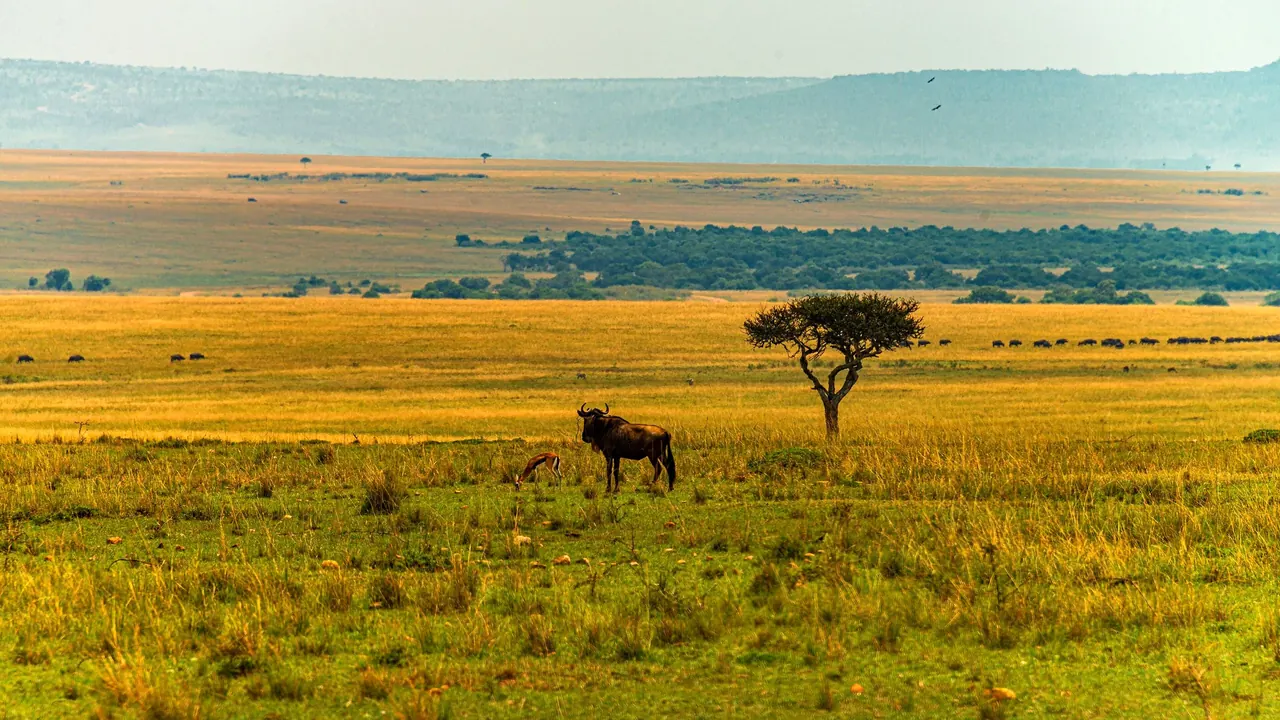
Wildebeest and an acacia below the Oloololo Escarpment
- Nature & outdoors94
- Families38
- Wellness & relaxation32
Photo: Daniel Case, CC BY-SA 4.0, cropped
Match
21
Every category weighted equally
- Beach & sun22
- Culture & arts17
- Food & nightlife14
- Family trip26
- Outdoors30
- Relax & unwind26
- Shopping & style17
- On a budget21
Masai Mara in twelve categories
Our verdict on each, scored 0 to 100 against the same fixed benchmark cities, so a score means the same thing on every page.
Beaches & swimming. Scores 4 out of 100.
Food & drink. Scores 18 out of 100.
Culture & sights. Scores 12 out of 100.
Nightlife. Scores 3 out of 100.
Nature & outdoors. Scores 94 out of 100.
Day trips. Scores 5 out of 100.
Good for families. Scores 38 out of 100.
Getting around. Scores 24 out of 100.
Shopping & style. Scores 7 out of 100.
Affordability. Scores 14 out of 100.
Live music & performing arts. Scores 6 out of 100.
Wellness & relaxation. Scores 32 out of 100.
Masai Mara category by category
Beaches & swimming
4There is no beach and no swimming here in any natural sense. The Mara lies on the high plains of south-western Kenya, hundreds of kilometres from the Indian Ocean, and its rivers are home to crocodiles and hippos. The only water a visitor gets into is a camp or lodge pool, and many tented camps have only a small plunge pool or none at all. Anyone who wants sand and sea pairs a safari with a separate stay on the Kenyan coast.
Food & drink
18Eating in the Mara means eating where you sleep. Camps and lodges serve full board, usually a mix of international dishes with some Kenyan touches such as grilled meats, sukuma wiki greens, ugali and chapati, and the quality follows the price of the camp. The memorable meals are the setting rather than the cooking: a picnic breakfast laid out on the plains after an early drive, or a sundowner with Kenyan beer or gin as the light goes.
There is no restaurant scene, no market to wander and no street food outside the small trading centres by the gates. A visitor who travels for food will find little here to seek out.
Culture & sights
12The Mara has no museums, monuments or historic architecture. Its cultural side is the Maasai, whose land surrounds the reserve and who own most of the conservancies on its borders. Many visitors spend an hour in a manyatta, a homestead of mud and dung houses inside a thorn fence, to see how families live, watch fire-making and hear about cattle and age-sets. Some of these visits feel staged for tourists, and the more thoughtful ones are arranged through conservancy camps with Maasai guides. Beyond that, the sights here are animals and landscape, not buildings.
Nightlife
3There is no going out in the Mara. Evenings are a drink by the campfire and dinner in camp, followed by an early night before a dawn game drive. After dark guests are walked to their tents by an askari because animals move through unfenced camps. The night is about listening to lions and hyenas, not bars.
Nature & outdoors
94This is one of the great wildlife landscapes on earth: open rolling grassland under huge skies, scattered with acacia, cut by the Mara and Talek rivers and closed to the west by the Oloololo Escarpment. Lion, leopard and cheetah are seen with unusual reliability, alongside elephant, buffalo, giraffe, hippo and large herds of plains game. From roughly July to October the wildebeest and zebra migration arrives from the Serengeti, and the river crossings, with crocodiles waiting, are the most famous wildlife spectacle anywhere.
The main reserve suits classic game drives, with the Mara Triangle in the west quieter and better managed. The private conservancies on the northern and eastern borders, such as Mara North, Olare Motorogi and Naboisho, limit vehicles and allow guided walks and night drives. Balloon flights at dawn add the view from above. What it lacks is freedom: there is no independent hiking, no mountains and no water to play in.
Day trips
5The Mara is a place you stay in, not a base for outings. Within a couple of hours there are only small trading centres by the gates and the market town of Narok, none of them worth a day. The lakes of the Rift Valley and Nairobi are a long drive away and belong to a separate leg of the trip, and the Serengeti across the border is not a day trip in practice. Days are spent on game drives inside the reserve and conservancies.
Good for families
38For children old enough to sit through a long game drive, the Mara can be the trip of a lifetime: lions at a few metres, elephants crossing the track, hippos in the river. A number of camps welcome families with connecting tents, private vehicles that can return when a child tires, and junior ranger activities such as tracking and bead-making with Maasai guides.
It is much harder with small children. Many camps set minimum ages, especially for walking safaris, game drives start before dawn and last hours on rough tracks, and the area is malarial. There are no playgrounds, pools are small and children cannot wander freely in unfenced camps. It works best with children of about eight and over.
Getting around
24Nothing in the Mara is reached on foot or by public transport. The usual ways in are a light aircraft from Nairobi's Wilson Airport, under an hour to one of several grass airstrips, or a long drive of most of a day whose final stretch is on rough, dusty or muddy roads. Once there, every movement is in a camp or tour vehicle with a guide, and walking outside camp is only possible on guided walks in the conservancies. Distances within the reserve are large and the tracks bumpy, so seeing a river crossing can mean hours in a vehicle. It is simple in that the camp arranges everything, but nothing is independent.
Shopping & style
7Shopping is limited to Maasai beadwork, shukas, carved wood and small crafts, sold at village visits, roadside stalls near the gates and the curio corners of camps and lodges. The beadwork is genuinely local and often made by the women who sell it. There is nothing else to browse.
Affordability
14The Mara is an expensive place to visit, and cheaper Kenyan prices elsewhere do not carry over. The daily reserve or conservancy fee alone is significant, and most stays are full-board camps or lodges where meals, game drives and guiding are bundled into a high nightly rate, rising sharply in the migration months from about July to October. Fly-in transfers add further cost.
Budget options exist in the form of group camping safaris by road from Nairobi, sleeping in simple tented camps outside the gates, but even these cost far more per day than a normal city trip. Travelling in the green seasons outside the migration brings rates down noticeably.
Live music & performing arts
6The performance a visitor meets here is Maasai song and the adumu, the leaping dance of young men, in which warriors take turns to jump straight up from a standing start while the group chants around them. It is shown during village visits and sometimes in camp after dinner, and it is striking to see up close.
It is a short demonstration rather than a scene, though. The Mara has no theatre, concert hall, music venue or performance season. Anyone who wants an evening of music or theatre has to wait for Nairobi.
Wellness & relaxation
32What the Mara offers for rest is quiet. There is no traffic and often no signal, and the long middle of the day is spent on a tent veranda looking over the plains while the animals shelter from the heat. At night there is nothing to hear but lions, hyenas and the wind in the grass. Many visitors find this deeply restful.
The pace is not lazy, though. The best wildlife comes with pre-dawn starts and late afternoon drives, so most days are bookended by hours in a vehicle. Spa treatments are limited to massage rooms or tents at the more expensive camps and lodges, and the Mara has no bathing tradition, hammam or thermal water. Visitors who want real pampering usually add a few days at the coast.
Where to stay in Masai Mara
Most visitors choose among three kinds of base. A stay of four or five nights often splits between two of them, with a drive or a short hop by light aircraft in between. The main reserve, around the Talek River and the eastern gates, puts you straight into classic game-drive country. It has the widest choice of camps and lodges and suits a first visit spent chasing lion, leopard and cheetah, though popular sightings draw many vehicles.
The Mara Triangle in the west lies between the Mara River and the Oloololo Escarpment. It is quieter and better managed, and its camps are close to the river crossings in the migration months, from about July to October. It suits photographers and anyone who wants long, patient drives with fewer vehicles around. The private conservancies on the northern and eastern borders, such as Mara North, Olare Motorogi and Naboisho, limit vehicle numbers and allow guided walks and night drives. They suit a quiet stay, a second visit, or families with older children who want to go on foot with Maasai guides.
On a tight budget, the simple tented camps just outside the gates, usually reached on group safaris by road from Nairobi, give access to the reserve for less money, at the cost of longer drives each morning.
When should you go?
Pick a month to see what it is like. The climate figures are measured averages, not a forecast.
Masai Mara in July
Daytime high, °C
Rainfall in the month, mm
The whole year
Shaded against this destination’s own year: the deepest cell is its best month for that figure and the palest its weakest.
Where the figures come from
Masai Mara has no weather station within reach, so its figures come from a gridded climate model rather than a measured record, and read a broad area rather than one spot.
Temperature and rainfall are climate normals, averaged over the years shown. Masai Mara: 2001-2020 normals, NASA POWER reanalysis grid, no weather station within 90 km.
Before you go
| Measure | Masai Mara |
|---|---|
| Official language | English, Swahili |
| Currency | Kenyan Shilling (KES) |
| Sockets | G240 V, 50 Hz |
| Driving side | Left |
| Time zone | UTC+3 |
| Emergency number | Police 112/999, ambulance 112/999, fire 112/999 |
| Main airport | Jomo Kenyatta International Airport (NBO)60 non-stop destinations |
| Public holidays this year | 10 days |
Compare Masai Mara with
Every comparison with a written verdict behind it.