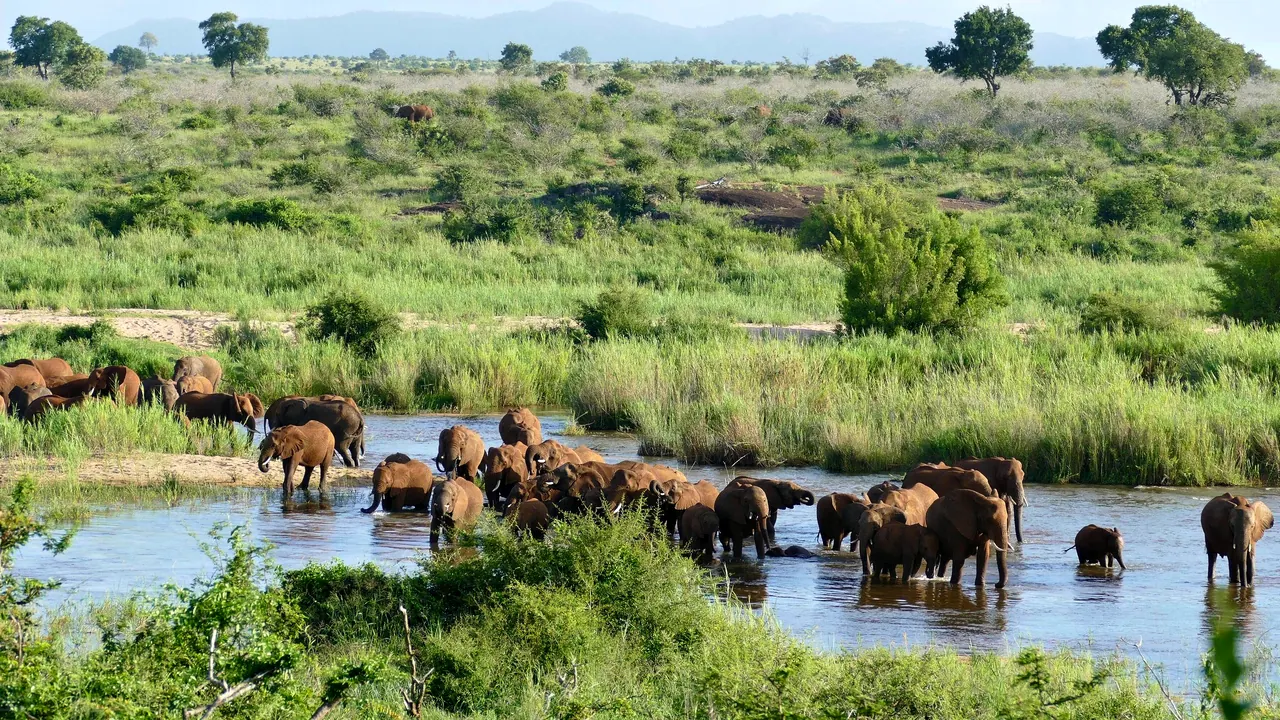
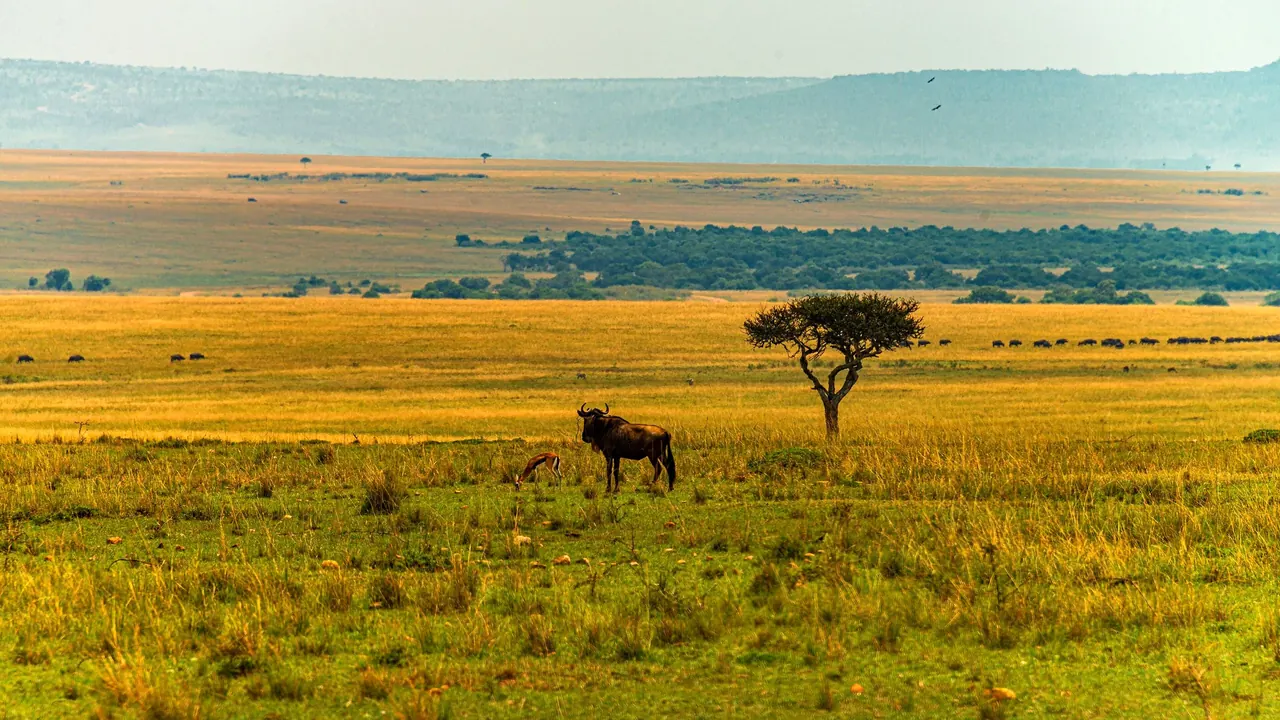
Photos: Kruger by Bernard DUPONT from FRANCE, CC BY-SA 2.0, cropped; Masai Mara by Daniel Case, CC BY-SA 4.0, cropped.
Kruger or Masai Mara?
Our verdict in twelve categories, each scored against the same fixed benchmark cities, and the climate month by month, so you can choose for your trip.
Choose Kruger for
- prices
- day trips
- wellness
Kruger suits travellers who want to run their own safari. You can hire a car, drive the park roads around Skukuza and Lower Sabie, sleep in rest camp bungalows and cook on the braai outside the door. Done this way it costs far less, works better for families, and leaves time for the escarpment viewpoints and Pilgrim's Rest between game drives. Anyone who wants luxury can still find it in Sabi Sand.
Choose Masai Mara for
- live music and the arts
Choose the Masai Mara for the open-grassland safari of the classic image, with big cats out on the plains and, from about July to October, the migration herds crossing the Mara River. It is a fly-in, guided, full-board trip where the camp arranges everything. It costs much more each day and gives you no independence, but the river crossings are something Kruger cannot offer.
Scoreboard
Twelve categories on one fixed scale from 0 to 100. The shaded stretch is the gap between the two.
Your match
Pick a travel style or drag the sliders, and both match scores follow your weighting.
Wins on prices and day trips with your weighting.
Wins on live music and the arts with your weighting.
What matters to you?
Category by category
What the scores mean for a trip.
Beaches & swimming
Neither has a beach, and crocodiles and hippos keep everyone out of the rivers in both, so swimming means a pool. Kruger's larger rest camps and lodges have proper pools that help in the summer heat, while many Mara tented camps have only a plunge pool or none at all. In either case the sea is a separate leg of the trip: the Mozambique coast from Kruger, the Kenyan coast from the Mara.
Food & drink
Neither is a food destination, but Kruger gives you more choice in how you eat. You can grill boerewors on the braai outside your rest camp bungalow, have polished lodge dinners in an open-air boma, or buy macadamias and avocados at the farm stalls around White River and Hazyview.
In the Mara every meal is full board in camp: international dishes alongside ugali, sukuma wiki and grilled meat. What you remember is the breakfast laid out on the plains rather than the cooking, and there are no towns or stalls nearby worth eating in.
Culture & sights
Kruger has a little more history to break up the game drives. There is the Iron Age hilltop citadel of Thulamela in the far north, the smelting site at Masorini, the museum on the park's founding at Skukuza and, up on the escarpment, the preserved 1870s gold-rush town of Pilgrim's Rest.
The Mara has no buildings or museums at all. Its culture is a living one: a visit to a Maasai manyatta to see how families live. These visits are best arranged through a conservancy camp, because some village visits feel staged.
Nightlife
Neither has any nightlife, and in both the evening ends with a drink by the fire and an early night. What differs is what happens after dark. Kruger runs guided spotlight drives from its camps, and its gateway towns have a few pubs. In the Mara, night drives are only allowed in the private conservancies, and an askari walks you back to your tent.
Nature & outdoors
Both are among the world's great wildlife areas, and the difference lies in the landscape and how you see it. Kruger is a long stretch of bush about 350km from north to south, where you can drive yourself, join ranger drives, go on guided walks or take multi-day wilderness trails. The Blyde River Canyon and the waterfalls on the escarpment add real hiking.
The Mara is open, rolling grassland where big cats are unusually easy to spot, and the migration river crossings come from about July to October. Everything is guided. Walking is limited to the conservancies, and dawn balloon flights take the place of hiking.
Day trips
Kruger has one excellent outing: the drive up the escarpment, which combines God's Window, the Three Rondavels, Graskop, Sabie and Pilgrim's Rest in a single day. Around Hoedspruit there are also wildlife rehabilitation centres to visit.
The Mara has no day trips worth making. Narok and the trading centres by the gates are not worth a day, while Nairobi, the Rift Valley lakes and the Serengeti each belong to a separate leg of the trip.
Good for families
Kruger is easier with children, mainly because a family can do it on its own timetable, with the gate hours giving each day a shape. Malaria is a concern in both, and many of Kruger's private lodges also restrict young children, so for families the national park camps are the option that works there.
The Mara works best for children of about eight and over. Some camps cater for them well, with connecting tents, private vehicles and junior ranger activities led by Maasai guides, but the pre-dawn starts on rough tracks are hard on small children.
Getting around
You can do Kruger on your own. Fly into Skukuza, Hoedspruit or Mbombela, or drive from Johannesburg on good highways, then use the tarred and gravel park roads in an ordinary car. Distances are long and speed limits low, so it is best to explore one section at a time.
The Mara is reached by light aircraft from Nairobi's Wilson Airport or by a long day's drive that ends on rough roads. Once you are there, every journey is in a guided vehicle. That keeps things simple, but you never choose your own route.
Shopping & style
Neither is a place to shop, though Kruger has a slightly wider choice. Its camp shops sell field guides and safari clothing, there are carvings and woven baskets along the Panorama Route, and Mbombela has malls for practical needs. The Mara has only Maasai beadwork, shukas and carvings, though the beadwork is often sold by the women who made it.
Affordability
This is the widest gap between the two. A self-drive Kruger trip is good value, with rest camp beds or guesthouses near Hazyview and Malelane and your own cooking. Only the private lodges in Sabi Sand and the neighbouring reserves reach the top prices found in Africa.
The Mara has no truly cheap way to visit. Reserve or conservancy fees, full-board camps and fly-in transfers all add up, rates climb in the migration months, and even group camping safaris from Nairobi cost a lot per day. The green seasons are the time to save.
Live music & performing arts
Neither has any theatre or concert life, and in both the only performance is traditional dance for visitors. A few Kruger lodges and cultural villages stage Shangaan song and dance. In the Mara it is the adumu, the Maasai jumping dance, performed during village visits or in camp after dinner, and it is striking to watch up close.
Wellness & relaxation
Kruger offers better rest days, mainly because the private lodges in Sabi Sand and the nearby reserves have proper spas. Their treatment rooms are open to views over dry riverbeds, and there are plunge pools for the long break at midday. The national park camps are plainer, but quiet.
The calm in the Mara is real, with no traffic, often no signal and long middays on a tent veranda, but treatments are limited to massage at the more expensive camps. In both places the dawn drive means you never get to sleep in.
When should you go?
Pick your month. The climate figures are measured averages, not a forecast.
Kruger in July
Masai Mara in July
Daytime high, °C
Rainfall in the month, mm
Where the figures come from
Masai Mara has no weather station within reach, so its figures come from a gridded climate model rather than a measured record, and read a broad area rather than one spot.
Temperature and rainfall are climate normals, averaged over the years shown. Kruger: 1991-2020 (rainfall 1981-2010) normals, Skukuza (1.6 km from centre). Masai Mara: 2001-2020 normals, NASA POWER reanalysis grid, no weather station within 90 km.
Kruger is hot for most of the year. From December to February highs reach about 33°C and the summer rains are at their heaviest, around 100mm a month, with lighter but still regular rain in November and March. May to August is the most comfortable stretch, dry and with days in the high twenties, and it is when the bush thins and game is easiest to find. By September the heat is building again, though the rain mostly holds off until October.
The Mara sits on high plains and stays milder, with highs between about 25°C and 29°C all year, so the weather to plan around is rain rather than heat. The long rains run from March to May and peak in April at over 170mm, and the short rains return in November and December. June to September is the driest stretch and overlaps with the migration, and October stays fairly dry before the short rains set in.
Which traveller are you?
On a trip on a tight budget, Kruger is the clear choice. With a hire car, national park rest camps and your own cooking, you see the same animals for a fraction of what a Mara stay costs, where fees and full-board camps keep prices high.
On a family trip with children, Kruger is the easier option. Its big rest camps such as Berg-en-Dal have pools, lawns and family bungalows, and your own car can turn back when children tire. In the Mara, more camps set age limits, and children must stay close in unfenced grounds.
For travellers who come to see the great migration, the Masai Mara is the place. From about July to October the wildebeest and zebra herds arrive from the Serengeti and cross rivers where crocodiles wait, and Kruger has nothing to match that spectacle.
Before you go
| Measure | Kruger | Masai Mara |
|---|---|---|
| Official language | English, Zulu, Xhosa, Afrikaans, Venda, Northern Sotho, Swazi, Tswana, Tsonga, Sesotho, Southern Ndebele, South African Sign Language | English, Swahili |
| Currency | Rand (ZAR) | Kenyan Shilling (KES) |
| Sockets | CMN230 V, 50 Hz | G240 V, 50 Hz |
| Driving side | Left | Left |
| Time zone | UTC+2 | UTC+3 |
| Emergency number | 112 | Police 112/999, ambulance 112/999, fire 112/999 |
| Main airport | Kruger Mpumalanga International Airport (MQP)8 non-stop destinations | Jomo Kenyatta International Airport (NBO)60 non-stop destinations |
| Public holidays this year | 13 days | 10 days |
Where else could you go?
Every comparison below shares a destination with this one, so you can follow Kruger or Masai Mara somewhere new.