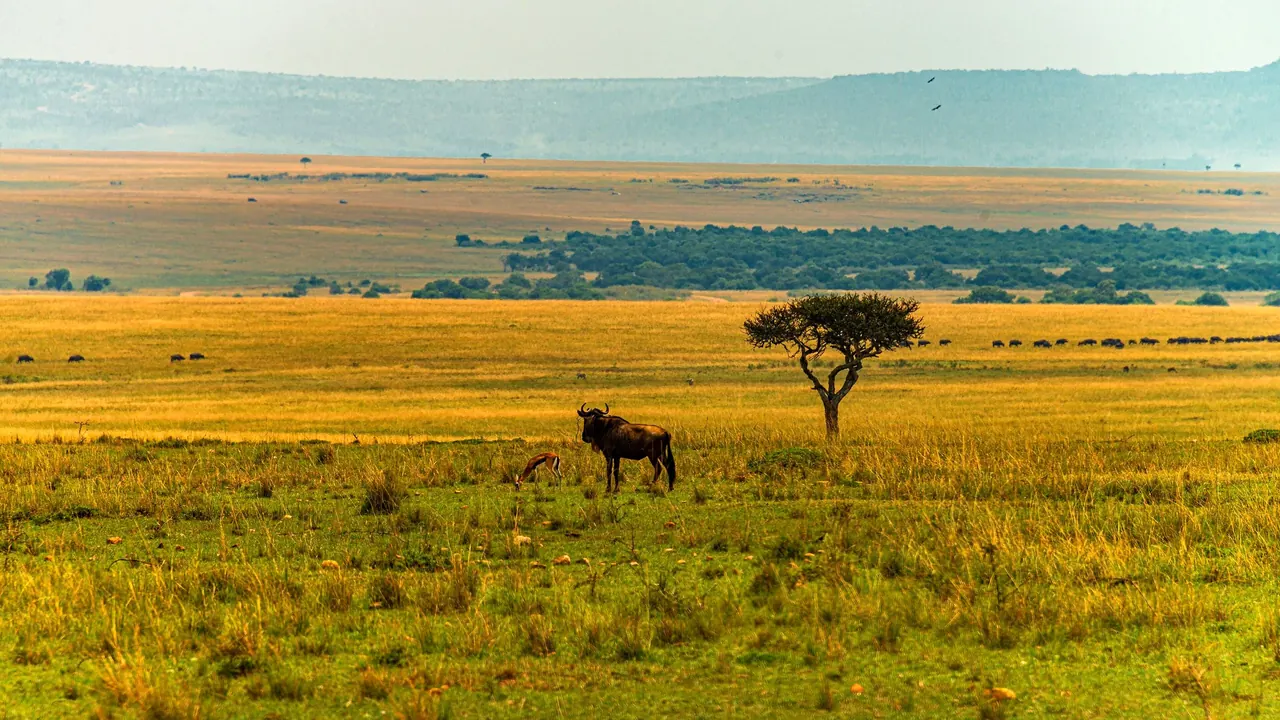
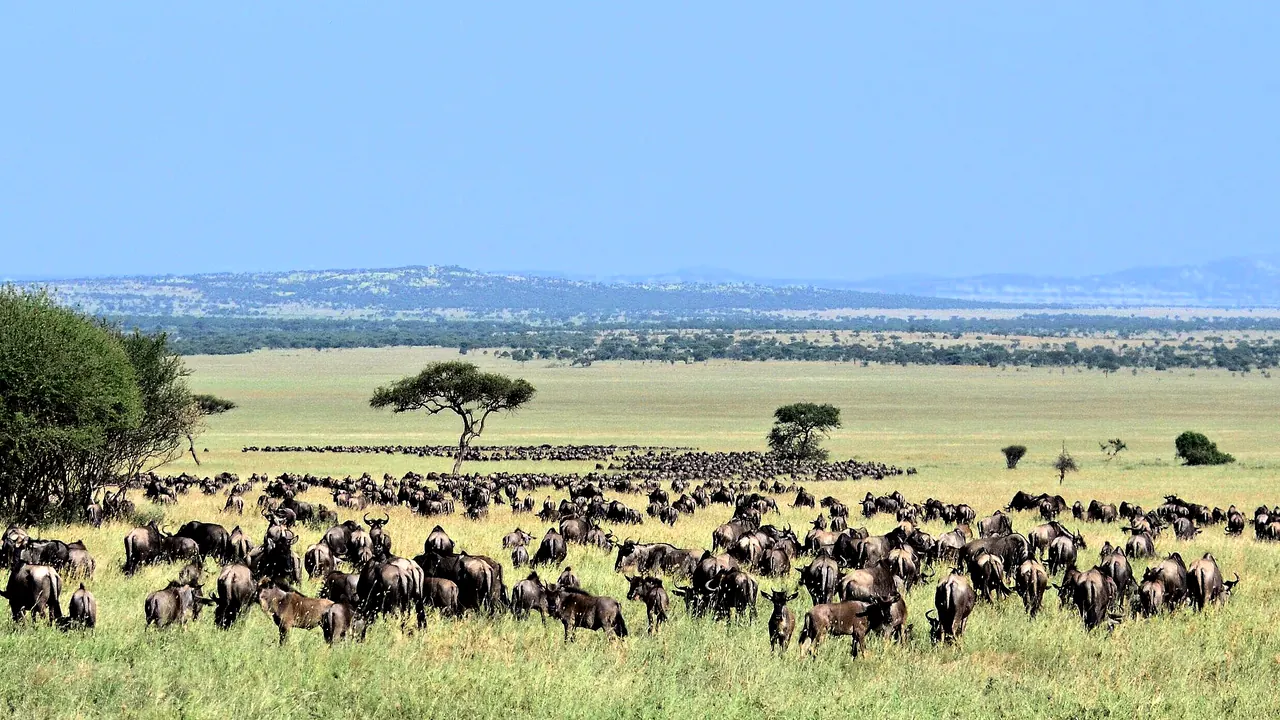
Photos: Masai Mara by Daniel Case, CC BY-SA 4.0, cropped; Serengeti by DipaliLath, CC BY-SA 4.0, cropped.
Masai Mara or Serengeti?
Our verdict in twelve categories, each scored against the same fixed benchmark cities, and the climate month by month, so you can choose for your trip.
Choose Masai Mara for
- getting around
- food and drink
- families
The Masai Mara is the better pick for a shorter safari, or for one squeezed into a wider trip through Kenya. A short flight from Nairobi puts you among the animals the same day, and the big cats are packed into a compact area, so even a few days can be very productive. Staying on the private land around the reserve gives you fewer vehicles and the chance to head out on foot or after dark, which the busier main reserve can't offer. It is also slightly easier with older children and slightly cheaper. It shines brightest in the dry season, when the herds arrive at the rivers.
Choose Serengeti for
- day trips
- nature and the outdoors
Travellers with more time and a bigger appetite for wildlife will get more from the Serengeti. Its size is the point: because the herds are on the move somewhere in the park for most of the year, you aren't tied to a single season. The landscapes also change as you go, from open grass to granite outcrops to woodland, and the human story at Olduvai Gorge lies just outside. In return you pay more and spend longer on rough tracks between regions, so it rewards those who can give it a week or more.
Scoreboard
Twelve categories on one fixed scale from 0 to 100. The shaded stretch is the gap between the two.
Your match
Pick a travel style or drag the sliders, and both match scores follow your weighting.
Too close to call, 1 point apart
Wins on getting around and food and drink with your weighting.
Wins on day trips and nature and the outdoors with your weighting.
What matters to you?
Category by category
What the scores mean for a trip.
Beaches & swimming
Neither has anywhere to swim beyond a camp pool, and some Mara tented camps have only a plunge pool or none at all. The rivers in the Mara are full of crocodiles and hippos, and on the Serengeti side Lake Victoria carries a risk of freshwater parasites. The real difference is which coast you add afterwards: the Kenyan shore after the Mara, or the Indian Ocean coast and Zanzibar after the Serengeti.
Food & drink
You eat at your camp in both, and the Mara has a slight edge. Its meals add Kenyan touches such as sukuma wiki greens and chapati, and the memorable moments are the picnic breakfast on the plains after an early drive and a sundowner as the light goes.
In the Serengeti, breakfast is more often a packed box in the vehicle. Some camps make up for it with lantern-lit dinners in the bush. There is nothing to eat outside the camps, so Tanzanian food is best tried in Arusha or on the coast.
Culture & sights
Neither is a trip for buildings or museums, and the cultural interest differs in kind. In the Mara it is about people. The Maasai own most of the conservancies around the reserve, and a manyatta visit arranged through a conservancy camp with Maasai guides is more genuine than the roadside versions.
Inside the Serengeti the interest is in places: the faded rock paintings and the hollow gong rock at the Moru Kopjes, and the visitor centre at Seronera, which explains the ecosystem.
Nightlife
There is no going out in either. Evenings mean a campfire drink, dinner and an early night. In the Mara's unfenced camps an askari walks you to your tent. In the Serengeti, where movement after dark is restricted, the night entertainment is lions calling and a sky full of stars.
Nature & outdoors
Both rank among the greatest wildlife landscapes on earth, and they are one ecosystem split by a border. The Mara is the smaller, more concentrated piece: rolling grassland below the Oloololo Escarpment, unusually reliable lion, leopard and cheetah sightings, and the river crossings from about July to October. Its conservancies, such as Mara North and Naboisho, limit vehicle numbers and allow walks and night drives.
The Serengeti is the larger stage. It has short-grass plains in the south, granite kopjes, central acacia woodland and northern hills, and the herds move through it all year. Calving around Ndutu early in the year and the Grumeti season in the western corridor have no equivalent in the Mara.
Day trips
The Serengeti has more to offer beyond the game drives, though not much. From the southern edge you can reach Olduvai Gorge, with its site museum overlooking the ravine where key early human fossils were found, and there are Maasai villages near the boundaries. From the western corridor, the Lake Victoria shore is a long drive away.
The Mara has nothing comparable. Narok and the trading centres by the gates are not worth a day out, and Nairobi and the Rift Valley lakes belong to a separate leg of the trip.
Good for families
Both work best with children of about eight and over, but the Mara is somewhat easier. Its family-minded camps offer connecting tents and private vehicles that can turn back when a child tires, and junior ranger days with Maasai guides include bead-making as well as tracking.
The Serengeti has family tents and junior ranger activities too. However, it has larger distances, longer drives and nothing else aimed at children. In both places, malaria precautions and unfenced camps mean small children need close watching.
Getting around
The Mara is quicker to reach and simpler once you arrive. A light aircraft from Nairobi's Wilson Airport lands on a grass strip in under an hour, and from there the camp's guided vehicles take you everywhere.
In the Serengeti, the road from Arusha through the Ngorongoro highlands takes most of a day, and flights to Seronera, Kogatende or Ndutu cost more. The park's regions are so far apart that most visitors pick one or two, depending on where the herds are.
Shopping & style
Both offer little beyond Maasai beadwork, blankets and carvings. In the Mara, the beadwork at village visits is often sold by the women who made it. Serengeti visitors are better off saving their shopping for Arusha, where Tanzanian textiles and tanzanite are easier to find.
Affordability
Both are expensive by any standard, and the Mara is the somewhat lighter bill. Its full-board camps bundle meals, drives and guiding into one rate, and group camping safaris from Nairobi and green-season stays bring the cost down further.
The Serengeti costs more. Park fees are charged per person each day, a guided vehicle is effectively required, and remote camps pass on the cost of trucking everything in. Flights between airstrips add more again. Public campsites and the green season are the main ways to save.
Live music & performing arts
Neither has a stage, concert hall or season, and in both the performance on offer is Maasai song and the jumping dance. In the Mara it comes on village visits and sometimes in camp after dinner, with the young men taking turns to leap straight up while the others chant around them. For an evening of real music or theatre you have to wait for Nairobi. In the Serengeti, whether you see it depends on your lodge or a village stop on the way in.
Wellness & relaxation
The rest in both comes from stillness rather than treatments. The midday hours on a tent veranda break up early starts and long drives, and neither has a bathing tradition. The Mara's quiet is helped by having no traffic and often no phone signal, with massage rooms at the pricier camps.
In the Serengeti, a lodge pool is a more common part of the midday break, and a few high-end lodges have proper spas. In both, people who want real pampering usually finish on the coast.
When should you go?
Pick your month. The climate figures are measured averages, not a forecast.
Masai Mara in July
Serengeti in July
Daytime high, °C
Rainfall in the month, mm
Where the figures come from
Masai Mara has no weather station within reach, so its figures come from a gridded climate model rather than a measured record, and read a broad area rather than one spot.
Serengeti has no weather station within reach, so its figures come from a gridded climate model rather than a measured record, and read a broad area rather than one spot.
Temperature and rainfall are climate normals, averaged over the years shown. Masai Mara: 2001-2020 normals, NASA POWER reanalysis grid, no weather station within 90 km. Serengeti: 2001-2020 normals, NASA POWER reanalysis grid, no weather station within 90 km.
Both are warm all year, with daytime highs of about 25°C to 29°C, so the choice is about rain, not heat. Each has two wet seasons: the long rains from March to May and the short rains from November to December. In the Mara the long rains peak in April at about 173mm, and the tracks turn muddy. June to October is the dry stretch, which is also when the migration reaches the river crossings.
On the Serengeti plains, where the climate is measured, the dry season is sharper. July brings barely 9mm of rain, and June to September is reliably dry, which is easy for driving between regions. The rains hit hard from November to April, and many camps close in April and May. February is a short drier spell in both places. In the Serengeti it falls during calving season on the southern plains, which makes the early months worth considering there in a way they are not in the Mara.
Which traveller are you?
On a family trip with children, the Masai Mara is the easier choice. The flight from Nairobi is short, a number of camps welcome families, and Maasai guides run junior ranger tracking and bead-making. The Serengeti asks for more hours in a bumpy vehicle between distant areas.
For an outdoors trip built around wildlife, the Serengeti offers more. The migration is somewhere in the park for most of the year, the Seronera valley is superb for big cats, and the kopjes and southern plains give a range of landscapes the Mara cannot match.
On a trip on a tight budget, neither is cheap, but the Masai Mara stretches the money a little further. Group camping safaris by road from Nairobi and green-season rates help, while the Serengeti's park fees, remote camps and long distances push the daily cost higher.
Before you go
| Measure | Masai Mara | Serengeti |
|---|---|---|
| Official language | English, Swahili | English, Swahili |
| Currency | Kenyan Shilling (KES) | Tanzanian Shilling (TZS) |
| Sockets | G240 V, 50 Hz | G230 V, 50 Hz |
| Driving side | Left | Left |
| Time zone | UTC+3 | UTC+3 |
| Emergency number | Police 112/999, ambulance 112/999, fire 112/999 | Police 112, ambulance 115, fire 114 |
| Main airport | Jomo Kenyatta International Airport (NBO)60 non-stop destinations | Kilimanjaro International Airport (JRO)14 non-stop destinations |
| Public holidays this year | 10 days | 13 days |
Where else could you go?
Every comparison below shares a destination with this one, so you can follow Masai Mara or Serengeti somewhere new.