Tanzania
Serengeti
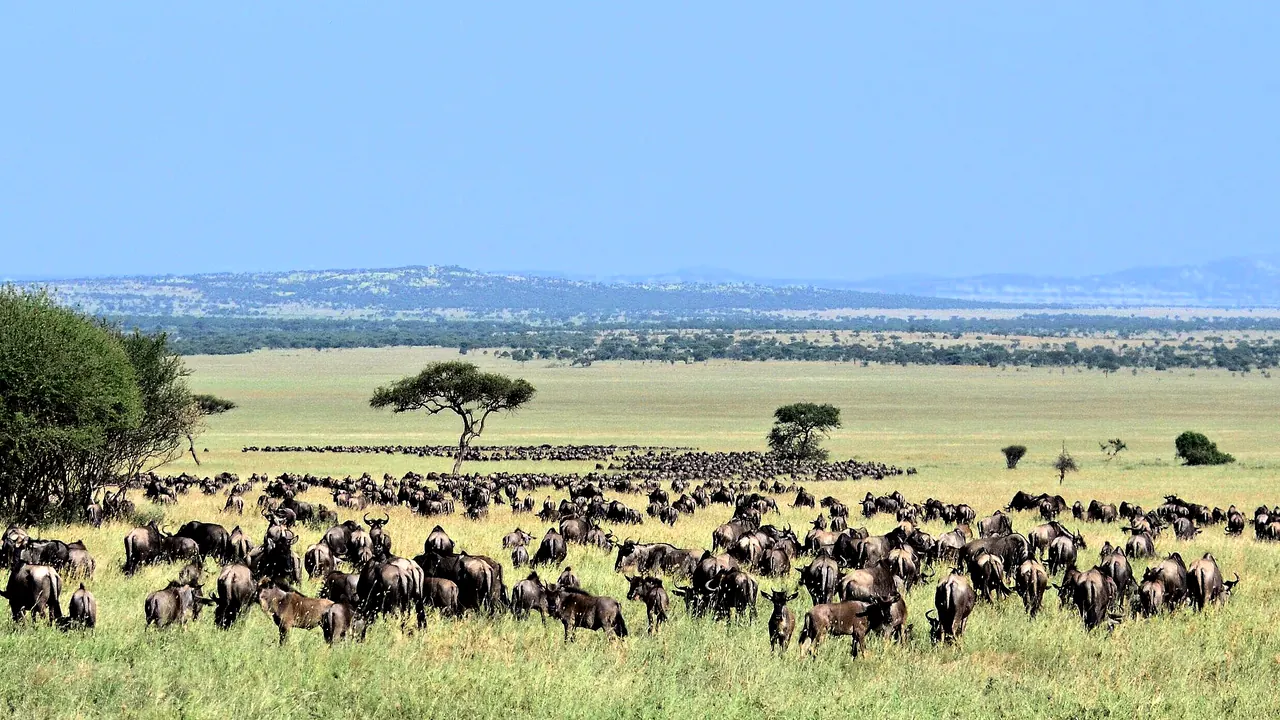
The wildebeest migration on the Serengeti plains
- Nature & outdoors97
- Families32
- Wellness & relaxation28
Photo: DipaliLath, CC BY-SA 4.0, cropped
Match
20
Every category weighted equally
- Beach & sun20
- Culture & arts15
- Food & nightlife11
- Family trip24
- Outdoors30
- Relax & unwind24
- Shopping & style14
- On a budget18
Serengeti in twelve categories
Our verdict on each, scored 0 to 100 against the same fixed benchmark cities, so a score means the same thing on every page.
Beaches & swimming. Scores 3 out of 100.
Food & drink. Scores 12 out of 100.
Culture & sights. Scores 10 out of 100.
Nightlife. Scores 2 out of 100.
Nature & outdoors. Scores 97 out of 100.
Day trips. Scores 18 out of 100.
Good for families. Scores 32 out of 100.
Getting around. Scores 15 out of 100.
Shopping & style. Scores 5 out of 100.
Affordability. Scores 8 out of 100.
Live music & performing arts. Scores 5 out of 100.
Wellness & relaxation. Scores 28 out of 100.
Serengeti category by category
Beaches & swimming
3There is no beach on a Serengeti vacation. The park lies far inland on the high savannah, and the nearest large water, Lake Victoria beyond the western corridor, is not a place visitors swim because freshwater parasites are a known risk. Swimming means the pool at your lodge or tented camp. Visitors who want sand often add a few days on the Indian Ocean coast or Zanzibar after the safari.
Food & drink
12Eating in the Serengeti happens where you sleep. Lodges and tented camps serve set menus or buffets, usually a mix of international dishes with some Tanzanian touches such as pilau rice, grilled meat and ugali, and the better camps cook surprisingly well given how remote they are. Breakfast is often a packed box eaten in the vehicle or under an acacia, and some camps lay out dinners in the bush by lantern light.
That is the whole offer. There are no markets, street food or restaurants to wander between, and choosing where to eat means choosing where to stay. Visitors who want to taste Tanzanian food properly do it in Arusha or on the coast.
Culture & sights
10The Serengeti is not visited for its sights. Within the park the cultural interest is modest: faded Maasai rock paintings and the hollow gong rock at the Moru Kopjes, and a small visitor centre at Seronera that explains the ecosystem and the migration. There are no towns, historic buildings or museums. The human story of the region, from early hominids to the pastoral Maasai, is better met on the way in, outside the park boundary.
Nightlife
2There is no going out. Evenings are a drink by the campfire, dinner, and an early night, since game drives start at dawn and movement after dark is restricted. The night itself is the entertainment: lions calling, hyenas whooping and a sky full of stars far from any city light.
Nature & outdoors
97This is one of the great wildlife landscapes on earth. Endless short-grass plains in the south, granite kopjes rising from the grass, acacia woodland in the centre and the rolling hills and river crossings of the north carry the annual migration of well over a million wildebeest with zebra and gazelle. Lions, cheetahs, leopards, hyenas, elephants and giraffes are seen daily, and the Seronera valley is among the best places anywhere to watch big cats.
The herds move with the rains: calving on the southern plains around Ndutu from January to March, the western corridor and Grumeti River from about May to July, and the dramatic Mara River crossings in the north from July to October. Most activity is by game-drive vehicle, with hot-air balloon flights at dawn and guided walks in some areas. The long rains of April and May make roads harder and many camps close.
Day trips
18Separate places to visit are few and far apart. From the southern edge of the park, Olduvai Gorge, where some of the most important early human fossils were found, has a small site museum overlooking the ravine, and Maasai villages near the park boundaries welcome visitors for a look at homesteads and cattle culture. From the western corridor, the fishing shores of Lake Victoria are within a long drive.
Most outings here are about wildlife rather than towns, and the drives on rough tracks are long. Ngorongoro Crater is the classic addition, but it is usually a stop on the route in or out rather than a day trip.
Good for families
32Seeing lions and elephants up close is unforgettable for children, and older ones who can sit through long game drives often love it. Some lodges offer family tents, junior ranger activities and private vehicles so a family can set its own pace.
The practicalities are hard, though. Days involve hours in a bumpy vehicle, malaria precautions are needed, camps are unfenced so small children must be watched closely, and many camps set minimum ages, especially for walking safaris. There is nothing else made for children. It suits families with children of about eight and older far better than toddlers.
Getting around
15Nothing here is walkable and there is no public transport; every visitor moves in a guided safari vehicle, and self-driving is rare and demanding. The road from Arusha through the Ngorongoro highlands takes most of a day, and tracks inside the park are dusty and corrugated in the dry season and muddy in the rains. Small planes link airstrips such as Seronera, Kogatende and Ndutu with Arusha, saving many hours but adding cost. Within the park, distances between regions are large, so most visitors pick one or two areas according to where the herds are.
Shopping & style
5Shopping is limited to lodge gift shops and the beadwork, blankets and carvings sold at Maasai villages and roadside curio stops on the way in. Anyone wanting Tanzanian crafts, textiles or tanzanite does better in Arusha before or after the safari.
Affordability
8The Serengeti is an expensive place to stay. Daily park fees are charged per person, a guided vehicle is effectively required, and remote lodges and tented camps price in the cost of supplying everything over long tracks. Flying in between airstrips adds more. Simpler camping safaris in public campsites are the cheapest way to see the park, but even these cost far more per day than travel elsewhere in Tanzania. Visiting in the green season of November and early in the year, outside the peak migration months, brings lower lodge rates.
Live music & performing arts
5There is no performing arts scene. The closest thing is Maasai song and the jumping dance, performed for guests at some lodges or during village visits.
Wellness & relaxation
28There is no bathing or spa tradition here, but the stillness counts for something. The rhythm of a safari, out at dawn, back to camp in the heat of the day, out again in the late afternoon, leaves long quiet hours by a pool or on a tent veranda overlooking the plains. A few of the higher-end lodges have spas and massage rooms. The early starts and long, bumpy drives mean it is not a restful trip in the usual sense, and those after real rest often finish on the coast.
Where to stay in Serengeti
The Serengeti has no towns to stay in, so choosing a base means choosing an area of the park and a lodge or tented camp within it. The central Seronera valley is the natural choice for a first visit. Big cats live there all year, the airstrip and visitor centre are close by, and game viewing is good in any month, though it is also the most visited part of the park.
The other bases follow the herds. The southern plains around Ndutu suit a stay from January to March, when the wildebeest calve on the short grass, and they lie closest to Olduvai Gorge and Ngorongoro on the road in. The western corridor along the Grumeti River is the place from about May to July, greener and quieter, with Lake Victoria a long drive further west. The far north around Kogatende is remote and is best reached by small plane. It is the base for the Mara River crossings from July to October and suits a second visit focused on the migration.
Distances inside the park are large, so most trips use one base or split their nights between two, often Seronera plus whichever area the herds are in. Families with children of about eight and older do best at a camp with family tents and a private vehicle. Travellers on a tighter budget can stay in the public campsites in the centre of the park.
When should you go?
Pick a month to see what it is like. The climate figures are measured averages, not a forecast.
Serengeti in July
Daytime high, °C
Rainfall in the month, mm
The whole year
Shaded against this destination’s own year: the deepest cell is its best month for that figure and the palest its weakest.
Where the figures come from
Serengeti has no weather station within reach, so its figures come from a gridded climate model rather than a measured record, and read a broad area rather than one spot.
Temperature and rainfall are climate normals, averaged over the years shown. Serengeti: 2001-2020 normals, NASA POWER reanalysis grid, no weather station within 90 km.
Before you go
| Measure | Serengeti |
|---|---|
| Official language | English, Swahili |
| Currency | Tanzanian Shilling (TZS) |
| Sockets | G230 V, 50 Hz |
| Driving side | Left |
| Time zone | UTC+3 |
| Emergency number | Police 112, ambulance 115, fire 114 |
| Main airport | Kilimanjaro International Airport (JRO)14 non-stop destinations |
| Public holidays this year | 13 days |
Compare Serengeti with
Every comparison with a written verdict behind it.