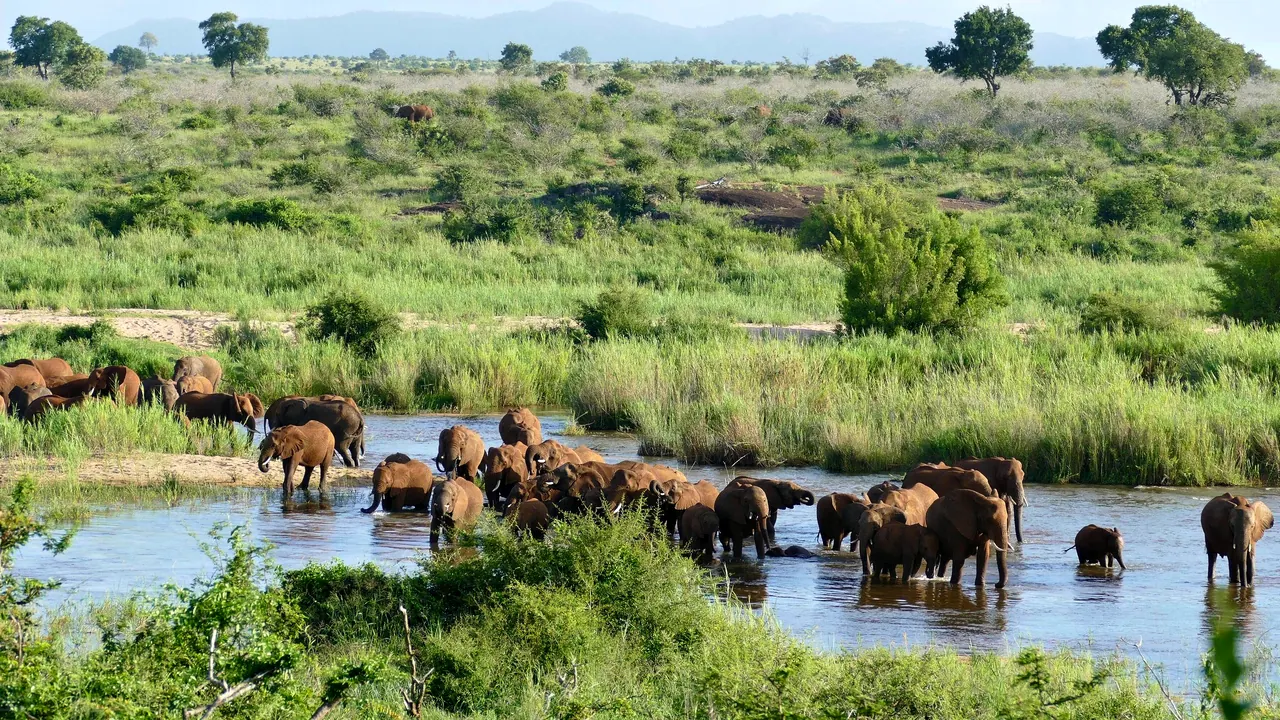
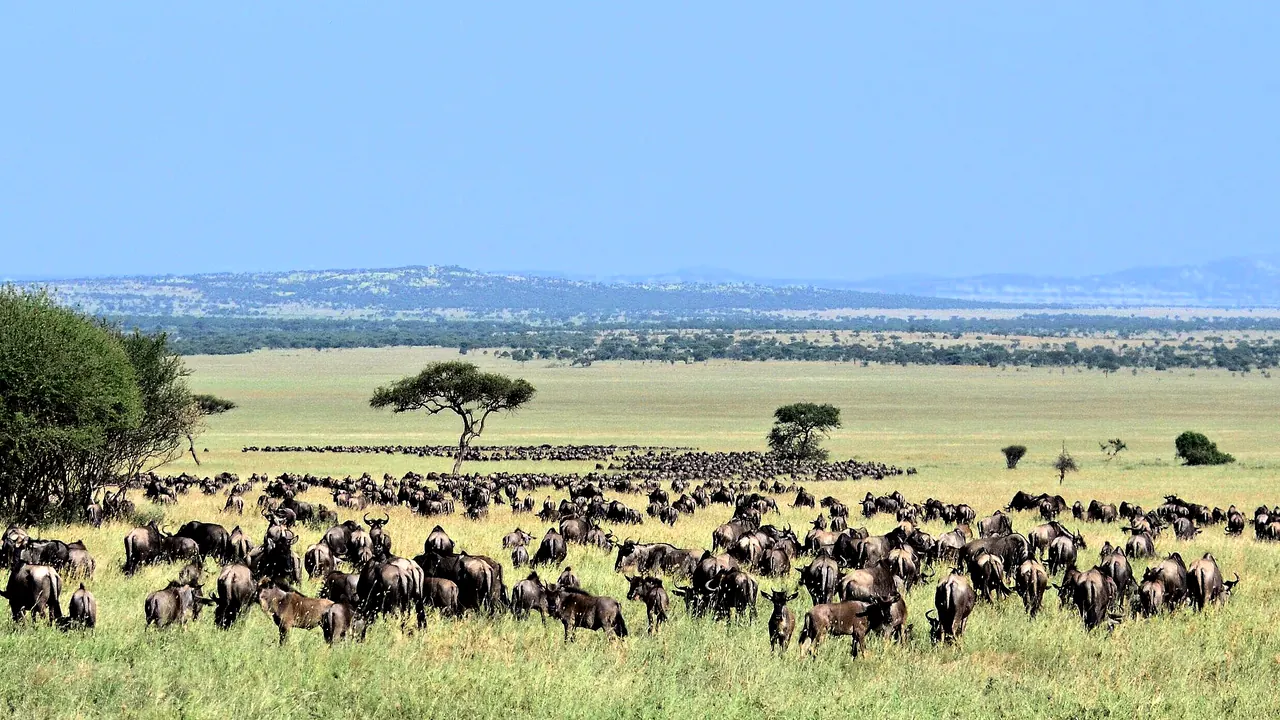
Photos: Kruger by Bernard DUPONT from FRANCE, CC BY-SA 2.0, cropped; Serengeti by DipaliLath, CC BY-SA 4.0, cropped.
Kruger or Serengeti?
Our verdict in twelve categories, each scored against the same fixed benchmark cities, and the climate month by month, so you can choose for your trip.
Choose Kruger for
- prices
- getting around
- wellness
Kruger suits travellers who want to run their own safari. You can hire a car in Johannesburg, drive good roads to the gates, sleep in national park rest camps and cook on the braai, and still see the same lions and leopards as guests at the luxury lodges next door. It is the easier choice with children, the more forgiving one on a budget, and the Blyde River Canyon and Pilgrim's Rest are close by when you want a day away from game drives.
Choose Serengeti for
- nature and the outdoors
The Serengeti is the one to pick for the migration itself, with over a million wildebeest moving across open grassland, calving around Ndutu and crossing the Mara River in the north. It costs more and gives you less freedom, because you travel in a guided vehicle, often fly between airstrips and eat where you sleep. In return you get huge plains, granite kopjes and the big cats of the Seronera valley, and the trip finishes easily on the beaches of Zanzibar.
Scoreboard
Twelve categories on one fixed scale from 0 to 100. The shaded stretch is the gap between the two.
Your match
Pick a travel style or drag the sliders, and both match scores follow your weighting.
Wins on prices and getting around with your weighting.
Wins on nature and the outdoors with your weighting.
What matters to you?
Category by category
What the scores mean for a trip.
Beaches & swimming
Neither has a beach, and in both the only swimming is in a camp or lodge pool. In Kruger the pool matters more, because summer afternoons are hot and the rivers belong to crocodiles and hippos. The Serengeti is milder, and its nearest big water, Lake Victoria, is no place to swim. Its usual beach add-on, Zanzibar or the Tanzanian coast, is a more common pairing than Kruger's long trip across the border to Mozambique.
Food & drink
Kruger gives you more say over what you eat. In the national park camps you buy boerewors and firewood at the camp shop and grill outside your bungalow. The private reserves serve polished meals, with dinner in an open-air boma. Outside the gates, farm stalls around White River and Hazyview sell macadamias, avocados and tropical fruit.
In the Serengeti, meals come with the bed: set menus or buffets with pilau, grilled meat and ugali, a packed breakfast in the vehicle, and sometimes a lantern-lit dinner in the bush. Some camps cook well, but there is nowhere else to eat, so Tanzanian food is better tried in Arusha or on the coast.
Culture & sights
Kruger's history is built in stone and iron. In the far north stands Thulamela, a walled Iron Age citadel on a hilltop, and near Phalaborwa is the reconstructed smelting site at Masorini. Up on the escarpment, Pilgrim's Rest is a gold-rush town from the 1870s, kept almost whole with its corrugated-iron cottages. Add the small museum at Skukuza on the park's founding and you have several worthwhile breaks between game drives.
In the Serengeti, what people left behind is painted, not built: faded Maasai rock art and the hollow gong rock at the Moru Kopjes. Beyond that there is only the visitor centre at Seronera, which explains the migration. For the region's deeper past, from early hominids to the Maasai, you have to look outside the park on the way in.
Nightlife
There is no nightlife in either, and evenings in both end early by the fire. Kruger at least lets you go out after dark on a guided night drive, using spotlights to find leopards, hyenas and owls, and its gateway towns have a few quiet pubs. In the Serengeti, movement after dark is restricted, so the night is the lions you hear and the stars you see from camp.
Nature & outdoors
Both rank among the finest wildlife areas on earth, but they offer different kinds of safari. Kruger gives you more ways in: you can drive yourself, join ranger drives in the unfenced private reserves such as Sabi Sand and Timbavati, go on bush walks or take multi-day wilderness trails on foot. The game is densest in the south around Lower Sabie and Skukuza, and the canyon viewpoints and waterfalls of the escarpment add hiking.
The Serengeti offers scale and movement. Short-grass plains, kopjes and woodland carry the migrating herds, the Seronera valley is outstanding for big cats, and balloon flights at dawn show the plains from above. Most of your time is spent in a guided vehicle following the herds.
Day trips
Kruger has a short but useful list of outings, led by a day on the escarpment that combines Pilgrim's Rest, Graskop, Sabie and the Blyde River Canyon viewpoints. Hoedspruit, near the central gates, adds wildlife rehabilitation centres.
The Serengeti's options are fewer and the drives to them rougher. Olduvai Gorge and its site museum, a Maasai village visit and a long drive to Lake Victoria are about all there is. Ngorongoro Crater usually fits as a stop on the way in or out rather than a separate outing.
Good for families
Kruger is the region many South African families tackle on their own. Gate hours give the day a routine, and the main roads make self-driving manageable. Malaria is a concern in the wet summer, though, and many private lodges turn away young children.
The Serengeti makes a real effort with family tents, junior ranger activities and private vehicles at some lodges. Still, malaria precautions, minimum ages for walking safaris and the lack of anything else aimed at children make it harder work.
Getting around
Kruger is far simpler to reach and to move around. It is a long but straightforward drive from Johannesburg, or a short flight to Skukuza, Hoedspruit or Mbombela. Inside the park, tarred main roads and decent gravel roads take an ordinary hire car. Low speed limits and gate times mean you should explore one section at a time.
In the Serengeti you travel in a guided safari vehicle. Reaching it from Arusha through the Ngorongoro highlands takes most of a day, and the tracks are dusty or muddy depending on the season. Light aircraft to Seronera, Kogatende or Ndutu save hours but add cost.
Shopping & style
You won't go to either for shopping, but Kruger has a little more on offer. Roadside stalls on the Panorama Route around Graskop and God's Window sell carvings, baskets and fabrics, and the malls in Mbombela cover anything you forgot to pack. In the Serengeti you are limited to lodge gift shops and the beadwork and blankets sold at Maasai villages, so leave crafts and tanzanite for Arusha.
Affordability
This is where the two differ most. Kruger can be done cheaply with a hire car, a rest camp or a guesthouse near Hazyview or Malelane, and your own groceries. It can also be among the most expensive stays in Africa if you choose an all-inclusive lodge in Sabi Sand.
The Serengeti has no cheap way in. Per-person park fees, the guided vehicle, remote camps and flights between airstrips all add up. Even simple camping safaris cost more than most other travel in the country, and the green season brings only some relief on lodge rates.
Live music & performing arts
In Kruger the music you are likely to hear is Shangaan song and dance, put on by a few lodges and cultural villages around the park. The Serengeti's is Maasai, with call-and-response singing and the jumping dance, where young men leap straight up from a standing start, performed at some lodges or during a village visit. In both regions it is a show staged for guests, with no theatre or concert hall to plan an evening around.
Wellness & relaxation
Kruger is better for real rest, mainly because of the private lodges along the park boundary. Many have open-sided treatment rooms above dry riverbeds and plunge pools where you can spend the midday break watching elephants come down to drink.
The Serengeti has the same pattern of quiet hours between drives, spent on a tent veranda overlooking the plains. Only a few top lodges have spas, though, and the long, rough drives tire you out, which is why many visitors finish on the coast to unwind.
When should you go?
Pick your month. The climate figures are measured averages, not a forecast.
Kruger in July
Serengeti in July
Daytime high, °C
Rainfall in the month, mm
Where the figures come from
Serengeti has no weather station within reach, so its figures come from a gridded climate model rather than a measured record, and read a broad area rather than one spot.
Temperature and rainfall are climate normals, averaged over the years shown. Kruger: 1991-2020 (rainfall 1981-2010) normals, Skukuza (1.6 km from centre). Serengeti: 2001-2020 normals, NASA POWER reanalysis grid, no weather station within 90 km.
Where most visitors stay in Kruger, the year divides into a hot, wet summer and a dry, mild winter. From May to September the rain almost stops and the days are comfortably warm, the easiest time for long drives and for walking on the escarpment. From November to February highs reach about 33°C, with storms bringing roughly 100mm a month. The bush turns green, but long hours in a vehicle are hard going in that heat.
The Serengeti lies on high savannah near the equator and stays warm rather than hot all year, with highs between 25°C and 29°C. It has two rainy seasons, the short rains in November and December and the long rains in March and April, when about 140mm falls and the tracks turn to mud. June to September is the driest stretch in both places, so a dry-season trip works for either. The difference is that Kruger's summer is a time of heat, while the Serengeti's wet months are a time of mud.
Which traveller are you?
On a trip on a tight budget, Kruger is the realistic choice. You drive yourself, stay in rest camps and cook your own food, and you see the same game. In the Serengeti you need a guide and vehicle and pay park fees per person, so even campsite safaris cost far more.
On a family trip with children, Kruger is easier. Big rest camps such as Skukuza and Berg-en-Dal have pools, lawns and bungalows, and you set the pace from your own car. The Serengeti's unfenced camps and long, bumpy drives suit only children of about eight and older.
For travellers set on seeing the great wildebeest migration, the Serengeti is the place. Herds calve on the southern plains early in the year and cross the Mara River later, a spectacle Kruger cannot offer, even though Kruger has plenty of resident game.
Before you go
| Measure | Kruger | Serengeti |
|---|---|---|
| Official language | English, Zulu, Xhosa, Afrikaans, Venda, Northern Sotho, Swazi, Tswana, Tsonga, Sesotho, Southern Ndebele, South African Sign Language | English, Swahili |
| Currency | Rand (ZAR) | Tanzanian Shilling (TZS) |
| Sockets | CMN230 V, 50 Hz | G230 V, 50 Hz |
| Driving side | Left | Left |
| Time zone | UTC+2 | UTC+3 |
| Emergency number | 112 | Police 112, ambulance 115, fire 114 |
| Main airport | Kruger Mpumalanga International Airport (MQP)8 non-stop destinations | Kilimanjaro International Airport (JRO)14 non-stop destinations |
| Public holidays this year | 13 days | 13 days |
Where else could you go?
Every comparison below shares a destination with this one, so you can follow Kruger or Serengeti somewhere new.