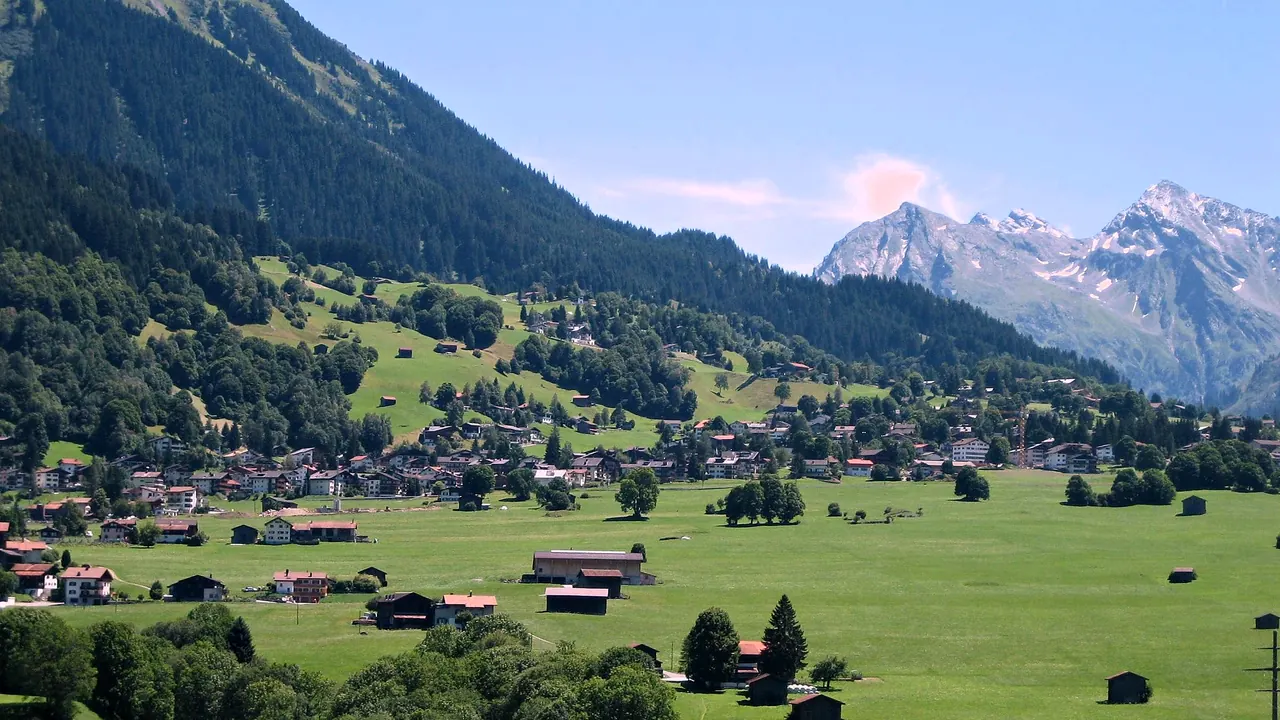
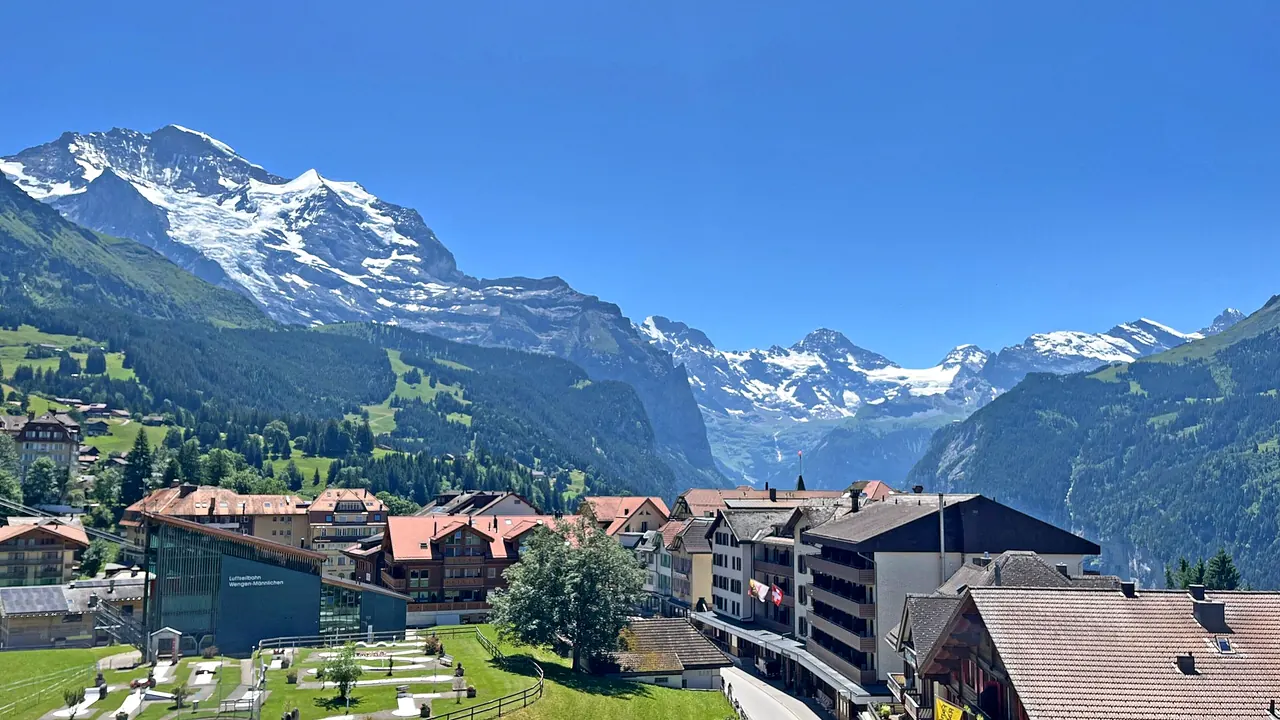
Photos: Klosters by Adrian Michael, CC BY-SA 3.0, cropped; Wengen by Charles J. Sharp, CC BY-SA 4.0, cropped.
Klosters or Wengen?
Our verdict in twelve categories, each scored against the same fixed benchmark cities, and the climate month by month, so you can choose for your trip.
Choose Klosters for
- food and drink
- wellness
- families
Klosters suits travellers who want the mountains with a bit more around them. It has a hearty Graubünden table with local Pinot Noir and a children's mountain at Madrisa. For days off the slopes, the thermal baths at Scuol and the big public pool and sauna complex in Davos are both within easy reach. Summers are milder too, which makes it the more rounded base for a family or for a quiet stay built around walking and the sauna.
Choose Wengen for
- beaches
- nature and the outdoors
- day trips
If the view comes first, pick Wengen. From its car-free shelf above the Lauterbrunnen valley you look straight at the Jungfrau, the Eiger and the Mönch, and trains and cable cars take you up to Kleine Scheidegg, the Männlichen and the Jungfraujoch. Walkers, skiers who want the Lauberhorn and anyone happy to sit on a balcony facing the high peaks will get more from it than from Klosters.
Scoreboard
Twelve categories on one fixed scale from 0 to 100. The shaded stretch is the gap between the two.
Your match
Pick a travel style or drag the sliders, and both match scores follow your weighting.
Too close to call, 1 point apart
Wins on food and drink and wellness with your weighting.
Wins on beaches and nature and the outdoors with your weighting.
What matters to you?
Category by category
What the scores mean for a trip.
Beaches & swimming
Swimming is a sideshow in both villages, but Wengen has slightly better water within reach. The lidos on Lake Thun, about an hour away by train, can reach around 20°C in a warm July.
From Klosters, the bathing area on the Davos lake is closer, but the mountain water rarely gets much above 17°C. Most swimming there ends up in hotel pools or thermal baths.
Food & drink
Klosters eats somewhat better. Its Graubünden cooking has a distinct character: capuns, pizokel, barley soup and Bündnerfleisch, Pinot Noir from the Bündner Herrschaft down the valley, and a few refined kitchens serving its well-off regulars.
Wengen sticks to the familiar Swiss staples of rösti, fondue and raclette, and many guests take half-board in their hotel. In both places the terrace lunch on the mountain is the best meal of the day, and in Wengen the Jungfrau view is what makes it.
Culture & sights
Neither village is a place for sightseeing, and the little there is differs in kind. Klosters has Augusto Giacometti's stained glass in the church of St. Jakob and a small museum of Prättigau farm life in the Nutli-Hüschi. Wengen's history is in its Belle Époque hotels from its days as an English resort, and in its long ski-racing tradition.
Nightlife
Evenings are early in both villages, and they liven up only at certain times. Klosters has a late spot or two that fill around Christmas, New Year and February, and Davos is a short train ride away if you want more. Wengen's one real party is the Lauberhorn race weekend in January. Otherwise it is après-ski, then dinner.
Nature & outdoors
Both are outstanding mountain bases, but Wengen puts you closer to the big peaks. It looks straight across the Lauterbrunnen trough at the Jungfrau, with waterfalls pouring down sheer rock walls and the railway climbing to the Jungfraujoch glacier. Its ski area links with Grindelwald and includes the long Lauberhorn run.
Klosters is greener and more open. The Parsenn is known for long runs down to the valley, Madrisa is the gentler side, and summer routes lead into the Silvretta massif. The Swiss National Park can be reached through the Vereina tunnel.
Day trips
From Klosters the Rhaetian Railway carries you straight out to towns, wine and painted villages. Chur's old town, the Bündner Herrschaft wine villages and Vaduz lie down the line, and through the Vereina tunnel you reach the sgraffito houses of Guarda and Scuol. The Albula line to St. Moritz makes a longer day.
Wengen's outings run to lakes and castles, and every one of them begins with the slow rack railway down to Lauterbrunnen. From there you can take a steamer on Lake Thun to the castles at Oberhofen and Spiez, or visit Brienz and the Ballenberg open-air museum. Bern's arcaded old town makes a full day out.
Good for families
Klosters is the easier choice with children. The Madrisa side is built around them, with a summer play and adventure area and gentle ski-school slopes, and the farm-hut hikes are short.
Wengen's main advantage is that it has no cars, so children can roam the village safely, and the nursery slopes are close to the hotels. However, the steep paths are hard work with a buggy in snow. Neither village has much for a rainy day.
Getting around
Neither village needs a car, but they are easy in opposite directions. Klosters sits on the main valley railway, so leaving is simple: direct trains run up to Davos and down towards Chur, and the Gotschna cable car starts beside the station. The catch is that the village is long and thin, so you use the bus more than you might expect.
Wengen is the reverse. It is car-free and small enough to cross on foot in minutes, and the railway and cable car lift you to Kleine Scheidegg, the Männlichen and the Jungfraujoch with almost no effort. Going down is the slow part, because every trip to the lowlands starts with the rack railway to Lauterbrunnen.
Shopping & style
Klosters has a little more to browse. Along with the ski and outdoor shops, there are upmarket fashion and interior boutiques for its regular guests and delicatessens selling Graubünden cured meats and cheese. Wengen's short main street covers gear hire, chocolate, souvenirs and groceries, and for anything more you go down to Interlaken.
Affordability
Both villages are very expensive and there is little to choose between them on price. The costs fall in different places, though. In Klosters, lift passes, ski lessons and an upmarket clientele push up the bill. In Wengen, the mountain railways add a heavy cost to almost every outing, and the Jungfraujoch train costs the most. In both, the transport guest card or rail passes and self-catering soften the bill a little.
Live music & performing arts
There is little live performance in either village. Klosters has a summer classical concert series and occasional church recitals. Wengen's evenings run more to yodelling, alphorn and brass-band music at village celebrations. For theatre you go to Chur from Klosters, or to Interlaken or Bern from Wengen.
Wellness & relaxation
Klosters is better for a spa-focused stay. Its hotel spas are good, the thermal baths at Scuol are under an hour away and Davos has a large public pool and sauna complex.
Wengen relaxes you in a different way. With no cars, the loudest sounds are cowbells and waterfalls, and the balcony view of the Jungfrau does much of the work. Beyond the hotel spas there is no bathing culture.
When should you go?
Pick your month. The climate figures are measured averages, not a forecast.
Klosters in July
Wengen in July
Daytime high, °C
Rainfall in the month, mm
Where the figures come from
Klosters's temperatures are measured 51 km from the centre, at S. Valentino Alla Muta.
Klosters's station stands 280 m above the city centre, so the centre is likely a little warmer than the figures say.
Klosters has no rain gauge within 25 km of the centre, so its rainfall comes from a gridded climate dataset read at the destination rather than from a gauge further away.
Wengen has no weather station within reach, so its figures come from a gridded climate model rather than a measured record, and read a broad area rather than one spot.
Temperature and rainfall are climate normals, averaged over the years shown. Klosters: 1991-2020 normals, S. Valentino Alla Muta (51.4 km from centre). Wengen: 1991-2020 normals, TerraClimate 4 km grid at the town, no weather station within 90 km.
Neither village is a beach destination in any month, so choose by the mountains. Klosters is the milder of the two. July and August reach about 20°C, which is pleasant hiking weather, but those are also its wettest months, with about 140mm of rain, so expect afternoon showers. Wengen sits higher and stays cooler, at around 16°C in high summer. Its rain is spread more evenly through the year, and autumn there stays damp too.
In winter both villages are snowbound and the highs hover around freezing, with Wengen a couple of degrees colder. Klosters is noticeably drier from December to April, which helps on ski days. For walking, June to September works in both villages, and Klosters has a little more warmth to spare in September and October.
Which traveller are you?
On an outdoors trip, Wengen has the edge. Trails start at the door and lead to the Männlichen ridge, Kleine Scheidegg and the foot of the Eiger north face, with the Lauterbrunnen waterfalls below and the railway up to the Jungfraujoch glacier.
For a relaxing and wellness trip, Klosters is the better choice. Its hotel spas are backed by a real bathing tradition close by: the thermal baths of Scuol are through the Vereina tunnel and the large pool and sauna complex in Davos is up the valley. Wengen offers calm but little bathing.
On a family trip with children, Klosters makes the days easier. The Madrisa side has a summer play and adventure area and gentle beginner slopes. Wengen's car-free lanes are safe, but they are steep and hard going with a buggy.
Before you go
| Measure | Klosters | Wengen |
|---|---|---|
| Official language | French, German, Italian, Romansh | French, German, Italian, Romansh |
| Currency | Swiss Franc (CHF) | Swiss Franc (CHF) |
| Sockets | CJ230 V, 50 Hz | CJ230 V, 50 Hz |
| Driving side | Right | Right |
| Time zone | UTC+1, UTC+2 in summer | UTC+1, UTC+2 in summer |
| Emergency number | 112 | 112 |
| Elevation | 1,179 m | 1,274 m |
| Main airport | Zürich Airport (ZRH)120 km from centre226 non-stop destinations | Zürich Airport (ZRH)106 km from centre226 non-stop destinations |
| Public holidays this year | 9 days | 10 days |
By the numbers
| Measure | Klosters | Wengen |
|---|---|---|
| Population | 4,499 | 1,116 |
| People per km² | 20 | 31 |
| Museums within 10 km | 3 | 2 |
| UNESCO World Heritage sites within 50 km | 1 | 1 |
Where else could you go?
Every comparison below shares a destination with this one, so you can follow Klosters or Wengen somewhere new.
- Mürrenvs Wengen
- Davosvs Klosters
- Grindelwaldvs Wengen
- Arosavs Klosters
- Lenzerheidevs Klosters
- Adelbodenvs Wengen