
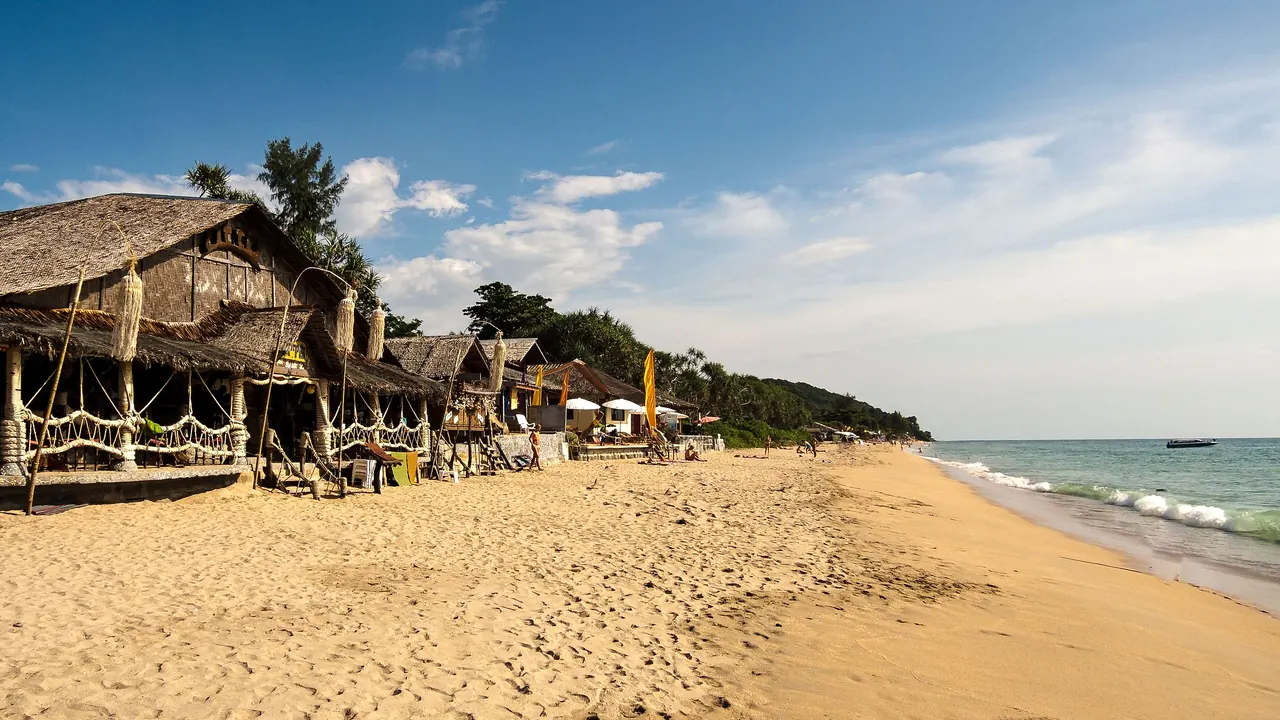
Photos: Koh Kood by Stéphane Bidouze, CC BY-SA 4.0, cropped; Koh Lanta by Dronepicr, CC BY 3.0, cropped.
Koh Kood or Koh Lanta?
Our verdict in twelve categories, each scored against the same fixed benchmark cities, and the climate month by month, so you can choose for your trip.
Choose Koh Kood for
Koh Kood does not lead in any category we score.
Koh Kood is for travellers who want to switch off completely. Its forested interior, waterfalls and thinly settled bays feel wilder than almost anywhere else on the Thai coast, and with no bars, shops or sights to pull you away, the trip comes down to a hammock, a kayak and a resort on a bay of its own. It suits couples and solo travellers on a comfortable budget who are happy to stay put.
Choose Koh Lanta for
- nightlife
- families
- wellness
Koh Lanta gives you the same kind of west-coast beaches, but it does more around them. It is cheaper and easier with children, its sea trips reach the limestone islands and the dive sites off the Trang coast, and in the evenings there are night markets and beach bars with fire shows. It is still quiet, and Krabi and Phi Phi are close enough for a change of scene, so it works better for a longer stay or for anyone who wants a little choice.
Scoreboard
Twelve categories on one fixed scale from 0 to 100. The shaded stretch is the gap between the two.
Your match
Pick a travel style or drag the sliders, and both match scores follow your weighting.
Has no clear advantage with the weighting you have chosen.
Wins on nightlife and families with your weighting.
What matters to you?
Category by category
What the scores mean for a trip.
Beaches & swimming
These are two of the finest beach islands in Thailand, and both keep their swimming bays on the west coast, with warm, calm water through the dry season. The difference is in mood. Koh Kood's bays, such as Klong Chao, Ao Tapao and Ao Prao, have only a few resorts each and feel close to empty. Some of them go very shallow at low tide or have sandflies, so it is worth choosing your bay carefully.
Koh Lanta's beaches look out to the sunset. Long Beach is a long strip lined with casuarina trees, and Kantiang Bay is a quieter cove further south. There are more people and a few beach bars on the sand, and boats run to the white beaches of Koh Kradan and Koh Ngai.
Food & drink
Neither island is a place to travel for food, but Koh Lanta gives you more to choose from. Its Muslim majority puts southern Thai curries, roti and halal cooking on everyday menus. There are night markets around Saladan, seafood grilled on the beach in the evening, and stilt restaurants over the water in the Old Town.
On Koh Kood, most meals end up at your resort, because the bays are far apart after dark. The best food is in the stilt fishing villages of Ao Salad and Ao Yai, where crab and squid come straight off the boats. There are no markets to plan around.
Culture & sights
Koh Kood's sights are its working fishing villages, Ao Yai and Ao Salad, where wooden houses and piers stand on stilts over the water, along with a few small temples and shrines. It is everyday island life rather than heritage.
Koh Lanta has a little more history to it. The Old Town on the east coast is a single street of wooden Chinese shophouses that was once a trading stop between Penang and Phuket, and the Urak Lawoi sea-people village at Sang Ka U keeps its own traditions. Even so, that fills half a day at most, and anyone who wants museums or grand architecture should look elsewhere.
Nightlife
Koh Kood has no nightlife at all. An evening means dinner, a drink at your resort bar and an early night. Koh Lanta stays relaxed too, but there is a little more going on. Along Long Beach and Klong Dao there are beach bars with cushions on the sand, reggae and fire shows, and the odd party night in high season. For anything bigger, you take the boat to Koh Phi Phi.
Nature & outdoors
Koh Lanta has more to do outdoors, and most of it is at sea. From November to April, boats go to the limestone islands of the Trang coast and the Emerald Cave on Koh Mook. Divers can reach Koh Haa and the pinnacles of Hin Daeng and Hin Muang, where mantas and whale sharks pass. On land there are the jungle trails and lighthouse headland of the national park, the Khao Mai Kaew caves and the mangroves of the east coast.
Koh Kood feels greener and wilder on land, because much of it is still forest. Short walks lead to the Klong Chao and Huang Nam Kheo waterfalls and to the giant old trees inland, and you can kayak up the Klong Chao river. Its snorkelling trips to the marine park are gentler and more limited.
Day trips
From Koh Kood there is really one outing, the boat to neighbouring Koh Mak in the dry season, often combined with a few sandy islets. The mainland is too far for a day, so most people stay on the island.
Koh Lanta has more within reach. Koh Phi Phi is roughly an hour away by boat, Koh Mook makes a quieter stop, and Krabi Town and Ao Nang can be reached in about two hours. Most of these trips depend on high-season boats, though.
Good for families
Koh Lanta is the easier island with children. Klong Dao's soft sand and shallow dry-season water suit small swimmers, family bungalows with pools are common, and when the days settle into beach, pool and an early dinner, there are no party crowds to work around. If a child needs a specialist, Krabi is about two hours away by road and car ferry.
Koh Kood can give you a calm beach week with kayaks and waterfall pools, but the journey from Bangkok by road and boat is hard going with small children. Serious medical care means a boat back to Trat. Older children on either island may get bored, because neither has any attractions made for them.
Getting around
The two are much alike. Neither has public transport, both have a single main road, and on both you mostly use a hired scooter or arranged transport. On Koh Kood the road is hilly, with steep, sandy turns down to the bays. Guests often stay close to their own bay, and reaching the island means a boat crossing from Trat, with fewer boats in the monsoon. Koh Lanta has a car ferry from the mainland and motorbike taxis with sidecars, and its beaches are easier to reach from wherever you stay.
Shopping & style
There is little to buy on either island, but Koh Lanta has slightly more to browse. Along the main road there are stalls of beachwear and souvenirs, there are small night markets around Saladan, and a few batik and craft shops sit in the Old Town's wooden houses. On Koh Kood, shopping means minimarts for sun cream and the beachwear sold in resort boutiques.
Affordability
Koh Lanta is easier on the wallet. Simple beach bungalows and guesthouses are common, local Thai kitchens and markets are cheap, and staying in the south or on the east coast costs less again. The costs that add up are the tuk-tuk and transfer fares.
Koh Kood is built around mid-range and upmarket bungalow resorts, with a few expensive retreats. Because the bays are isolated, you often eat at resort prices, and the boat crossing and snorkelling trips add to the bill. Fan bungalows exist, but the island suits a comfortable budget better than a tight one.
Live music & performing arts
On Koh Kood, the most you can hope for is a resort bar putting on an acoustic guitar evening, and it is not worth planning around. Koh Lanta at least has something to watch: fire twirling on the sand, the occasional reggae or acoustic band in a beach bar in high season, and Muay Thai bouts at small local rings. On both islands, though, this is entertainment that comes with the beach, not a reason to choose one over the other.
Wellness & relaxation
Koh Lanta is better set up for a restful stay. As well as massage pavilions on almost every beach and spas at the resorts, it has yoga studios and retreats around Long Beach and the southern bays, and Kantiang Bay is the calmest place to base yourself.
Koh Kood's strength is its quiet, which comes naturally. There is no traffic, there is no nightlife, and many resorts sit alone in the jungle or on their own bay. Treatments mostly stop at Thai massage and the spa menus of the upmarket resorts, so it suits people who rest best when nothing is on offer.
When should you go?
Pick your month. The climate figures are measured averages, not a forecast.
Koh Kood in July
Koh Lanta in July
Daytime high, °C
Rainfall in the month, mm
Where the figures come from
Koh Kood's temperatures are measured 39 km from the centre, at Khlong Yai.
Koh Kood has no rain gauge within 25 km of the centre, so its rainfall comes from a gridded climate dataset read at the destination rather than from a gauge further away.
Koh Lanta's temperatures are measured 65 km from the centre, at Trang.
Koh Lanta's station stands 188 m below the place it is measured for, so that place is likely a little cooler than the figures say.
Koh Lanta has no rain gauge within 25 km of the centre, so its rainfall comes from a gridded climate dataset read at the destination rather than from a gauge further away.
Temperature and rainfall are climate normals, averaged over the years shown. Koh Kood: 1971-2000 (rainfall 1991-2020) normals, Khlong Yai (38.5 km from centre). Koh Lanta: 1971-2000 (rainfall 1991-2020) normals, Trang (64.9 km from centre).
Both islands are hot all year, and the sea stays around 29°C in every month, so the real question is rain. Koh Kood has the sharper dry season, and it starts earlier. November is already fairly dry, and December to February are the driest stretch, with December down to about 19mm, so this is the island's best window for the beach. March and April turn showery. From May the monsoon arrives hard, and June to September are very wet, with August reaching about 777mm.
Koh Lanta's rain is spread more evenly through the year. November and December are still fairly wet there, and its best beach weather runs from January to March. In January and February it is dry, though Koh Kood is slightly drier still, and in March Koh Lanta is clearly the drier of the two. February to April are also its hottest months, up to 35°C, which makes the middle of the day heavy going away from the water. From May to October it is steadily wet, but never as wet as Koh Kood. In November or December, choose Koh Kood. In January and February both are at their best, and in March Koh Lanta is the safer bet.
Which traveller are you?
On a beach and sun trip where the goal is an empty stretch of sand, Koh Kood has the edge. Its pale west-coast bays have only a few resorts behind them, there are no bars along the sand, and its drier Novembers and Decembers start the beach season earlier.
On a family trip with young children, Koh Lanta is easier. Getting there from Krabi is shorter, Klong Dao has shallow water and soft sand, and family bungalows with pools are common. Hospital care in Krabi is also closer than the boat crossing to Trat from Koh Kood.
On a trip on a tight budget, Koh Lanta stretches money further. It has simple beach bungalows, cheap local kitchens and night markets, and the south and east coast are cheaper still. On Koh Kood, resort meals and the boat transfers make a cheap stay hard to manage.
Before you go
| Measure | Koh Kood | Koh Lanta |
|---|---|---|
| Official language | Thai | Thai |
| Currency | Baht (THB) | Baht (THB) |
| Sockets | ABCF220 V, 50 Hz | ABCF220 V, 50 Hz |
| Driving side | Left | Left |
| Time zone | UTC+7 | UTC+7 |
| Emergency number | Police 191, ambulance 1669, fire 199 | Police 191, ambulance 1669, fire 199 |
| Main airport | Trat Airport (TDX)1 non-stop destination | Krabi International Airport (KBV)14 non-stop destinations |
By the numbers
| Measure | Koh Kood | Koh Lanta |
|---|---|---|
| Population | 2,000 | - |
| People per km² | 18 | - |
| Swim season, months above 21 °C | 12 months | 12 months |
Where else could you go?
Every comparison below shares a destination with this one, so you can follow Koh Kood or Koh Lanta somewhere new.
- Koh Phi Phivs Koh Lanta
- Koh Changvs Koh Kood
- Phuketvs Koh Lanta
- Koh Lipevs Koh Lanta
- Koh Rongvs Koh Kood
- Koh Sametvs Koh Kood