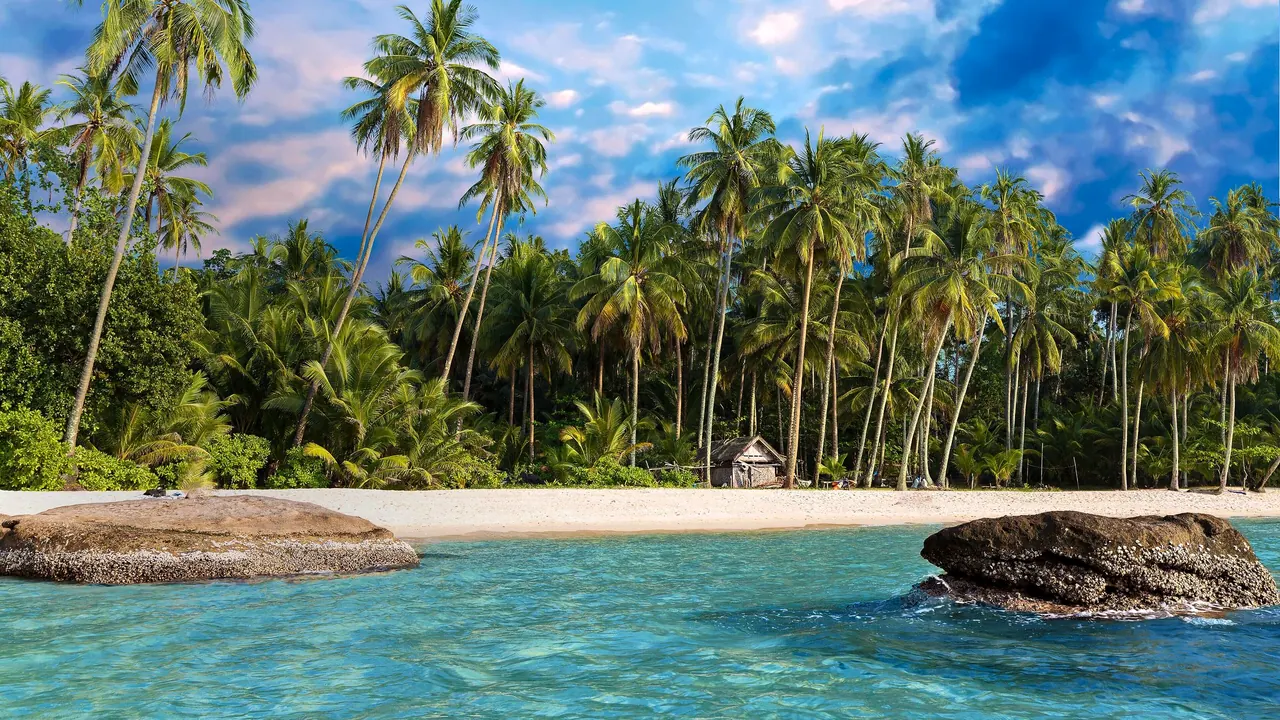
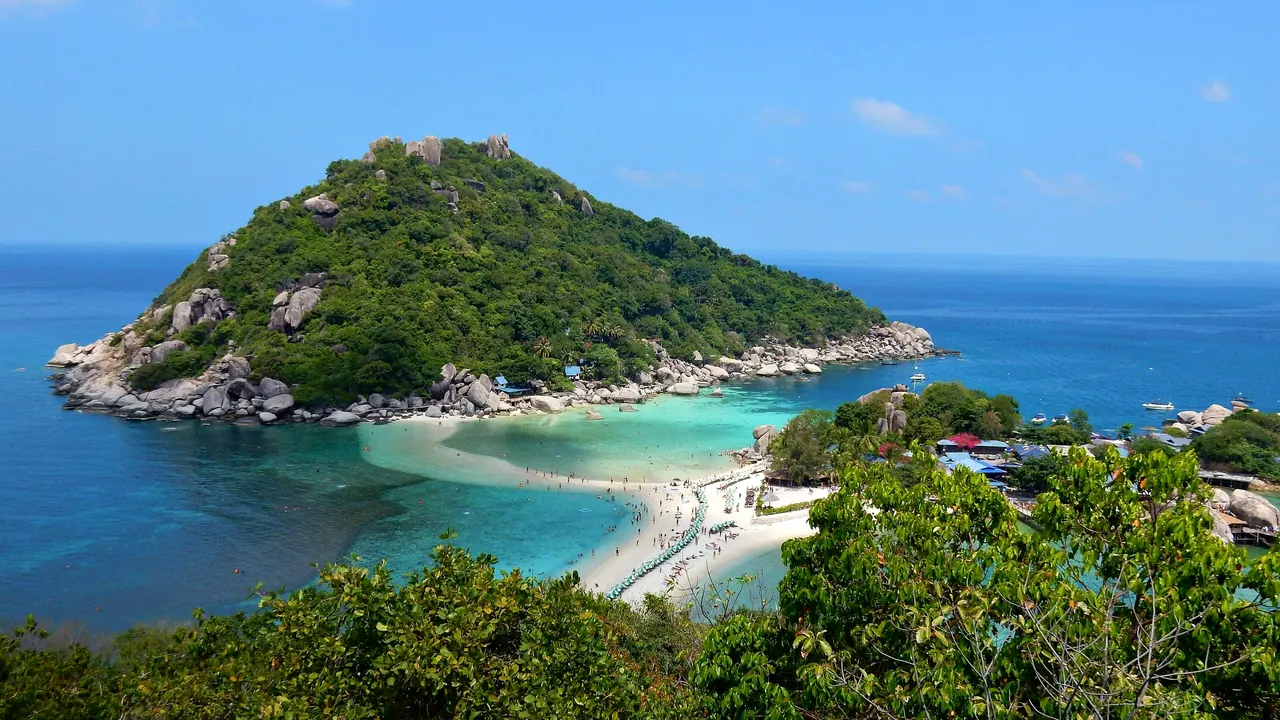
Photos: Koh Kood by Stéphane Bidouze, CC BY-SA 4.0, cropped; Koh Tao by Roma Neus, CC BY 3.0, cropped.
Koh Kood or Koh Tao?
Our verdict in twelve categories, each scored against the same fixed benchmark cities, and the climate month by month, so you can choose for your trip.
Choose Koh Kood for
- families
- wellness
- beaches
Koh Kood is the island for doing very little with plenty of room around you. Its west coast bays are softer, emptier and quieter than Koh Tao's, the forest runs down to the sand, and there is no bar strip to keep anyone awake. Couples, families with young children and anyone after a week of hammock, kayak and early nights will find it the better fit, as long as they accept a long journey and eating mostly at their resort.
Choose Koh Tao for
- nightlife
- nature and the outdoors
- prices
Choose Koh Tao if you want to get into the sea rather than just look at it. Its reefs and granite pinnacles make it one of the world's great places to learn to dive, a stay costs less, and the southern end of Sairee gives evenings a social life that Koh Kood does not try to offer. It suits younger travellers, divers and anyone who wants company after dark, and Koh Phangan and Koh Samui are a ferry ride away when a change of scene is needed.
Scoreboard
Twelve categories on one fixed scale from 0 to 100. The shaded stretch is the gap between the two.
Your match
Pick a travel style or drag the sliders, and both match scores follow your weighting.
Wins on families and wellness with your weighting.
Wins on nightlife and nature and the outdoors with your weighting.
What matters to you?
Category by category
What the scores mean for a trip.
Beaches & swimming
Koh Kood has the better beaches for lying on. Klong Chao, Ao Tapao, Ao Prao and the other west coast bays are long, pale and backed by palms and jungle, with only a few resorts on each, so there is room even in the dry months. The trade-offs are small: some bays go very shallow at low tide and a few have sandflies.
Koh Tao's beaches are busier and more varied. Sairee is the one long strand, with sunsets over the gulf. The rest are small coves such as Tanote Bay and Aow Leuk, where you can snorkel straight off the sand, plus the sandbar at Koh Nang Yuan. Several of the coves are reached down steep tracks.
Food & drink
Neither island is a place to plan a trip around food, and the standard is much the same on both. On Koh Kood the meals worth seeking out are in the stilt fishing villages of Ao Salad and Ao Yai, where crab and squid come straight off the boats, but most guests eat at their resort because the bays are far apart after dark.
Koh Tao has more choice close together, with Thai kitchens, breakfast cafés, pizza places and night stalls along Sairee and around Mae Haad. Much of it is cooked for divers and foreign tastes, though, so it lacks the local seafood character of Koh Kood's villages.
Culture & sights
Neither island is for sightseeing. Koh Kood's wooden fishing villages on stilts at least make a pleasant hour's wander, while Koh Tao's past as a place of political exile has left almost nothing to see beyond a couple of small temples.
Nightlife
Koh Kood has no night out at all, and the island means it that way. Evenings end at the resort table, and with the bays so far apart after dark there is nowhere else to go. Anyone who travels partly to meet people, or who wants a drink somewhere other than their own hotel, will start to feel it after a couple of nights.
Koh Tao has a real social life, but a small one, and it sits almost entirely at the southern end of Sairee among a young crowd who came to dive. If you stay there, a beach bar with music is a short walk from your room. In the eastern bays or around Chalok Baan Kao, your evenings will look much like Koh Kood's. The scene also thins out in the wet months at the end of the year.
Nature & outdoors
Koh Tao has the stronger outdoors, and most of it is underwater. Coral gardens ring the coast, dive boats head to granite pinnacles where barracuda school and whale sharks sometimes pass, and the conditions suit beginners. On land there are boulders to climb and short, steep trails to viewpoints.
Koh Kood is the greener island and the gentler one. Its forest interior holds the Klong Chao and Huang Nam Kheo waterfalls and some giant old trees, and you can paddle a kayak up the mangrove river from the beach. For snorkelling and diving, though, you take a boat to the marine park islets to the north.
Day trips
Koh Tao gives you more ways to leave for a day. Koh Phangan is about an hour away by ferry and Koh Samui about two, both with towns, temples and markets, and Koh Nang Yuan is a short hop for a beach afternoon. Rough seas can still cut off the ferries in the monsoon.
From Koh Kood the only real outing is to flat, quiet Koh Mak and the islets around it, and only in the dry season. The mainland is too far to be worth a day.
Good for families
Koh Kood is the easier island with young children. Its calm, uncrowded bays, waterfall pools and resorts with family rooms and pools make a gentle beach week. Choose a bay with deeper water at low tide, and allow for the long journey and the fact that serious medical care is a boat ride away in Trat.
Koh Tao suits older children who can swim, since snorkelling from the bays and children's dive courses keep them busy. Toddlers find it harder going, with steep tracks down to many beaches and roads full of inexperienced scooter riders.
Getting around
Both islands take a long day to reach, and neither has buses. Koh Tao is slightly easier once you arrive, because it is small and you can walk along the beach and village lane from Sairee to Mae Haad pier. Shared pickup taxis and longtail boats cover the rest, but the eastern roads are steep and rutted.
Koh Kood is more spread out. One hilly main road links bays that are too far apart to walk between, so it comes down to resort pick-ups or a scooter, and many guests rarely leave their own beach.
Shopping & style
There is no shopping to speak of on either island. Koh Tao's dive shops, sarong stalls and souvenir T-shirts along Sairee give you a little more to browse than Koh Kood's minimarts and resort boutiques, but on both it is wise to bring what you need.
Affordability
Koh Tao is the cheaper island. Simple bungalows, Thai meals and beer cost little, the dive courses are among the best value anywhere, and booking through a dive school often brings the room price down. Imported food and drink cost more because everything comes in by boat.
Koh Kood is built around mid-range and upmarket bungalow resorts. With the bays so isolated, many meals end up at resort prices, and the boat crossing and transfers add to the bill. Fan bungalows and local Thai restaurants are possible, but the island suits a comfortable budget more than a shoestring one.
Live music & performing arts
Neither island has a stage, a concert hall or any traditional performance. Koh Tao's fire-dancers on Sairee at least give you something to watch after dark, while on Koh Kood the most you can expect is an occasional acoustic guitar at a resort bar.
Wellness & relaxation
Koh Kood is the more restful island, because nothing gets in the way of the rest. There is no bar strip and no traffic noise, and the days follow the tide and the light, so an oil massage on the beach and an afternoon in a hammock make up the whole programme. The upmarket resorts add proper spas and some yoga for anyone who wants more structure, although treatments rarely go beyond the spa menu.
Koh Tao offers a more active kind of rest, with yoga classes above the bays and a few small retreats inland. Where you stay matters more here. Sairee stays loud late, so book in the slower southern coves around Chalok Baan Kao or in the eastern bays. On both islands the sea stands in for hot springs or bathhouses, and swimming is as close to a bathing ritual as either gets.
When should you go?
Pick your month. The climate figures are measured averages, not a forecast.
Koh Kood in July
Koh Tao in July
Daytime high, °C
Rainfall in the month, mm
Where the figures come from
Koh Kood's temperatures are measured 39 km from the centre, at Khlong Yai.
Koh Kood has no rain gauge within 25 km of the centre, so its rainfall comes from a gridded climate dataset read at the destination rather than from a gauge further away.
Koh Tao's temperatures are measured 83 km from the centre, at Chumphon.
Koh Tao has no rain gauge within 25 km of the centre, so its rainfall comes from a gridded climate dataset read at the destination rather than from a gauge further away.
Temperature and rainfall are climate normals, averaged over the years shown. Koh Kood: 1971-2000 (rainfall 1991-2020) normals, Khlong Yai (38.5 km from centre). Koh Tao: 1991-2020 (sunshine 1981-2010) normals, Chumphon (82.5 km from centre).
Both islands are hot all year, with daytime highs that barely move between about 30°C and 34°C and sea warm enough to swim in every month. The real difference is the rain, and it falls at opposite times. On Koh Kood's west coast, December to February is close to dry, with December bringing only about 19mm. March and April add some showers. From May the southwest monsoon sets in hard, with August the wettest month at around 777mm. Swell builds on the bays and many resorts close until about November.
Koh Tao's wet spell comes at the end of the year. October to December is when the rain peaks, with about 290mm in November, and the east coast gets rough water. For the rest of the year rainfall is moderate, the sea is calm and clear from about February to September, and February to April is the sunniest stretch. Put simply, December and January favour Koh Kood, the middle of the year belongs to Koh Tao, and February to April works well on both.
Which traveller are you?
On a relaxing and wellness trip, Koh Kood is the better choice. The quiet covers the whole island rather than a few corners, resorts sit alone in the jungle or on their own bay, and a massage pavilion is rarely far from the sand.
For a food and nightlife trip, Koh Tao wins easily. The cooking on the two islands is on a par, but Sairee puts dozens of casual places within walking distance and ends the night with beach bars and fire-dancers. Koh Kood goes to bed after dinner.
For anyone who wants to learn to dive or dive seriously, Koh Tao is the obvious pick. Beginner-friendly coral sits off the beaches, the dive schools are cheap and well run, and boats reach Chumphon Pinnacle and Sail Rock. Koh Kood's reefs mean a longer boat trip.
Before you go
| Measure | Koh Kood | Koh Tao |
|---|---|---|
| Official language | Thai | Thai |
| Currency | Baht (THB) | Baht (THB) |
| Sockets | ABCF220 V, 50 Hz | ABCF220 V, 50 Hz |
| Driving side | Left | Left |
| Time zone | UTC+7 | UTC+7 |
| Emergency number | Police 191, ambulance 1669, fire 199 | Police 191, ambulance 1669, fire 199 |
| Main airport | Trat Airport (TDX)1 non-stop destination | Samui International Airport (USM)10 non-stop destinations |
By the numbers
| Measure | Koh Kood | Koh Tao |
|---|---|---|
| Population | 2,000 | 1,382 |
| People per km² | 18 | 66 |
| Swim season, months above 21 °C | 12 months | 12 months |
Where else could you go?
Every comparison below shares a destination with this one, so you can follow Koh Kood or Koh Tao somewhere new.
- Koh Phanganvs Koh Tao
- Koh Changvs Koh Kood
- Koh Samuivs Koh Tao
- Koh Rongvs Koh Kood
- Koh Sametvs Koh Kood
- Phu Quocvs Koh Kood