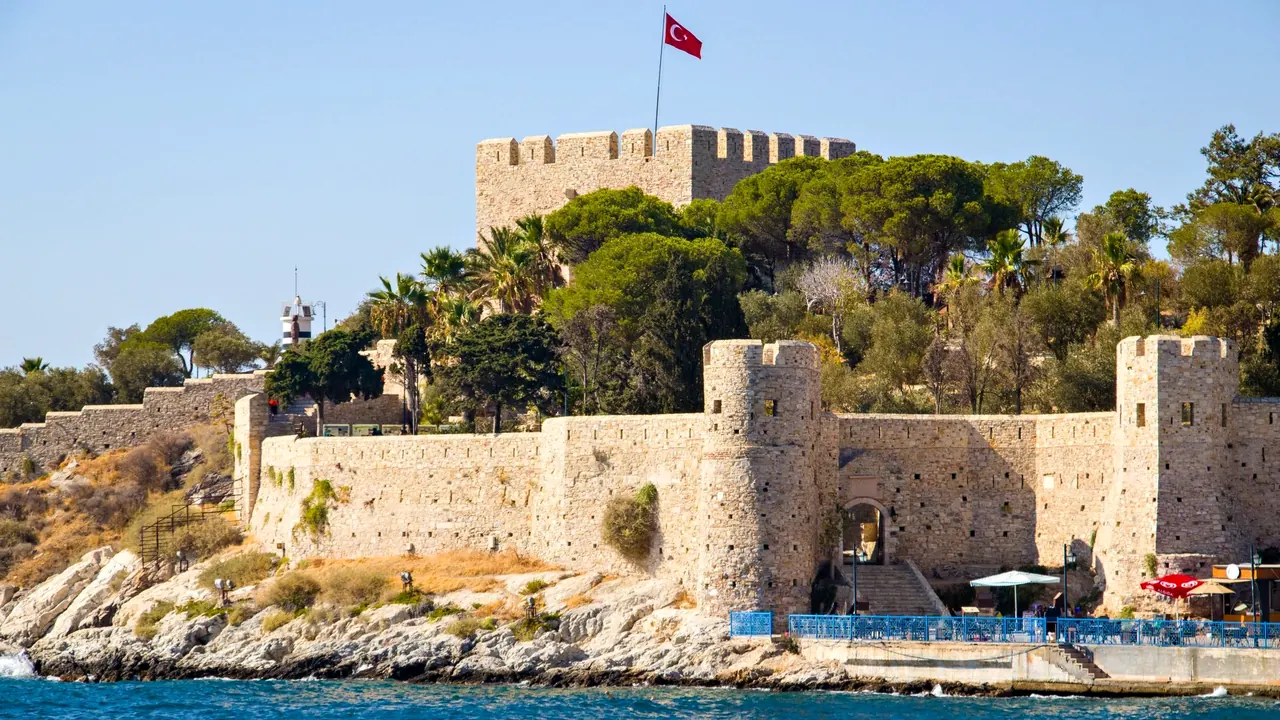
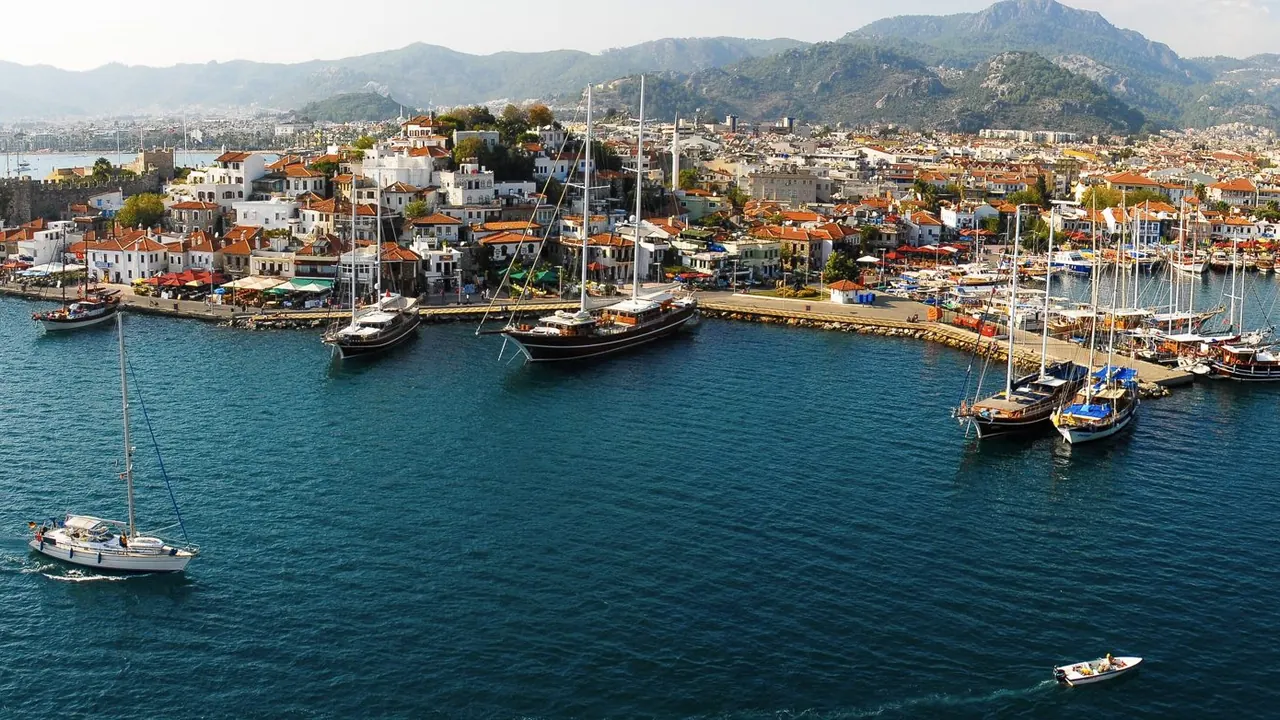
Photos: Kusadasi by Murat Halıcı, Pexels License; Marmaris by Mstyslav Chernov, CC BY-SA 3.0, cropped.
Kusadasi or Marmaris?
Our verdict in twelve categories, each scored against the same fixed benchmark cities, and the climate month by month, so you can choose for your trip.
Choose Kusadasi for
- day trips
- food and drink
- culture and sights
Kusadasi suits travellers who want a beach vacation with serious history close by. Ephesus is a short ride away, and Priene, Miletus and Didyma fill another day, so you can mix sunbeds with some of the finest ancient sites in the Mediterranean. It is also the slightly better place to eat, with meze and fish in the old Kaleiçi quarter, and its town beaches are proper sand.
Choose Marmaris for
- nature and the outdoors
- nightlife
- getting around
Marmaris is the better pick if the sea and the landscape matter more than ruins. Pine-covered hills almost close off its calm bay, and gulets sail from the marina along the empty Bozburun and Datca coastline. The sea is warmer and the walking and diving are better. Its Bar Street is the more full-on party, and Rhodes is a short ferry crossing away.
Scoreboard
Twelve categories on one fixed scale from 0 to 100. The shaded stretch is the gap between the two.
Your match
Pick a travel style or drag the sliders, and both match scores follow your weighting.
Too close to call, 1 point apart
Wins on day trips and food and drink with your weighting.
Wins on nature and the outdoors and nightlife with your weighting.
What matters to you?
Category by category
What the scores mean for a trip.
Beaches & swimming
Both are swimming resorts first, and on beaches alone there is little to choose between them. Kusadasi's town beaches are proper sand: Ladies Beach by the centre, Long Beach further south, and the wide, quieter sweep of Pamucak to the north. For the clearest water, go to the pine-backed coves of the Dilek Peninsula.
The Marmaris promenade has coarse sand and shingle instead. However, the enclosed bay keeps the water calm, and by late summer it is a couple of degrees warmer. Its best swimming is mostly reached by boat or water taxi: the bay's coves, Icmeler and Turunc, and the fine sand of Sedir Island.
Food & drink
Kusadasi eats better, though neither town is a reason to travel for food. In the fish restaurants and meyhanes of Kaleiçi you can spend a whole evening over meze and rakı away from the harbour front, and the plain lunchtime lokantas cook for locals.
In Marmaris, resort menus cover more of the town, and good Turkish cooking takes more searching for, in the harbour fish restaurants and the pide houses behind the promenade. Its local speciality is pine honey from the surrounding forests. In both towns the weekly market is a better food experience than most of the restaurants.
Culture & sights
Neither town will keep a sightseer busy for long. Kusadasi has slightly more to look at: the little fortress on Pigeon Island, the fortified Ottoman caravanserai in the centre and the old Kaleiçi lanes with their mosque and hammam. Marmaris has its hilltop castle with a modest archaeological museum and an old quarter of whitewashed stepped lanes, worth an hour for the marina views. In both towns, the history lies outside town.
Nightlife
Both towns have a Bar Street, but the one in Marmaris is louder and runs later. It is a lane of open-fronted clubs with laser shows and foam parties, filling up after midnight and going on until nearly dawn, with a young, mostly British crowd. Calmer cocktail bars line the marina.
Kusadasi offers more of a mix, with pubs, karaoke and dance bars by the harbour and large open-air clubs out by Long Beach. A long dinner in Kaleiçi is the gentler alternative. In both towns the scene largely shuts down outside summer.
Nature & outdoors
Marmaris has the stronger natural setting. Pine-covered hills almost ring its bay, and beyond them the Bozburun and Datca peninsulas form a barely built-up run of headlands, inlets and islands, one of Turkey's great sailing grounds. Gulet cruises, the Carian Trail, diving and sea kayaking all start here, and the loggerhead turtle beach near Dalyan is within reach.
Kusadasi's best landscape is concentrated in the Dilek Peninsula national park, with its canyon walk, wild horses and the Büyük Menderes delta. The granite Latmos mountains above Lake Bafa add rockier hiking. It is good country for a day out, but the wild coast does not start on your doorstep as it does in Marmaris.
Day trips
This is where Kusadasi pulls well ahead. Ephesus is about twenty minutes away, with Selçuk, the Basilica of St John and the House of the Virgin Mary next to it, and Şirince's hill village a short drive further. Priene, Miletus and Didyma make a second full day among ancient cities, and in summer the ferry crosses to Samos.
Marmaris has one excellent outing: the ferry to Rhodes and its walled medieval town. Dalyan's river boats beneath Lycian rock tombs make another good day. Beyond those, its trips are mostly to quiet peninsula villages, plus the long drive to Knidos, rather than a run of major sites.
Good for families
For a beach-and-pool family trip the two are evenly matched. Both have kids' clubs and water parks, children are made welcome everywhere, and beyond the beach there is little made for children in either. Kusadasi has sandy town beaches with gentle entry and two water parks. Marmaris has a calm, shallow bay and boat trips with swimming stops that older children love, and families are best based in Icmeler or Armutalan, away from the noise of Bar Street.
Getting around
Both towns run on dolmuş minibuses, and both need a hire car or a tour to see the wider area. Kusadasi's great asset is the direct dolmuş to Selçuk, which puts Ephesus within easy reach. Its centre climbs steeply, though, and many hotels sit far out on the coast road.
Marmaris is easier within its bay. A flat promenade several kilometres long is good for walking or cycling, and water taxis cross to Icmeler and Turunc. Outside the bay, the peninsula villages and Dalyan lie along winding mountain roads with little bus service.
Shopping & style
The bazaars sell much the same in both towns: leather jackets, carpets, Turkish delight and copy designer goods, with haggling expected. Kusadasi's shops are geared to cruise passengers, and the sales pitch is more persistent. Marmaris has the better souvenirs to take home, in pine honey, natural sponges, olive oil soap and peshtemal towels. In both towns the weekly market rewards a visit more than the bazaar.
Affordability
Overall costs are much the same. Both have plenty of package and all-inclusive hotels at fair prices, cheap dolmuş rides and inexpensive lokanta meals away from the front, and both charge tourist prices on the seafront and for imported drinks.
Where the extra money goes is different. In Kusadasi it is site entry, charged at rates set for foreign visitors, which adds up over Ephesus and the Ionian cities. In Marmaris it is organised boat and jeep trips and nights on Bar Street, so compare the trips before you book.
Live music & performing arts
Neither town has a theatre, concert hall or performance season, so this should not sway the choice. Live entertainment in both means Turkish-night dinner shows with folk and belly dancing, cover bands in bars and the odd summer concert. In Marmaris those concerts are held in an open-air amphitheatre.
Wellness & relaxation
The hammam is the main way to unwind in both towns, mostly in hotel or tourist form. Kusadasi has a historic Turkish bath in its old quarter. Marmaris has more hammams spread across town, plus the mud baths and hot springs near Dalyan for half a day of soaking.
For real quiet in Kusadasi, stay in the hotels outside town or head for the southern coves in May, June or September. Marmaris has calmer Icmeler and, slower still, the peninsula villages of Turunc, Selimiye and Bozburun.
When should you go?
Pick your month. The climate figures are measured averages, not a forecast.
Kusadasi in July
Marmaris in July
Daytime high, °C
Rainfall in the month, mm
Where the figures come from
Kusadasi's temperatures are measured 36 km from the centre, at Samos Airport.
Kusadasi has no rain gauge within 25 km of the centre, so its rainfall comes from a gridded climate dataset read at the city rather than from a gauge further away.
Kusadasi's sunshine is measured 51 km from the centre, at Aydin.
Marmaris's temperatures are measured 49 km from the centre, at Dalaman.
Marmaris has no rain gauge within 25 km of the centre, so its rainfall comes from a gridded climate dataset read at the city rather than from a gauge further away.
Temperature and rainfall are climate normals, averaged over the years shown. Kusadasi: 1991-2020 normals, Samos Airport (35.7 km from centre). Marmaris: 2000-2020 (rainfall 1991-2020) normals, Dalaman (48.8 km from centre).
Both towns follow the same rhythm of dry, hot summers and wet winters. The sea is warm enough for swimming from about June into October. In July and August Kusadasi reaches 33°C and Marmaris is barely cooler, so walking ruins or streets at midday is hard work. May, late September and early October are the comfortable months for sightseeing and hiking, and the sea is still pleasant then.
Through the year, Marmaris has the warmer water: it reaches 27°C in August against 24°C at Kusadasi, and it stays mild a little longer into autumn. Its winters are much wetter, with around 230mm in both December and January, and the autumn rain arrives sooner, in October. Kusadasi stays drier in the cooler months and has long, cloudless days through the summer.
Which traveller are you?
On a culture and arts trip, Kusadasi is the clear choice. Neither town has much to see within its own streets, but from Kusadasi you can reach Ephesus, Selçuk, Priene, Miletus and Didyma in easy day trips, and Ephesus is reachable by dolmuş without a car.
For an outdoors trip, choose Marmaris. Its bay opens onto one of Turkey's great sailing coasts, with gulet cruises, diving and sea kayaking, and the Carian Trail runs through forest and fishing villages. Kusadasi's Dilek Peninsula park is good for a day but covers less ground.
On a food and nightlife trip, the deciding question is which half matters more. Kusadasi has the better meals, with meze and rakı in Kaleiçi's meyhanes. Marmaris has the bigger nights, with clubs on its Bar Street running almost until dawn all summer.
Before you go
| Measure | Kusadasi | Marmaris |
|---|---|---|
| Official language | Turkish | Turkish |
| Currency | Turkish Lira (TRY) | Turkish Lira (TRY) |
| Sockets | CF230 V, 50 Hz | CF230 V, 50 Hz |
| Driving side | Right | Right |
| Time zone | UTC+3 | UTC+3 |
| Emergency number | 112 | 112 |
| Elevation | 11 m | 7 m |
| Main airport | Adnan Menderes International Airport (ADB)49 km from centre120 non-stop destinations | Dalaman International Airport (DLM)49 km from centre61 non-stop destinations |
| Public holidays this year | 14 days | 14 days |
By the numbers
| Measure | Kusadasi | Marmaris |
|---|---|---|
| City population | 130,835 | 97,818 |
| People per km² | 494 | 111 |
| Museums within 10 km | 0 | 1 |
| UNESCO World Heritage sites within 50 km | 2 | 1 |
| Swim season, months above 21 °C | 5 months | 6 months |
Where else could you go?
Every comparison below shares a destination with this one, so you can follow Kusadasi or Marmaris somewhere new.