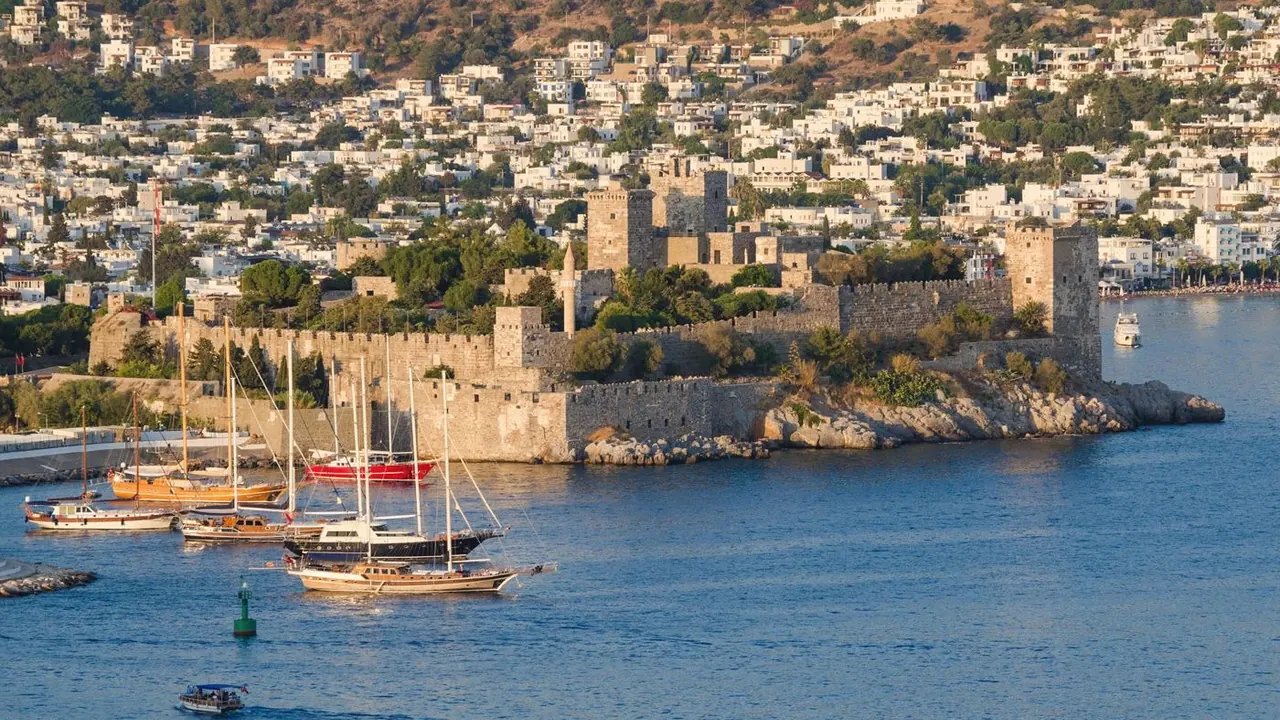
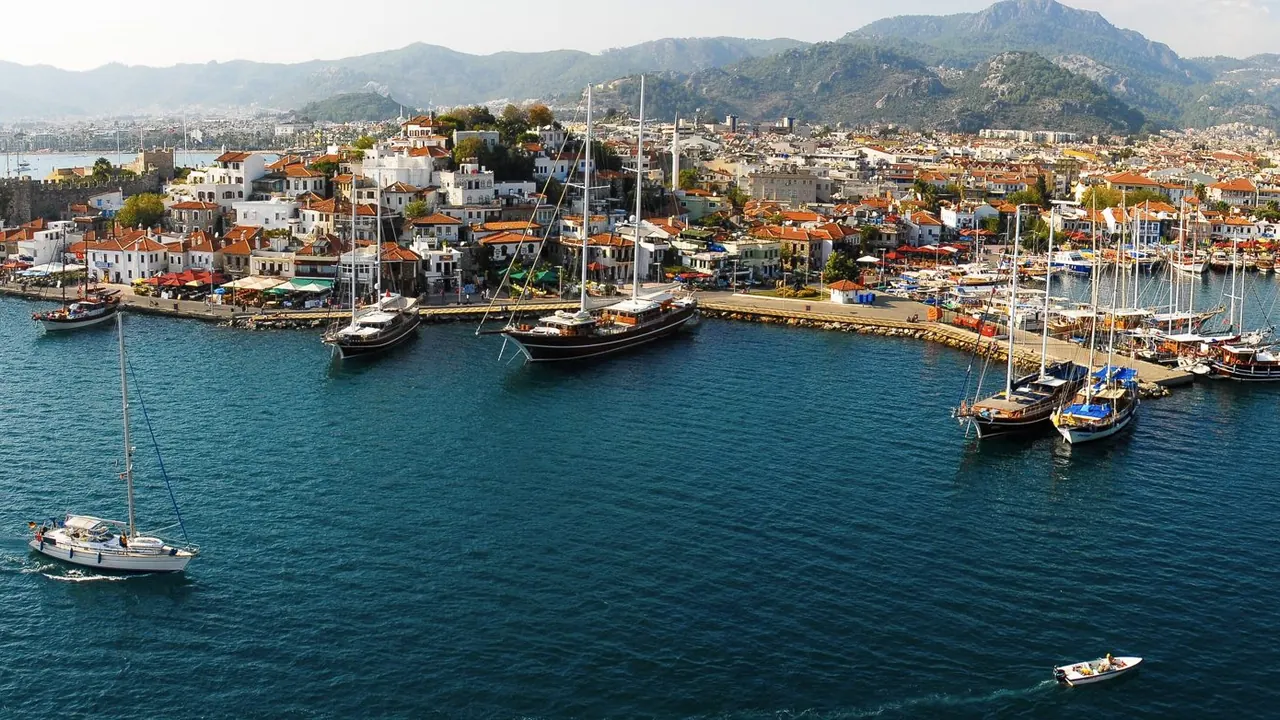
Photos: Bodrum by Serhio Magpie, CC BY 4.0, cropped; Marmaris by Mstyslav Chernov, CC BY-SA 3.0, cropped.
Bodrum or Marmaris?
Our verdict in twelve categories, each scored against the same fixed benchmark cities, and the climate month by month, so you can choose for your trip.
Choose Bodrum for
- culture and sights
- food and drink
- live music and the arts
Bodrum suits travellers who want more from the Aegean than a sunbed. The Castle of St Peter and its shipwreck museum, the fish market and Gümüşlük's waterfront tables, summer concerts in the ancient theatre and the ruins of Didyma, Miletus and Priene give a week here more variety. The price is higher bills, and you will want a car if you plan to move between bays.
Choose Marmaris for
- prices
- getting around
- nature and the outdoors
Marmaris is the better choice if the coast itself is the point and the budget matters. Its pine-covered bay, the wild Bozburun and Datça peninsulas and some of Türkiye's best sailing waters lie right on the doorstep, a flat promenade links the beaches, and package stays cost noticeably less. Just don't expect much culture or good cooking in town without going looking for it.
Scoreboard
Twelve categories on one fixed scale from 0 to 100. The shaded stretch is the gap between the two.
Your match
Pick a travel style or drag the sliders, and both match scores follow your weighting.
Wins on culture and sights and food and drink with your weighting.
Wins on prices and getting around with your weighting.
What matters to you?
Category by category
What the scores mean for a trip.
Beaches & swimming
Both are strong swimming destinations, but the beaches work differently. Bodrum is a peninsula of separate bays, so you choose a mood each day: the shallow sand at Bitez and Ortakent, the jetties and decks of Türkbükü and Yalıkavak, or the windier western bays near Turgutreis. Many of the best spots belong to beach clubs.
Marmaris has one sheltered bay, with a long strip of loungers running from the centre towards Icmeler and calmer water that warms a little more by late summer. The best swimming there is a short trip away, in the quieter coves at Turunc, the small pebble bays of Bozburun and on Sedir Island's fine sand.
Food & drink
Bodrum eats noticeably better. Choosing your fish at the town market and having it cooked at the tables around it, the long waterfront lunches at Gümüşlük and the village breakfasts in the hills all give meals a sense of place, and the north coast adds polished seafood restaurants.
In Marmaris the seafront serves mostly resort food, so you have to seek out the lokanta, the pide houses and the harbour fish restaurants for real Turkish cooking. Its weekly market and the local pine honey are the highlights, but there is no fine dining to compare with Bodrum's north coast.
Culture & sights
Neither is a sightseeing city, but Bodrum has far more to see. The Castle of St Peter, built partly from the Mausoleum's stone, holds raised shipwrecks of real international importance, and the Mausoleum site, the ancient theatre and the Myndos Gate fill out a couple of days.
In Marmaris, the small Ottoman castle with its modest museum and the stepped lanes of the old quarter take about an hour. Anyone interested in history spends their days on excursions rather than in town.
Nightlife
Both are true summer party towns, and both go quiet in winter. What differs is the range. Bodrum offers three kinds of night: the harbour bar street, the cheaper and louder clubs of Gümbet, and the dressed-up beach clubs of Türkbükü and Yalıkavak, which turn into parties after sunset.
Marmaris centres on a single Bar Street of foam parties and laser shows, packed with a young, mostly British crowd until near dawn. For a quieter drink, the marina and seafront cocktail bars are the alternative.
Nature & outdoors
Marmaris has the finer setting. Steep pine-covered hills almost close off its bay, and beyond them the Bozburun and Datça peninsulas form a wild, barely built coastline that ranks among the great sailing grounds of the Turkish coast. Kayaking, diving, jeep tours and the turtle beach near Dalyan are all within easy reach.
Bodrum's landscape is drier, with scrub, olive groves and bare hills, and it looks best from a gulet heading to Kara Ada or into the greener Gulf of Gökova. Its steady meltem does give the western bays better windsurfing.
Day trips
Bodrum has the better spread of trips, above all for ancient history. Didyma's Temple of Apollo, Miletus and Priene make one full day, and Euromos, Iasos and Herakleia on Lake Bafa are closer still. The short ferry to Kos adds a Greek island town with its own Knights' castle.
Marmaris has fewer options, but they are memorable. Rhodes's walled medieval town is an hour away by boat, Dalyan's river passes beneath Lycian rock tombs, and Knidos makes a long but rewarding drive to the tip of the Datça peninsula.
Good for families
Both work for a beach-and-pool family vacation, with shallow water, kids' clubs and large water parks, and in both towns families do better away from the bar district. In Bodrum that means Bitez or Ortakent, and the castle's shipwrecks make one good outing beyond the beach.
Marmaris has the gentler layout: the calm enclosed bay, a flat promenade for pushchairs and scooters, and boat trips with swimming stops that older children enjoy. Families tend to stay in Icmeler or Armutalan.
Getting around
Marmaris is easier day to day. A flat promenade runs for several kilometres along the bay, dolmuş minibuses run back and forth all the time, and water taxis cross to Icmeler and Turunc. A car is only needed for the peninsulas and Dalyan.
Bodrum is spread around a peninsula, and getting from one bay to another usually means going back through town by dolmuş. The roads clog in summer and taxis are expensive, so many visitors hire a car or scooter.
Shopping & style
Neither is a shopping destination, but Bodrum has a little more worth buying. Its leather sandals are made to measure in small workshops, the village markets are lively, and at the other extreme the Yalıkavak marina has luxury boutiques.
The Marmaris bazaar sells much the same leather, carpets and copied goods, with plenty of haggling. The best things to take home are local: pine honey, natural sponges and cotton peshtemal towels.
Affordability
Marmaris is clearly the cheaper stay. All-inclusive hotels are plentiful and keenly priced, and simple meals away from the seafront cost little. Only Bar Street, seafront dining and organised trips push the bills up.
Bodrum is Türkiye's most expensive resort area, and in midsummer Yalıkavak and Türkbükü are priced for a wealthy crowd. Staying in Gümbet or Turgutreis, or travelling in May, June or late September, keeps costs manageable.
Live music & performing arts
This is a summer-only interest in both, but Bodrum has real events to plan around. There are concerts in the restored ancient theatre, a long-running ballet festival on the castle stage and chamber music in Gümüşlük's old stone quarry.
In Marmaris, performance mostly means hotel entertainment and Turkish nights with folk and belly dancing, plus the odd open-air concert and bar cover bands.
Wellness & relaxation
The two are evenly matched for unwinding, but in different ways. Bodrum's relaxation centres on its hotels, especially the large spas of Türkbükü and Yalıkavak, while Gümüşlük and the western villages are its quiet corners.
Marmaris has hammams all over town as well as in the resorts. The Dalyan mud baths and hot springs make an easy half-day of soaking, and Selimiye and Bozburun are about as slow as this coast gets.
When should you go?
Pick your month. The climate figures are measured averages, not a forecast.
Bodrum in July
Marmaris in July
Daytime high, °C
Rainfall in the month, mm
Where the figures come from
Bodrum's temperatures are measured 43 km from the centre, at Kos Airport.
Bodrum has no rain gauge within 25 km of the centre, so its rainfall comes from a gridded climate dataset read at the city rather than from a gauge further away.
Marmaris's temperatures are measured 49 km from the centre, at Dalaman.
Marmaris has no rain gauge within 25 km of the centre, so its rainfall comes from a gridded climate dataset read at the city rather than from a gauge further away.
Temperature and rainfall are climate normals, averaged over the years shown. Bodrum: 1993-2020 (rainfall 1991-2020) normals, Kos Airport (42.7 km from centre). Marmaris: 2000-2020 (rainfall 1991-2020) normals, Dalaman (48.8 km from centre).
Both towns follow the same rhythm. Swimming is good from June into October, and July and August are hot, with daytime highs of about 31°C in Bodrum and 32°C in Marmaris. That makes midday sightseeing and hillside lanes hard work in both. Marmaris runs a little warmer all year, and its enclosed bay holds the warmer sea, reaching 27°C in late summer against Bodrum's 25°C. May, June and late September are the best months for pairing beach time with walking or excursions.
The difference shows in the wet season. Rain arrives sooner and falls much harder in Marmaris, where October is already fairly wet and December and January each bring around 232mm. Bodrum stays drier into autumn and gets less winter rain, though neither town is a good choice between November and March.
Which traveller are you?
On a culture and arts trip, Bodrum is the clear choice. It has the castle and its museum of underwater archaeology, festivals of ballet and chamber music, and Didyma, Miletus and Priene within a day's drive. Marmaris has a small castle and little else in town.
For a trip on a tight budget, go to Marmaris. All-inclusive and package hotels there are keenly priced, the dolmuş runs along the bay all day, and lokanta meals are cheap. Bodrum is Türkiye's priciest resort area, and its sunbed fees and taxis soon add up.
For an outdoors trip, Marmaris wins. Its bay is ringed with pine forest and opens onto a largely unbuilt coast of inlets and islands, ideal for gulet cruises, kayaking and walking the Carian Trail. Bodrum's dry scrub hills are best seen from a boat.
Before you go
| Measure | Bodrum | Marmaris |
|---|---|---|
| Official language | Turkish | Turkish |
| Currency | Turkish Lira (TRY) | Turkish Lira (TRY) |
| Sockets | CF230 V, 50 Hz | CF230 V, 50 Hz |
| Driving side | Right | Right |
| Time zone | UTC+3 | UTC+3 |
| Emergency number | 112 | 112 |
| Elevation | 10 m | 7 m |
| Main airport | Milas Bodrum International Airport (BJV)32 km from centre83 non-stop destinations | Dalaman International Airport (DLM)49 km from centre61 non-stop destinations |
| Public holidays this year | 14 days | 14 days |
By the numbers
| Measure | Bodrum | Marmaris |
|---|---|---|
| City population | 175,000 | 97,818 |
| People per km² | 314 | 111 |
| Museums within 10 km | 4 | 1 |
| UNESCO World Heritage sites within 50 km | 0 | 1 |
| Swim season, months above 21 °C | 5 months | 6 months |
Where else could you go?
Every comparison below shares a destination with this one, so you can follow Bodrum or Marmaris somewhere new.