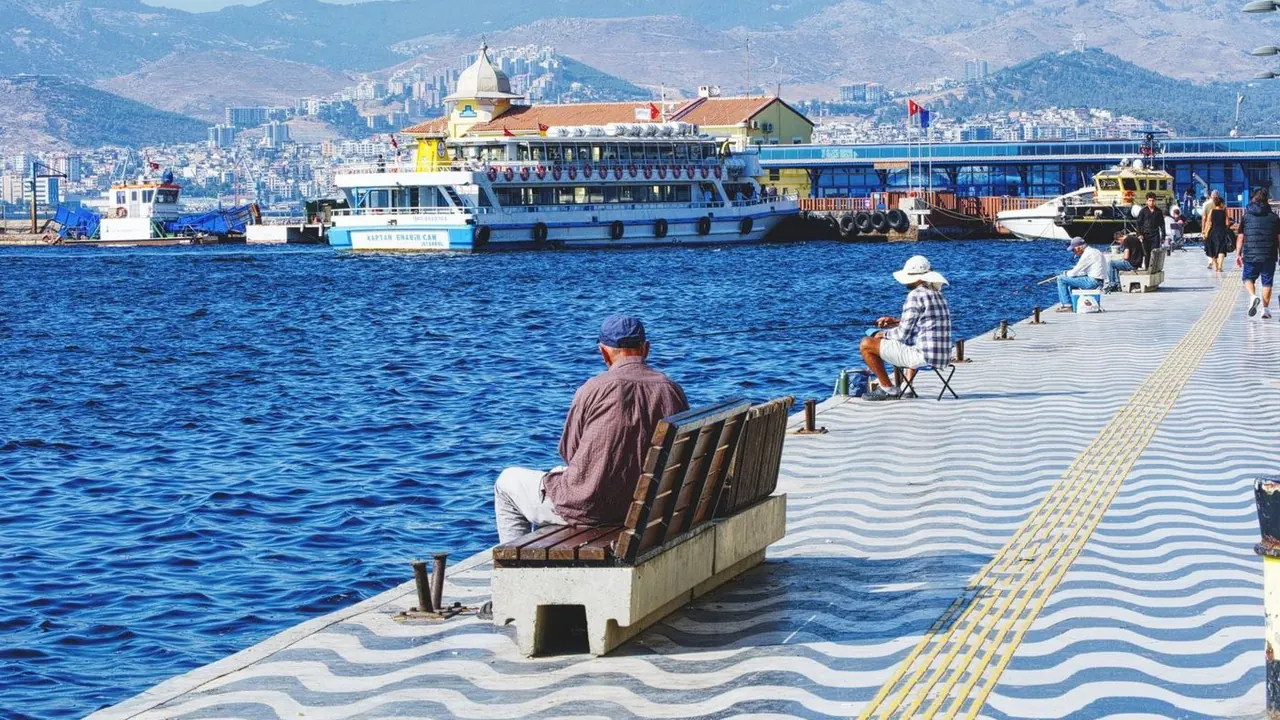
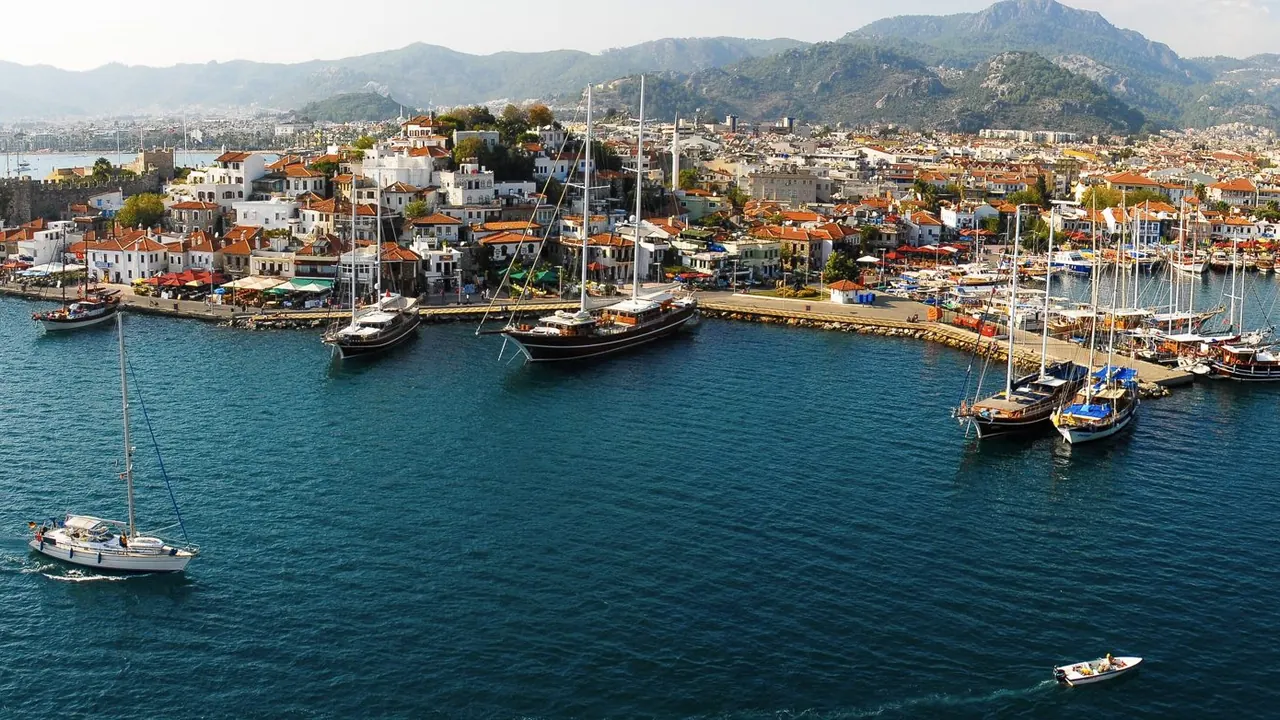
Photos: Izmir by Toygar Par, Pexels License; Marmaris by Mstyslav Chernov, CC BY-SA 3.0, cropped.
Izmir or Marmaris?
Our verdict in twelve categories, each scored against the same fixed benchmark cities, and the climate month by month, so you can choose for your trip.
Choose Izmir for
- culture and sights
- live music and the arts
- food and drink
Izmir suits the traveller who wants a real Turkish city with the ancient Aegean on its doorstep. Ephesus, Pergamon and Sardis are all within a day's reach, and the meyhane tables and Kemeraltı market lanes make eating a reason in itself to come. There is also opera, a symphony and an easy-going bar life in Alsancak. Beaches here are an outing rather than the point of the stay.
Choose Marmaris for
- beaches
- families
- nature and the outdoors
For a vacation built around the water, Marmaris is the better pick. Its almost enclosed bay is calm and warm for swimming, the pine-covered hills and the empty Bozburun coast make it a superb place to sail, and the family hotels in Icmeler make the beach-and-pool routine easy. There is little to see in town and not much to eat or do in the evening beyond Bar Street, so the ferry to Rhodes is where you go for history.
Scoreboard
Twelve categories on one fixed scale from 0 to 100. The shaded stretch is the gap between the two.
Your match
Pick a travel style or drag the sliders, and both match scores follow your weighting.
Wins on culture and sights and live music and the arts with your weighting.
Wins on beaches and families with your weighting.
What matters to you?
Category by category
What the scores mean for a trip.
Beaches & swimming
Izmir's own waterfront is not for swimming, so every beach day starts with an hour's drive. You can head west to the shallow sand at Ilica and the wilder coves around Altinkum, or south to the long family strips at Gumuldur. These are good beaches, but the northerly winds that bring windsurfers can make the water feel cool.
Marmaris has the sea at its door. The town beach of coarse sand and shingle meets a calm, enclosed bay, and Icmeler, Turunc and the coves visited by bay boat trips give clearer water close by. The price is crowding on the main strip in high summer.
Food & drink
Food is one of Izmir's real reasons to visit. Its Aegean cooking is built on olive oil and wild greens, served in long meyhane spreads of meze and raki, alongside street classics such as boyoz and kumru. Kemeraltı's lanes are full of fish, olives and old dessert shops, and the vineyards around Urla supply the wine.
In Marmaris you have to look past the seafront's steaks and pizza to find the lokanta, the pide houses and the harbour fish restaurants. The weekly market and the local pine honey are the highlights, and there is no dining scene to match Izmir's.
Culture & sights
Izmir has real history to see, even though the fire of 1922 left the centre mostly modern. There is the Roman Agora of Smyrna, Kadifekale above the gulf, the Clock Tower on Konak Square and the Ottoman hans of Kemeraltı, plus two museums worth a few hours.
Marmaris fills an afternoon at most: the small castle and museum above the harbour, then a wander through the stepped lanes of the old quarter. Anyone interested in the past will spend their days on excursions.
Nightlife
Both towns go out late in summer, but in opposite styles. Izmir's evenings begin with drinks on the Kordon at sunset and move into the crowded small bars, pubs and rock bars in the back streets of Alsancak. The crowd is local and belongs to the city rather than the tourist season, and the bigger beach-club nights are an hour away at Alaçatı.
Marmaris puts nearly everything on Bar Street, where open-fronted clubs with laser shows and foam parties run until near dawn for a young, largely British crowd. Apart from calmer cocktail bars at the marina it is one kind of night, and from November to April most of it closes.
Nature & outdoors
Izmir's outdoors are spread out. There is the gulf promenade for walking and cycling, flamingos on the salt pans of the Gediz Delta, the olive groves and cliffs of Karaburun, and the steady winds at Alaçatı for windsurfing and kitesurfing. Inland are the pine forests of Spil Mountain and winter skiing at Bozdağ.
Marmaris has the finer setting right on its doorstep. Its bay is ringed by pine-covered hills, the Bozburun and Datca peninsulas beyond are largely unbuilt, and the marina is the base for gulet cruises through some of the best sailing waters on the Turkish coast. With the Carian Trail, diving and sea kayaking on top, the scenery is part of every day.
Day trips
Izmir is the better base by a wide margin. Ephesus is an hour away by train, with Şirince and the Basilica of St John nearby. Pergamon, Sardis and the southern trio of Priene, Miletus and Didyma each make a full day, and Alaçatı, Urla and Old Foça add gentler coastal outings.
Marmaris has fewer outings, but distinctive ones: the ferry to the walled medieval town of Rhodes, the river boats past the Lycian rock tombs at Dalyan, and a long drive out to Knidos. From both towns, much of the list needs a hire car or a tour.
Good for families
Izmir is a city-style family trip. Children can ride scooters along the Kordon, see the Wildlife Park at Sasalı and take ferries across the bay, but the sandy shallows that suit small children are an hour away at Ilica.
Marmaris is the easier family base. Calm, shallow bay water, hotel pools and kids' clubs, a big water park and boat trips with swimming stops fill the days with little planning, as long as you stay in Icmeler or Armutalan, away from the noise of Bar Street. In both places the midsummer heat pushes activity into the mornings and evenings.
Getting around
Izmir is a proper city to move around. The flat centre from Konak to Alsancak is easy on foot, and beyond it the metro, trams, the İZBAN line round the gulf and the bay ferries all run on one card, with trains to Selçuk and the airport. The drawback is rush-hour traffic on the coastal roads.
Marmaris is simple only inside the bay, where the promenade, dolmus minibuses and water taxis link the town with Icmeler and Turunc. Beyond it, winding roads and sparse buses mean a tour or a hire car, and Dalaman airport is an hour and a half away.
Shopping & style
Kemeraltı gives Izmir the better shopping. It is a working bazaar among old hans, where locals buy fabrics, copperware, leather and olive oil soaps, and Alsancak's boutiques and malls cover fashion.
Marmaris's covered bazaar is built for visitors, full of leather jackets, carpets and copy designer goods to haggle over. Its weekly market feels more local, and pine honey, natural sponges and peshtemal towels are the best things to bring home.
Affordability
Both are good value, and the difference lies in where the money goes. In Izmir, street breakfasts, lokanta meals and the bay ferries cost little, while meyhane bills, summer on the Cesme peninsula and entry fees at Ephesus and the other sites add up.
Marmaris is cheapest as a package or all-inclusive stay, with dolmus rides and back-street kebab houses easy on the wallet. Costs climb at the seafront restaurants, on Bar Street and on organised trips, and room rates are lower in spring and autumn.
Live music & performing arts
Izmir has a real, if mostly local, programme. The State Opera and Ballet plays at the Elhamra, the State Symphony at the Ahmed Adnan Saygun Arts Centre, and theatre is staged in Turkish. Each summer the International Izmir Festival holds concerts in the ancient theatre at Ephesus, and Alsancak adds bars with live rock, jazz and Turkish music.
Marmaris has nothing comparable. It offers hotel entertainment and staged Turkish nights, with an occasional open-air concert in summer.
Wellness & relaxation
Izmir has the longer bathing tradition. There are the Balçova hot springs, known in antiquity as the Baths of Agamemnon, the warm springs at Ilıca on the Cesme coast, and old neighbourhood hammams in Kemeraltı. Its calm comes from the rhythm of the city: tea and long meze dinners on the Kordon.
Marmaris's hammams are modern places run for visitors, backed by resort spas and plenty of massage. Its rest comes from the setting instead: quiet Turunc, Selimiye and Bozburun, and a half-day soaking in the mud baths near Dalyan.
When should you go?
Pick your month. The climate figures are measured averages, not a forecast.
Izmir in July
Marmaris in July
Daytime high, °C
Rainfall in the month, mm
Where the figures come from
Marmaris's temperatures are measured 49 km from the centre, at Dalaman.
Marmaris has no rain gauge within 25 km of the centre, so its rainfall comes from a gridded climate dataset read at the city rather than from a gauge further away.
Temperature and rainfall are climate normals, averaged over the years shown. Izmir: 1991-2020 normals, Izmir (3.4 km from centre). Marmaris: 2000-2020 (rainfall 1991-2020) normals, Dalaman (48.8 km from centre).
Both are hot and dry from June to September, with almost no rain in July and August. Izmir gets the fiercer heat, around 34°C at midday in high summer, which makes walking Kemeraltı or the ruins hard going. Marmaris peaks a little lower at 32°C, and its bay warms further, to about 27°C in August against roughly 24°C in Izmir's waters. That gives Marmaris the longer, more comfortable swimming season, running from June well into October.
For sightseeing, April, May and October are the sweet spot in both. Izmir's long, sunny days in May are especially good for Ephesus and Pergamon. In winter both turn mild and wet, but Marmaris is far wetter, with about 232mm of rain in January, while Izmir's winter is drier and still fine for city walking.
Which traveller are you?
For a beach and sun trip, Marmaris wins easily. You swim straight off the promenade into a calm, warm bay, boat trips reach clearer coves, and Icmeler and Turunc lie under the pines. From Izmir, every beach day starts with an hour's drive.
On a culture and arts trip, Izmir is the clear choice. Ephesus is an hour away by train, Pergamon and Sardis make further days out, and the city adds its Roman Agora, museums, opera and symphony. Marmaris offers a small castle and little more.
For a food and nightlife trip, Izmir has the better table, with Aegean meze, boyoz breakfasts and Kemeraltı's market, followed by bars spilling into Alsancak's lanes. Marmaris competes after dark only if you want Bar Street's clubs until dawn, and its food leans towards resort menus.
Before you go
| Measure | Izmir | Marmaris |
|---|---|---|
| Official language | Turkish | Turkish |
| Currency | Turkish Lira (TRY) | Turkish Lira (TRY) |
| Sockets | CF230 V, 50 Hz | CF230 V, 50 Hz |
| Driving side | Right | Right |
| Time zone | UTC+3 | UTC+3 |
| Emergency number | 112 | 112 |
| Elevation | 2 m | 7 m |
| Main airport | Adnan Menderes International Airport (ADB)13 km from centre120 non-stop destinations | Dalaman International Airport (DLM)49 km from centre61 non-stop destinations |
| Public holidays this year | 14 days | 14 days |
By the numbers
| Measure | Izmir | Marmaris |
|---|---|---|
| City population | 4,493,242 | 97,818 |
| People per km² | 4,760 | 111 |
| Museums within 10 km | 29 | 1 |
| UNESCO World Heritage sites within 50 km | 0 | 1 |
| Swim season, months above 21 °C | 5 months | 6 months |
Where else could you go?
Every comparison below shares a destination with this one, so you can follow Izmir or Marmaris somewhere new.