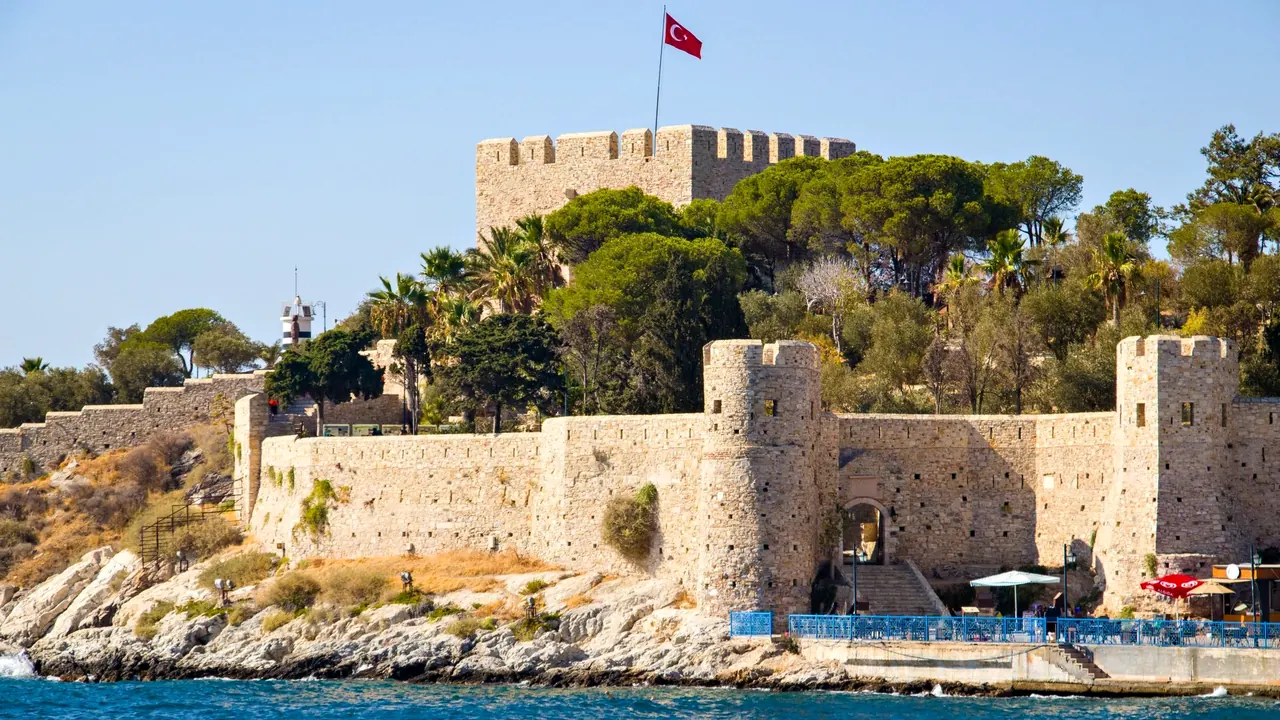
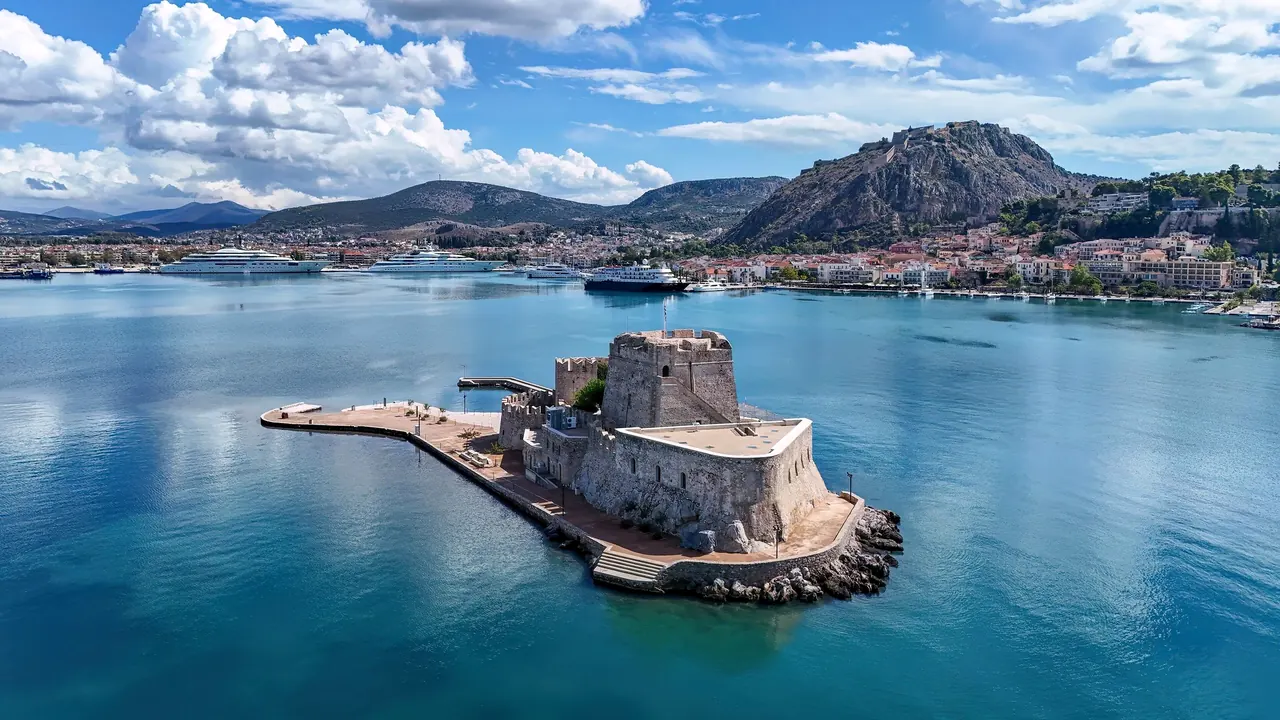
Photos: Kusadasi by Murat Halıcı, Pexels License; Nafplio by Giles Laurent, CC BY-SA 4.0, cropped.
Kusadasi or Nafplio?
Our verdict in twelve categories, each scored against the same fixed benchmark cities, and the climate month by month, so you can choose for your trip.
Choose Kusadasi for
- nightlife
- families
- shopping
Kusadasi suits a sun-and-sand vacation with a lively evening scene. Its beaches are bigger and sandier, from Ladies Beach to the long stretch south of town. Resort hotels and water parks keep children busy, and Bar Street runs late all summer. Ephesus is twenty minutes away for a day of history, but the town itself has little to look at.
Choose Nafplio for
- culture and sights
- live music and the arts
- day trips
Choose Nafplio if the place you stay in matters as much as the excursions. The old town of Venetian and neoclassical houses under the Palamidi fortress is a pleasure to wander, Mycenae and Epidaurus are close by, and in summer you can watch ancient drama in the theatre built for it. The evenings are quieter, the beaches near town are smaller and the pace is slower.
Scoreboard
Twelve categories on one fixed scale from 0 to 100. The shaded stretch is the gap between the two.
Your match
Pick a travel style or drag the sliders, and both match scores follow your weighting.
Wins on nightlife and families with your weighting.
Wins on culture and sights and live music and the arts with your weighting.
What matters to you?
Category by category
What the scores mean for a trip.
Beaches & swimming
Kusadasi has more beach, and more of it is sand. There is Ladies Beach by the town, several kilometres of Long Beach and the wide, quieter sweep at Pamucak, plus clear coves in the Dilek Peninsula park for snorkelling. The price is that the town stretches are heavily built up in summer.
Nafplio's swimming is on a smaller scale. Arvanitia below the old town is pebble, and for sand you go to the pine-backed bay at Karathona or the busier strip at Tolo. None of them is large. The gulf water is calmer and a little warmer, though, and a swim fits easily around a day of sightseeing.
Food & drink
Neither is a place to travel to for the food, but Kusadasi's table has a little more to it. You get Aegean meze, olive-oil vegetable dishes and grilled fish with rakı in the meyhanes of Kaleiçi, and the big weekly market is full of local produce. That gives more range than Nafplio, as long as you stay away from the harbour front and the resort buffets.
Nafplio's taverna cooking, with octopus from the gulf, slow-cooked lamb and Nemea red, is pleasant enough. The menus around the squares tend to repeat, though, and the better meals are often out at Tolo or in the villages of the plain.
Culture & sights
Here Nafplio is far stronger. The town itself is the sight. It was the first capital of modern Greece, and it has an old town of Venetian, Ottoman and neoclassical houses, the Palamidi fortress above, the Bourtzi in the harbour and the Archaeological Museum in the Venetian arsenal. It is compact rather than deep, but it fills a couple of days.
Kusadasi's own sights take an hour or two: the fortress on Pigeon Island, the Ottoman caravanserai and a few old lanes in Kaleiçi. Its real history lies inland.
Nightlife
Kusadasi is the place for a late night. In July and August the pubs, karaoke and dance bars of Bar Street and the open-air clubs near Long Beach and the marina run into the early hours, mostly for a young package crowd.
Nafplio has no real clubs. An evening there is a long dinner followed by drinks on the harbour front or off Syntagma Square, and it is busiest on summer weekends when Athenians come down. Out of season, both towns go quiet.
Nature & outdoors
South of Kusadasi, the Dilek Peninsula national park is the outdoor highlight. A forested ridge drops to the sea, with a canyon walk, wild horses and birds of prey, and clear water for diving. About an hour inland, the granite Latmos mountains above Lake Bafa offer rocky hikes past old hermitages.
Nafplio's outdoors starts at the edge of town rather than a drive away. A path circles the Akronafplia headland and a coastal trail leads to Karathona. The limestone draws rock climbers, kayakers paddle around the islets off Tolo, and the fir-covered Mainalo range lies further inland. In high summer both towns limit walking to the early mornings.
Day trips
Both are outstanding bases for ancient sites, and the difference is in how the sites are spread. Kusadasi has one supreme site on its doorstep in Ephesus, with Selçuk and Şirince beside it and Priene, Miletus and Didyma further south. A dolmuş gets you to Ephesus, and in summer a ferry crosses to Samos.
Nafplio has a cluster of short outings instead. Tiryns, Mycenae and Epidaurus are all within forty minutes, and Nemea, Ancient Corinth and Mystras lie further out. Most of it needs a car.
Good for families
Kusadasi is the more child-focused choice. Sandy beaches with gentle entry, resort hotels with kids' clubs and pools, and two big water parks make for easy days, though the centre is hilly with busy roads.
Nafplio is gentler, with a traffic-free old town, shallow water at Karathona and Tolo and a boat ride out to the Bourtzi. Beyond that there is little laid on for children, and the Palamidi steps are a slog in the heat.
Getting around
Kusadasi's shared dolmuş minibuses make it the easier base without a car. They run along the coast to Ladies Beach and Long Beach and inland to Selçuk. The centre around the harbour and Kaleiçi is compact, though some lanes climb steeply, and many hotels sit far out on the coast road where pavements are patchy.
Nafplio's old town is small and flat, and the squares, museums and Arvanitia beach are all a short walk apart. Beyond the walls, regional buses are thin. Most visitors hire a car for the sites and the coast, then struggle to find parking near the old town in summer.
Shopping & style
Kusadasi has more to buy, if you can face the sales pitch. The covered bazaar by the cruise port is full of leather, carpets, jewellery and Turkish delight, and bargaining is expected. The weekly market is good for olive oil, spices and dried figs.
Shopping in Nafplio is a quiet hour's browse through souvenir and sandal shops, with a few jewellers and galleries and the local komboloi. The most rewarding buys are food from the Argolid, such as honey and Nemea wine.
Affordability
Kusadasi is somewhat easier on the budget. Mid-range hotels and all-inclusive packages cost less than at comparable Aegean resorts, and dolmuş rides and lokanta meals cost little, though entry to Ephesus and the other major sites adds up.
In Nafplio the site fees are modest and taverna meals are fair, but rooms in the old-town mansions cost more at weekends and in high summer. Coming on weekdays or in the shoulder seasons, or staying in Tolo, brings the cost down.
Live music & performing arts
Nafplio has one great reason to plan a trip around a performance: ancient Greek drama in the theatre of Epidaurus during the summer festival. There are also concerts at Palaia Epidavros and classical music in the old Parliament. Outside summer there is little.
Kusadasi has Turkish-night dinner shows, cover bands and the odd open-air concert, with no theatre or concert season at all.
Wellness & relaxation
Kusadasi has a bathing tradition to fall back on. There is a historic hammam in the old quarter, and most larger hotels have their own hammams with scrub and foam massage, even if they are tourist versions. May, June and September are the calm months away from the centre.
Nafplio has no bathhouses, only a few hotel spas. Relaxing there means the slow rhythm of harbour coffee and walks around the headland, and for thermal water you drive about an hour to Loutraki.
When should you go?
Pick your month. The climate figures are measured averages, not a forecast.
Kusadasi in July
Nafplio in July
Daytime high, °C
Rainfall in the month, mm
Where the figures come from
Kusadasi's temperatures are measured 36 km from the centre, at Samos Airport.
Kusadasi has no rain gauge within 25 km of the centre, so its rainfall comes from a gridded climate dataset read at the city rather than from a gauge further away.
Kusadasi's sunshine is measured 51 km from the centre, at Aydin.
Nafplio's temperatures are measured 89 km from the centre, at Kalamata Airport.
Nafplio has no rain gauge within 25 km of the centre, so its rainfall comes from a gridded climate dataset read at the city rather than from a gauge further away.
Temperature and rainfall are climate normals, averaged over the years shown. Kusadasi: 1991-2020 normals, Samos Airport (35.7 km from centre). Nafplio: 1991-2020 normals, Kalamata Airport (88.8 km from centre).
Both towns have the same hot, dry summer. July and August reach around 33°C in Kusadasi and barely less in Nafplio. That is fine for the beach but too hot for walking ruins or old lanes in the middle of the day. Late May, June and September are the best months for combining swimming with sightseeing in either place. The sea is where they differ. The sheltered Argolic Gulf warms to about 26°C in high summer and stays pleasant into October, while the Aegean off Kusadasi peaks near 24°C and cools sooner. Nafplio also gets a little more sunshine from May to July.
Winter separates them more clearly. From December to February Kusadasi is wet, with around 146mm of rain in January. Nafplio has about 66mm that month and is slightly milder, which makes it the better choice for an off-season stay built around walks and museums.
Which traveller are you?
On a culture and arts trip, Nafplio is the clear pick. You stay inside a historic old town with a hilltop fortress, a museum of Mycenaean armour and summer drama at Epidaurus. Kusadasi offers little beyond a caravanserai and a small island castle.
For a food and nightlife trip, Kusadasi gives you more to do after dark. Bar Street and the clubs near Long Beach run into the early hours in summer, and meze with rakı in Kaleiçi beats Nafplio's steady but predictable taverna menus.
On a family trip with children, Kusadasi is the easier base. Sandy beaches with gentle entry, hotels with kids' clubs and two water parks fill the days. Nafplio has calm water and castles but little that is built for children.
Before you go
| Measure | Kusadasi | Nafplio |
|---|---|---|
| Official language | Turkish | Greek |
| Currency | Turkish Lira (TRY) | Euro (EUR) |
| Sockets | CF230 V, 50 Hz | CF230 V, 50 Hz |
| Driving side | Right | Right |
| Time zone | UTC+3 | UTC+2, UTC+3 in summer |
| Emergency number | 112 | 112 |
| Elevation | 11 m | 6 m |
| Main airport | Adnan Menderes International Airport (ADB)49 km from centre120 non-stop destinations | Athens Eleftherios Venizelos International Airport (ATH)109 km from centre173 non-stop destinations |
| Public holidays this year | 14 days | 15 days |
By the numbers
| Measure | Kusadasi | Nafplio |
|---|---|---|
| City population | 130,835 | 14,532 |
| People per km² | 494 | 433 |
| Museums within 10 km | 0 | 5 |
| UNESCO World Heritage sites within 50 km | 2 | 2 |
| Swim season, months above 21 °C | 5 months | 5 months |
Where else could you go?
Every comparison below shares a destination with this one, so you can follow Kusadasi or Nafplio somewhere new.
- Izmirvs Kusadasi
- Bodrumvs Kusadasi
- Athensvs Nafplio
- Marmarisvs Kusadasi
- Fethiyevs Kusadasi
- Kasvs Kusadasi