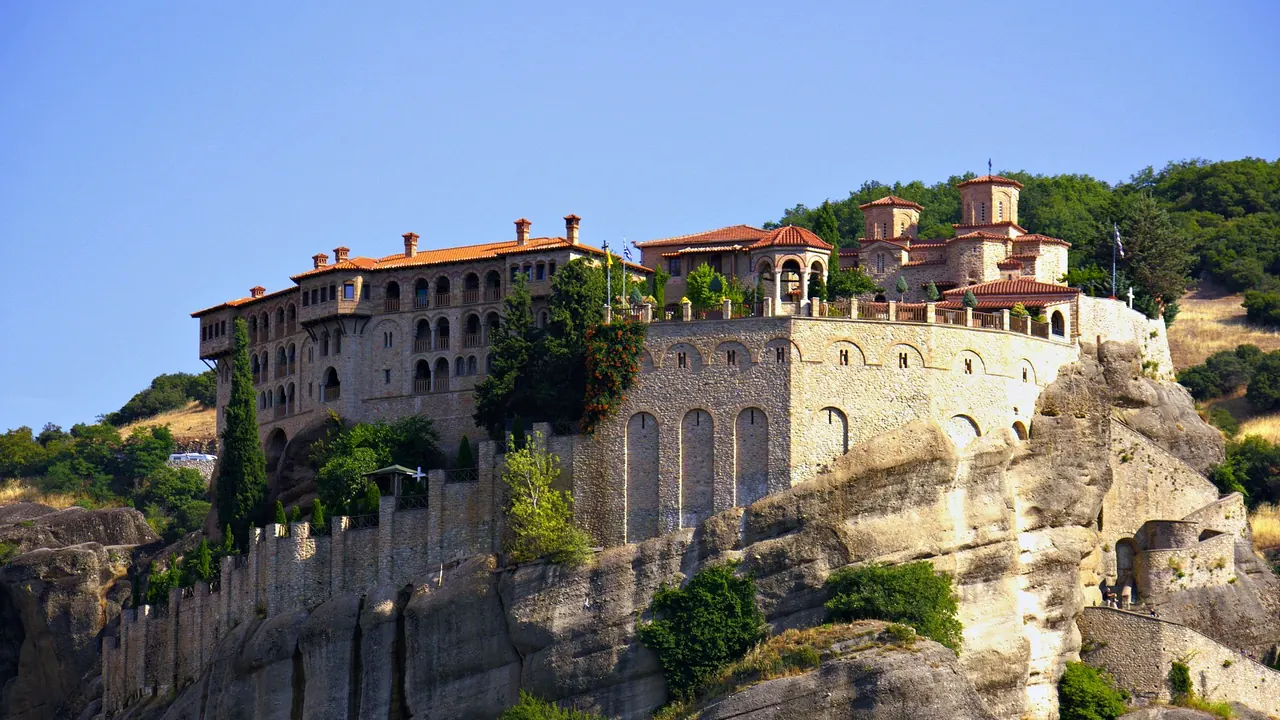
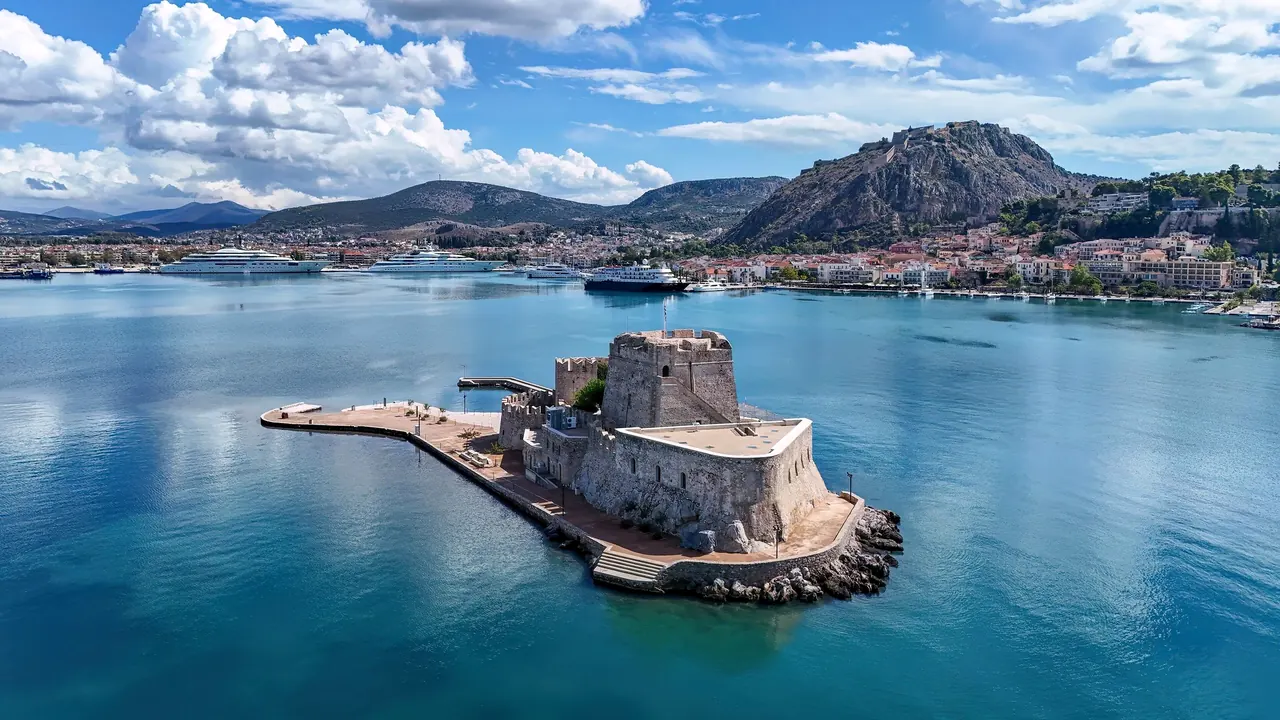
Photos: Kalambaka by José Barbosa, Pexels License; Nafplio by Giles Laurent, CC BY-SA 4.0, cropped.
Kalambaka or Nafplio?
Our verdict in twelve categories, each scored against the same fixed benchmark cities, and the climate month by month, so you can choose for your trip.
Choose Kalambaka for
- nature and the outdoors
- prices
- culture and sights
Kalambaka is for travellers who come for the landscape. The Meteora pillars rise straight behind the town, old monks' footpaths lead up to clifftop monasteries, and the Pindos fir forests and climbing routes fill an active couple of days. It suits walkers, climbers and anyone watching their spending, provided they are happy with quiet evenings, plain food and no sea.
Choose Nafplio for
- beaches
- day trips
- live music and the arts
Choose Nafplio for a fuller stay of several days that mixes swimming, evenings in the old town and the great ancient sites of the Argolid. Mycenae, Tiryns and Epidaurus are all a short drive away and the gulf is warm through the summer. Families, couples and anyone who wants a drink by the harbour after dinner will find more to do here than in Kalambaka.
Scoreboard
Twelve categories on one fixed scale from 0 to 100. The shaded stretch is the gap between the two.
Your match
Pick a travel style or drag the sliders, and both match scores follow your weighting.
Wins on nature and the outdoors and prices with your weighting.
Wins on beaches and day trips with your weighting.
What matters to you?
Category by category
What the scores mean for a trip.
Beaches & swimming
Kalambaka has no beach at all. It lies well inland on the Thessalian plain, so swimming means a hotel pool or a cold dip in a Pindos river, and the sea is more than two hours away by car.
Nafplio has the calm Argolic Gulf at its door. Pebbly Arvanitia lies below the Palamidi cliffs within a walk of the old town, the pine-backed sand of Karathona is a short way along the coast, and Tolo has the longer and busier stretch. None of these beaches is large, but in summer a swim fits easily around a day of sightseeing.
Food & drink
Both towns eat in tavernas, and neither offers fine dining or much beyond Greek cooking. Kalambaka serves mountain food: grilled lamb and pork, bean soups, pies and tsipouro with meze. The menus repeat themselves, though a table facing the rocks at sunset makes up for a lot.
Nafplio has a little more range, with grilled fish and octopus from the gulf, Nemea red wine, Argolid citrus, and gelato and loukoumades by the harbour. Its central squares lean towards tourist menus, so the better meals are often found at Tolo or in the villages of the plain.
Culture & sights
Both reward two or three days of sightseeing, but in very different ways. Kalambaka's culture is almost entirely the Meteora monasteries: frescoed churches, old refectories and icon collections on top of sandstone pillars, reached by rock-cut steps and with dress rules to respect. The town below is modern and plain.
In Nafplio the appeal is the town itself. Its well-preserved old quarter of Venetian, Ottoman and neoclassical houses dates from its years as the first capital of modern Greece. The Palamidi fortress stands above it, the Archaeological Museum is housed in the Venetian arsenal, and Kapodistrias was killed at the door of Agios Spyridon. This is history you walk through rather than one spectacular site.
Nightlife
Neither town has clubs. In Kalambaka the evening ends with a drink at a café-bar on the central square, and anyone wanting more has to drive half an hour to Trikala.
Nafplio has bars along the harbour and a few cocktail and music bars in the lanes off Syntagma Square, and these stay busy late on summer weekends when visitors arrive from Athens. It is still a place for a glass of wine by the water rather than a big night.
Nature & outdoors
This is where Kalambaka is strongest. The Meteora pillars, some around 400m high, rise from the back streets, monks' paths climb through oak woods between them, and the conglomerate rock is famous among climbers. West of town the Pindos adds fir forests around Pertouli, rafting in the Aspropotamos valley and small ski slopes near Metsovo.
Nafplio's outdoors is gentler and mostly coastal: the path around the Akronafplia headland, the coast trail to Karathona, limestone crags for climbing and sea kayaking off Tolo. Real mountains, in the fir-covered Mainalo range, are a longer drive inland.
Day trips
Nafplio has a remarkable ring of excursions. Tiryns is ten minutes away, Mycenae within half an hour and the theatre at Epidaurus not much further, while Ancient Corinth, the Nemea wine villages and the car-free islands of Hydra and Spetses fill longer days. Few bases in Greece have so much ancient history within a short drive.
From Kalambaka the choice is smaller but still worthwhile, mostly over the mountains to the west: Metsovo for smoked cheese and folk art, lakeside Ioannina, and the stone villages of Zagori at the limit of a day, with Trikala close by. In both places a car makes these trips far easier.
Good for families
Nafplio is the easier choice with children. The old town is mostly free of traffic, there is ice cream along the harbour, the water at Karathona and Tolo is calm and shallow, and the boat out to the Bourtzi feels like an adventure. The Palamidi steps and the midday heat at the ancient sites are the main trials.
Kalambaka can thrill older children who are able to hike or try a beginners' climb. Younger ones struggle with the long stairways, hushed rooms and dress codes of the monasteries, and beyond a hotel pool there is little made for them, so one or two nights is usually enough.
Getting around
Both towns have small, flat centres that are easy on foot, and in both a hire car is the realistic way to see the region. What differs is how far away the main sight is. Kalambaka's monasteries sit several kilometres up a winding road served by an infrequent bus, so visitors either walk up the old paths in about an hour or take a taxi or tour. The town does have a rail branch connecting to the Athens to Thessaloniki line.
In Nafplio the museums, squares and Arvanitia beach are all within a walk, with only Palamidi needing a climb. Buses reach Athens in about two hours and serve the main sites, but they run thinly, and parking near the old town fills up in summer.
Shopping & style
Neither is a shopping destination, but Nafplio makes for a better browse. Its old-town lanes mix souvenirs and sandals with small jewellers, ceramics shops and galleries, and you can take home komboloi worry beads, Argolid olive oil or Nemea wine. Kalambaka has one street of shops selling painted icons, carvings, honey and tsipouro, plus whatever the monasteries sell themselves.
Affordability
Kalambaka is the cheaper stay. Guesthouses and simple hotels cost less and taverna meals are generous. The main extra costs are car hire, guided tours and rooms that look straight at the rocks, and prices rise at Orthodox Easter and over the long weekends around national feast days.
Nafplio is fairly priced for food and site entry, but its restored old-town mansions charge more at weekends and in high summer, when visitors come from Athens. Staying midweek, outside high summer or in Tolo brings the cost down.
Live music & performing arts
Here Nafplio has a real draw. In summer the Athens and Epidaurus Festival stages ancient drama in the 4th-century BC theatre at Epidaurus, about forty minutes away, and a classical music festival uses historic buildings in town such as the old Parliament.
Kalambaka has nothing comparable: perhaps an open-air concert or a festival of traditional dance in summer, and a taverna musician on busy nights. Byzantine chant at a monastery service is moving to hear, but it is worship, not a performance.
Wellness & relaxation
Kalambaka offers rest of a simple kind. It is a small mountain town that goes to bed early, mornings are slow as the light changes on the rocks, and a few hotels have pools, saunas and massage rooms. There is no bathing tradition, and the calm lasts about a couple of nights.
Nafplio is the better choice for a restful trip. Long lunches, coffee by the water and an evening walk around the Akronafplia headland make a slow harbour routine that is easy to keep up for several days. A few larger hotels have proper spas, and there is thermal water at Loutraki, about an hour's drive away, with the sulphur springs of Methana a little further.
When should you go?
Pick your month. The climate figures are measured averages, not a forecast.
Kalambaka in July
Nafplio in July
Daytime high, °C
Rainfall in the month, mm
Where the figures come from
Kalambaka's temperatures are measured 68 km from the centre, at Larissa Airport.
Kalambaka's station stands 164 m below the city centre, so the centre is likely a little cooler than the figures say.
Kalambaka has no rain gauge within 25 km of the centre, so its rainfall comes from a gridded climate dataset read at the city rather than from a gauge further away.
Nafplio's temperatures are measured 89 km from the centre, at Kalamata Airport.
Nafplio has no rain gauge within 25 km of the centre, so its rainfall comes from a gridded climate dataset read at the city rather than from a gauge further away.
Temperature and rainfall are climate normals, averaged over the years shown. Kalambaka: 1991-2020 normals, Larissa Airport (68.1 km from centre). Nafplio: 1991-2020 normals, Kalamata Airport (88.8 km from centre).
Kalambaka has the hotter summer and the colder winter. July reaches about 34°C, which makes the exposed trails among the rocks hard going in the middle of the day, and the winter months are chilly, with November and December the wettest of the year. April and May, and late September into October, are the best times for walking and climbing. Summer brings long sunny days, but they are best used early and late.
Nafplio is milder all year round. Winter days stay around 15°C, and the summer peaks at about 32°C with almost no rain from June to August. The sea is warm enough for swimming from June to October and reaches about 26°C in July and August. Spring and autumn are the comfortable seasons for the ancient sites, and both towns turn wet in late autumn.
Which traveller are you?
For an outdoors trip, Kalambaka is the clear choice. Footpaths lead from the town straight into the Meteora rocks, the climbing is famous, and the Pindos adds fir forests, rafting and winter skiing near Metsovo. Nafplio's coastal paths and kayaking are pleasant but smaller.
On a beach and sun trip, Nafplio wins easily. The sheltered Argolic Gulf is warm all summer, Arvanitia is a walk from the old town, and Karathona and Tolo have sand. Kalambaka is more than two hours from the sea, with only pools and rivers.
On a trip on a tight budget, Kalambaka makes the money go further. Rooms and taverna meals cost less than in Nafplio, monastery entry fees are small, and fit walkers can climb to the monasteries on the old paths instead of paying for taxis or tours.
Before you go
| Measure | Kalambaka | Nafplio |
|---|---|---|
| Official language | Greek | Greek |
| Currency | Euro (EUR) | Euro (EUR) |
| Sockets | CF230 V, 50 Hz | CF230 V, 50 Hz |
| Driving side | Right | Right |
| Time zone | UTC+2, UTC+3 in summer | UTC+2, UTC+3 in summer |
| Emergency number | 112 | 112 |
| Elevation | 237 m | 6 m |
| Main airport | Thessaloniki Macedonia International Airport (SKG)146 km from centre90 non-stop destinations | Athens Eleftherios Venizelos International Airport (ATH)109 km from centre173 non-stop destinations |
| Public holidays this year | 15 days | 15 days |
By the numbers
| Measure | Kalambaka | Nafplio |
|---|---|---|
| City population | 8,372 | 14,532 |
| People per km² | 4,925 | 433 |
| Museums within 10 km | 0 | 5 |
| UNESCO World Heritage sites within 50 km | 1 | 2 |
| Swim season, months above 21 °C | - | 5 months |
Where else could you go?
Every comparison below shares a destination with this one, so you can follow Kalambaka or Nafplio somewhere new.
- Athensvs Nafplio
- Thessalonikivs Kalambaka
- Ohridvs Kalambaka
- Tiranavs Kalambaka
- Skopjevs Kalambaka
- Athensvs Kalambaka