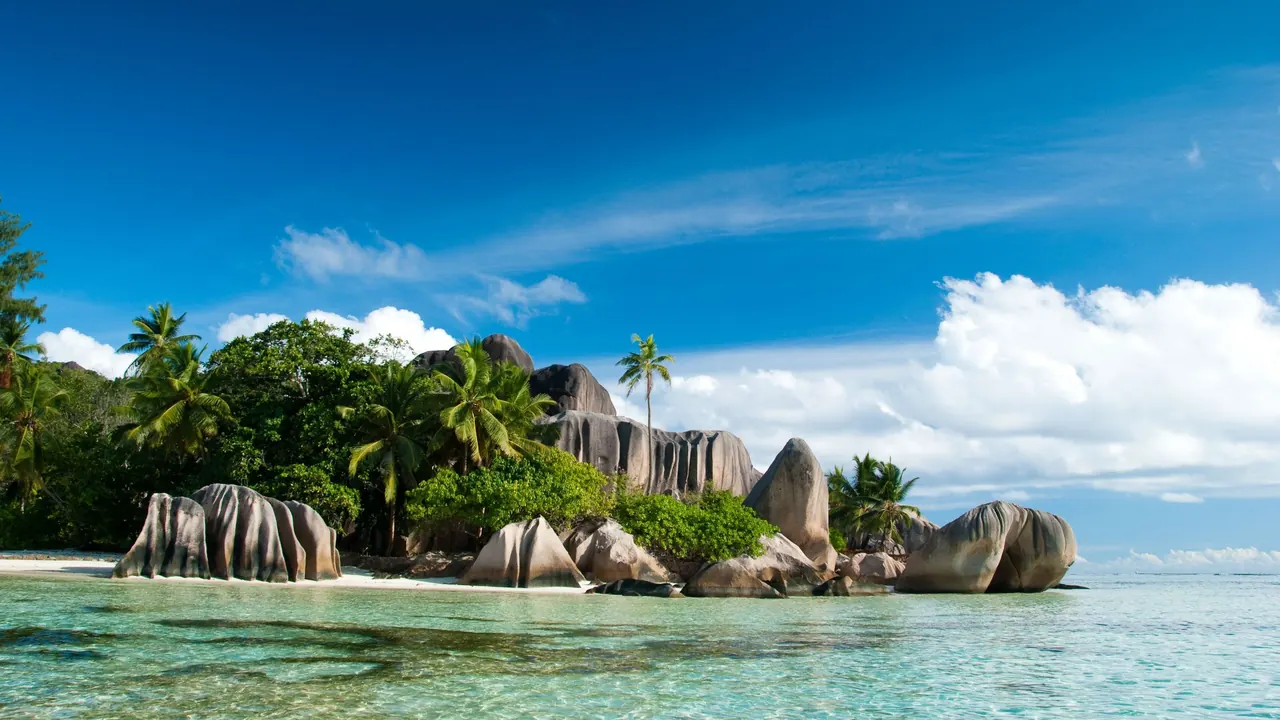
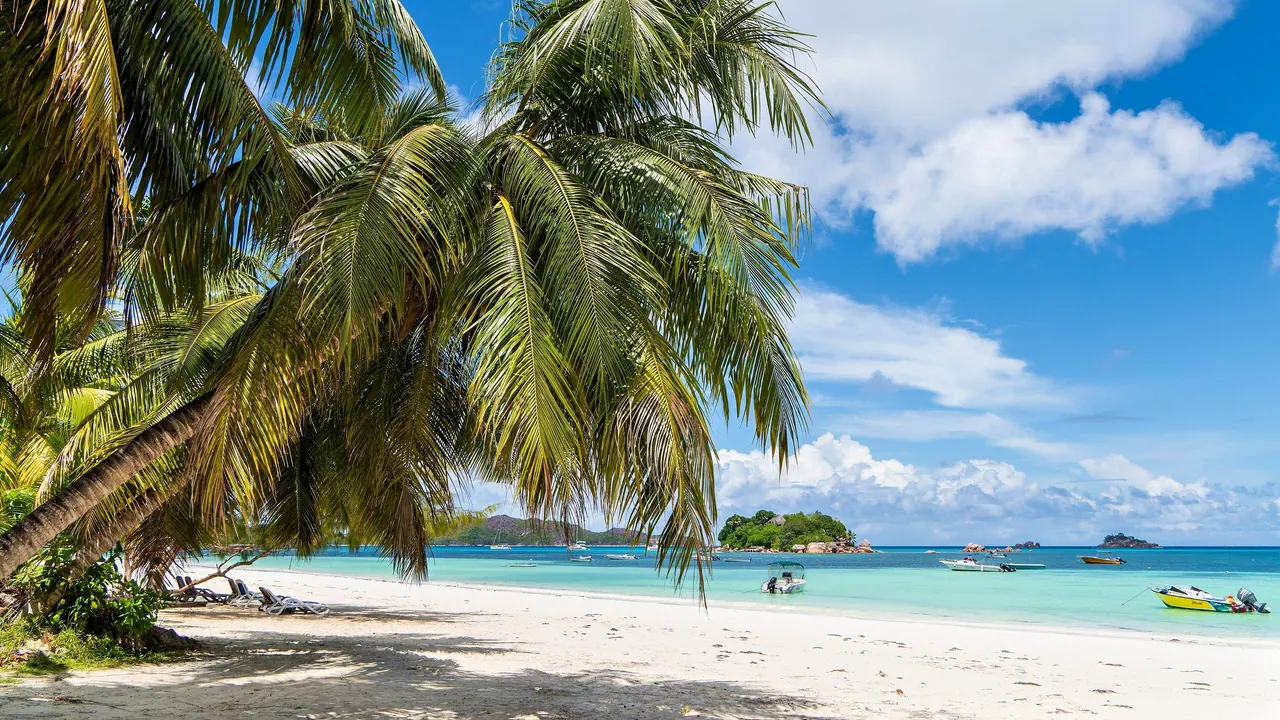
Photos: La Digue by Didier Baertschiger from Genève, Suisse, CC BY-SA 2.0, cropped; Praslin by NorbertNagel, CC BY-SA 4.0, cropped.
La Digue or Praslin?
Our verdict in twelve categories, each scored against the same fixed benchmark cities, and the climate month by month, so you can choose for your trip.
Choose La Digue for
- getting around
- prices
- live music and the arts
La Digue suits travellers who want the slowest possible version of the Seychelles: an island small enough to cross by bicycle, with almost no cars, the boulder-framed coves of Anse Source d'Argent on the doorstep and nothing to do after dark. It is the better choice for couples and anyone who wants to leave the car keys and the itinerary behind, and it gives up some range in exchange.
Choose Praslin for
- nature and the outdoors
- day trips
- beaches
Praslin is the stronger base for a longer stay with more to fill the days. It has the Vallée de Mai's palm forest, dive sites around the outer islets, seabird reserves on Cousin and Aride, and a choice of coasts so there is always a calm one to swim from. La Digue itself is a short ferry ride away. The price is a hire car on narrow hill roads rather than a bike along a flat lane.
Scoreboard
Twelve categories on one fixed scale from 0 to 100. The shaded stretch is the gap between the two.
Your match
Pick a travel style or drag the sliders, and both match scores follow your weighting.
Too close to call, 1 point apart
Wins on getting around and prices with your weighting.
Wins on nature and the outdoors and day trips with your weighting.
What matters to you?
Category by category
What the scores mean for a trip.
Beaches & swimming
Both islands are built around their beaches, and both are outstanding. The difference is in the swimming. La Digue's famous Anse Source d'Argent is a lagoon for wading among granite boulders, often too shallow for a proper swim at low tide, so real swimming means Anse Union or the northern coves. The wild south-east beaches, Grand Anse and Anse Cocos, are for walking rather than swimming.
Praslin gives a little more choice. Anse Lazio has fine white sand and deeper water with snorkelling off the rocks at each end, and the gently shelving bay at Côte d'Or and Anse Volbert is calm enough for long, easy swims. Because its good beaches face different directions, you can follow the wind to a sheltered one in any season.
Food & drink
Food is much the same on both: Creole cooking of grilled reef fish, octopus curry and fruit chutneys, honest when fresh and limited by what comes over on the boat. On La Digue the best meals are from the takeaways around La Passe and the fruit stalls along the coast road selling fresh coconut and mango. On Praslin they come from the beach restaurants along the Grand Anse and Côte d'Or roads, although most dinners end up in resort dining rooms.
Culture & sights
Neither island is a place for sightseeing, but what little there is differs in kind. La Digue has the built heritage: L'Union Estate's plantation house, copra mill and settlers' cemetery, the church in La Passe and a few tin-roofed Creole wooden houses. Praslin has no old buildings worth the trip, and its heritage is the UNESCO-listed palm forest, so anyone curious about plantation history will find it on the ferry across to La Digue.
Nightlife
Both islands go quiet after sunset, and nobody should choose either for going out. On La Digue the night is literally dark, with no streetlights on much of the island and a bicycle ride home. Praslin has a little more: hotel bars and a couple of beach bars around Côte d'Or, though nothing keeps going late.
Nature & outdoors
Praslin has more to offer outdoors. The Vallée de Mai is the main reason, a primeval forest of coco de mer palms with black parrots and endemic chameleons, and the Fond Ferdinand walk adds viewpoints over to La Digue. Offshore there are dive sites with reef sharks and rays, Curieuse's tortoises and mangrove boardwalk, and the bird and turtle reserves of Cousin and Aride.
La Digue's strength is its scenery: weathered pink granite boulders in the sea and a short, steep climb to Nid d'Aigle. The coastal path to Anse Cocos and the Veuve reserve's paradise flycatchers are worth the effort, and boat trips to Coco Island and Félicité give excellent snorkelling. All of it fits into a day or two by bicycle.
Day trips
Praslin is the better hub. La Digue is a quarter of an hour away by ferry and makes the natural day out. Curieuse and Saint Pierre are paired on boat trips from Côte d'Or, and Mahé's market and botanical garden are about an hour away by catamaran.
From La Digue the obvious outing is the reverse trip to Praslin for the Vallée de Mai, often combined with Curieuse. Mahé is a long day by ferry, and beyond that the options are snorkelling trips to the nearby granite islets.
Good for families
For families the two islands are about equal, with the same limits: nothing built for children and a long journey with a ferry at the end. La Digue's appeal is freedom, with lanes quiet enough for older children to cycle on their own and tortoises to visit at L'Union Estate, though the south-east beaches need close watching.
Praslin offers the long, calm bay at Côte d'Or for small swimmers and a few good half-day outings to Curieuse and the Vallée de Mai, though older children may run out of things to do after a few days.
Getting around
La Digue is much easier to get around once you arrive. You rent a bicycle at the jetty in La Passe, ride the flat west coast road and call an electric buggy for luggage. Only the climb towards Grand Anse is hard work in the heat. The catch is reaching it: a flight to Mahé, then a ferry that can be rough, often with a change on Praslin.
Praslin is the reverse. It is reached directly by catamaran or a short flight, but getting around means a slow coastal bus or a hire car driven on the left on narrow, winding hill roads with deep storm drains at the edges.
Shopping & style
Neither island is for shopping, and the stalls differ only in their souvenirs. La Digue has craft stands by the jetty and at L'Union Estate, some selling local vanilla and spices. Praslin has woven baskets, model boats and polished coco de mer nuts, which need an official permit to take home.
Affordability
Both are expensive, with imported food, costly restaurant meals and boat trips that add up. The ways to save are similar, family-run guesthouses and Creole takeaways for lunch, but La Digue has one more: a rented bicycle replaces taxis entirely. On Praslin a car hire is hard to avoid, and the entry fee for the Vallée de Mai adds to the bill.
Live music & performing arts
There is no stage on either island, only the occasional hotel evening of sega music and moutya drumming. La Digue has one real occasion, the Feast of the Assumption in August with its procession, while Praslin has nothing comparable to plan a trip around.
Wellness & relaxation
Both islands offer relaxation rather than treatments, and their main asset is the slow pace. On La Digue that pace is built into the place: no traffic, bicycles and nothing to do after dark, with only a couple of resort spas and some guesthouse massage rooms using coconut oil.
Praslin's larger resorts give a little more spa choice, often in open pavilions among boulders and palms, but the quiet there comes with a car and longer distances.
When should you go?
Pick your month. The climate figures are measured averages, not a forecast.
La Digue in July
Praslin in July
Daytime high, °C
Rainfall in the month, mm
Where the figures come from
La Digue's temperatures are measured 49 km from the centre, at Seychelles International Airport.
La Digue has no rain gauge within 25 km of the centre, so its rainfall comes from a gridded climate dataset read at the destination rather than from a gauge further away.
Praslin's temperatures are measured 45 km from the centre, at Seychelles International Airport.
Praslin's station stands 225 m below the place it is measured for, so that place is likely a little cooler than the figures say.
Praslin has no rain gauge within 25 km of the centre, so its rainfall comes from a gridded climate dataset read at the destination rather than from a gauge further away.
Temperature and rainfall are climate normals, averaged over the years shown. La Digue: 1991-2020 normals, Seychelles International Airport (48.7 km from centre). Praslin: 1991-2020 normals, Seychelles International Airport (45.2 km from centre).
The two islands sit a few kilometres apart and share the same weather: hot all year at around 30°C, with a warm sea in every month. Rain decides the timing. December to February is the wet season, with January bringing over 450mm, while June to August is the driest stretch, July falling to about 100mm. April and May combine the most sunshine with the warmest sea, about 30°C, and are the easiest months on both islands. In July and August the sea cools to about 26°C, still pleasant for swimming.
Wind matters more than temperature, and it affects the two islands differently. From about May to September the south-east trade winds make La Digue's east coast too rough for swimming, so beach days move to the west and north coves. Praslin's north and west coasts stay calm in the same months. From December to March the north-west monsoon can push swell onto Anse Lazio, so swimmers on Praslin shift to the Côte d'Or side.
Which traveller are you?
On a beach and sun trip, Praslin has the edge. Anse Lazio's fine white sand and snorkelling off the rocks, the long calm bay at Côte d'Or and coasts facing different winds mean a sheltered swim in any month, with La Digue's coves an easy outing.
For an outdoors trip, Praslin offers more. The Vallée de Mai's coco de mer forest and black parrots, the Fond Ferdinand walk, dive sites with reef sharks and turtles, and the bird reserves of Cousin and Aride outweigh La Digue's single hilltop and coastal path.
On a relaxing and wellness trip, La Digue wins on pace. With almost no cars, bicycles for transport and unlit lanes at night, the days slow to swimming and reading without any effort. Praslin has more resort spas but needs a car to get anywhere.
Before you go
| Measure | La Digue | Praslin |
|---|---|---|
| Official language | French, English, Seychellois Creole | French, English, Seychellois Creole |
| Currency | Seychelles Rupee (SCR) | Seychelles Rupee (SCR) |
| Sockets | G240 V, 50 Hz | G240 V, 50 Hz |
| Driving side | Left | Left |
| Time zone | UTC+4 | UTC+4 |
| Emergency number | 112 or 999 | 112 or 999 |
| Main airport | Praslin Island Airport (PRI)1 non-stop destination | Praslin Island Airport (PRI)1 non-stop destination |
| Public holidays this year | 13 days | 13 days |
By the numbers
| Measure | La Digue | Praslin |
|---|---|---|
| Population | 2,200 | 8,449 |
| People per km² | 224 | 225 |
| Swim season, months above 21 °C | 12 months | 12 months |
Where else could you go?
Every comparison below shares a destination with this one, so you can follow La Digue or Praslin somewhere new.