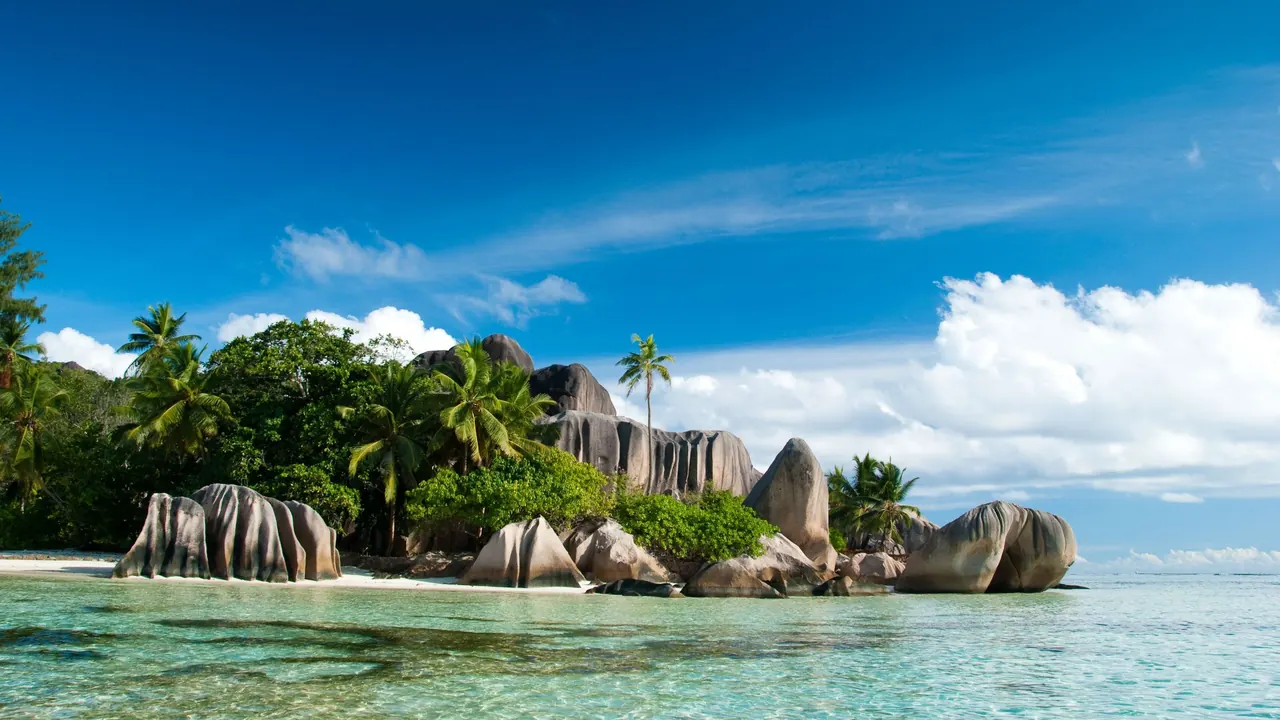
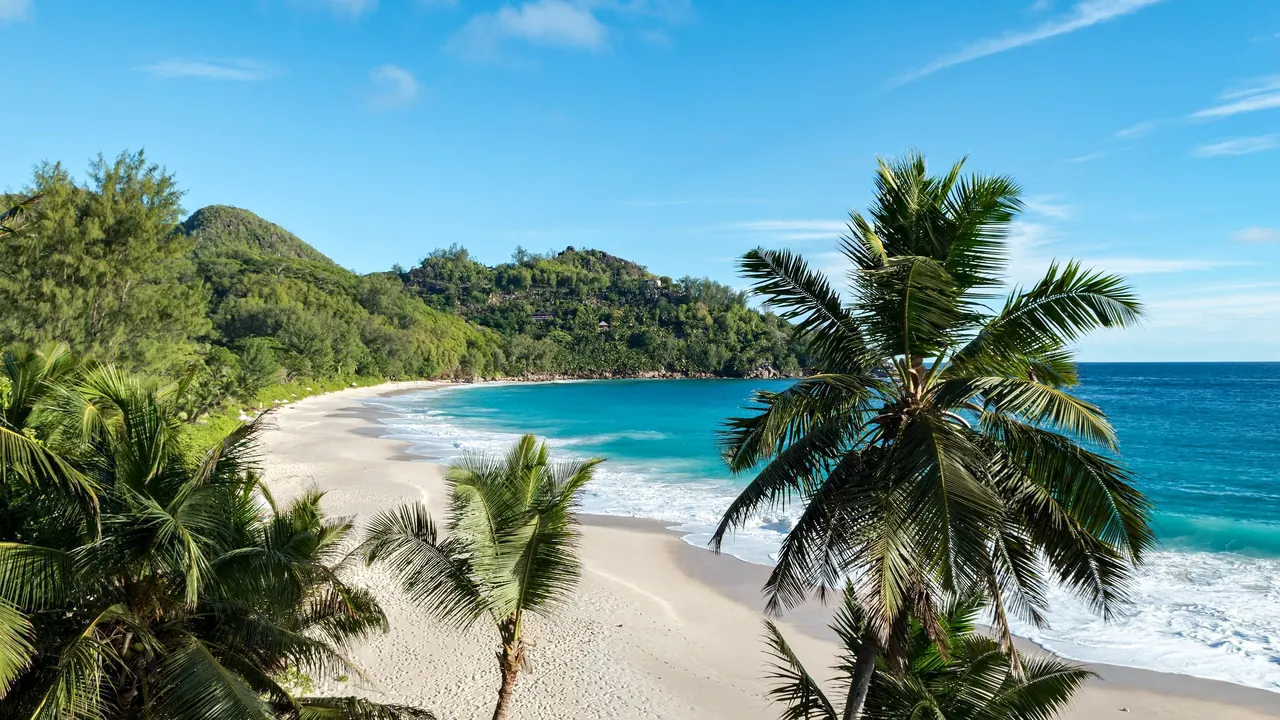
Photos: La Digue by Didier Baertschiger from Genève, Suisse, CC BY-SA 2.0, cropped; Mahe by dronepicr, CC BY 2.0, cropped.
La Digue or Mahe?
Our verdict in twelve categories, each scored against the same fixed benchmark cities, and the climate month by month, so you can choose for your trip.
Choose La Digue for
- getting around
- prices
La Digue suits travellers who want one small island to settle into: cycling between coves, Anse Source d'Argent in the morning, the coastal walk to Anse Cocos in the afternoon and evenings that end after dinner. Once you arrive it is far easier to get around than Mahe, and its slow pace is the reason to go. In return there is less to eat, see and do, and fewer outings beyond the beach.
Choose Mahe for
- nature and the outdoors
- food and drink
- day trips
Mahe is the better pick for a longer or more varied stay. It has more beaches to choose from, proper hiking in Morne Seychellois, diving and marine parks, the market in Victoria, a little life after dark at Beau Vallon, and the ferry quay for trips to Praslin and La Digue. The price is a hire car or slow buses on twisting roads, and life in a resort rather than a village.
Scoreboard
Twelve categories on one fixed scale from 0 to 100. The shaded stretch is the gap between the two.
Your match
Pick a travel style or drag the sliders, and both match scores follow your weighting.
Wins on getting around and prices with your weighting.
Wins on nature and the outdoors and food and drink with your weighting.
What matters to you?
Category by category
What the scores mean for a trip.
Beaches & swimming
Both islands have the Seychelles look of white sand between granite boulders and a sea that is warm all year, so the difference lies in range rather than quality. La Digue is built around a handful of famous coves. Anse Source d'Argent is the postcard, but its lagoon is often too shallow for real swimming at low tide, so you end up swimming in the northern coves such as Anse Sévère and Anse Patates. The wild southeast beaches are for looking, not swimming.
Mahe has more than sixty beaches, and the trade winds decide which coast you use: Beau Vallon and the north-west in the middle of the year, the south from November to April. Anse Royale and Anse Forbans give sheltered snorkelling and Anse Intendance has surf. On Mahe you need transport to reach most of these, whereas La Digue's best coves are a short bike ride apart.
Food & drink
You eat better on Mahe, mainly because it has something La Digue lacks: a proper market. The Sir Selwyn Selwyn-Clarke Market in Victoria, with its fish slabs and spices, together with roadside curry takeaways around the island and local rum and palm drinks, gives a fuller picture of Creole cooking.
La Digue serves the same grilled fish and octopus curry, but only from a few takeaways around La Passe, beach shacks and guesthouse dinners. With most supplies arriving by boat, the choice runs thin over a week.
Culture & sights
Neither island is a place for sightseeing, but Mahe can fill a few more mornings. In Victoria there are the Clock Tower, the cathedrals, the Hindu temple and the National History Museum, and out on the island the Sans Souci mission ruins and the plantation houses at Domaine de Val des Prés. Together they make two or three short outings. On La Digue the heritage comes down to L'Union Estate with its copra mill, the church at La Passe and the old wooden Creole houses, which you can see in an hour or two.
Nightlife
Mahe at least gives you somewhere to go in the evening. Beau Vallon has beach bars, weekend music and a street market with food stalls and local bands, and a few clubs near Victoria fill with locals on Friday and Saturday nights. La Digue has none of this. The roads are unlit and everyone travels by bicycle, so a sunset drink and dinner make up the whole night out.
Nature & outdoors
Mahe has the bigger landscape. Morne Seychellois National Park rises above 900m through cloud forest with pitcher plants, and trails such as Copolia and Trois Frères climb to views over the reef. Under water, the marine parks, the dive sites off the north-west and the chance of whale sharks from August to October add a great deal.
La Digue's nature is smaller and closer at hand: granite boulders standing in the sea, the climb to Nid d'Aigle at about 330m, the coastal path to Anse Cocos, and the Veuve reserve for the rare paradise flycatcher. Its boat trips to Coco Island and the Sisters are excellent for snorkelling, but you can cover the whole island by bike in a day.
Day trips
Inter-island ferries run from Mahe, and that is what decides this one. From La Digue, Praslin is a short crossing, so the coco de mer palms of the Vallée de Mai are easy to reach, and Curieuse, with its tortoises and leper colony ruins, fits into the same boat trip. Victoria, though, is over an hour away by sea each way, and the other outings are snorkelling trips to the granite islets rather than places to visit.
From Mahe the fast ferry reaches Praslin in about an hour, La Digue's bicycles and the old plantation at L'Union can be added in a long day, and Ste Anne, Moyenne and the other marine park islets are close by. Every outing is still island, beach and forest, with no other towns to vary it.
Good for families
Families do about as well on either island, for different reasons. La Digue offers freedom: with almost no traffic, older children can cycle on their own, there is shallow reef water at Anse Source d'Argent, and the tortoises at L'Union are a favourite. The extra ferry leg and the small guesthouses are harder going with toddlers.
Mahe has resorts with kids' clubs and family rooms, glass-bottom boats and calm water at Beau Vallon, which suit younger children. Its narrow roads have no pavements, though, so children get everywhere by car.
Getting around
La Digue clearly wins here. The island is a few kilometres across, has almost no cars and is flat along the west coast, so a bicycle hired at the jetty in La Passe takes you everywhere, and buggy taxis carry luggage. The effort is in getting there: a flight to Mahe and then a ferry that can be rough.
Mahe is about 27km long but slow to cross. Its winding mountain roads are driven on the left, the buses are crowded and often mean a change in Victoria, and taxis add up quickly. Most visitors end up hiring a car, and walking beyond your own bay isn't realistic.
Shopping & style
Mahe has a little more, though all of it is small. There are spices, vanilla and chilli sauces at the Victoria market, sarongs and model boats in the streets around it, craft workshops at Domaine de Val des Prés and polished coco de mer nuts. On La Digue, shopping comes down to a few stalls by the jetty and at L'Union Estate, plus the grocery shops in La Passe. Pick up vanilla there and leave anything more for Victoria.
Affordability
Both islands are expensive in the same way, because nearly everything is imported, and neither is cheaper than the other. Where you save differs. On La Digue a bicycle replaces taxis entirely and family-run guesthouses are easy to find. On Mahe the public bus, the market and roadside curry bring costs down, but car hire and transfers push them back up.
Live music & performing arts
Neither island has a theatre or a concert programme. Mahe has a little more, with sega and moutya shows in hotels, weekend bands in beach bars and the Festival Kreol, which fills Victoria with music and dance in late October. La Digue has only the occasional sega evening at a hotel and the Feast of the Assumption procession in August.
Wellness & relaxation
Both islands are good places to switch off, and neither has a bathing or massage tradition of its own, so the difference lies in what a treatment looks like. On La Digue it usually means a massage in a small room at a guesthouse, often with local coconut oil, or a booking at one of the couple of resort spas. If you want a full course of treatments or a retreat, you will run out of options within a few days.
Mahe's spas are bigger and belong to the large resorts on the west and south coasts, with treatment pavilions on the hillside, yoga on open decks and oils made from vanilla and local herbs. Where you stay matters more on Mahe. The south-west and north-west coasts are far quieter than the area around Victoria or the livelier stretch of Beau Vallon.
When should you go?
Pick your month. The climate figures are measured averages, not a forecast.
La Digue in July
Mahe in July
Daytime high, °C
Rainfall in the month, mm
Where the figures come from
La Digue's temperatures are measured 49 km from the centre, at Seychelles International Airport.
La Digue has no rain gauge within 25 km of the centre, so its rainfall comes from a gridded climate dataset read at the destination rather than from a gauge further away.
Mahe's station stands 237 m below the place it is measured for, so that place is likely a little cooler than the figures say.
Temperature and rainfall are climate normals, averaged over the years shown. La Digue: 1991-2020 normals, Seychelles International Airport (48.7 km from centre). Mahe: 1991-2020 normals, Seychelles International Airport (10 km from centre).
The two islands share one climate, measured where most visitors stay: hot and humid in every month, so the time to go depends on rain and wind rather than heat. December to February is the wet heart of the year, with about 450mm falling in January on both. La Digue is noticeably wetter than Mahe in November and February. June to August are the driest months, but the south-east trade winds then make the southern and eastern shores of both islands rough. April and May have the most sunshine.
You can swim in the sea all year. It cools to 26°C in July and August and warms to 30°C in April. April and October fall between the two wind seasons and bring calm water on almost every coast. That matters most on La Digue, where swimming in the trade-wind months is limited to the west and north.
Which traveller are you?
On an outdoors trip, Mahe is the stronger choice. The steep cloud-forest trails of Morne Seychellois look out over the reef, the north-west has dive sites and marine parks, and whale sharks sometimes pass through. La Digue's boulders and walks are lovely but take a day or two.
For a food and nightlife trip, neither island is ideal, but Mahe gives you more to work with: the Victoria market, roadside curry all over the island, and the evening market and weekend bands at Beau Vallon. On La Digue, a sunset drink and dinner are the whole evening.
On a relaxing and wellness trip where the aim is simply to slow down, La Digue does it best: no cars, a bicycle for every errand, coves within easy pedalling distance and dark, early nights. Pick Mahe instead if a large resort spa matters to you.
Before you go
| Measure | La Digue | Mahe |
|---|---|---|
| Official language | French, English, Seychellois Creole | French, English, Seychellois Creole |
| Currency | Seychelles Rupee (SCR) | Seychelles Rupee (SCR) |
| Sockets | G240 V, 50 Hz | G240 V, 50 Hz |
| Driving side | Left | Left |
| Time zone | UTC+4 | UTC+4 |
| Emergency number | 112 or 999 | 112 or 999 |
| Main airport | Praslin Island Airport (PRI)1 non-stop destination | Seychelles International Airport (SEZ)19 non-stop destinations |
| Public holidays this year | 13 days | 13 days |
By the numbers
| Measure | La Digue | Mahe |
|---|---|---|
| Population | 2,200 | 77,000 |
| People per km² | 224 | 490 |
| Swim season, months above 21 °C | 12 months | 12 months |
Where else could you go?
Every comparison below shares a destination with this one, so you can follow La Digue or Mahe somewhere new.