Seychelles
La Digue
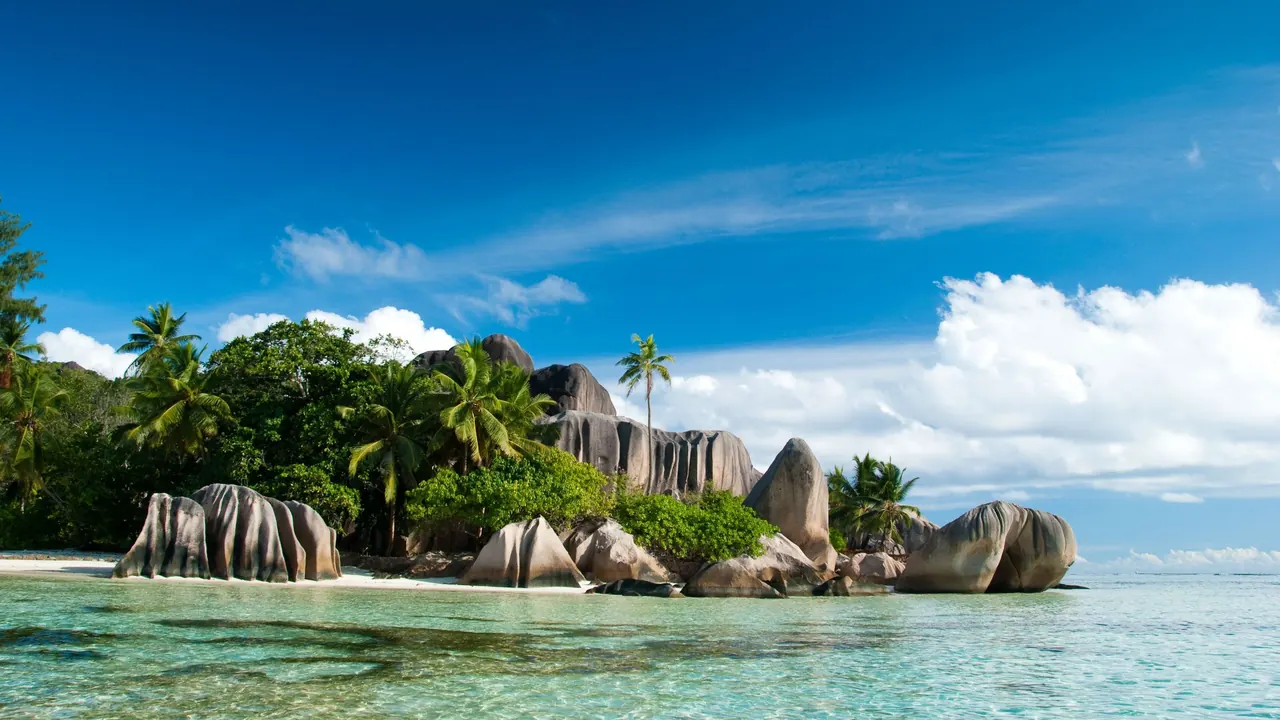
The granite boulders and palms of Anse Source d'Argent
- Beaches90
- Nature & outdoors62
- Getting around62
Photo: Didier Baertschiger from Genève, Suisse, CC BY-SA 2.0, cropped
Match
35
Every category weighted equally
- Beach & sun43
- Culture & arts27
- Food & nightlife28
- Family trip42
- Outdoors42
- Relax & unwind43
- Shopping & style29
- On a budget32
La Digue in twelve categories
Our verdict on each, scored 0 to 100 against the same fixed benchmark cities, so a score means the same thing on every page.
Beaches & swimming. Scores 90 out of 100.
Food & drink. Scores 30 out of 100.
Culture & sights. Scores 12 out of 100.
Nightlife. Scores 5 out of 100.
Nature & outdoors. Scores 62 out of 100.
Day trips. Scores 30 out of 100.
Good for families. Scores 42 out of 100.
Getting around. Scores 62 out of 100.
Shopping & style. Scores 8 out of 100.
Affordability. Scores 15 out of 100.
Live music & performing arts. Scores 5 out of 100.
Wellness & relaxation. Scores 55 out of 100.
La Digue category by category
Beaches & swimming
90Beaches are the reason to come to La Digue. On the west coast, Anse Source d'Argent is a run of small coves between pink-grey granite boulders, with pale sand and clear, shallow water held in by the reef. The lagoon is lovely for wading and floating but often too shallow to swim properly at low tide. Anse Union next to it and the quieter coves of the north, Anse Sévère and Anse Patates, are better for actual swimming and snorkelling, with the sea at around 27°C to 29°C all year.
The southeast coast is wilder and very different. Grand Anse, Petite Anse and Anse Cocos, the last reached only on foot, are long, empty and dramatic, but strong currents and surf make them dangerous for swimming, especially when the southeast trade winds blow from about May to September. Those winds also bring seaweed to some beaches. Plan to swim on the sheltered west and north coasts and treat the east as a place to walk and look.
Food & drink
30Eating on La Digue means Seychellois Creole food: grilled reef fish, octopus curry, fish cooked in banana leaf, breadfruit, lentils and chutneys made from local fruit. The most local meals come from the Creole takeaways around La Passe and from guesthouses that cook dinner for their guests. Fruit stalls along the coast road sell fresh coconut, mango and juice.
Beyond that the choice is small. There are a few beach-shack lunch spots and hotel restaurants, the island has no market to speak of, and most ingredients other than fish come over on the boat, which shows in what's available. Food is honest and good when it is fresh, but no one comes to La Digue to eat.
Culture & sights
12La Digue has little to see in the way of sights. L'Union Estate is the main one, an old coconut and vanilla plantation with a colonial plantation house, a copra mill, the island's first settlers' cemetery and a pen of giant tortoises. It is pleasant for an hour on the way to the beach. Around La Passe there is the Catholic church of Notre Dame de l'Assomption and a few old Creole wooden houses with tin roofs and verandas. These give the island its character, but they make for a short walk rather than a programme.
Nightlife
5There is essentially no nightlife. Evenings mean a drink at sunset on the west coast, dinner, and an early night, since there are no streetlights on much of the island and most people go by bicycle. A beach bar or a local dance may get going at the weekend or around a festival, but anyone who wants to go out at night should stay somewhere else.
Nature & outdoors
62The landscape is the island's other great asset after its beaches: huge rounded granite boulders, weathered pink and grey, standing in the sea and among the palms, with a steep wooded interior behind. A short, sweaty hike climbs to Nid d'Aigle, the highest point at about 330m, with views over Praslin and the outer islands. The coastal path from Grand Anse over to Petite Anse and Anse Cocos is the best walk on the island.
The Veuve Nature Reserve protects the Seychelles paradise flycatcher, a rare black bird with long tail feathers that is found almost nowhere else. Boat trips go to Coco Island, Félicité and the Sisters for some of the best snorkelling in the area, with turtles, rays and reef fish. Everything else is on a small scale. You can see the whole island by bicycle in a day, and there is no real wilderness.
Day trips
30Day trips mean boats. Praslin is a short ferry ride away, and the reason to go is the Vallée de Mai, the palm forest where the coco de mer grows. Curieuse Island, with its giant tortoises and old leper colony ruins, is easily combined with Praslin on an organised boat trip. Mahé, with the small capital Victoria, its market and botanical gardens, is over an hour away by ferry, which is a long day. Island-hopping tours also go to the granite islets nearby, but they are for snorkelling rather than visiting anywhere. Beyond these, there is nowhere else to go.
Good for families
42La Digue suits families who want a quiet beach vacation. There is very little traffic, so older children can ride their own bikes, and the shallow, reef-protected water at Anse Source d'Argent and the calmer northern coves suits small swimmers. Watching the giant tortoises at L'Union Estate is a hit with children. The island is safe and relaxed, and Seychellois people are warm towards children.
There is nothing built for children, though: no attractions, no play areas to speak of and very little to do on a rainy day. Some beaches on the southeast coast have strong currents, so you need to supervise children closely there. Getting to the island involves a long flight and then a ferry, often with a change, which is tiring with small children. Accommodation is mostly in guesthouses or a few small hotels, and some of these are not suited to families.
Getting around
62On the island, getting around is simple and part of the charm. La Digue is only a few kilometres across, has very few cars and is best explored by bicycle, which almost everyone rents when they arrive at the jetty in La Passe. The west coast road is flat. The road across to Grand Anse climbs a little, and in the heat that can be hard work. Anse Cocos is reached only on foot along a coastal path. Electric buggy taxis fill the gaps for anyone with luggage or who doesn't want to cycle.
Getting to the island is the effort. You fly into Mahé and then take a ferry, either direct or via Praslin, or fly to Praslin and take a short boat across. Rough seas can make the crossing uncomfortable.
Shopping & style
8Shopping amounts to a few craft and souvenir stalls near the jetty and on the way into L'Union Estate, along with a handful of small shops selling beachwear, pareos and coconut and shell crafts. Some stalls sell local vanilla and spices. The small shops in La Passe exist to sell groceries to residents and visitors. There is nothing for anyone who wants to go shopping.
Affordability
15La Digue is an expensive place to visit. Almost everything is imported, restaurant meals and drinks cost far more than you might expect for a small island, and the ferry crossings and boat trips quickly add up. Upmarket hotels charge resort-level prices. The island has more modest options than most of the Seychelles, though: family-run guesthouses and self-catering rooms, Creole takeaways for cheap lunches and bicycles instead of taxis. That makes it one of the more manageable places in the country for travellers on a tighter budget, but it is not cheap.
Live music & performing arts
5La Digue has no theatre, concert hall or live-music venue. Some hotels hold occasional evenings of sega, the Creole dance music, and moutya drumming. The island's biggest gathering is the Feast of the Assumption in August, with a procession and celebrations, but there is otherwise nothing to attend.
Wellness & relaxation
55The wellness on La Digue comes from its pace. With no traffic, few cars, bicycles for transport and nothing to do after dark, days slow down to swimming, reading and long lunches. That is what many people come for. Spa options are few: a couple of resort spas and a handful of massage rooms at guesthouses, often with treatments using local coconut oil. There are no baths or bathing traditions. Visitors who want serious spa treatments or a retreat programme will find more on the larger islands.
Where to stay in La Digue
La Digue is only a few kilometres across, so one base does for the whole stay. Most visitors choose between the village, the west coast and the quieter north. La Passe, where the ferry comes in, is the practical choice for a first visit. Bikes are rented at the jetty, the Creole takeaways and grocery shops are close by, and family-run guesthouses that cook dinner make it the best base for food and for a tighter budget. It is also handy for boats to Praslin and the granite islets.
Further south along the flat west coast road, towards L'Union Estate and Anse Source d'Argent, you are a short, level ride from the shallow lagoon and the sunset drinks. This suits families with small children and anyone who wants easy beach days. The north coast, around Anse Sévère and Anse Patates, is the quiet option, with calmer coves for proper swimming and snorkelling.
Staying inland or towards Grand Anse suits walkers who want to be near the coastal path to Anse Cocos. The sea on that side is for looking at, not swimming in, and the ride back over the hill is hard work in the heat. Nowhere on the island suits anyone who wants nightlife.
When should you go?
Pick a month to see what it is like. The climate figures are measured averages, not a forecast.
La Digue in July
Daytime high, °C
Rainfall in the month, mm
The whole year
Shaded against this destination’s own year: the deepest cell is its best month for that figure and the palest its weakest.
Where the figures come from
La Digue's temperatures are measured 49 km from the centre, at Seychelles International Airport.
La Digue has no rain gauge within 25 km of the centre, so its rainfall comes from a gridded climate dataset read at the destination rather than from a gauge further away.
Temperature and rainfall are climate normals, averaged over the years shown. La Digue: 1991-2020 normals, Seychelles International Airport (48.7 km from centre).
Before you go
| Measure | La Digue |
|---|---|
| Official language | French, English, Seychellois Creole |
| Currency | Seychelles Rupee (SCR) |
| Sockets | G240 V, 50 Hz |
| Driving side | Left |
| Time zone | UTC+4 |
| Emergency number | 112 or 999 |
| Main airport | Praslin Island Airport (PRI)1 non-stop destination |
| Public holidays this year | 13 days |
By the numbers
| Measure | La Digue |
|---|---|
| Population | 2,200 |
| People per km² | 224 |
| Swim season, months above 21 °C | 12 months |
Compare La Digue with
Every comparison with a written verdict behind it.