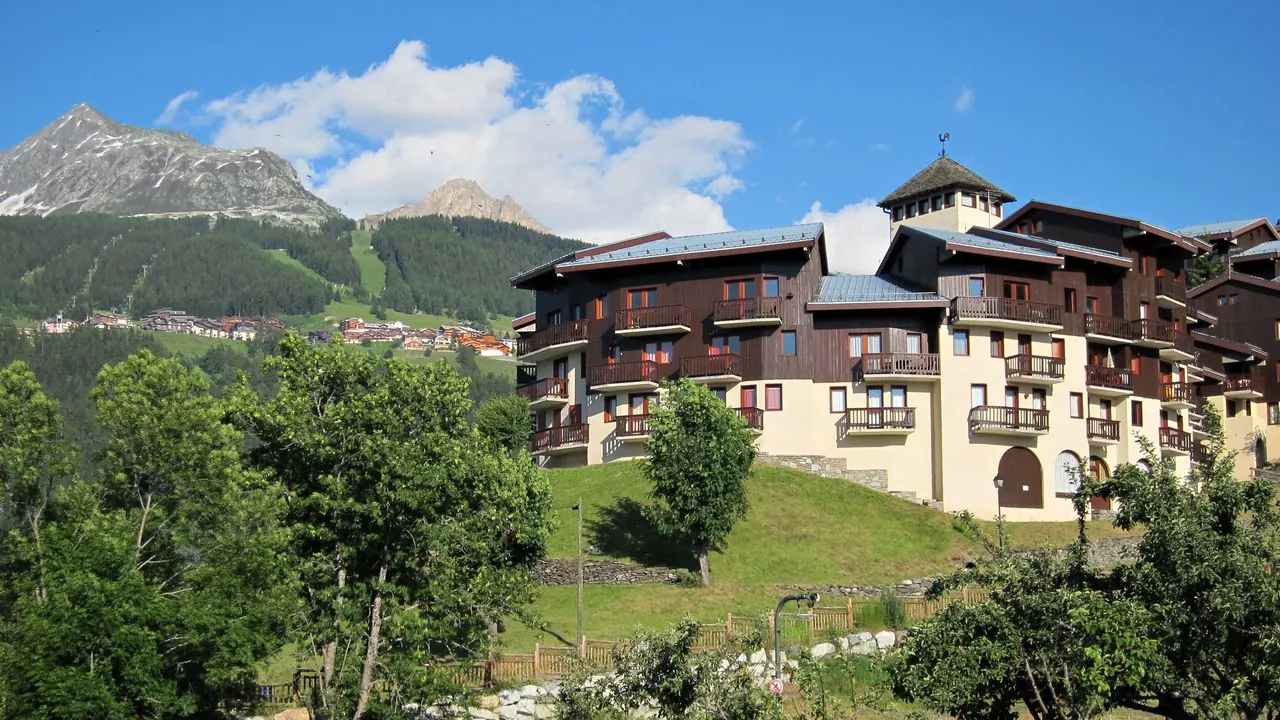
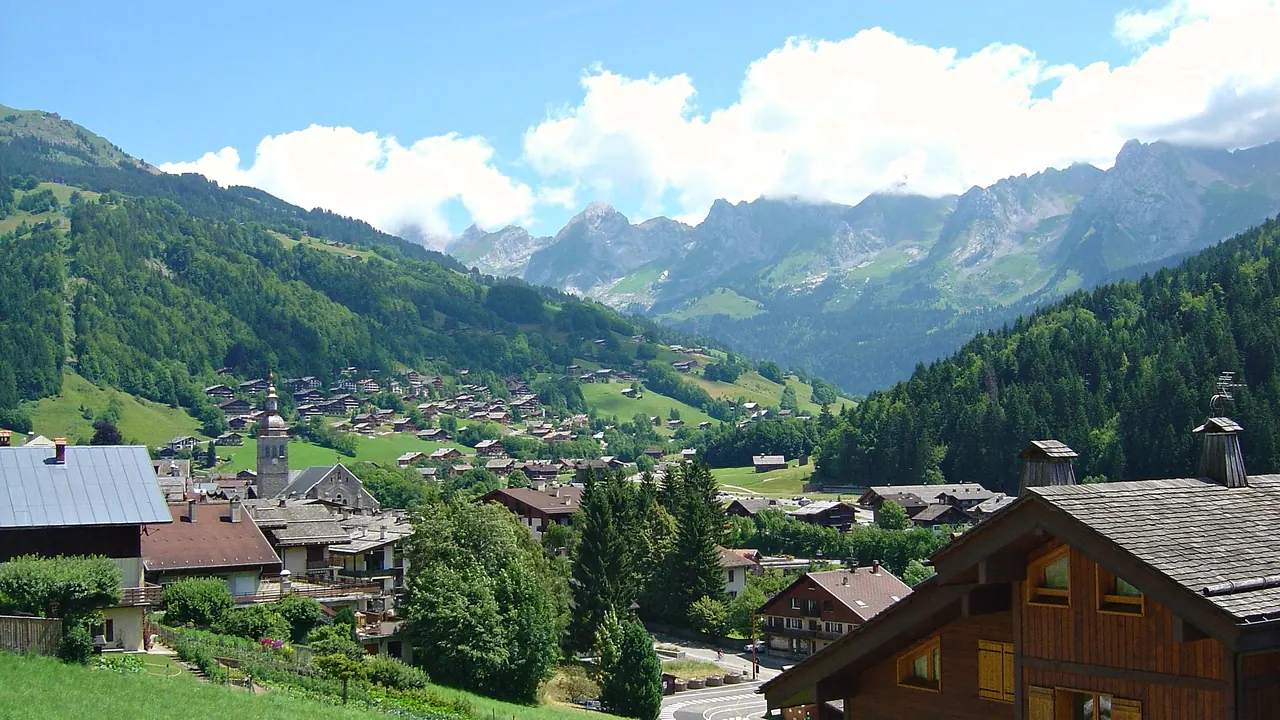
Photos: La Plagne by Henk Monster, CC BY 3.0, cropped; Le Grand-Bornand by Anthospace, CC BY-SA 3.0, cropped.
La Plagne or Le Grand-Bornand?
Our verdict in twelve categories, each scored against the same fixed benchmark cities, and the climate month by month, so you can choose for your trip.
Choose La Plagne for
- nightlife
- getting around
- nature and the outdoors
La Plagne suits skiers who want mileage and altitude: a huge linked area that climbs to a glacier, ski-in and ski-out beds, and a railway station in the valley, so the car can stay at home. It also has the livelier après-ski of the two. Expect the week to cost more.
Choose Le Grand-Bornand for
- beaches
- day trips
- prices
Families and couples after a smaller, more rounded mountain stay will find Le Grand-Bornand the better fit, especially in summer. Lake Annecy's beaches, Annecy itself and Geneva are all an easy drive away, the August children's festival fills the streets, and Reblochon farms and quiet days matter more here than vast ski terrain.
Scoreboard
Twelve categories on one fixed scale from 0 to 100. The shaded stretch is the gap between the two.
Your match
Pick a travel style or drag the sliders, and both match scores follow your weighting.
Wins on nightlife and getting around with your weighting.
Wins on beaches and day trips with your weighting.
What matters to you?
Category by category
What the scores mean for a trip.
Beaches & swimming
Neither has swimming on the doorstep, but only Le Grand-Bornand has a real lake swim within reach. At La Plagne the water means cold mountain lakes and the resort's pools, which are fine for children after skiing but not worth planning a day around.
From Le Grand-Bornand, Lake Annecy is well under an hour's drive down the valley through Thônes. Its clear water warms to around 22°C to 24°C in high summer, and there are lawns and pontoons at Talloires, Menthon-Saint-Bernard and Sevrier. It is an outing rather than daily life, and only really in July and August.
Food & drink
Both kitchens are Savoyard through and through, so the fondue, tartiflette and raclette will taste much the same. The difference is where the best meals happen. In La Plagne it is lunch on a chalet terrace up on the slopes between runs, and the villages add a few more ambitious dining rooms.
Le Grand-Bornand sits closer to the source. This is Reblochon country, and buying cheese at a farm or at the weekly market is the highlight, with Apremont and Mondeuse on the table. Both are narrow beyond that. From Le Grand-Bornand, Annecy is the escape for wider cooking, while most of La Plagne's kitchens close out of season.
Culture & sights
A ski station built from scratch in the 1960s faces an old farming village here, so the heritage could hardly be more different, though there is little of it in either. La Plagne's sights are period resort architecture, such as the ship-like block of Aime 2000 and the towers of Plagne Centre, along with the bobsleigh track left by the Albertville Winter Olympics.
Le Grand-Bornand has real rural heritage on a small scale: an onion-domed baroque church, old farm chalets with deep roofs, and a farmhouse museum about valley life and cheese-making. You can see all of it in an afternoon.
Nightlife
La Plagne has the livelier evenings, though only in the peak winter weeks. There are après-ski bars at the foot of the slopes, a few pubs and late bars in Plagne Centre and Belle Plagne, and a small club or two.
Le Grand-Bornand stops at a few après-ski drinks in the village and at Chinaillon, with no club at all, and in summer a night out means driving to Annecy. Both are family places where most people are in bed early.
Nature & outdoors
Both are superb mountain country, but La Plagne works on a bigger, higher stage. Its wide, sunny slopes drop to wooded runs above Montchavin and Champagny and climb to the Bellecôte glacier above 3,000m, and the Vanoise Express links it into the vast Paradiski area with Les Arcs. In summer, Champagny-le-Haut leads into the Vanoise National Park, where ibex and marmots are common.
Le Grand-Bornand is mid-mountain country, with peaks around 2,500m beneath the limestone wall of the Aravis. Instead of scale it offers variety: cross-country trails in the valley, walks over high pastures to the Col de la Colombière, road climbs known from the Tour de France, and sailing on Lake Annecy within an hour.
Day trips
From La Plagne, every outing starts with the long drive down the mountain, and in winter most visitors stay on the slopes. Aime's Romanesque basilica and walled Conflans are close by, but Annecy is two hours away. In summer the open passes lead to the Beaufortain and over the Little St Bernard into the Aosta Valley, though the Italian run makes a long day.
Le Grand-Bornand is far better placed. Annecy's canals, old town and lakeside castle are about 40 minutes away, Geneva is roughly an hour, and Talloires and Menthon's castle fit easily into the same day. In both places you will need a car.
Good for families
Both resorts were built around families, and either works well for small children learning to ski. La Plagne's strength is convenience on the snow. Belle Plagne is largely car-free, doors open onto gentle slopes, the ski schools run large programmes, and older children can ride a padded bob-raft down the Olympic track.
Le Grand-Bornand is smaller and easier to manage, and it comes into its own in summer. Children can watch Reblochon being made on farms, play in the river and go to the August arts festival. Its drawbacks are the need for a car and nothing large-scale nearby. La Plagne's are altitude, cold and little to do for children who do not take to skiing.
Getting around
La Plagne is easier to get around once you arrive, and easier to reach without a car. Most beds are ski-in and ski-out, free shuttles and a small cable car link the villages, and buses climb up from the railway station at Aime, though snow chains are often needed in winter.
Le Grand-Bornand's centre is easy to walk, and free winter shuttles run to Chinaillon and the lifts. There is no railway, however, and buses to Annecy are few, so the lake, summer trailheads and day trips really mean driving.
Shopping & style
Shopping is practical in both places: ski hire, outdoor gear and groceries, with nothing in the way of fashion. The difference is in the food to take home. La Plagne's cheese counters sell Beaufort, génépi and cured sausages. Le Grand-Bornand has its weekly market of Reblochon, local produce and crafts, and Annecy is close for anything more.
Affordability
Neither is cheap in winter, but Le Grand-Bornand is noticeably easier on the budget. A week in La Plagne adds up fast once you pay for lift passes, equipment hire, lessons and mountain lunches, and groceries in the resort cost more than in the valley.
Le Grand-Bornand is more modest than the high-altitude names, and January and March outside the school vacation weeks are cheaper still. In both, self-catering apartments and summer stays are the way to keep costs down.
Live music & performing arts
La Plagne's live entertainment amounts to torchlight descents, a few open-air concerts in season and bands in the après-ski bars. Chambéry is the nearest place with a proper stage.
Le Grand-Bornand has an event worth planning a trip around. Au Bonheur des Mômes, a children's festival held every August for decades, fills the village with street theatre, circus, puppetry and music for a week. The rest of the year is quiet, with occasional concerts in the church, and Annecy and Geneva have the theatre and opera.
Wellness & relaxation
Both offer the same comforts after skiing: hot tubs, saunas and small spas in hotels and residences. La Plagne adds aquatic centres, and about an hour down the valley there is real thermal bathing at Brides-les-Bains and La Léchère, which have been spa towns since the nineteenth century.
Le Grand-Bornand has no bathing tradition. What it offers instead is calm: slow days off-peak and in early summer in a quiet village of wooden balconies and cow bells, without the physical demands of a big ski week.
When should you go?
Pick your month. The climate figures are measured averages, not a forecast.
La Plagne in July
Le Grand-Bornand in July
Daytime high, °C
Rainfall in the month, mm
Where the figures come from
La Plagne has no weather station within reach, so its figures come from a gridded climate model rather than a measured record, and read a broad area rather than one spot.
Le Grand-Bornand's temperatures are measured 45 km from the centre, at Bourg-St-Maurice.
Le Grand-Bornand has no rain gauge within 25 km of the centre, so its rainfall comes from a gridded climate dataset read at the destination rather than from a gauge further away.
Temperature and rainfall are climate normals, averaged over the years shown. La Plagne: 2001-2020 normals, NASA POWER reanalysis grid, no weather station within 90 km. Le Grand-Bornand: 1999-2020 (rainfall 1991-2020) normals, Bourg-St-Maurice (44.7 km from centre).
La Plagne has a true high-altitude climate. From December to February the highs stay below freezing, around -4°C in January, and March is still wintry. Even July peaks at only about 18°C, which is ideal for hiking but never beach weather. Rain is moderate all year and heaviest in May.
Le Grand-Bornand's figures are much milder. Highs stay above freezing even in January, so snow in the village is less of a given than up at La Plagne. July reaches around 27°C, which makes June to August warm enough for shorts on the trails and swims in Lake Annecy. It is also the wetter of the two, peaking at 144mm in December. Its springs and autumns are pleasant for walking while La Plagne is still cold, or already cold again.
Which traveller are you?
For a food and nightlife trip, La Plagne is the stronger choice. In peak winter weeks its après-ski bars, late pubs and small clubs in Plagne Centre and Belle Plagne keep going, and long lunches on chalet terraces up on the slopes make the days just as sociable.
On a beach and sun trip, Le Grand-Bornand wins easily. Its summer highs are properly warm, and the clear water, pontoons and small beaches of Lake Annecy are about 40 minutes away. At La Plagne, swimming means cold mountain lakes and indoor pools.
For a trip on a tight budget, Le Grand-Bornand is the safer bet. It is more modest than the big high-altitude resorts, self-catering is the norm, and the quiet weeks of January and March cut costs further. A week in La Plagne adds up quickly.
Before you go
| Measure | La Plagne | Le Grand-Bornand |
|---|---|---|
| Official language | French | French |
| Currency | Euro (EUR) | Euro (EUR) |
| Sockets | CE230 V, 50 Hz | CE230 V, 50 Hz |
| Driving side | Right | Right |
| Time zone | UTC+1, UTC+2 in summer | UTC+1, UTC+2 in summer |
| Emergency number | 112 | 112 |
| Elevation | 1,974 m | 892 m |
| Main airport | Geneva International Airport (GVA)92 km from centre150 non-stop destinations | Geneva International Airport (GVA)41 km from centre150 non-stop destinations |
| Public holidays this year | 11 days | 11 days |
By the numbers
| Measure | La Plagne | Le Grand-Bornand |
|---|---|---|
| Population | - | 2,050 |
| People per km² | - | 33 |
| Museums within 10 km | 2 | 1 |
| UNESCO World Heritage sites within 50 km | 0 | 2 |
Where else could you go?
Every comparison below shares a destination with this one, so you can follow La Plagne or Le Grand-Bornand somewhere new.
- La Clusazvs Le Grand-Bornand
- Courchevelvs La Plagne
- Les Arcsvs La Plagne
- Méribelvs La Plagne
- Megèvevs Le Grand-Bornand
- Tignesvs La Plagne