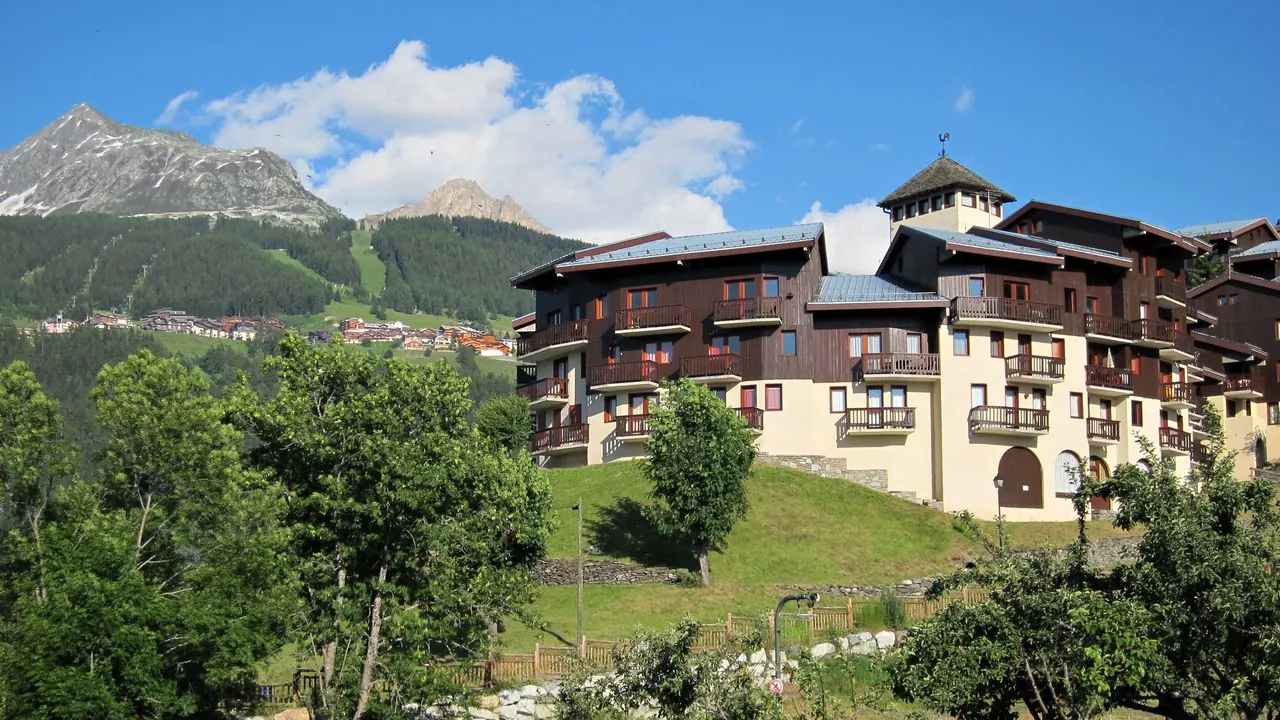
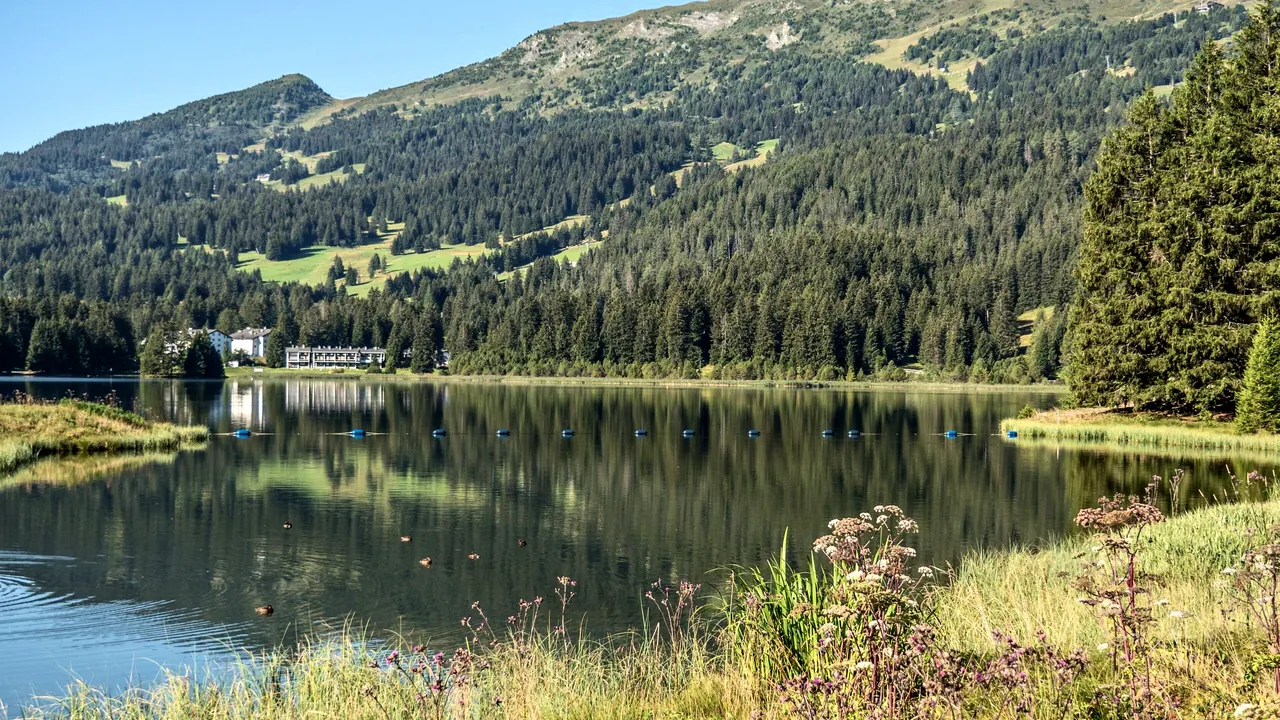
Photos: La Plagne by Henk Monster, CC BY 3.0, cropped; Lenzerheide by Jag9889, CC BY-SA 4.0, cropped.
La Plagne or Lenzerheide?
Our verdict in twelve categories, each scored against the same fixed benchmark cities, and the climate month by month, so you can choose for your trip.
Choose La Plagne for
- prices
- nightlife
- families
La Plagne suits a classic ski week, especially with children or on a tighter budget. Its car-free villages sit right on the snow, ski schools run big programmes for little ones, and the Paradiski link to Les Arcs gives keen skiers more terrain than they can cover in a week. A self-catering apartment keeps the costs of a French resort within reach in a way Switzerland rarely allows.
Choose Lenzerheide for
- day trips
- beaches
- getting around
Travellers who want a mountain stay with a bit of country around it will be happier in Lenzerheide. A PostBus ride connects it to the Swiss rail network, so there is no need for a car, and Chur, the Albula railway and the Heidi wine villages all make easy days out. In summer it adds a swimmable lake and one of the Alps' leading bike parks. The price is high almost everywhere you look, so it rewards travellers who are less worried about cost.
Scoreboard
Twelve categories on one fixed scale from 0 to 100. The shaded stretch is the gap between the two.
Your match
Pick a travel style or drag the sliders, and both match scores follow your weighting.
Too close to call, 1 point apart
Wins on prices and nightlife with your weighting.
Wins on day trips and beaches with your weighting.
What matters to you?
Category by category
What the scores mean for a trip.
Beaches & swimming
In La Plagne the water worth getting into is warm and chlorinated, in the indoor pools at the leisure centres or a heated outdoor one. The high lakes make a pretty spot for a picnic in summer, but they are too cold to tempt most people in.
Lenzerheide has a real lake on its doorstep. The Heidsee lies just below the village, with a lido and a lawn to spread a towel on, and in July and August it gives you a bracing dip with mountains all round, though it rarely gets much above 18°C. Hardier swimmers can try the Lai Barnagn or the higher tarns, so a summer afternoon outdoors by the water is easy here and not really possible in La Plagne.
Food & drink
Food is much the same in both, mountain cooking from a fairly narrow range, but the cheese and the wine differ. La Plagne serves Savoyard dishes, fondue, tartiflette and raclette made with Beaufort and Reblochon, and its best meals are lunches on the terraces of slope-side chalets. Its cheese counters also make self-catering a pleasure.
Lenzerheide's menus come from Graubünden: capuns, pizokel, barley soup and air-dried beef, with nut tart to finish. A Bündner Herrschaft wine is worth ordering. Both thin out badly between seasons.
Culture & sights
Neither will fill many days with sightseeing, and the little each has is quite different. La Plagne's interest is modern. The resort is a showpiece of 1960s French mountain planning, from the stepped block of Aime 2000, sitting on the slope like a stranded ship, to the towers of Plagne Centre, and it also has the bob run from the Albertville Olympics.
Lenzerheide's is quieter and older in feel: a few small village churches and the Romansh names on the signposts. For real history you have to go down the valley, to Aime's Romanesque basilica from La Plagne or to Chur's cathedral from Lenzerheide.
Nightlife
La Plagne has a little more going on after dark, largely because it is a bigger resort spread over several villages. Plagne Centre and Belle Plagne have pubs, late bars and a small club or two once après-ski at the foot of the slopes is over.
Lenzerheide has the same loud après-ski as the lifts close, then only a couple of village bars and one small club that stay open late on peak weekends. In both, summer evenings end early.
Nature & outdoors
Both are first-rate mountain bases, but each has different strengths. La Plagne is the bigger ski destination: Paradiski runs from wooded slopes at about 1,250m up to the Bellecôte glacier, and the Vanoise Express crosses to Les Arcs. In summer, Champagny-le-Haut leads into the Vanoise National Park, where you can see ibex and marmots, and there is paragliding and rafting on the Isère.
Lenzerheide shares its ski area with Arosa and adds cross-country trails round the Heidsee and a biathlon arena. In summer it is a serious mountain-biking destination with a race-standard bike park and long singletrack, and the Rothorn cable car gives easy access to high-alpine views.
Day trips
Lenzerheide is the better base for getting out. Chur's old town is half an hour away by PostBus. The UNESCO-listed Albula line climbs over spiral tunnels and viaducts to St Moritz, and Maienfeld, the wine villages and Vaduz in Liechtenstein are all close, mostly without a car.
From La Plagne every outing starts with the long drive down the mountain, so most winter visitors stay put. A car brings Conflans, Chambéry and Annecy within reach, and in summer the Beaufortain or the pass into Italy's Aosta Valley.
Good for families
La Plagne is the stronger family resort, especially in winter. It was designed around children, with car-free villages on the snow, large ski-school programmes and kids' clubs, and wide, easy runs for nervous beginners.
Lenzerheide is also a good family choice, and it comes into its own in summer, with pedalos and playgrounds at the Heidsee, summer toboggan runs and easy bike trails for young riders. Neither has much for a rainy day.
Getting around
Lenzerheide is easier to reach and leave. The PostBus from Chur station takes about half an hour, local buses link the villages and lifts, and you can manage without a car. The resort stretches along the valley road, though, so you will walk only around the centre and the lake.
La Plagne is the opposite. Once you arrive, ski-in ski-out lodging, free shuttles and a small cable car make getting about simple. The problem is the winding climb from Aime station, often with snow chains in winter, and a car for anything beyond the resort.
Shopping & style
Both offer only practical shopping: ski and bike hire, outdoor clothing and groceries. The difference is in what you take home: Beaufort, génépi and valley honey from La Plagne, or Graubünden sausage and nut tart from Lenzerheide's delis. For proper retail, Lenzerheide's shoppers go to Chur or Zurich.
Affordability
Neither is cheap, but La Plagne costs noticeably less. Lift passes, hire and mountain lunches add up there too, but the many self-catering apartments and the cheaper quieter weeks give families real ways to cut the bill.
In Lenzerheide almost everything costs Swiss resort prices, from hotel rooms to a plate of pizokel. The free guest card covers local buses, but it does little to change the overall cost.
Live music & performing arts
Neither has anything you could call a performance scene. La Plagne offers torchlight descents and après-ski bands, and Lenzerheide has open-air concerts around its big sporting events. Lenzerheide's nearest real stages, in Chur, are much closer than La Plagne's in Chambéry.
Wellness & relaxation
Neither is a spa destination, and wellness in both means unwinding after an active day. Lenzerheide's larger hotels have the more substantial spas, and Bad Ragaz is an hour away, with Vals's stone baths further off.
In La Plagne it is more often a hot tub in an apartment residence or a soak at the aquatic centre, with the old spa towns of Brides-les-Bains and La Léchère an hour down the valley.
When should you go?
Pick your month. The climate figures are measured averages, not a forecast.
La Plagne in July
Lenzerheide in July
Daytime high, °C
Rainfall in the month, mm
Where the figures come from
La Plagne has no weather station within reach, so its figures come from a gridded climate model rather than a measured record, and read a broad area rather than one spot.
Lenzerheide's temperatures are measured 33 km from the centre, at Samedan.
Lenzerheide's station stands 234 m above the city centre, so the centre is likely a little warmer than the figures say.
Lenzerheide has no rain gauge within 25 km of the centre, so its rainfall comes from a gridded climate dataset read at the destination rather than from a gauge further away.
Temperature and rainfall are climate normals, averaged over the years shown. La Plagne: 2001-2020 normals, NASA POWER reanalysis grid, no weather station within 90 km. Lenzerheide: 2015-2025 (rainfall 1991-2020) normals, Samedan (32.9 km from centre).
Both are winter resorts above all, but La Plagne is the colder of the two, with daytime highs around -4°C in January and frost on most days from December into March, which keeps its high snow reliable. Lenzerheide hovers around freezing in the same months, so village walks and lakeside cross-country loops feel a little kinder. April is the shoulder month in both places, with soft spring snow and many places closing.
Summer is where they really differ. La Plagne stays mild, around 18°C in July, with rain spread evenly through the year and May the wettest month at about 103mm. Lenzerheide is a touch warmer at about 20°C, warm enough for a brisk lake swim, but from May to October it gets much more rain, peaking at about 164mm in August. Expect afternoon showers there, and plan hikes and rides for the mornings.
Which traveller are you?
On a family trip with young children, La Plagne has the edge. Belle Plagne and other car-free villages let children walk straight onto gentle slopes, ski schools and snow gardens are built on a large scale, and older children can ride the Olympic bob track in a bob-raft.
For a trip on a tight budget, La Plagne is the easier choice. Neither is cheap, but its large stock of self-catering apartments and its quieter ski weeks keep a French resort affordable, while in Lenzerheide hotels, meals and lift passes all come at Swiss prices.
On a relaxing and wellness trip, Lenzerheide fits better. The larger hotels have proper spas, the evenings are slow, and in summer you can lie by the Heidsee or swim in it. Bad Ragaz's thermal baths are an hour away. La Plagne feels more like a physical ski week.
Before you go
| Measure | La Plagne | Lenzerheide |
|---|---|---|
| Official language | French | French, German, Italian, Romansh |
| Currency | Euro (EUR) | Swiss Franc (CHF) |
| Sockets | CE230 V, 50 Hz | CJ230 V, 50 Hz |
| Driving side | Right | Right |
| Time zone | UTC+1, UTC+2 in summer | UTC+1, UTC+2 in summer |
| Emergency number | 112 | 112 |
| Elevation | 1,974 m | 1,473 m |
| Main airport | Geneva International Airport (GVA)92 km from centre150 non-stop destinations | Zürich Airport (ZRH)112 km from centre226 non-stop destinations |
| Public holidays this year | 11 days | 9 days |
By the numbers
| Measure | La Plagne | Lenzerheide |
|---|---|---|
| Population | - | 2,641 |
| Museums within 10 km | 2 | 1 |
| UNESCO World Heritage sites within 50 km | 0 | 1 |
Where else could you go?
Every comparison below shares a destination with this one, so you can follow La Plagne or Lenzerheide somewhere new.
- Arosavs Lenzerheide
- Courchevelvs La Plagne
- Les Arcsvs La Plagne
- Méribelvs La Plagne
- Tignesvs La Plagne
- La Rosièrevs La Plagne