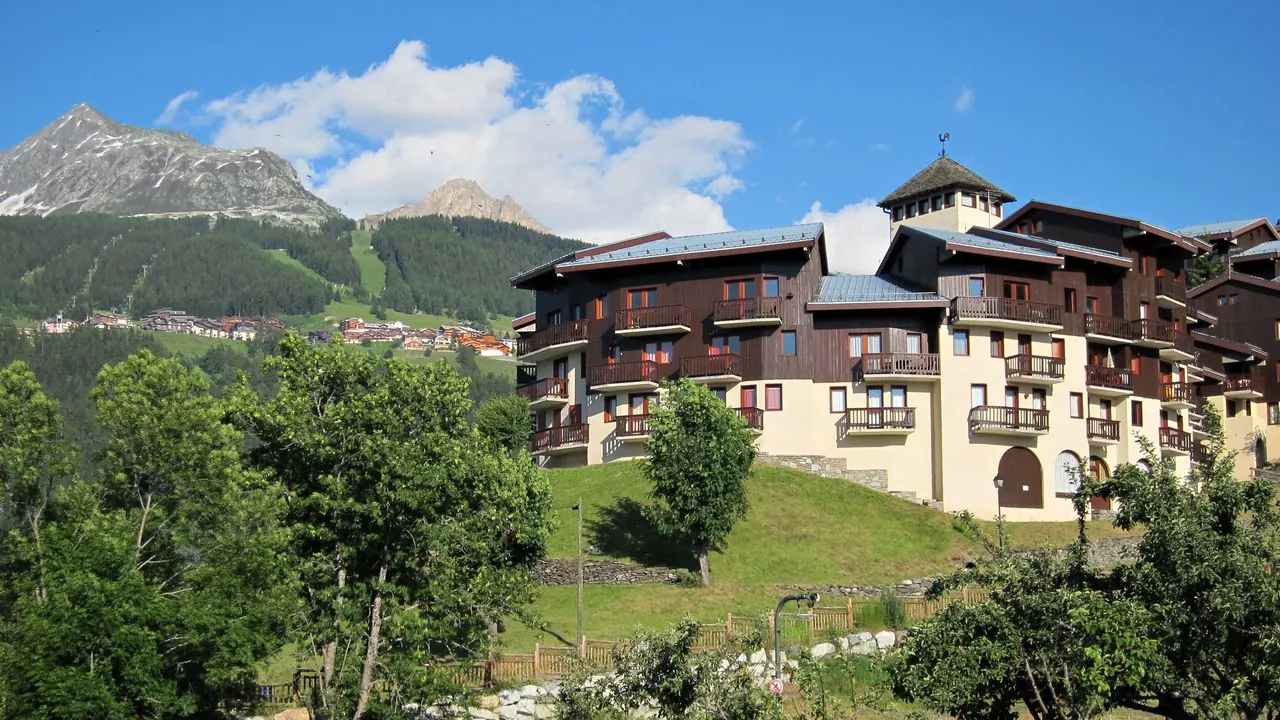
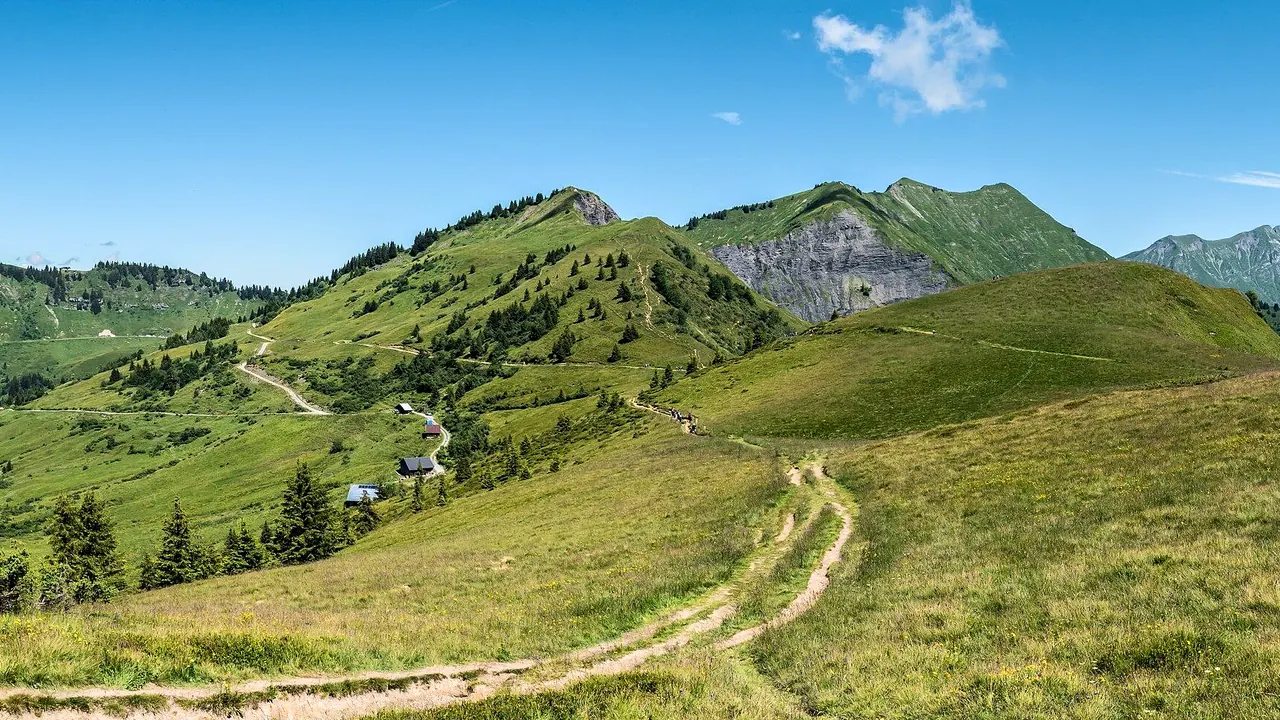
Photos: La Plagne by Henk Monster, CC BY 3.0, cropped; Samoëns by Krzysztof Golik, CC BY-SA 4.0, cropped.
La Plagne or Samoëns?
Our verdict in twelve categories, each scored against the same fixed benchmark cities, and the climate month by month, so you can choose for your trip.
Choose La Plagne for
- nightlife
- getting around
- wellness
La Plagne is the choice for a ski week built around the mountain itself. Its villages sit high on the snow, most lodgings let you ski from the door, and the Paradiski link to Les Arcs gives keen skiers more terrain than they can cover in a week. Families with small children do especially well in car-free Belle Plagne, and the après-ski has a little more life in the evenings. The trade-off is a purpose-built resort with almost no old heritage and a high bill.
Choose Samoëns for
- day trips
- beaches
- culture and sights
Travellers who want a real village and a broader trip will be happier in Samoëns. The stone centre, the old lime tree and the alpine garden give it character that La Plagne lacks, and summer is warm enough for the lake. Geneva, Annecy and Chamonix are all close enough for a day out. It costs less too, though its nights are quieter and its slopes start lower down.
Scoreboard
Twelve categories on one fixed scale from 0 to 100. The shaded stretch is the gap between the two.
Your match
Pick a travel style or drag the sliders, and both match scores follow your weighting.
Wins on nightlife and getting around with your weighting.
Wins on day trips and beaches with your weighting.
What matters to you?
Category by category
What the scores mean for a trip.
Beaches & swimming
Neither has a coast, but Samoëns gives summer swimmers a lot more. The Lac aux Dames on the edge of the village has a lifeguarded bathing area in July and August, a grassy shore and an outdoor pool facing the peaks, and Lake Geneva's beaches at Évian and Thonon are about an hour away.
In La Plagne the mountain lakes are too cold to be more than a picnic spot, so swimming happens in the leisure centres' indoor and heated pools.
Food & drink
The cooking is the same Savoyard fare of fondue, raclette and tartiflette, and the range is narrow in both. La Plagne's best meals are lunches on chalet terraces between runs, with Beaufort the local cheese, and many visitors self-cater from the resort's cheese counters.
Samoëns adds diots sausages with polenta, Abondance and Tomme, and a weekly market on the main square where local producers sell cheese, charcuterie and honey, which suits anyone who enjoys shopping for food more.
Culture & sights
La Plagne was built from scratch in the 1960s purely for skiing, so its sights are period pieces of French resort planning. The best known are the stepped concrete mass of Aime 2000, which looks like a stranded liner on the slope, the towers of Plagne Centre and the Olympic bobsleigh track. For Romanesque churches and old Savoyard villages you have to drive down to the valley.
Samoëns has far more to look at, because it kept its old village. The stone centre is the work of the frahans, local masons who spent centuries working across Europe. On the Grande Place a lime tree said to date from the Middle Ages stands beside the church and its carved fountain. The Jaÿsinia alpine garden climbs the hillside above, and an afternoon is enough to see it all.
Nightlife
La Plagne's evenings start at the foot of the slopes, where the bars fill as the lifts close. In peak winter weeks Plagne Centre and Belle Plagne keep a few pubs, late bars and a small club or two going after dinner, though this is still a family resort and most people turn in early.
Samoëns is quieter still. An evening there means a drink on the square or by the gondola, then dinner, and perhaps one of the couple of pubs that stay open later in winter. Outside the ski season both villages are very quiet at night.
Nature & outdoors
Both are first-rate mountain bases, and the difference is altitude and setting. La Plagne's villages sit on wide, sunny slopes from about 1,250m up to the Bellecôte glacier above 3,000m, and the Vanoise Express links them into the vast Paradiski area. In summer, Champagny-le-Haut leads into the Vanoise National Park.
Samoëns starts lower, with a gondola climbing from the village into the Grand Massif, forest runs and views to Mont Blanc, plus cross-country skiing on the valley floor. Its summer walking is more varied, with the cliffs and waterfalls of the Cirque du Fer-à-Cheval, the Gorges des Tines and the karst of the Désert de Platé.
Day trips
Samoëns is much better placed for days out. Geneva and Chamonix are each about an hour by road, Annecy is a little further, and the Lake Geneva shore adds walled Yvoire, Évian and the ferry to Lausanne.
From La Plagne every outing begins with the long drive down the mountain. Conflans and Aime's Romanesque basilica are the near options, Chambéry and Annecy take longer, and the summer pass into the Aosta Valley makes a long day. Both need a car.
Good for families
Both work well with children, and La Plagne is slightly ahead because it was designed for them. Car-free villages like Belle Plagne sit right on the snow, ski schools run large programmes for the very young, and the bob-raft ride is a treat for older children. The downside is altitude and cold, with little to do for a child who dislikes skiing.
Samoëns is a small, traffic-calmed village with gentle beginner slopes, and in summer the Lac aux Dames leisure base adds a pool with a slide, a paddling area and play areas. Teenagers may find its evenings slow.
Getting around
La Plagne is a little easier once you arrive. Most lodgings are ski-in and ski-out, free shuttles link the villages, and a small cable car joins Plagne Centre to Aime 2000. Getting there is the hard part, with a long winding climb from Aime station that often needs snow chains.
Samoëns has a compact, walkable centre with the gondola at its edge and winter shuttles, so a ski week can be car-free. Its trailheads and day trips, though, depend more heavily on having a car.
Shopping & style
La Plagne's shops are practical: ski hire, sports gear and outdoor clothing in every village, with Beaufort, cured sausages and génépi from the cheese and produce counters the things worth taking home. Samoëns is a little nicer to browse, with gift and homeware boutiques around the square and a weekly market selling woollens alongside mountain cheese and honey. For fashion or anything bigger, Geneva and Annecy are within reach of Samoëns.
Affordability
Samoëns is the cheaper of the two. Prices peak in the school vacation weeks, but its self-catering apartments, supermarket and free summer hiking keep it gentler than the more glamorous resorts.
A winter week in La Plagne costs noticeably more, with lift passes, lessons and mountain lunches mounting up and groceries pricier up in the resort than in the valley. In both, self-catering and the summer season soften the bill.
Live music & performing arts
Neither has a theatre or regular venue. Samoëns has slightly more on offer, with summer music in the church, outdoor concerts and village festivals, and Geneva's opera is about an hour away. La Plagne's version is torchlight descents and bands in the après-ski bars, and Chambéry is the nearest place for serious music.
Wellness & relaxation
La Plagne is better equipped for unwinding after a day on the slopes. Its hotel and residence spas are backed by the resort's own aquatic centres, and the old spa towns of Brides-les-Bains and La Léchère are about an hour below.
Samoëns relies on hotel saunas and the pools in neighbouring resorts, with Saint-Gervais the nearest thermal baths. What it offers instead is a slower pace, and a calm evening on the square outside the peak weeks.
When should you go?
Pick your month. The climate figures are measured averages, not a forecast.
La Plagne in July
Samoëns in July
Daytime high, °C
Rainfall in the month, mm
Where the figures come from
La Plagne has no weather station within reach, so its figures come from a gridded climate model rather than a measured record, and read a broad area rather than one spot.
Samoëns's temperatures are measured 49 km from the centre, at Sion.
Samoëns's station stands 189 m below the city centre, so the centre is likely a little cooler than the figures say.
Samoëns has no rain gauge within 25 km of the centre, so its rainfall comes from a gridded climate dataset read at the destination rather than from a gauge further away.
Temperature and rainfall are climate normals, averaged over the years shown. La Plagne: 2001-2020 normals, NASA POWER reanalysis grid, no weather station within 90 km. Samoëns: 1991-2020 (sunshine 1961-1990) normals, Sion (49.1 km from centre).
La Plagne's villages are high enough that daytime highs stay below freezing from December to February, around -4°C in January, which keeps winter firmly wintry for skiing. Spring arrives late, and even July only reaches about 18°C, ideal for hiking the high pastures but never truly warm. Rain is spread fairly evenly through the year, with May the wettest month.
Samoëns sits much lower in its valley and has a milder, wetter climate. Winter highs in the village are around 5°C, with the skiing up in the Grand Massif above, and December is the dampest month at about 129mm. Summer is the real difference: July and August reach about 27°C and are the sunniest stretch of the year, warm enough for the Lac aux Dames and comfortable for strolling the village. That makes Samoëns the better summer base, while La Plagne is the colder, more reliably wintry one.
Which traveller are you?
On a family trip with young children, La Plagne has the edge. In Belle Plagne and other car-free villages children walk straight onto gentle slopes, ski schools run big programmes for the very young, and the Olympic bob-raft thrills older ones.
For a culture and arts trip, Samoëns is the clear pick. It has a real stone village built by its travelling masons, the Jaÿsinia alpine garden and a heritage centre, and Geneva's museums and concert halls are only about an hour away.
On a trip with a tight budget, Samoëns is easier on the wallet. It has plenty of self-catering apartments, a supermarket and a weekly market, and hiking is free in summer. La Plagne's resort prices and lift costs add up faster.
Before you go
| Measure | La Plagne | Samoëns |
|---|---|---|
| Official language | French | French |
| Currency | Euro (EUR) | Euro (EUR) |
| Sockets | CE230 V, 50 Hz | CE230 V, 50 Hz |
| Driving side | Right | Right |
| Time zone | UTC+1, UTC+2 in summer | UTC+1, UTC+2 in summer |
| Emergency number | 112 | 112 |
| Elevation | 1,974 m | 671 m |
| Main airport | Geneva International Airport (GVA)92 km from centre150 non-stop destinations | Geneva International Airport (GVA)51 km from centre150 non-stop destinations |
| Public holidays this year | 11 days | 11 days |
By the numbers
| Measure | La Plagne | Samoëns |
|---|---|---|
| Population | - | 2,203 |
| People per km² | - | 23 |
| Museums within 10 km | 2 | 1 |
| UNESCO World Heritage sites within 50 km | 0 | 3 |
Where else could you go?
Every comparison below shares a destination with this one, so you can follow La Plagne or Samoëns somewhere new.
- Flainevs Samoëns
- Les Getsvs Samoëns
- Morzinevs Samoëns
- Courchevelvs La Plagne
- Les Arcsvs La Plagne
- Avoriazvs Samoëns