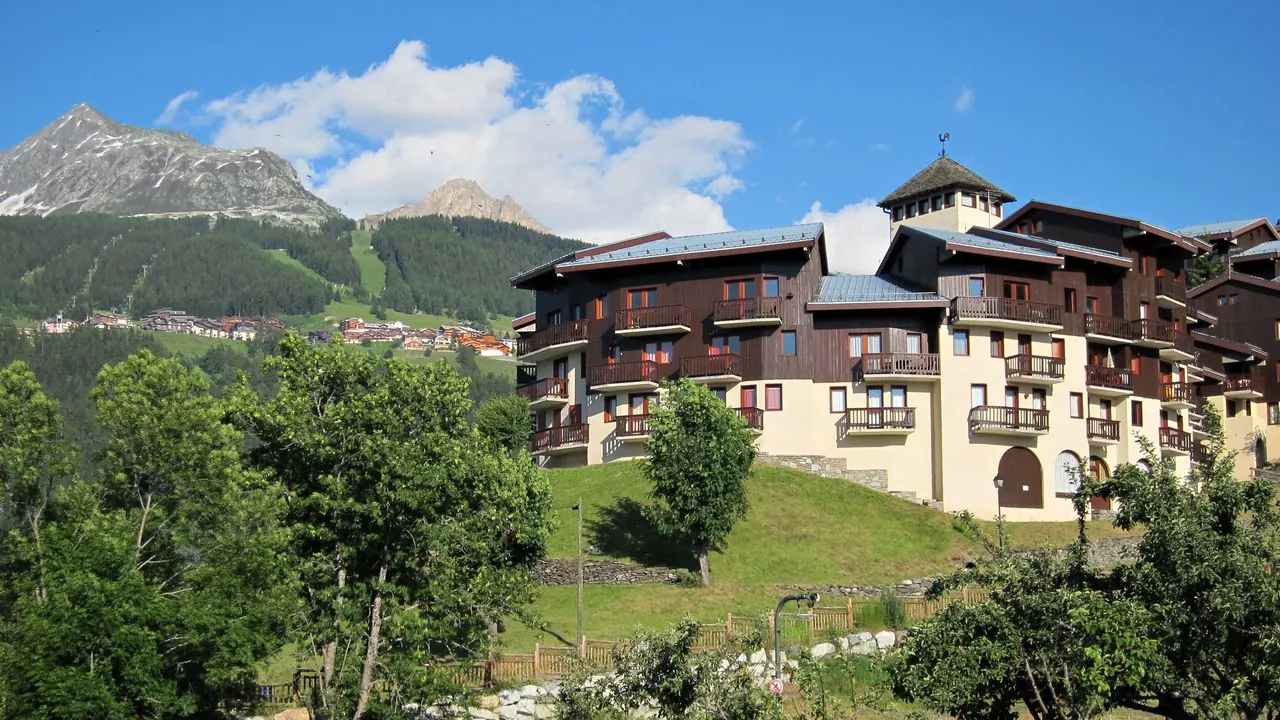
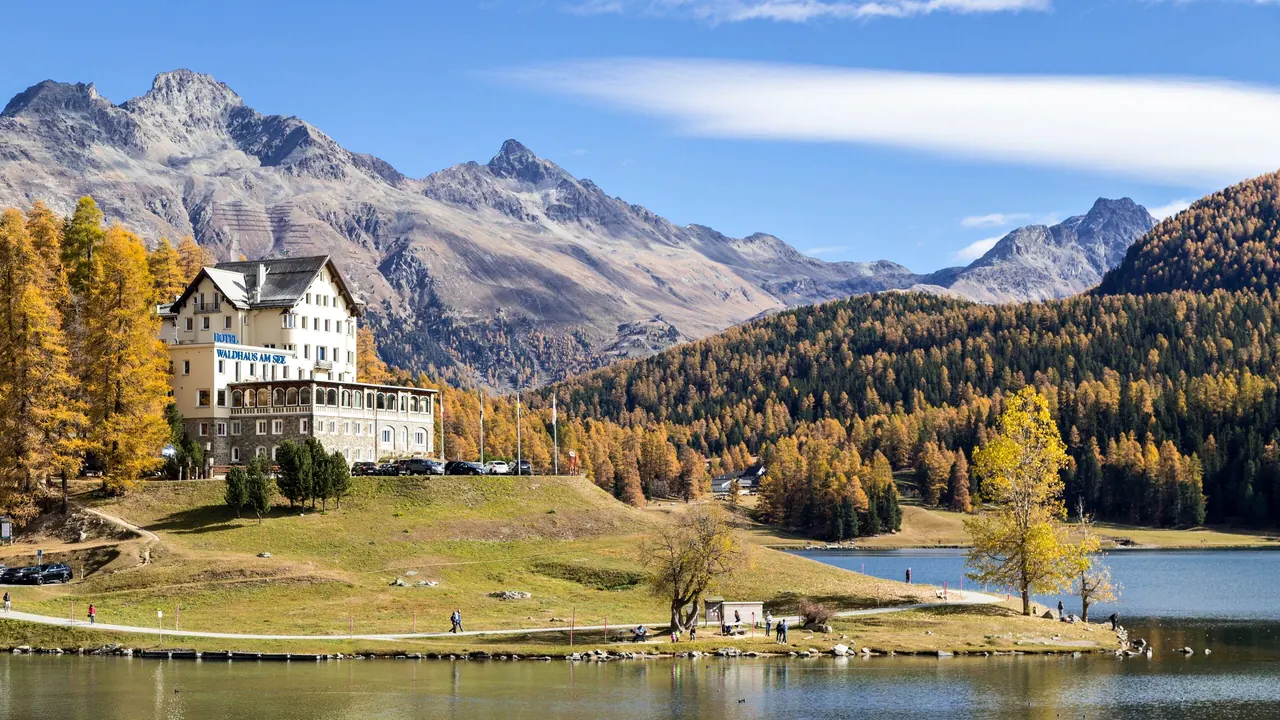
Photos: La Plagne by Henk Monster, CC BY 3.0, cropped; St. Moritz by JoachimKohler-HB, CC BY-SA 4.0, cropped.
La Plagne or St. Moritz?
Our verdict in twelve categories, each scored against the same fixed benchmark cities, and the climate month by month, so you can choose for your trip.
Choose La Plagne for
- families
- prices
La Plagne suits families and groups who want a week on the snow without fuss. Its car-free villages sit right on the pistes, the wide runs of the Paradiski area are made for beginners and confident intermediates, and a self-catering apartment keeps a costly ski week within reach. Expect little beyond the mountain itself: evenings are early and the sightseeing is down in the valley.
Choose St. Moritz for
- shopping
- getting around
- wellness
St. Moritz is the choice when the setting and the comfort matter as much as the skiing. You can arrive by train and never need a car, and the Engadine's lakes, glaciers and cross-country trails are on the doorstep, along with grand hotel spas, serious restaurants and a short run of luxury boutiques. The price of all that is steep, and children are welcome rather than catered for.
Scoreboard
Twelve categories on one fixed scale from 0 to 100. The shaded stretch is the gap between the two.
Your match
Pick a travel style or drag the sliders, and both match scores follow your weighting.
Wins on families and prices with your weighting.
Wins on shopping and getting around with your weighting.
What matters to you?
Category by category
What the scores mean for a trip.
Beaches & swimming
Neither place is for a swimming trip. In both, swimming mostly means a pool. In La Plagne that is the heated pools at the resort's leisure centres, because its mountain lakes are better for a picnic than a dip.
St. Moritz at least offers one real outdoor swim. Lej da Staz, a forest lake within walking distance, has a lawn and a small bathing area for a few weeks in July. Lake Silvaplana is for windsurfers and kitesurfers in wetsuits.
Food & drink
La Plagne feeds you well in a narrow, hearty way. You get fondue, tartiflette and Beaufort, and the best meals are lunches on chalet terraces between runs. Down in the villages the choice is mostly pizzerias and crêperies, and many visitors cook in their apartments.
St. Moritz eats noticeably better at dinner. Its grand hotels and mountain restaurants hold far more ambitious kitchens than a village that size would suggest. Local dishes such as capuns, pizzoccheri and Engadine nut tart give it a regional character of its own, though the choice thins out quickly below the luxury end.
Culture & sights
La Plagne was built from nothing in the 1960s, so its sights are the resort itself. The ship-like block of Aime 2000 and the towers of Plagne Centre are period pieces of French mountain planning, and the bob track built for the Winter Olympics in Savoie is a landmark of sorts. For Romanesque churches or old stone villages you have to drive down to the valley.
St. Moritz has a little more to fill an afternoon. The highlight is the Segantini Museum and its great Alpine triptych. There are also the painted farmhouse rooms of the Engadin Museum and the leaning tower of a lost church above the village. The resort's own history adds to this: Alpine winter tourism began here, the town has hosted the Winter Olympics twice, and the Cresta Run is still in use.
Nightlife
Both go quiet early, but the evenings feel different. La Plagne's nights are casual après-ski: pubs and late bars in Plagne Centre and Belle Plagne, and a small club or two. Most guests are families heading to bed before the first lifts.
St. Moritz is dressier. There is champagne in grand hotel bars and a couple of exclusive clubs that are hard to get into, all at high-season prices. Outside winter, both villages are silent by late evening.
Nature & outdoors
Both are first-rate mountain destinations, and the choice comes down to what kind of mountain trip you want. La Plagne is about sheer downhill mileage. It is linked to Les Arcs by the Vanoise Express, with wide open intermediate slopes rising to the Bellecôte glacier, and in summer Champagny-le-Haut leads into the Vanoise National Park.
St. Moritz has a wider range of landscape and sport. Lakes lie along the valley floor, the Engadine has some of the finest cross-country skiing in the Alps, and there are horse races on the frozen lake, kitesurfing on Silvaplana and summer walks to the Morteratsch glacier.
Day trips
St. Moritz has the better outings, and you don't need a car for them. The Bernina line climbs over the pass and down to Tirano in Italy. Sils Maria, the sgraffito-covered houses of Guarda and Scuol, and the stone village of Soglio over the Maloja are all easy to reach.
From La Plagne, every trip starts with the long road down the mountain. Below are Aime's Romanesque basilica, walled Conflans, Chambéry and, about two hours away, Annecy. In summer the drive over the Little St Bernard into the Aosta Valley makes a fine, long day.
Good for families
For a family ski week, La Plagne is the stronger choice. You stay on the snow, so nobody has to carry gear and small skiers to a distant lift. Snow gardens ease the youngest onto skis, the wide, easy runs let a family of mixed abilities ski together, and older children can ride the Olympic bob track in a padded bob-raft. The weak spot is a child who doesn't take to skiing, because there is little else to do up here in winter.
St. Moritz copes well enough, with ski schools and nursery slopes on Corviglia, but the town is shaped around grown-up luxury. Sledging and skating on natural ice are pleasant extras, and apart from an indoor pool little is made with children in mind. Many families with small children prefer one of the calmer villages along the valley.
Getting around
St. Moritz is the easier place to arrive and to explore from. The Rhaetian Railway brings you to the lakeside station, and trains and buses link the whole Upper Engadine. The one nuisance is the steep climb between Bad and Dorf, eased by escalators and a lift.
La Plagne works well once you are there, with ski-in, ski-out lodgings, free shuttles and lifts between the villages. Getting there means a bus or drive up a winding road from Aime, often with snow chains in winter, and most trips beyond the resort need a car.
Shopping & style
St. Moritz is the place for shopping, though only at the luxury end. Via Serlas and the nearby streets hold watchmakers, jewellers, furriers and designer labels aimed at the winter crowd.
La Plagne's shops are practical: ski hire, outdoor clothing and groceries. The best things to bring home from La Plagne are Beaufort, cured sausage and génépi. In St. Moritz the equivalent is nut tart and Engadine linen.
Affordability
Neither is cheap, but La Plagne is the one you can make affordable. Self-catering apartments and supermarket meals take the edge off lift passes and lessons, and summer or quieter ski weeks cost noticeably less.
St. Moritz is among the most expensive places to stay anywhere, and no style of trip makes it cheap. The best savings come from hotels that include lifts and local transport, or from staying elsewhere in the Engadine and coming in for the day.
Live music & performing arts
St. Moritz is the better choice for live music, provided your dates match a festival. The summer jazz festival plays in small rooms, and the Engadin Festival holds chamber concerts in churches around the valley. In winter there is a classical series in hotel ballrooms.
La Plagne offers torchlight descents and bands at the après-ski bars. For a proper concert or theatre you would have to go to Chambéry.
Wellness & relaxation
St. Moritz began as a spa town and remains the better place to unwind. The medical bath in Bad still uses its iron-rich spring water and peat, and the grand hotel spas have indoor-outdoor pools facing the peaks. Scuol's thermal baths are a train ride away.
In La Plagne, wellness means a sauna or hot tub in your residence, or the aquatic centres after skiing. For real thermal bathing you drive about an hour down to Brides-les-Bains or La Léchère.
When should you go?
Pick your month. The climate figures are measured averages, not a forecast.
La Plagne in July
St. Moritz in July
Daytime high, °C
Rainfall in the month, mm
Where the figures come from
La Plagne has no weather station within reach, so its figures come from a gridded climate model rather than a measured record, and read a broad area rather than one spot.
St. Moritz has no rain gauge within 25 km of the centre, so its rainfall comes from a gridded climate dataset read at the destination rather than from a gauge further away.
Temperature and rainfall are climate normals, averaged over the years shown. La Plagne: 2001-2020 normals, NASA POWER reanalysis grid, no weather station within 90 km. St. Moritz: 2015-2025 (rainfall 1991-2020) normals, Samedan (5.5 km from centre).
For snow, La Plagne is the colder of the two. Daytime highs stay below freezing from December to February, with January around -4°C, which keeps the high slopes in good condition. May is its wettest month at 103mm, when the snow turns heavy and the resort winds down, so late spring is the weakest time to go. July and August reach the upper teens, which is comfortable hiking weather but nowhere near warm enough for a lake swim.
St. Moritz runs a few degrees milder all year and peaks around 20°C in July. Its rain falls the other way round: winter is the driest season, while June to August are the wettest months, up to 111mm in August, so summer hikers should plan around showers. For skiing, mid-winter is reliable in both. For summer walking, La Plagne's drier summers are an advantage and St. Moritz's slightly warmer days are its edge.
Which traveller are you?
For a shopping trip, St. Moritz is the obvious pick. Via Serlas packs watch, jewellery and fashion houses into a small village. La Plagne offers ski hire, outdoor clothing and cheese counters, and nothing in the way of fashion.
On a family trip with young children, La Plagne does more of the work for you. Belle Plagne and other car-free villages open straight onto gentle slopes, and there are kids' clubs and large ski schools. St. Moritz is safe, but it is built around adults.
On a tight budget, La Plagne is the only one of the two worth considering. Apartments and supermarket shopping can trim a ski week there. St. Moritz has no cheap way in, and thrifty visitors sleep elsewhere in the valley.
Before you go
| Measure | La Plagne | St. Moritz |
|---|---|---|
| Official language | French | French, German, Italian, Romansh |
| Currency | Euro (EUR) | Swiss Franc (CHF) |
| Sockets | CE230 V, 50 Hz | CJ230 V, 50 Hz |
| Driving side | Right | Right |
| Time zone | UTC+1, UTC+2 in summer | UTC+1, UTC+2 in summer |
| Emergency number | 112 | 112 |
| Elevation | 1,974 m | 1,822 m |
| Main airport | Geneva International Airport (GVA)92 km from centre150 non-stop destinations | Zürich Airport (ZRH)145 km from centre226 non-stop destinations |
| Public holidays this year | 11 days | 9 days |
By the numbers
| Measure | La Plagne | St. Moritz |
|---|---|---|
| Population | - | 5,027 |
| People per km² | - | 175 |
| Museums within 10 km | 2 | 7 |
| UNESCO World Heritage sites within 50 km | 0 | 2 |
Where else could you go?
Every comparison below shares a destination with this one, so you can follow La Plagne or St. Moritz somewhere new.
- Courchevelvs La Plagne
- Les Arcsvs La Plagne
- Méribelvs La Plagne
- Tignesvs La Plagne
- La Rosièrevs La Plagne
- Les Menuiresvs La Plagne