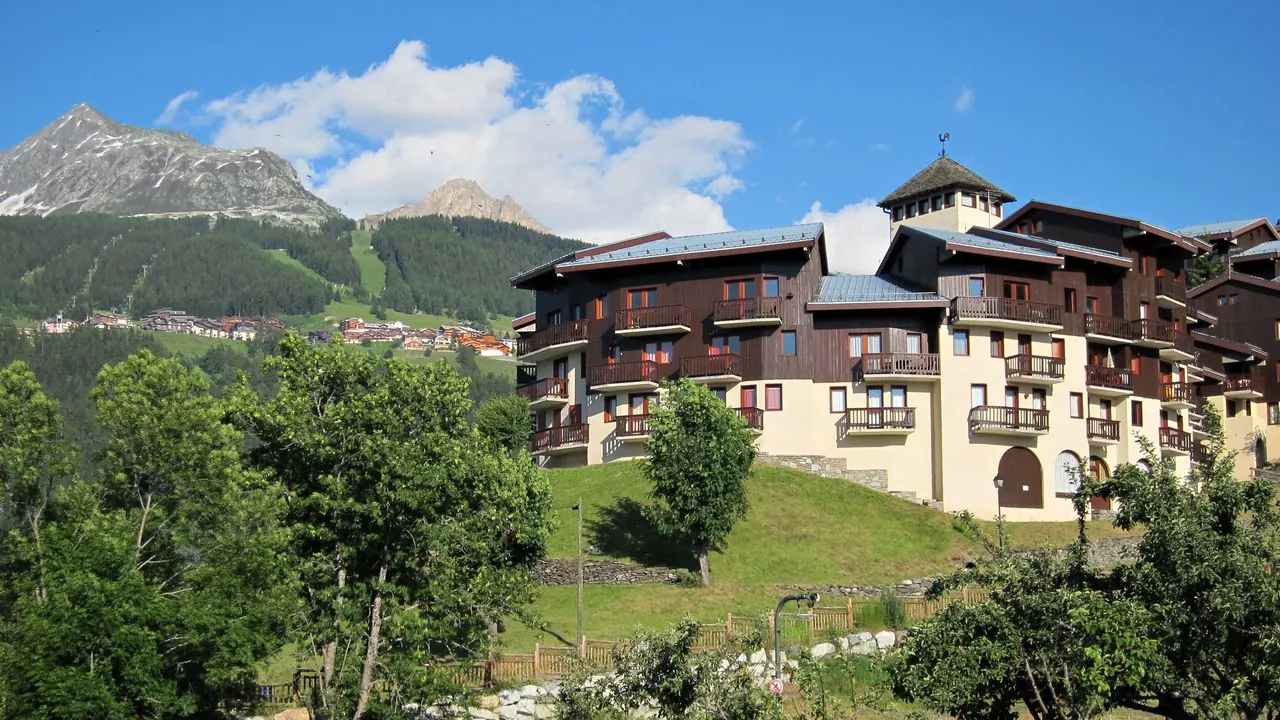
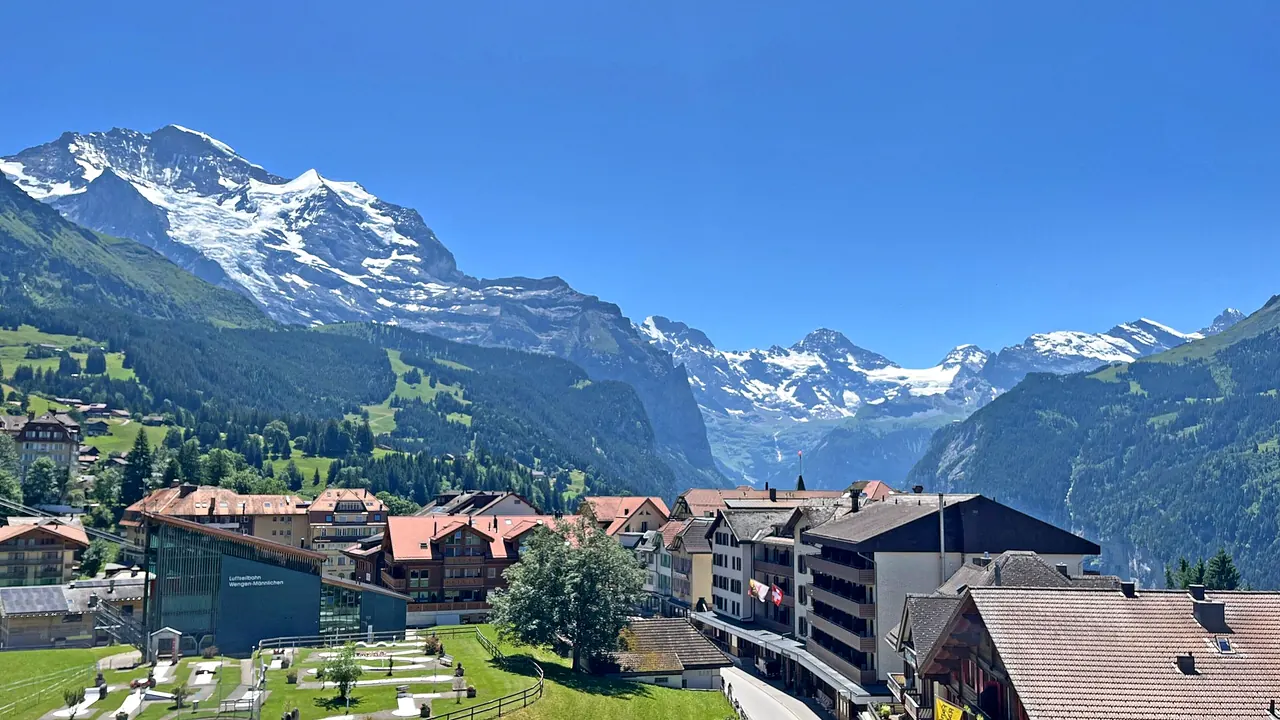
Photos: La Plagne by Henk Monster, CC BY 3.0, cropped; Wengen by Charles J. Sharp, CC BY-SA 4.0, cropped.
La Plagne or Wengen?
Our verdict in twelve categories, each scored against the same fixed benchmark cities, and the climate month by month, so you can choose for your trip.
Choose La Plagne for
- prices
- nightlife
- families
La Plagne is the better pick for a classic French ski week, especially with children. Its villages sit right on the snow, the runs are wide and forgiving, and self-catering apartments keep costs within reach. Evenings also have more going on, with fuller après-ski bars and more places to eat. It suits groups who want plenty of easy skiing and a resort laid out around them.
Choose Wengen for
- getting around
- day trips
- beaches
Wengen is for travellers who come mainly for the scenery and the quiet. A car-free village facing the Jungfrau, a railway running straight up into the high mountains and easier trips to the Swiss lakes make it a strong summer base for walkers as well as a winter one. The price is high and the evenings are quiet, but few places sit this close to the big peaks.
Scoreboard
Twelve categories on one fixed scale from 0 to 100. The shaded stretch is the gap between the two.
Your match
Pick a travel style or drag the sliders, and both match scores follow your weighting.
Too close to call, 1 point apart
Wins on prices and nightlife with your weighting.
Wins on getting around and day trips with your weighting.
What matters to you?
Category by category
What the scores mean for a trip.
Beaches & swimming
Swimming plays no real part in either stay, but Wengen comes slightly closer. About an hour away by train, the lidos on Lake Thun make a pleasant hot-day outing in July.
La Plagne has no lake of that kind within easy reach. Its mountain lakes are too cold for more than a paddle, so swimming there means the pools at the resort's leisure centres.
Food & drink
La Plagne gives you more choice at the table. Besides the fondue, tartiflette and Beaufort, its villages have pizzerias, crêperies and a few more ambitious dining rooms, and there are proper cheese counters for anyone cooking in an apartment.
Wengen's eating mostly happens in hotel dining rooms and mountain huts, with solid rösti and veal in cream sauce but almost nothing casual or cheap. Its best meal is a terrace lunch facing the Jungfrau, and that is about the view more than the food.
Culture & sights
Neither is a sightseeing destination, and the little each has is very different. La Plagne was built from scratch for skiing, so its heritage is mid-century resort planning: the stepped concrete hulk of Aime 2000, the towers of Plagne Centre and the bobsleigh track left by the Albertville Winter Olympics.
Wengen has the opposite look, with wooden chalets and Belle Époque hotels from its days as an English resort, plus a long ski-racing history. In both places, historic towns and museums mean heading down to the valley.
Nightlife
La Plagne has more going on after dark. In peak winter weeks the slope-side bars fill as the lifts close, and Plagne Centre and Belle Plagne have pubs, late bars and a small club or two.
Wengen manages a few après-ski bars and the odd lively hotel bar, and really lets go only on Lauberhorn race weekend in January. Summer evenings are early in both, but more so in Wengen.
Nature & outdoors
Both are outstanding mountain settings, but they offer different things. La Plagne is about range: it is part of the huge Paradiski area linked to Les Arcs, with slopes rising to the Bellecôte glacier, and in summer Champagny-le-Haut leads into the Vanoise National Park, home to ibex and marmots.
Wengen is about the drama of the view. It sits on a shelf above the waterfall-lined Lauterbrunnen valley, faces the Eiger, Mönch and Jungfrau, and has classic walks such as the one from Männlichen to Kleine Scheidegg. Its ski area with Grindelwald is smaller, and cloud can hide the peaks for days.
Day trips
Wengen makes the better base for outings. Within about an hour you can reach Thun's castle, the lakeside castles at Oberhofen and Spiez by steamer, and Brienz with the Ballenberg open-air museum, and Bern's arcaded old town is a full day out by train.
From La Plagne, everything begins with the long road down, and a car is almost essential. Aime's Romanesque basilica and medieval Conflans are close, while Chambéry, Annecy and, in summer, the Aosta Valley take longer drives.
Good for families
La Plagne gives children more to do beyond the ski lessons. Older children can ride a padded bob-raft down the 1992 Olympic track, and the resort's pools are something to fall back on when the weather turns, while in Wengen a rainy day is hard to fill. In winter, though, both depend heavily on children taking to the snow, and a child who doesn't will find cold, altitude and long ski-school mornings hard going in either.
Wengen's advantage is that the whole village is free of cars, while in La Plagne that is true of only some villages. In summer it is also the easier place to show young children the high mountains, because a train or cable car turns the Jungfrau views into a short outing. Against that, its lanes are steep and hard work with a buggy, and nothing there is built specially for children.
Getting around
Wengen is easier to get to and around without a car. The train from Lauterbrunnen brings you straight up, carts collect your luggage, and the same railway continues to Kleine Scheidegg and the Jungfraujoch, so the high mountains are always within reach.
La Plagne works well once you are there, with ski-in accommodation, free shuttles and a small cable car between Plagne Centre and Aime 2000. Getting up there is harder, though: a bus or a winding drive from Aime, often with snow chains.
Shopping & style
Neither is a place to shop as an activity. Both cover ski hire, outdoor gear and groceries, and differ mainly in what you take home: Beaufort, cured sausage and génépi from La Plagne's produce counters, or chocolate and souvenirs from Wengen's short main street.
Affordability
Neither is cheap, but La Plagne is far easier to manage on a budget. Its large stock of self-catering apartments and its cheaper quieter weeks let families control the cost of a ski week.
In Wengen, hotels and meals are priced at Swiss resort levels, and the railways you came for add to the cost of every outing. Rail passes and free trails help, but it remains one of the most expensive places to stay in Europe.
Live music & performing arts
There is essentially nothing to see on stage in either place. The difference is in the small touches: torchlight descents and après-ski bands in La Plagne, alphorn or yodelling evenings in Wengen's hotels. Real theatre or concerts mean going to Chambéry from one, or Bern from the other.
Wellness & relaxation
The two are about level, but they help you rest in different ways. La Plagne has aquatic centres for tired legs, and the old thermal spa towns of Brides-les-Bains and La Léchère are about an hour away, though a ski week there is busy and physical.
Wengen has no public baths, just hotel saunas. What it does offer is stillness: no cars, cowbells and waterfalls, and a balcony facing the Jungfrau.
When should you go?
Pick your month. The climate figures are measured averages, not a forecast.
La Plagne in July
Wengen in July
Daytime high, °C
Rainfall in the month, mm
Where the figures come from
La Plagne has no weather station within reach, so its figures come from a gridded climate model rather than a measured record, and read a broad area rather than one spot.
Wengen has no weather station within reach, so its figures come from a gridded climate model rather than a measured record, and read a broad area rather than one spot.
Temperature and rainfall are climate normals, averaged over the years shown. La Plagne: 2001-2020 normals, NASA POWER reanalysis grid, no weather station within 90 km. Wengen: 1991-2020 normals, TerraClimate 4 km grid at the town, no weather station within 90 km.
Neither place is ever warm enough for a beach, and both are at their best in two seasons: deep winter for snow, and June to September for walking. La Plagne gets colder in winter, with daytime highs around -4°C in January against roughly freezing in Wengen, which suits the snow on its higher slopes. Its summers are a little warmer too, reaching about 18°C in July.
Wengen is the wetter of the two all year. From May to August it gets well over 100mm a month, so summer walks there need a rain plan and some patience with cloud. La Plagne's summers are drier, though May is damp there as well. In both places, spring and November fall between the seasons, when it is too cold for comfortable walking and there is no reliable snow.
Which traveller are you?
On a family trip with young children, La Plagne has the edge. Car-free villages like Belle Plagne open straight onto gentle slopes, ski schools and kids' clubs are large, and self-catering apartments make a week with children far more affordable.
For a food and nightlife trip, La Plagne again does better. It has more restaurants, from slope-side chalets to crêperies, and après-ski that runs later in Plagne Centre and Belle Plagne. Wengen's evenings mostly end after dinner in the hotel.
On an outdoors trip without a car, Wengen is the easier choice. Trails start in the village, and the rack railway and Männlichen cable car take you up beneath the Eiger and Jungfrau with no driving, while La Plagne's valley sights need a car.
Before you go
| Measure | La Plagne | Wengen |
|---|---|---|
| Official language | French | French, German, Italian, Romansh |
| Currency | Euro (EUR) | Swiss Franc (CHF) |
| Sockets | CE230 V, 50 Hz | CJ230 V, 50 Hz |
| Driving side | Right | Right |
| Time zone | UTC+1, UTC+2 in summer | UTC+1, UTC+2 in summer |
| Emergency number | 112 | 112 |
| Elevation | 1,974 m | 1,274 m |
| Main airport | Geneva International Airport (GVA)92 km from centre150 non-stop destinations | Zürich Airport (ZRH)106 km from centre226 non-stop destinations |
| Public holidays this year | 11 days | 10 days |
By the numbers
| Measure | La Plagne | Wengen |
|---|---|---|
| Population | - | 1,116 |
| People per km² | - | 31 |
| Museums within 10 km | 2 | 2 |
| UNESCO World Heritage sites within 50 km | 0 | 1 |
Where else could you go?
Every comparison below shares a destination with this one, so you can follow La Plagne or Wengen somewhere new.
- Mürrenvs Wengen
- Grindelwaldvs Wengen
- Courchevelvs La Plagne
- Les Arcsvs La Plagne
- Méribelvs La Plagne
- Tignesvs La Plagne