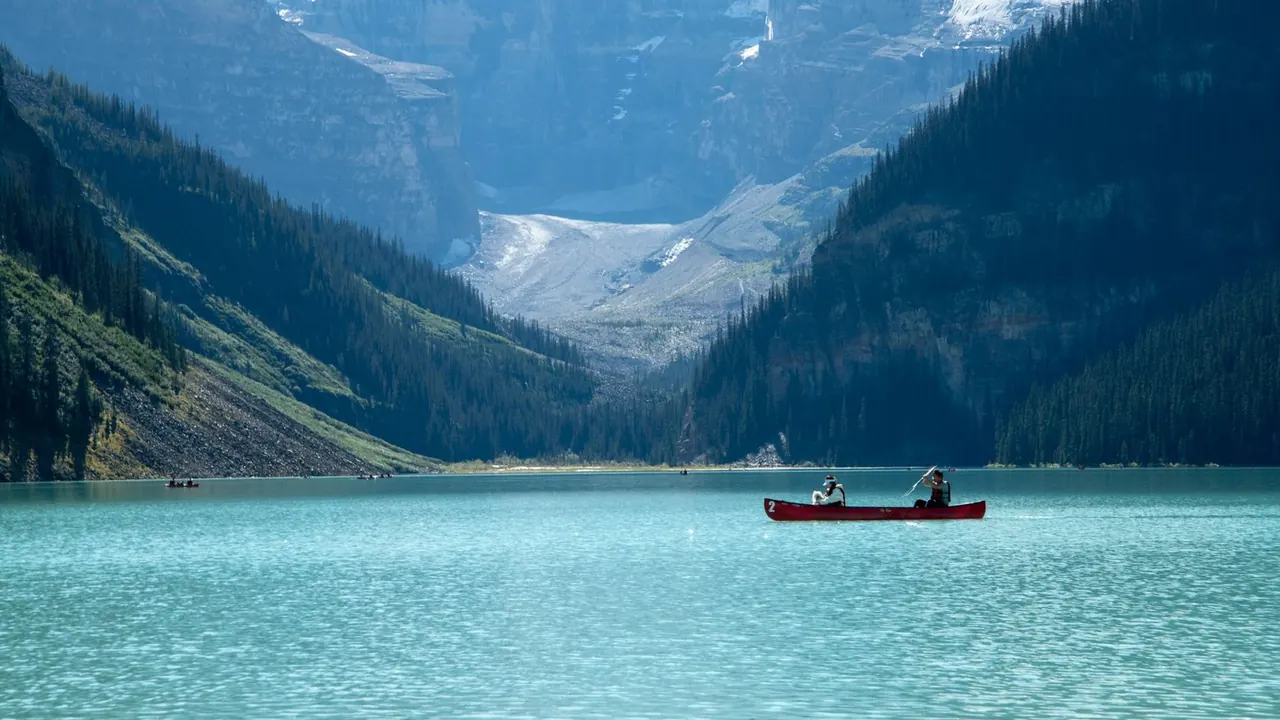
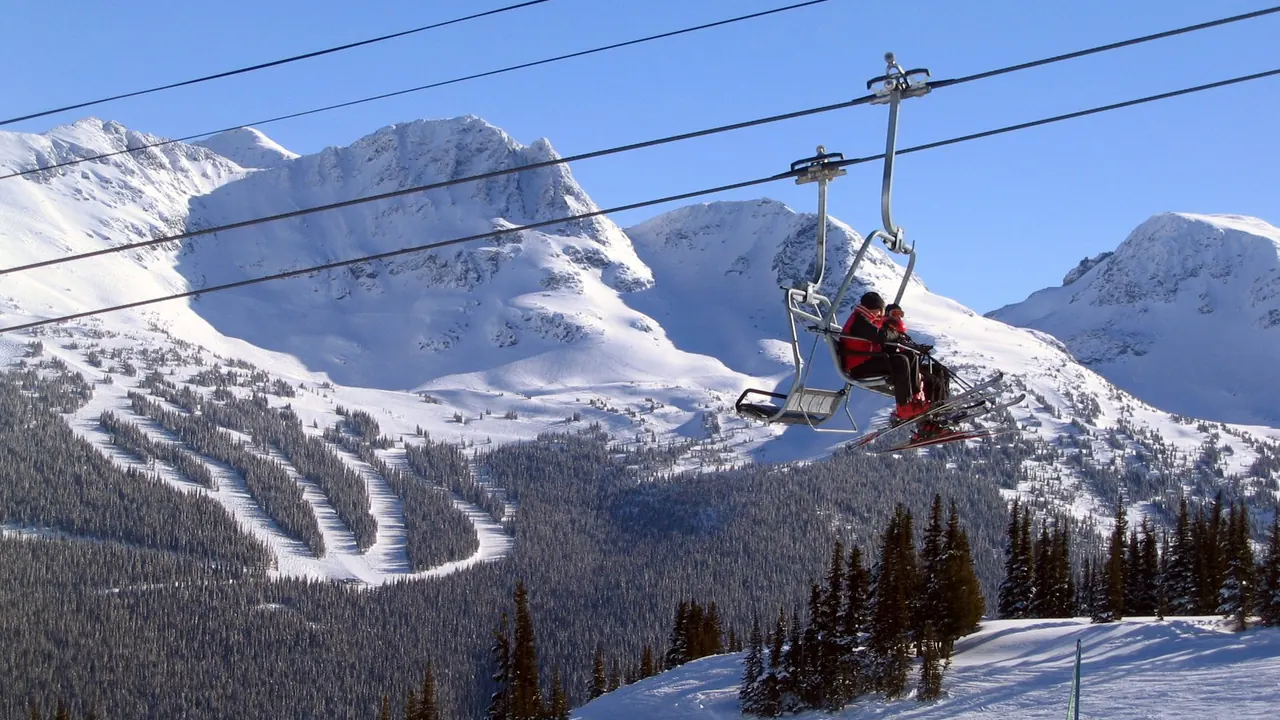
Photos: Lake Louise by Andrew Patrick Photo, Pexels License; Whistler by Ruth Hartnup, CC BY 2.0, cropped.
Lake Louise or Whistler?
Our verdict in twelve categories, each scored against the same fixed benchmark cities, and the climate month by month, so you can choose for your trip.
Choose Lake Louise for
- day trips
Lake Louise is for travellers who come to look at mountains and walk into them, and want little else. The glacier lakes, the teahouse trails and the gold larches of autumn are the whole point, and the evenings are early and quiet. It suits hikers, photographers and couples after stillness, as long as they accept a narrow choice of food and almost nothing to do indoors.
Choose Whistler for
- getting around
- nightlife
- families
Whistler gives you a full resort around the mountains. A car-free village sits at the foot of two huge ski areas and a bike park, with a proper spa, lively après-ski and better restaurants. Families, skiers who want company in the evening and anyone who would rather not drive every day will find it the easier and more rounded base.
Scoreboard
Twelve categories on one fixed scale from 0 to 100. The shaded stretch is the gap between the two.
Your match
Pick a travel style or drag the sliders, and both match scores follow your weighting.
Wins on day trips with your weighting.
Wins on getting around and nightlife with your weighting.
What matters to you?
Category by category
What the scores mean for a trip.
Beaches & swimming
Neither place is a beach destination, but Whistler at least offers summer swimming. In July and August, Lost Lake, Alta Lake and Alpha Lake have docks, rafts and grassy shores, and the shallow water warms enough for an afternoon swim after a ride.
At Lake Louise and Moraine Lake the water is glacial meltwater that stays painfully cold, so a dip is only for the photo. Swimmers have to use a hotel pool or drive towards Banff.
Food & drink
Whistler eats noticeably better. Its village has a group of ambitious kitchens cooking BC salmon and spot prawns with deep local wine cellars, plus ramen, sushi, bakeries and the burger-and-beer ritual of après-ski. A week still means the same few streets.
Lake Louise has almost no independent dining. Meals happen in hotel dining rooms and lodges, with a bakery-deli for hikers. Its most memorable food is tea and soup at the Lake Agnes and Plain of Six Glaciers teahouses at the end of a climb, and serious diners drive to Banff.
Culture & sights
Culture is thin at both, but Whistler has something to fill a rainy afternoon. The Audain Art Museum holds Emily Carr paintings and Northwest Coast masks, the Squamish Lil'wat Cultural Centre presents the two nations whose land this is, and the 2010 Olympic venues are worth a look.
Lake Louise offers only its railway history: the Chateau that grew from an 1890s log chalet, and the old log station in the village. There are no museums at all, so for heritage you go to Banff.
Nightlife
Whistler has a real night out, even if it is mostly one kind. Après-ski crowds the patios as the lifts close, and on winter weekends a handful of clubs and late bars in the village stay loud into the early hours, filled with young seasonal workers and groups.
Lake Louise has a hotel lounge and a pub by the fire, and that is all. People there go to bed early for sunrise at the lakes, and anyone wanting a bar goes to Banff.
Nature & outdoors
Both are world-class mountain landscapes, but they work in different ways. Lake Louise is about looking and walking: glacier lakes under the Victoria Glacier and the Valley of the Ten Peaks, trails to the Beehives and Larch Valley, canoes on turquoise water, grizzlies above the gondola, and the Icefields Parkway running north. Its ski area is among Canada's largest.
Whistler is about moving fast. Two joined mountains offer huge skiing and deep coastal snow, and in summer one of the best-known downhill bike parks anywhere and dense singletrack. Hikers head for Garibaldi's lakes, and paddlers float the River of Golden Dreams.
Day trips
From Lake Louise, nearly every good day out leads to Banff. It is an easy 45 minutes down the valley and gives you the museums, the Banff Springs hotel, the old hot springs and the Cave and Basin site, which are all the history and indoor sights the hamlet itself lacks. Beyond Banff the choice thins out to Canmore, the railway village of Field and Calgary two hours away, so most other days out are drives for the scenery rather than visits to towns.
Whistler has no nearby town like Banff. Its close stops are smaller: Pemberton, a farming village to the north, and Squamish to the south with its gondola, plus the Britannia mine museum on the way down. The big outing is Vancouver, a major city with far more to offer than anything near Lake Louise. At about two hours down the Sea to Sky Highway it is too much for a single day, so it works best as a night or two at the start or end of the trip.
Good for families
Whistler is far easier with children. The car-free village, large ski schools, tubing and sledding in winter, and lake beaches, an adventure park and gondola rides to see bears and marmots in summer keep most ages busy, and kitchen apartments are common.
Lake Louise suits families whose children like walking: canoeing, the gondola and the teahouse hike. On cold or wet days there is little to fall back on, and the drives between stops are long.
Getting around
Getting around is where the two differ most in daily life. In Whistler you can leave the car behind: the pedestrian village, gondolas at its edge, free shuttles and the paved Valley Trail between lakes cover most of a stay.
Lake Louise splits its sights across a valley. The lake is a steep 4km above the village, Moraine Lake further along a winding road and the ski area across the valley, so you depend on park shuttles, buses or a car, and summer parking fills at dawn.
Shopping & style
If you need to buy or rent skis, boards or bikes, Whistler is far better, while Lake Louise has one small mall. That mall covers groceries, maps, books, outdoor basics and souvenirs, and the Chateau adds a few boutiques. It is enough to replace whatever you left at home.
Most of Whistler's pedestrian village sells gear, from big Canadian outdoor brands to rental counters and specialist tuning shops. Galleries selling Indigenous prints and carvings and the summer farmers' market in the Upper Village add some variety, but beyond equipment the choice is thin.
Affordability
Both are expensive, and the costs pile up in different ways. At Lake Louise the problem is how few places there are to stay, so summer rooms and resort-priced meals hurt most. Hiking costs nothing, and sleeping in Banff or Canmore saves a lot.
At Whistler, lift passes, lessons and rentals are the heavy items, and Christmas is the costliest time. Kitchen condos, free shuttles and lodgings further down the valley help, especially in spring and autumn.
Live music & performing arts
Whistler has a modest summer stage: free concerts on Olympic Plaza, buskers in the village, a small community arts centre and cover bands in ski-season pubs. For anything serious, you go to Vancouver.
At Lake Louise, a pianist in a hotel lounge is about the limit, and live performance means Banff's arts centre programme.
Wellness & relaxation
Whistler makes more of rest. Its Nordic-style outdoor spa in the cedars by the river has hot pools, saunas and cold plunges, and guests keep silent, so soaking under falling snow becomes the evening's main event. Massage for sore legs is easy to find everywhere.
Lake Louise offers a different kind of calm: hotel spas, silent winter forest and early nights. For hot springs you drive to Banff, and in high summer the coach crowds at the lakeshore make midday anything but peaceful.
When should you go?
Pick your month. The climate figures are measured averages, not a forecast.
Lake Louise in July
Whistler in July
Daytime high, °C
Rainfall in the month, mm
Where the figures come from
Lake Louise has no rain gauge within 25 km of the centre, so its rainfall comes from a gridded climate dataset read at the city rather than from a gauge further away.
Whistler has no rain gauge within 25 km of the centre, so its rainfall comes from a gridded climate dataset read at the city rather than from a gauge further away.
Temperature and rainfall are climate normals, averaged over the years shown. Lake Louise: 1991-2020 normals, Yoho Park (11.2 km from centre). Whistler: 1991-2020 normals, Whistler - Nesters (1.1 km from centre).
Lake Louise is a high, cold place. Winter days stay well below freezing, around -8°C in December, which is fine for skiing and skating on the frozen lake but hard for anything else. The high trails only clear of snow in summer, so July and August, with highs near 20°C, are the main walking months, and late September brings the gold larches if you can take the chill. Rain is moderate all year, with no very wet season.
Whistler is milder and much wetter. From October to January the valley takes heavy rain, up to 196mm in November, which falls as deep snow on the mountains and feeds the ski season. Summer is the dry spell, down to about 46mm in July, and highs reach 25°C, warm enough for the valley lakes. June and September are good for hiking and riding at both, with Whistler the warmer of the two.
Which traveller are you?
On a family trip with children, Whistler is the clear choice. The village is car-free, ski schools are large and well organised, and summer adds lake beaches, mini-golf and easy bike paths. At Lake Louise, children need to enjoy long walks.
For a food and nightlife trip, Whistler wins easily. It has Pacific Northwest cooking, serious British Columbia wine lists and packed après-ski patios that turn into late bars. Lake Louise eats in hotel dining rooms, and everyone is in bed early.
For an outdoors trip built around hiking and scenery, Lake Louise has the edge. Trails start right at the shore of glacier lakes, the Icefields Parkway and Yoho are close by, and nothing in the village distracts from the landscape.
Before you go
| Measure | Lake Louise | Whistler |
|---|---|---|
| Official language | French, English | French, English |
| Currency | Canadian Dollar (CAD) | Canadian Dollar (CAD) |
| Sockets | AB120 V, 60 Hz | AB120 V, 60 Hz |
| Driving side | Right | Right |
| Time zone | UTC-7, UTC-6 in summer | UTC-8, UTC-7 in summer |
| Emergency number | 911 | 911 |
| Elevation | 1,600 m | 670 m |
| Main airport | Calgary International Airport (YYC)155 km from centre102 non-stop destinations | Vancouver International Airport (YVR)104 km from centre109 non-stop destinations |
| Public holidays this year | 13 days | 11 days |
By the numbers
| Measure | Lake Louise | Whistler |
|---|---|---|
| City population | - | 13,982 |
| People per km² | - | 58 |
| Museums within 10 km | 0 | 1 |
| UNESCO World Heritage sites within 50 km | 2 | 0 |
Where else could you go?
Every comparison below shares a destination with this one, so you can follow Lake Louise or Whistler somewhere new.