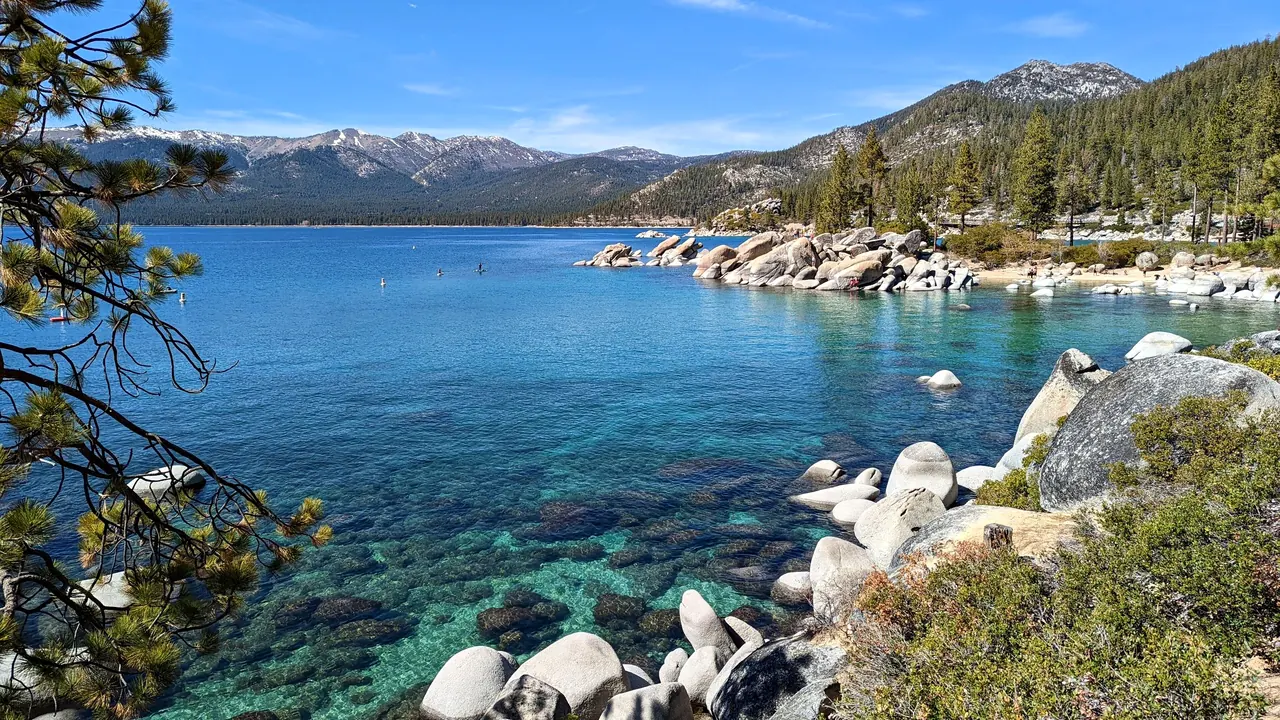
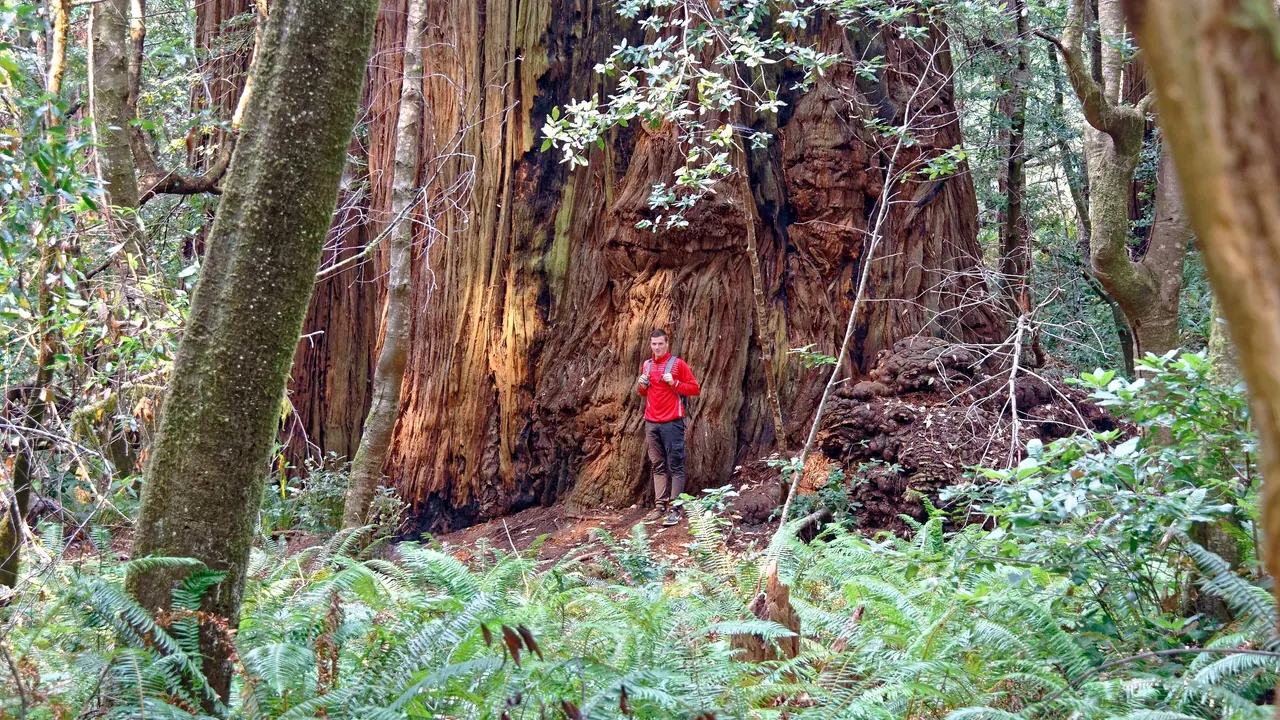
Photos: Lake Tahoe by Blake Everett Carroll, CC BY-SA 4.0, cropped; Redwood National Park by Dirtsc, CC BY-SA 3.0, cropped.
Lake Tahoe or Redwood National Park?
Our verdict in twelve categories, each scored against the same fixed benchmark cities, and the climate month by month, so you can choose for your trip.
Choose Lake Tahoe for
- beaches
- nightlife
- families
Lake Tahoe suits travellers who want to be active in two seasons, swimming and paddling a clear alpine lake in high summer and skiing the Sierra in winter. It is also the easier pick for families and for anyone who wants a few evenings out, with the Stateline casinos, summer theatre by the water and better day trips into Nevada's silver country. You pay for all this in lodging and lift tickets, and in summer traffic on the lake road.
Choose Redwood National Park for
- prices
- getting around
- culture and sights
Redwood National Park is for people who come to walk among the tallest trees on earth and don't need much else. It is quieter, cheaper and easier to get around once you have a car, and it suits a road trip, a camping trip or a slow week on foot in the groves and along the coast. What you give up is swimming in the sea, any real nightlife, and most of the comforts Tahoe's resort towns offer.
Scoreboard
Twelve categories on one fixed scale from 0 to 100. The shaded stretch is the gap between the two.
Your match
Pick a travel style or drag the sliders, and both match scores follow your weighting.
Wins on beaches and nightlife with your weighting.
Wins on prices and getting around with your weighting.
What matters to you?
Category by category
What the scores mean for a trip.
Beaches & swimming
Lake Tahoe is clearly the better place to swim. Its water is very clear, with turquoise shallows, and you can choose between granite-boulder coves at Sand Harbor and long sand at Pope, Baldwin and Zephyr Cove. It is cold at altitude even in August, and swimming really works from July to early September.
At the redwoods the shore is for looking, not swimming. Gold Bluffs and Enderts are wild and empty, but the Pacific is far colder than the lake and its sneaker waves are dangerous. The one good swim is in the clear summer pools of the Smith River, after a walk through the trees.
Food & drink
Neither is a food destination, and the difference is in kind. Tahoe has resort dining: diners for skiers, lakeside grills and a few ambitious kitchens in Truckee, Tahoe City and Incline Village. The best part is usually a sunset drink on a deck over the water.
The redwood coast eats more locally. There are Humboldt Bay oysters, Dungeness crab, craft beer in Arcata and Eureka, and fresh fish by Trinidad's harbour. The catch is that the good tables are at the southern edge, and near the groves themselves you are mostly eating picnics and burgers.
Culture & sights
Both are thin on sights, and each takes about a day. Tahoe's history comes from its summer estates: Vikingsholm at Emerald Bay, the Tallac retreats of wealthy San Franciscans and Thunderbird Lodge. Donner Memorial State Park adds the grim story of the 1846-47 emigrant party.
The redwood coast has older roots and more variety. The rebuilt Yurok plank-house village at Sue-meg State Park shows the Native heritage. Eureka's Victorian Old Town and the Carson Mansion are the best architecture in either area, and you can walk out to Battery Point Lighthouse at low tide.
Nightlife
Tahoe has far more going on after dark, and nearly all of it is at Stateline. The Nevada casino hotels keep gaming floors and lounges open very late, with ski-town pubs and après-ski nearby, though the north and west shores are quiet by eleven.
Near the redwoods, the evenings are campfires and stars, with a few taverns in Crescent City. For a drink with company you drive an hour south to the brewpubs around Arcata's plaza, and even those close early.
Nature & outdoors
Both are outstanding, but the landscapes are very different. Tahoe is alpine and active: a deep lake ringed by granite peaks, the bare high country of Desolation Wilderness, the Rim Trail along the ridges, the Flume Trail for mountain bikers, and a full ski season in winter.
The redwood coast is quieter and more about the forest. You walk among trees over 100m tall in Stout Grove and Lady Bird Johnson Grove, scramble through Fern Canyon and follow the Coastal Trail above the sea stacks. Wildlife is the other draw, with Roosevelt elk in the meadows near Orick and grey whales passing offshore.
Day trips
Tahoe has more worthwhile outings, in two directions. To the east are Virginia City's wooden sidewalks and Comstock saloons, plus Reno and Genoa. To the west, the Gold Rush towns of Coloma and Placerville and the foothill vineyards of El Dorado and Amador counties are down Highway 50.
From the redwoods the choice is small coastal towns. The best are Victorian Ferndale, Eureka's Old Town and Trinidad on its headland, with harbour towns over the Oregon line to the north. They make pleasant drives, but there is no wine country or major historic site within reach.
Good for families
Tahoe is the easier family trip. Kings Beach and Commons Beach have shallows that warm up enough for paddling, there are bike paths along the north and west shores, and in winter every ski area runs a ski school. Cabins and condos with kitchens make longer stays easy.
The redwoods appeal more to children who already like being outdoors. They can climb over logs in Fern Canyon, spot elk and do the Junior Ranger programme. But the beaches are unsafe for paddling, fog and rain are common, and there is little to do indoors on a wet day.
Getting around
You need a car in both places, but driving is easier among the redwoods. Tahoe's single road around the lake is about 115km of winding two-lane highway, with summer jams at Emerald Bay and Tahoe City, car parks that fill early, and chain requirements on the passes in winter.
Along the redwood coast, traffic on US-101 and the scenic Newton B. Drury Parkway is light, and the main groves are only a short drive apart. The awkward parts are gravel: Howland Hill Road to Stout Grove, and the creek crossings on the way to Fern Canyon.
Shopping & style
Neither is worth a trip for shopping, though Tahoe offers a little more. Downtown Truckee's railroad-era buildings hold independent clothing shops and galleries, and Reno's malls are down the hill.
The redwood coast has less, but what it sells is more local: huge redwood burl carvings and chainsaw sculptures by the highway, Native basketry and jewellery in Arcata and Eureka, and antique shops in Eureka's Old Town.
Affordability
The redwoods cost much less. Park entry is free, the state campgrounds among the trees are cheap, and motels in Crescent City cost far less than lodging near the famous parks. Camping and picnics keep the bill low, though a hire car is unavoidable.
Tahoe is expensive in both seasons, with lift tickets in winter and lakefront rentals with minimum stays in summer. The best savings are in midweek casino hotels at Stateline and the older south-shore motels.
Live music & performing arts
Tahoe has the better summer evenings out. A long-established Shakespeare festival plays among the boulders at Sand Harbor with the lake behind the stage, there is a classical series on the north shore, and touring bands and comedians appear at the Stateline casinos.
Near the groves there is little beyond ranger campfire talks. The nearest stage is an hour south, with Arcata's university concerts in term time and Eureka's small symphony and community theatre.
Wellness & relaxation
Tahoe is better if you want some pampering along with the rest. The resort hotels at Incline Village and in the ski areas have proper spas, the ski towns have yoga studios, and there are natural hot springs within a short drive on both the California and Nevada sides. The calmest parts are the west and north shores, with slow mornings by the lake and evenings by a cabin fire. The south shore is far from restful on peak weekends.
The redwood coast offers rest without treatments. It has no spas or hot springs, only a few hot tubs and saunas in Arcata that you rent by the hour, and massage at some of the lodges. What it does have is silence: long walks on soft paths through the hushed old-growth groves and nights with no traffic noise. If quiet is all you need, that is plenty, but anyone hoping for a spa day will be disappointed.
When should you go?
Pick your month. The climate figures are measured averages, not a forecast.
Lake Tahoe in July
Redwood National Park in July
Daytime high, °C
Rainfall in the month, mm
Where the figures come from
Lake Tahoe has no rain gauge within 25 km of the centre, so its rainfall comes from a gridded climate dataset read at the destination rather than from a gauge further away.
Redwood National Park's temperatures are measured 35 km from the centre, at Arcata / Clam Beach.
Redwood National Park has no rain gauge within 25 km of the centre, so its rainfall comes from a gridded climate dataset read at the destination rather than from a gauge further away.
Redwood National Park's sunshine is measured 55 km from the centre, at Eureka.
Temperature and rainfall are climate normals, averaged over the years shown. Lake Tahoe: 2000-2020 (rainfall 1991-2020) normals, South Lake Tahoe / Tahoe Valley (5.3 km from centre). Redwood National Park: 1991-2020 (sunshine 1981-2010) normals, Arcata / Clam Beach (34.6 km from centre).
Around the lake, Tahoe has two clear seasons. July and August are warm and almost dry, with highs around 27°C, and this is the only stretch when swimming in the lake makes sense. Spring and autumn are mild and good for hiking. From November to March it is cold and wet, with about 119mm of rain or snow in January, which feeds the ski season but makes the streets and trails wintry.
On the Redwood coast the temperature barely changes. Daytime highs stay between 13°C and 17°C all year, so it is never too hot to walk, but it is never beach weather either, and the sea stays near 13°C at its warmest. The real difference is rain. Winters are very wet, peaking around 309mm in December. From June to September it is dry, and spring and summer have the most sunshine. Tahoe has the summer for lake days and the winter for snow, while the redwoods are best from late spring to early autumn, mainly for walking.
Which traveller are you?
For a beach and sun trip, Lake Tahoe is the clear choice. Its sandy coves at Sand Harbor and along the south shore are swimmable from July to early September. On the Redwood coast the cold Pacific and its sneaker waves keep you on the sand.
On a tight budget, Redwood National Park goes much further. Park entry is free, the state campgrounds in the groves are cheap and highway motels cost little. At Tahoe, even the cheaper south-shore motels sit in a resort that is expensive in both seasons.
For a winter ski trip, only Lake Tahoe works. A dozen ski areas ring the lake, including the 1960 Olympic valley, with deep Sierra snow and ski schools for beginners. The redwood coast gets winter rain, not snow, and has no slopes at all.
Before you go
| Measure | Lake Tahoe | Redwood National Park |
|---|---|---|
| Currency | US Dollar (USD) | US Dollar (USD) |
| Sockets | AB120 V, 60 Hz | AB120 V, 60 Hz |
| Driving side | Right | Right |
| Time zone | UTC-8, UTC-7 in summer | UTC-8, UTC-7 in summer |
| Emergency number | 911 | 911 |
| Main airport | Reno Tahoe International Airport (RNO)25 non-stop destinations | California Redwood Coast-Humboldt County Airport (ACV)6 non-stop destinations |
| Public holidays this year | 13 days | 13 days |
By the numbers
| Measure | Lake Tahoe | Redwood National Park |
|---|---|---|
| Swim season, months above 21 °C | - | None |
Where else could you go?
Every comparison below shares a destination with this one, so you can follow Lake Tahoe or Redwood National Park somewhere new.
- Yosemitevs Lake Tahoe
- Kings Canyonvs Lake Tahoe
- Sequoiavs Lake Tahoe
- Death Valleyvs Lake Tahoe
- Yosemitevs Redwood National Park
- Mount Rainiervs Redwood National Park