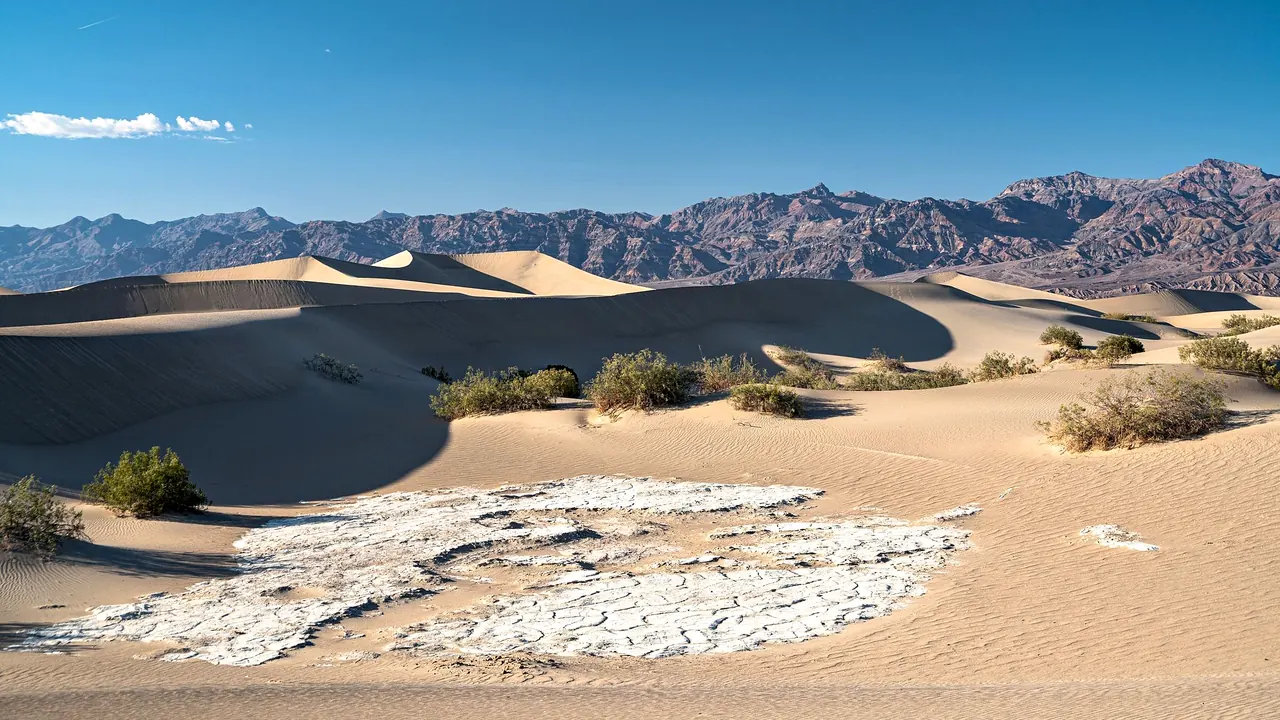
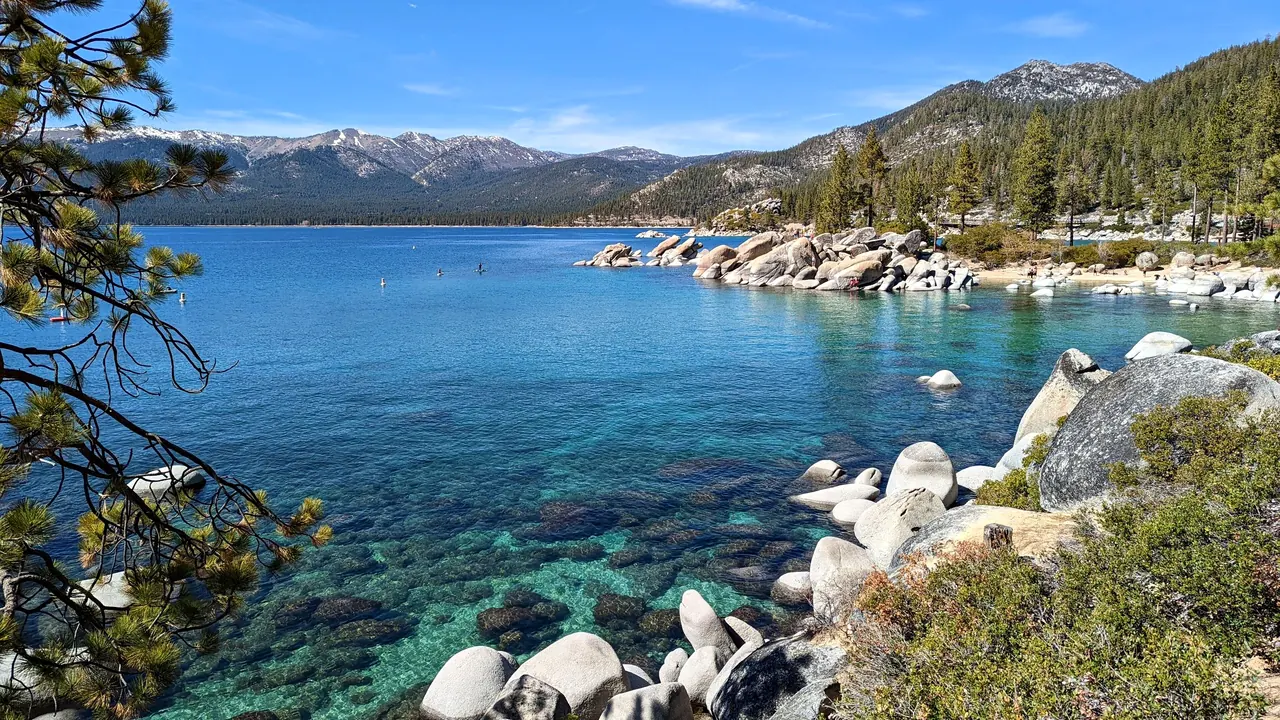
Photos: Death Valley by Anthony Brown, Pexels License; Lake Tahoe by Blake Everett Carroll, CC BY-SA 4.0, cropped.
Death Valley or Lake Tahoe?
Our verdict in twelve categories, each scored against the same fixed benchmark cities, and the climate month by month, so you can choose for your trip.
Choose Death Valley for
- prices
Death Valley is for travellers who want raw desert and the deep silence that goes with it. It has salt flats below sea level, golden badlands, dunes and marble canyons, and one of the darkest night skies in the country. It works best as a cool-season road trip, driving between sights and sleeping in a campground or one of the few lodges. In return you give up almost everything else, from good meals to any kind of evening out.
Choose Lake Tahoe for
- beaches
- families
- nightlife
Families, and anyone who wants water in summer or snow in winter, will find Lake Tahoe the easier and broader choice. The outdoors is just as strong but gentler to use: you can swim and paddle in the clear lake, hike into granite high country and learn to ski on a dozen mountains. At the end of the day there are towns with restaurants, bars and cabins. It costs more, and busy summer weekends on the south shore are the price of that comfort.
Scoreboard
Twelve categories on one fixed scale from 0 to 100. The shaded stretch is the gap between the two.
Your match
Pick a travel style or drag the sliders, and both match scores follow your weighting.
Wins on prices with your weighting.
Wins on beaches and families with your weighting.
What matters to you?
Category by category
What the scores mean for a trip.
Beaches & swimming
For swimming, the gap is as wide as it gets. Death Valley has no open water at all. Its ancient lakebeds are cracked salt for nearly the whole year, and a swim means the spring-fed pools at the Furnace Creek resort, which only guests can use, at the end of a day in the car.
Tahoe is a proper lake vacation. The water is clear enough to see the bottom well out from shore, and you can choose between long sand at Pope, Baldwin and Zephyr Cove or the boulder-sheltered coves of Sand Harbor. The drawback is temperature, not access. At nearly 1,900m the lake stays bracing even in high summer, so the swimming window runs from midsummer to the start of September, and on fine weekends you share the sand with many others.
Food & drink
Neither place is worth travelling to for the food, and Death Valley hardly offers any choice. Meals there are something to organise: you eat in the lodge dining rooms and saloons at Furnace Creek, Stovepipe Wells and Panamint Springs, shop at a general store or bring a cool box packed before you drive in. The one local taste is dates from the farm near Tecopa, made into shakes and bread.
Tahoe gives you far more choice, even though it is resort dining. The better kitchens are in Truckee's old railroad downtown, Tahoe City and Incline Village, and a drink on a lakeside deck at sunset is a real pleasure.
Culture & sights
Neither has much culture, and in both it is background to the landscape, but the two tell different stories. Death Valley's history is about industry and survival: the ruins of Harmony Borax Works beside the salt flats, the beehive charcoal kilns at Wildrose, and the Timbisha Shoshone, whose story is told at the Furnace Creek visitor centre.
Tahoe's history is mostly about leisure, plus one famous ordeal. It has the summer estates at Vikingsholm, the Tallac Historic Site and Thunderbird Lodge, Truckee's brick railroad main street, and the Donner Party memorial. In either place the sights fill a day or two at most.
Nightlife
Death Valley has no evening life beyond a beer in the saloons at Stovepipe Wells or Furnace Creek, which are quiet by mid-evening. The real night-time show is the sky, one of the darkest in the country.
Tahoe at least gives you options. The casino hotels at Stateline keep gaming floors and lounges open very late, South Lake Tahoe adds sports bars and pubs, and Truckee and Tahoe City have a few lively bars. The north and west shores go quiet early.
Nature & outdoors
Both are among the great landscapes of the American West, and they could hardly be more different. Death Valley is all dry rock and light: Badwater's salt crust below sea level, the badlands of Zabriskie Point, the Mesquite Flat dunes, Mosaic Canyon and the Ubehebe crater. The best of it can be hiked only in the cool months, and much of the back country is on rough dirt roads.
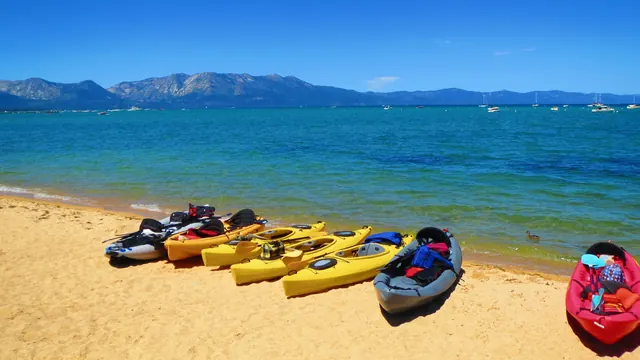
Tahoe is water, granite and forest, and it works in both seasons. In summer there are Emerald Bay, the Desolation Wilderness, the Tahoe Rim Trail and kayaking on the lake. In winter there are a dozen ski areas and deep Sierra snow.
Day trips
From Death Valley, the outings are few and far apart. You can visit the ghost town of Rhyolite near Beatty and the hot-spring hamlet of Tecopa, and about two hours west are Lone Pine and the sobering Manzanar historic site. Most days are spent inside the park.
Tahoe has more within reach in two directions. To the east are Virginia City, the Comstock silver town about an hour from the north shore, along with Carson City, Genoa and Reno. To the west, Highway 50 drops to Coloma and Placerville in Gold Rush country and to the foothill vineyards.
Good for families
Death Valley can thrill older children who like adventure. They can slide down the Stovepipe Wells dunes, walk across the salt at Badwater and do the Junior Ranger programme. But that works only in winter, and the heat, the distances and the lack of services make it hard with small children.
Tahoe is the easy family choice. It has gently shelving beaches at Kings Beach, Pope Beach and Commons Beach, bike paths along the north and west shores and glass-bottom boat trips. In winter there are ski schools and sledding hills, and all year there are cabins and condos with kitchens to come home to.
Getting around
In both places you need a car, and the driving eats time, but for different reasons. Death Valley's paved roads are empty and easy, but the distances are huge, fuel is scarce, there is no public transport at all, and the Racetrack and Titus Canyon need a high-clearance vehicle.
Tahoe's problem is congestion and weather. A single two-lane road circles the lake, and it backs up on summer weekends and needs chains in winter storms. In return, Tahoe has local buses, ski shuttles and walkable centres in Truckee, Tahoe City and around Stateline.
Shopping & style
Death Valley offers supplies, maps, borax souvenirs and dates from Tecopa, so stock up in Las Vegas or Pahrump on the way in. Tahoe has more, though it is mostly outdoor gear and ski rentals. Downtown Truckee's independent clothing shops and galleries, in old railroad buildings, are worth an hour, and Reno's malls are down the hill.
Affordability
Death Valley is the cheaper trip, as long as you camp. Rooms and meals inside the park cost what a remote resort charges, and fuel in the valley is dear. Staying in the park campgrounds with your own food, or in a motel in Beatty or Pahrump, keeps costs down.
Tahoe is expensive in both seasons, with steep lift tickets in winter and costly lakefront rentals with minimum stays in summer. The cheaper beds are the casino hotels at Stateline and the older motels in South Lake Tahoe, and the beaches and trails are mostly free.
Live music & performing arts
Death Valley has a single stage, the Amargosa Opera House at Death Valley Junction. It is a small adobe theatre with an audience painted on its walls, and most people stop to see the building rather than a show.
Tahoe has a real summer season. Shakespeare is played on an outdoor stage at Sand Harbor with the lake behind the actors, a classical series plays on the north shore, and touring bands and comedians appear at Stateline. Outside summer there is little beyond bands in bars.
Wellness & relaxation
In both places rest comes from quiet more than from treatments, and both have hot springs nearby, but the settings feel very different. Death Valley's calm is desert silence in the cool months, with warm spring-fed pools and a spa at Furnace Creek and the simple mineral soaks at Tecopa, which are best at night under the stars.
At Tahoe it means slow lakeside mornings and evenings by a cabin fire on the west and north shores, resort spas at Incline Village, and hot springs a drive away at Grover Hot Springs and Genoa. The catch is long drives in the desert and busy south-shore weekends at the lake.
When should you go?
Pick your month. The climate figures are measured averages, not a forecast.
Death Valley in July
Lake Tahoe in July
Daytime high, °C
Rainfall in the month, mm
Where the figures come from
Death Valley has no weather station within reach, so its figures come from a gridded climate model rather than a measured record, and read a broad area rather than one spot.
Lake Tahoe has no rain gauge within 25 km of the centre, so its rainfall comes from a gridded climate dataset read at the destination rather than from a gauge further away.
Temperature and rainfall are climate normals, averaged over the years shown. Death Valley: 1991-2020 normals, TerraClimate 4 km grid at the town, no weather station within 90 km. Lake Tahoe: 2000-2020 (rainfall 1991-2020) normals, South Lake Tahoe / Tahoe Valley (5.3 km from centre).
Through the year the two work almost as mirror images. Death Valley is a winter destination. From November to March the valley floor is mild, around 19°C in January, which is ideal for walking canyons and dunes, and it barely rains in any month. By May it is hot. From June to September highs reach about 46°C, too hot for anything more than early-morning stops close to the car.
Lake Tahoe is at its best the other way round. July and August are dry, with highs around 27°C, and they are the only weeks warm enough for the beaches. June and September are pleasant for hiking. From November to March the basin is cold and wet, with about 119mm in January, and at this altitude that means the snow the ski season depends on. April, May and October are cool months in between.
Which traveller are you?
For a beach and sun trip, Lake Tahoe is the only choice of the two. Death Valley has no open water at all. Tahoe has the boulder coves of Sand Harbor and long sandy south-shore beaches, though the water stays bracing and the swimming season is short.
On a family trip with children, Tahoe is far easier. Shallow beaches at Kings Beach and Tahoe City, lakeside bike paths and ski schools fill the days, with kitchen cabins to come back to. Death Valley suits only older, adventurous children, and only in winter.
On a tight budget, Death Valley goes further. If you camp in the park and bring food and fuel from outside, the stay stays cheap, and the landscape is the whole point. Tahoe is expensive in both seasons, and lift tickets and summer rentals are hard to avoid.
Before you go
| Measure | Death Valley | Lake Tahoe |
|---|---|---|
| Currency | US Dollar (USD) | US Dollar (USD) |
| Sockets | AB120 V, 60 Hz | AB120 V, 60 Hz |
| Driving side | Right | Right |
| Time zone | UTC-8, UTC-7 in summer | UTC-8, UTC-7 in summer |
| Emergency number | 911 | 911 |
| Main airport | Harry Reid International Airport (LAS)160 non-stop destinations | Reno Tahoe International Airport (RNO)25 non-stop destinations |
| Public holidays this year | 13 days | 13 days |
Where else could you go?
Every comparison below shares a destination with this one, so you can follow Death Valley or Lake Tahoe somewhere new.
- Yosemitevs Lake Tahoe
- Sequoiavs Death Valley
- Kings Canyonvs Death Valley
- Kings Canyonvs Lake Tahoe
- Joshua Treevs Death Valley
- Yosemitevs Death Valley