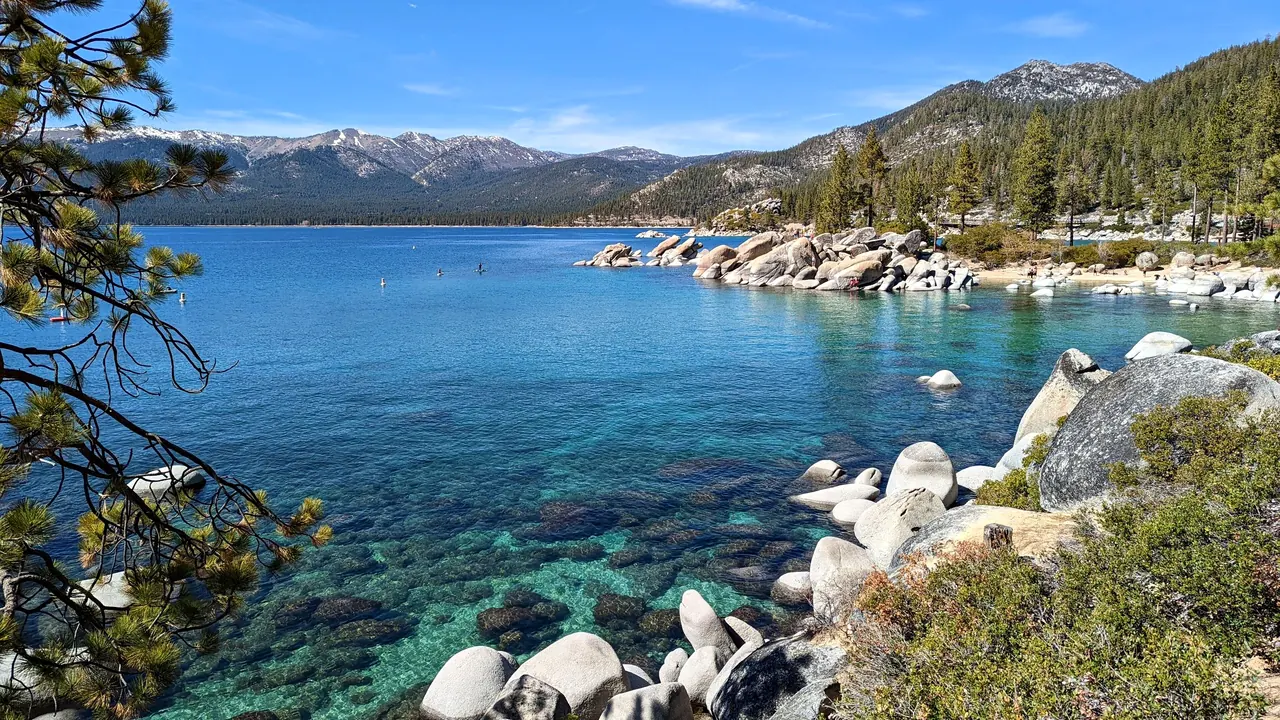
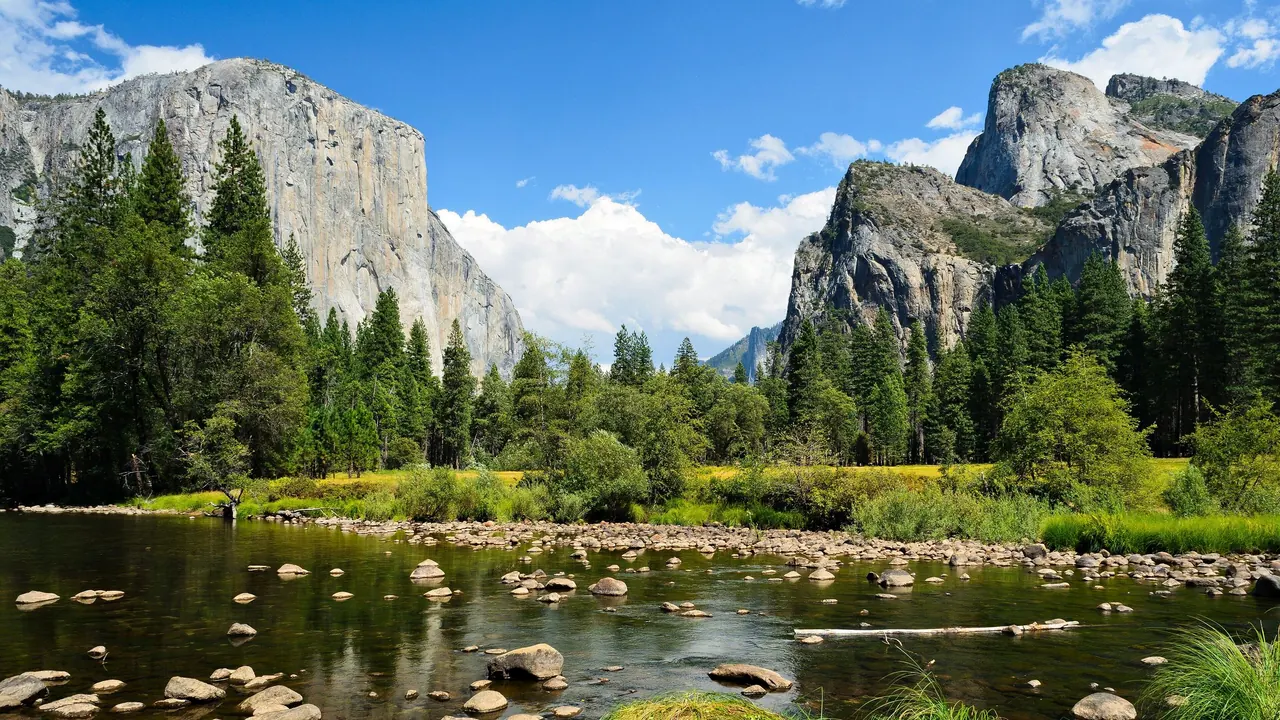
Photos: Lake Tahoe by Blake Everett Carroll, CC BY-SA 4.0, cropped; Yosemite by King of Hearts, CC BY-SA 3.0, cropped.
Lake Tahoe or Yosemite?
Our verdict in twelve categories, each scored against the same fixed benchmark cities, and the climate month by month, so you can choose for your trip.
Choose Lake Tahoe for
- nightlife
- beaches
- live music and the arts
Lake Tahoe suits a summer or winter vacation where the outdoors comes with some comfort. It has sandy beaches and clear water to swim in, a dozen ski areas, lakeside decks for dinner, casino lounges at Stateline for a late drink and spas at Incline Village. It is the better choice for families, and for groups who want to mix active days with easier ones, provided they have a car for the drive around the shore.
Choose Yosemite for
- prices
- nature and the outdoors
Travellers who want the scenery and nothing to distract from it belong in Yosemite. The granite walls of the Valley, the spring waterfalls, the sequoias of Mariposa Grove and the high country along Tioga Road make it the stronger pick for keen hikers, climbers and campers, and a campsite keeps the cost down. Evenings end at a campfire and meals are simple, so there is little to do except be outside.
Scoreboard
Twelve categories on one fixed scale from 0 to 100. The shaded stretch is the gap between the two.
Your match
Pick a travel style or drag the sliders, and both match scores follow your weighting.
Wins on nightlife and beaches with your weighting.
Wins on prices and nature and the outdoors with your weighting.
What matters to you?
Category by category
What the scores mean for a trip.
Beaches & swimming
In summer Lake Tahoe is a real swimming destination, with sandy beaches all round the shore. There are granite coves at Sand Harbor, long beaches at Pope and Baldwin on the south side, and shallow family beaches at Kings Beach. The water is cold even in August, but it is clear enough to make a whole day of it.
Yosemite has nothing to match this. A swim means wading into the Merced River's pools in late summer or braving Tenaya Lake, and in spring the rivers are dangerous. For a proper lake beach near the park, you have to drive south to Bass Lake.
Food & drink
Tahoe eats like a mountain resort and Yosemite like a national park, and the difference shows on a longer stay. Around the lake there are grills, pizza places and skiers' breakfast diners, plus a handful of more ambitious kitchens in Truckee's railroad downtown, Tahoe City and Incline Village that cook with Californian produce and wine. A drink on a lakeside deck at sunset is the evening most people remember.
Yosemite has no towns like these inside the park, and nothing to match an evening on the water. Apart from one grand historic dining room, meals come from lodge restaurants and cafeterias, and anything more varied means leaving the park for the diners and wine bars of the gateway towns. Campers who bring their own supplies lose little, but if you want somewhere different to eat each night, Tahoe has far more to offer.
Culture & sights
Culture is a side note in both, though Tahoe has a little more to fill an afternoon. There are the old lakeside estates of Vikingsholm and Thunderbird Lodge, the Donner Party story near Truckee and Truckee's brick main street from the railroad era.
Yosemite's heritage belongs to the park itself: the grand timber and stone hotel, the Ahwahneechee Miwok collections at the Yosemite Museum, Ansel Adams's photographs and the Pioneer History Center at Wawona. Together they tell the story of American conservation, but an hour or two covers each one.
Nightlife
Tahoe at least has late nights on offer. The Stateline casino hotels keep their gaming floors and lounges open long after the rest of the lake has gone quiet, and there are après-ski pubs and a few lively bars in Truckee and Tahoe City.
Yosemite has essentially no nightlife: a lodge lounge, a ranger talk or a campfire, and one saloon in each gateway town. The best thing to do after dark is look at the stars over the high country.
Nature & outdoors
Both are among the great landscapes of the Sierra Nevada, and they differ in kind rather than quality. Tahoe is a lake landscape: a vast clear lake ringed by peaks, Emerald Bay, and ridge routes like the Rim Trail and the Flume Trail. Summer brings kayaking and sailing, and winter brings a dozen ski areas.
Yosemite's drama is on land. Sheer granite walls rise from the Valley floor, the waterfalls pour at full strength in spring, climbers work up El Capitan, and there are the sequoias of Mariposa Grove and the domes of Tuolumne. It is the place for hiking and climbing, while Tahoe is the one for water sports and for skiing beyond Badger Pass's gentle slopes.
Day trips
From Tahoe there is more to drive to, in two directions. To the east are the Comstock mining town of Virginia City, little Genoa, Carson City and Reno. To the west, Highway 50 leads down to Coloma, Placerville and the foothill vineyards.
Yosemite's outings lead mostly west into the Gold Country, to Columbia's preserved main street and the steam railway yard at Jamestown. The trips east to the ghost town of Bodie and to Mammoth Lakes are memorable, but only while Tioga Pass is open, and most days are spent inside the park anyway.
Good for families
Tahoe is the easier family trip. It has shallow sandy beaches warm enough for paddling, flat bike paths along the north and west shores, glass-bottom boats in summer and ski schools in winter. Cabins and condos with kitchens make the logistics simple.
Yosemite works best for families who already like to camp and hike. The flat Valley floor, the Junior Ranger programme and the giant sequoias keep children busy. But the drives in are long and winding, and cliff edges, fast spring rivers and bears mean children need close watching.
Getting around
Both are hard going without a car, in different ways. Tahoe is a 115km loop of two-lane road around the lake. It is slow on summer weekends, and in winter there are chain requirements and closures above Emerald Bay. Only Truckee, Tahoe City and the Stateline area are walkable, linked by local buses.
Yosemite allows a car-free stay as long as it stays in the Valley, which has free shuttles and a regional bus from the train station at Merced. Beyond the Valley, Glacier Point, Mariposa Grove and Tuolumne are each an hour or more of winding road away, and Tioga Road is closed for much of the year.
Shopping & style
Downtown Truckee is the one street in either place worth an afternoon's browsing. Its railroad-era buildings hold independent clothing shops, galleries and homeware stores, the resort villages around the lake cover outdoor gear and the basics, and Reno's malls are down the hill for anything bigger.
In Yosemite, shopping means the park stores, with their maps, books and souvenirs. The exception is the long-standing gallery in the Valley, where a fine-art landscape print makes a far better keepsake than anything else on sale in the park.
Affordability
Both are expensive in season, but Yosemite can be done more cheaply. Its campsites cost very little, and once you are inside the shuttles and trails are free. The catch is that campsites are hard to get and rooms in the park sell out early at high prices. A winter visit or a base in the foothills cuts costs further.
Tahoe stays expensive in summer and winter alike, with steep lift tickets, costly lakefront rentals and minimum stays at weekends. The way to save is a midweek stay in a casino hotel or an older South Lake Tahoe motel.
Live music & performing arts
Tahoe has a real summer season. Shakespeare is staged outdoors among the boulders at Sand Harbor with the lake behind the actors, a classical series plays on the north shore, and touring bands and comedians appear at the Stateline showrooms and the lakeside stage.
Yosemite offers ranger campfire talks and the odd one-person historical show in the Valley. The nearest real stage is a small repertory theatre in Sonora.
Wellness & relaxation
Tahoe is the more restful choice. There are good spas at Incline Village and in the ski resorts, yoga studios in the ski towns, and quiet evenings by a cabin fire on the calmer west and north shores. Hot springs at Grover, Genoa and Reno are within a short drive.
Yosemite's calm comes from the wilderness itself, and it is best found in winter or up in the high country, because the Valley is busy in July. A couple of resort hotels near the southern entrance offer spa treatments, and the hot springs near Bridgeport and Mammoth Lakes can only be reached in summer, over Tioga Pass.
When should you go?
Pick your month. The climate figures are measured averages, not a forecast.
Lake Tahoe in July
Yosemite in July
Daytime high, °C
Rainfall in the month, mm
Where the figures come from
Lake Tahoe has no rain gauge within 25 km of the centre, so its rainfall comes from a gridded climate dataset read at the destination rather than from a gauge further away.
Yosemite has no weather station within reach, so its figures come from a gridded climate model rather than a measured record, and read a broad area rather than one spot.
Temperature and rainfall are climate normals, averaged over the years shown. Lake Tahoe: 2000-2020 (rainfall 1991-2020) normals, South Lake Tahoe / Tahoe Valley (5.3 km from centre). Yosemite: 1991-2020 normals, TerraClimate 4 km grid at the town, no weather station within 90 km.
Both follow the same Sierra pattern of dry, warm summers and wet, cold winters. At lake level Tahoe reaches about 27°C in July, and swimming is realistic from July into early September. Storms arrive in November, January brings around 119mm, and the cold months belong to skiers rather than walkers. Late spring and autumn are cool but good for hiking, though the high trails can hold snow into early summer.
Yosemite Valley is a little warmer in high summer and much wetter in winter, with about 157mm in January. The best time to go depends on what you want: April to June for the waterfalls at full strength, June to October for the high country once Tioga Road opens, and late summer for dry hiking days and calmer river pools. In winter the Valley is quiet and snowy, better for a short visit than for long hikes.
Which traveller are you?
On a beach and sun trip, Lake Tahoe is the clear choice. Sand Harbor's boulder coves and the long south-shore beaches give real lake days from July to early September, while Yosemite has only river pools and a cold dip at Tenaya Lake.
For a trip on a tight budget, Yosemite has the edge if you plan ahead. Its campsites are very cheap, and the Valley shuttles and trails cost nothing. Tahoe stays expensive in both seasons, with high lift tickets and costly lakefront rentals.
On an outdoors trip built around hiking and climbing, Yosemite pulls ahead. The Mist Trail, Half Dome, El Capitan and the Tuolumne high country are world classics. Tahoe is better for paddling on the lake, the Rim Trail and serious winter skiing.
Before you go
| Measure | Lake Tahoe | Yosemite |
|---|---|---|
| Currency | US Dollar (USD) | US Dollar (USD) |
| Sockets | AB120 V, 60 Hz | AB120 V, 60 Hz |
| Driving side | Right | Right |
| Time zone | UTC-8, UTC-7 in summer | UTC-8, UTC-7 in summer |
| Emergency number | 911 | 911 |
| Main airport | Reno Tahoe International Airport (RNO)25 non-stop destinations | Fresno Yosemite International Airport (FAT)15 non-stop destinations |
| Public holidays this year | 13 days | 13 days |
Where else could you go?
Every comparison below shares a destination with this one, so you can follow Lake Tahoe or Yosemite somewhere new.
- Kings Canyonvs Yosemite
- Sequoiavs Yosemite
- Kings Canyonvs Lake Tahoe
- Death Valleyvs Yosemite
- Sequoiavs Lake Tahoe
- Death Valleyvs Lake Tahoe