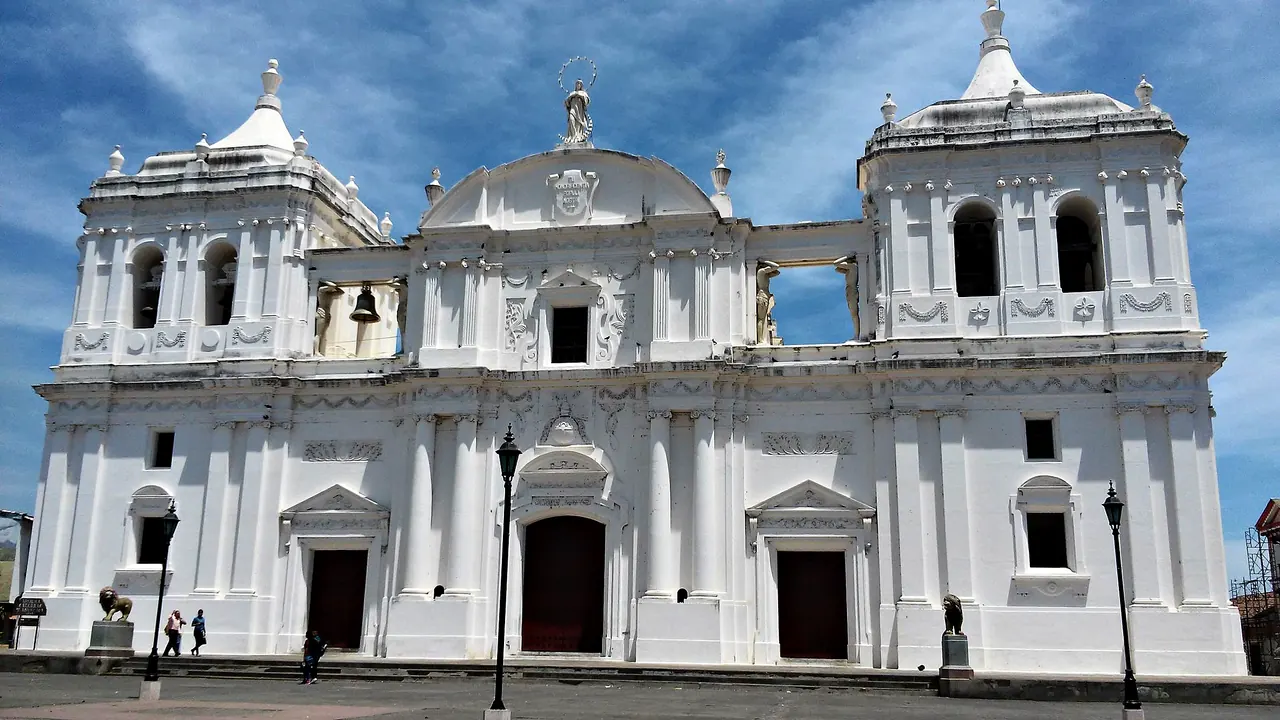
Photos: Leon, Nicaragua by Byralaal, CC BY-SA 4.0, cropped.
Leon, Nicaragua or Monteverde?
Our verdict in twelve categories, each scored against the same fixed benchmark cities, and the climate month by month, so you can choose for your trip.
Choose Leon, Nicaragua for
- prices
- culture and sights
- beaches
León suits travellers who want a colonial city with everyday life in it. There is a vast whitewashed cathedral whose roof you can walk on, a dozen churches across a flat grid you can cover on foot, fritanga suppers on the pavement, weekend bars full of students, and the Pacific surf coast close enough for a few nights by the sea. It is also one of the cheapest stops in the Americas, so it rewards backpackers and anyone stretching a budget. Its volcano climbs and sandboarding on Cerro Negro keep active travellers busy too.
Choose Monteverde for
- families
- nature and the outdoors
- wellness
Monteverde is for people who travel to be in the forest. Mossy trails, hanging bridges through the canopy, quetzals at dawn and tarantulas on a night walk with a torch fill the whole stay, in mild mountain air rather than León's lowland heat. Families with school-age children do better here, and so does anyone after quiet evenings and early nights. Expect to spend more, though, and to find little in the way of sights, beaches or a night out.
Scoreboard
Twelve categories on one fixed scale from 0 to 100. The shaded stretch is the gap between the two.
Your match
Pick a travel style or drag the sliders, and both match scores follow your weighting.
Wins on prices and culture and sights with your weighting.
Wins on families and nature and the outdoors with your weighting.
What matters to you?
Category by category
What the scores mean for a trip.
Beaches & swimming
León has a real coast within reach. Poneloya and Las Peñitas lie about 20km west, with warm water and grey volcanic sand. It is surf rather than gentle swimming, with heavy waves and rip currents, so bathers keep to the shallows or the quieter end of Las Peñitas while surfers make the most of it.
Monteverde has no beach at all. It sits on a cool mountain ridge, and the nearest shore, on the Gulf of Nicoya, is about two hours down winding roads. If you want sand, plan separate nights elsewhere on your route.
Food & drink
Neither is a place for serious eating, but León gives you more choice, much of it on the street. In the evenings fritangas grill meat and plantain on the pavement, the Mercado Central serves soups at its lunch counters, quesillo is sold everywhere, and the students keep a few cafés and juice bars going near the cathedral.
In Monteverde you mostly eat casados in the sodas of Santa Elena or at a few lodge restaurants, and there is little choice after dark. What the area is proud of is its produce: coffee tasted on farms on the surrounding slopes, and cheese from the dairy the Quakers founded.
Culture & sights
This is where León pulls far ahead. You can walk across the white roof of its UNESCO-listed cathedral, the largest in Central America, among the domes. La Recolección, El Calvario and the old church of Subtiava fill two or three days of wandering, and there are also the Rubén Darío house, the Ortiz-Gurdián art collection and the revolutionary murals.
Monteverde has almost nothing of the kind. Its unusual story is the Quaker dairy farmers who arrived in the early 1950s and helped protect the forest, but the exhibits and farm tours here are really nature outings.
Nightlife
León is a university town on the backpacker route. From Thursday to Saturday, hostel bars, rum joints with plastic tables and a few reggaeton and salsa clubs near the cathedral fill up. The scene is small and short on variety, and late at night a taxi home is wiser than walking the dark side streets.
In Monteverde, the night out is a guided walk looking for tree frogs and sloths, then an early night before the dawn birding. A drink after dinner in Santa Elena is about as late as it gets.
Nature & outdoors
Both are strong outdoor bases, but Monteverde is built entirely around nature and offers more of it. Its reserves of moss-hung cloud forest have marked trails, hanging bridges and lookouts over the continental divide. Birders come for quetzals, bellbirds and hummingbirds, and this is where the zip-line canopy tour began.
León's outdoors is rougher and hotter. The Maribios volcanoes offer everything from sandboarding on Cerro Negro to night hikes up Telica and dawn climbs of Momotombo, and boats explore the Juan Venado mangroves, where turtles nest. Outings in León start early to beat the heat, while Monteverde's mild days let you walk at any hour, rain permitting.
Day trips
León has a few good outings. The ruins of León Viejo on Lake Managua are about an hour away, and there is a rum distillery near Chichigalpa and the pilgrimage basilica at El Viejo. Granada and Masaya are too far for a comfortable day.
Monteverde is itself the excursion, at the end of a slow mountain road. Puntarenas is two hours away and hardly worth the trip, and Arenal is better treated as your next stop than as a day out and back.
Good for families
Monteverde is the better bet with children, especially those who like animals. Butterfly gardens, frog exhibits, canopy bridges and night walks with a torch suit school-age children, and older ones can try the zip-lines. Toddlers struggle with the steep, wet trails and the long drive up.
León has little made for children. There is no zoo or science museum, the pavements are narrow, the heat is draining and the surf is heavy. Adventurous teenagers may enjoy volcano boarding and the mangrove boats, but younger children tend to spend most of their time in the hotel pool.
Getting around
León is the easier place to get around. The cathedral, churches, museums and markets are all within about fifteen minutes' walk on a flat grid. Taxis and tricycle taxis are plentiful, and old school buses run out to the coast. The only hardships are the midday heat and broken pavements.
Monteverde's lodges and reserves are strung along steep, rough roads, and the main reserve is about 6km uphill from Santa Elena. Most visitors depend on tour pick-ups, and even getting there means a slow shuttle or drive up the mountain.
Shopping & style
Neither is a shopping destination, though León has a little more to browse. The Mercado Central is worth a walk for its everyday life, and shops near the cathedral sell hammocks, leatherwork, coffee and rum, but the country's great craft market is at Masaya, a long way off. In Monteverde, the best buy is embroidery from the women's artisan cooperative, and beyond that there are souvenir and outdoor-gear shops, local coffee and chocolate.
Affordability
León is far cheaper. Guesthouses, market meals, beer, rum and buses to the coast cost next to nothing, and even guided volcano trips and boutique hotels in colonial houses stay modest.
In Monteverde the basics are manageable, but nearly everything worth doing costs money: reserve entry, a guide to spot the wildlife, canopy tours, night walks and the shuttle up the mountain. Forest lodges and restaurants aimed at visitors charge closer to North American prices than Central American ones.
Live music & performing arts
León has more to offer, mostly in its streets. The Teatro Municipal José de la Cruz Mena stages occasional concerts and folk dance, but the memorable sights are the Gigantona dancing to drums, the sawdust carpets of Holy Week in Subtiava, and the singing and fireworks of the Gritería in early December.
Monteverde has no theatre or regular programme, only the occasional local musicians in a restaurant or a small community concert.
Wellness & relaxation
Neither has spas or thermal baths, but Monteverde is the calmer place to slow down. Cool, misty air, birdsong at dawn, early nights and lodge balconies over the trees make it restful. For proper pools and massages you would need a stop elsewhere, such as the hot springs around Arenal.
León's centre is hot, loud with traffic and full of students. Rest there comes from a hammock in a shaded courtyard or a few slow days in the beach villages to the west.
When should you go?
Pick your month. The climate figures are measured averages, not a forecast.
Leon, Nicaragua in July
Monteverde in July
Daytime high, °C
Rainfall in the month, mm
Where the figures come from
Leon, Nicaragua's temperatures are measured 84 km from the centre, at Managua A. C. Sandino.
Leon, Nicaragua has no rain gauge within 25 km of the centre, so its rainfall comes from a gridded climate dataset read at the destination rather than from a gauge further away.
Monteverde has no weather station within reach, so its figures come from a gridded climate model rather than a measured record, and read a broad area rather than one spot.
Temperature and rainfall are climate normals, averaged over the years shown. Leon, Nicaragua: 1961-1990 (sunshine 1991-2020, rainfall 1991-2020) normals, Managua A. C. Sandino (83.6 km from centre). Monteverde: 1991-2020 normals, TerraClimate 4 km grid at the town, no weather station within 90 km.
León is hot all year and climbs to 35°C in April, so walk the streets early in the morning or late in the day. December to April is the dry season, almost rainless and very sunny, and the best time for the beaches at Poneloya and Las Peñitas, where the sea stays around 28°C in every month. The rain arrives in May and peaks in October at 389mm, which turns the volcano trails muddy and the plain green.
Monteverde has the same wet and dry rhythm but a mild mountain climate, with days around 23°C all year. January to April are the driest months, though the ridge is often windy and misty then. From May to November the afternoon downpours are heavy, reaching 459mm in October. If you are visiting both, the early months of the year are the clear choice: dry in León, and as dry as the cloud forest gets.
Which traveller are you?
On a trip on a tight budget, León is the obvious choice. Guesthouses, market lunches, rum and buses to the coast cost very little. In Monteverde, the reserve fees, guides and canopy tours that make the visit worthwhile soon add up.
On a family trip with children, Monteverde works better. Hanging bridges, butterfly gardens and night walks with a torch keep school-age children absorbed in mild weather. León offers young children little beyond a hotel pool, heavy surf and draining heat.
For an outdoors trip, Monteverde is the stronger pick, with cloud forest trails, quetzals, hummingbirds and zip-lines over the canopy. León offers harder, hotter adventure, such as climbing Telica or sandboarding down Cerro Negro, for those who prefer volcanoes to birds.
Before you go
| Measure | Leon, Nicaragua | Monteverde |
|---|---|---|
| Official language | Spanish | Spanish |
| Currency | Cordoba Oro (NIO) | Costa Rican Colon (CRC) |
| Sockets | AB120 V, 60 Hz | AB120 V, 60 Hz |
| Driving side | Right | Right |
| Time zone | UTC-6 | UTC-6 |
| Emergency number | Police 118, ambulance 128, fire 115/120 | 911 |
| Elevation | 104 m | 1,330 m |
| Main airport | Augusto C. Sandino (Managua) International Airport (MGA)84 km from centre11 non-stop destinations | Juan Santamaría International Airport (SJO)76 km from centre49 non-stop destinations |
| Public holidays this year | 12 days | 11 days |
By the numbers
| Measure | Leon, Nicaragua | Monteverde |
|---|---|---|
| Population | 174,051 | 5,386 |
| People per km² | 212 | 101 |
| Museums within 10 km | 3 | 1 |
| UNESCO World Heritage sites within 50 km | 2 | 1 |
| Swim season, months above 21 °C | 12 months | 12 months |
Where else could you go?
Every comparison below shares a destination with this one, so you can follow Leon, Nicaragua or Monteverde somewhere new.
- La Fortunavs Monteverde
- Santa Teresa, Costa Ricavs Monteverde
- San Jose, Costa Ricavs Monteverde
- Tamarindovs Monteverde
- Granada, Nicaraguavs Leon, Nicaragua
- Granada, Nicaraguavs Monteverde